
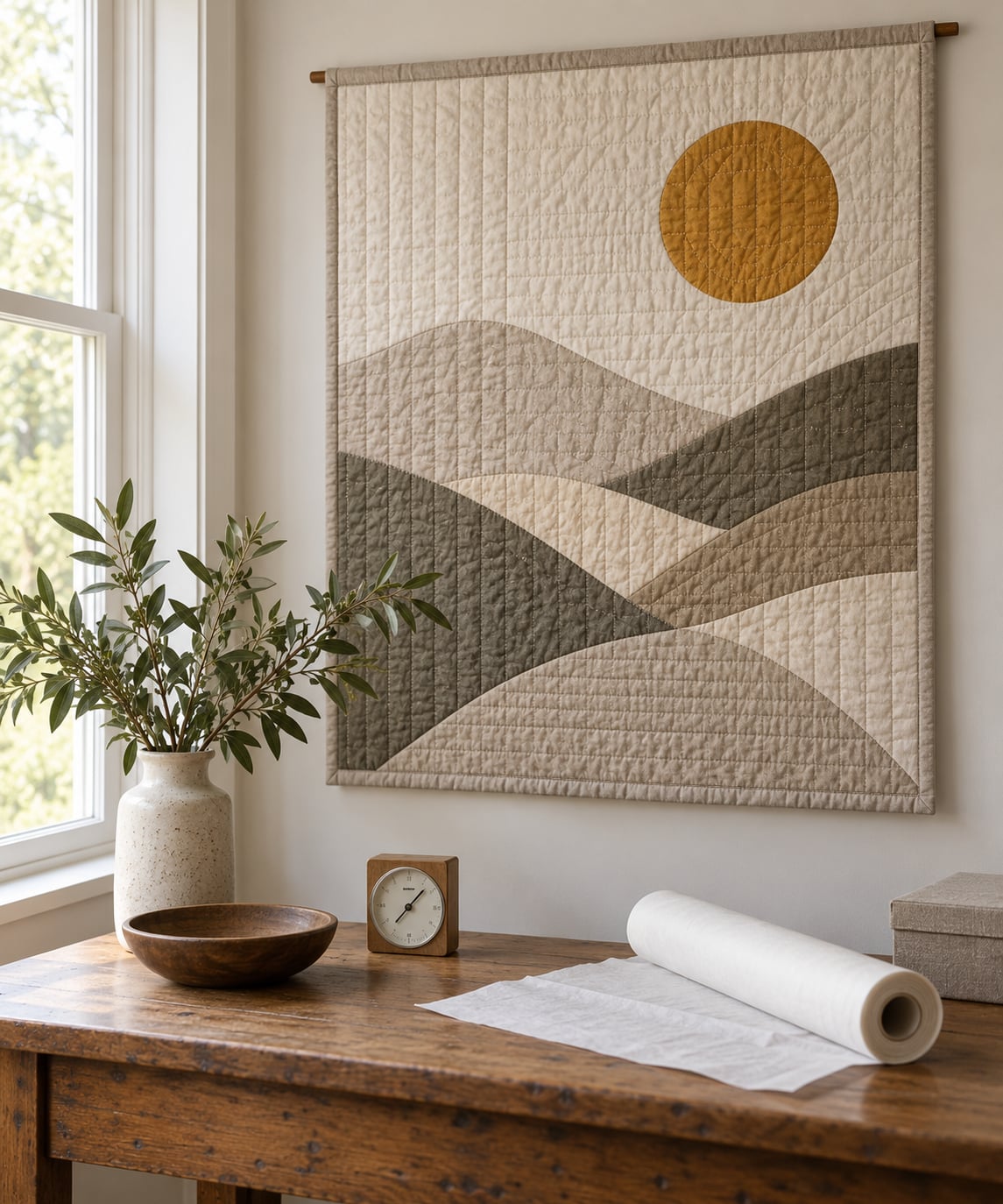
To protect fabric art from fading, keep it out of direct sunlight, limit the light it does receive, seal the surface with a UV-protective spray made for textiles, and store it in archival materials at a stable humidity. Fading is permanent, so prevention during the years a piece hangs on a wall matters far more than any repair afterwards. Most of the work is habits rather than equipment, and an afternoon of setup covers it.
I have watched a dyed wall hanging go from a deep magenta to a dusty pink over roughly four years in a south-facing room, with no UV film and no rotation. The same piece moved to a hallway with LED lighting and a UV-filtering window film looks untouched. That gap is entirely about light exposure, and it is the single thing you control.
There is one more thing worth settling early, because the advice out there contradicts itself constantly: sprayed sealers are good for hand-painted and dyed fabric art, and bad for factory-printed canvas. Once you know which one you are holding, the rest is straightforward. This guide walks through materials first, then light, handling, storage and inspection, in that order, because the early decisions are the ones you cannot revisit later.
Last reviewed for 2026.
Table of Contents
- What You Need
- How to Protect Fabric Art From Fading Step by Step
- 1. Start With Fade-Resistant Materials
- 2. Limit Light Exposure
- 3. Handle and Clean the Art Safely
- 4. Store Fabric Art in Stable Conditions
- 5. Inspect and Maintain It Over Time
- Common Mistakes
- Hanging Textile Art in Direct Sunlight
- Sealing Factory-Printed Canvas
- Storing in Plastic Bags or Bins
- Cleaning With Household Products
- Handling With Unwashed Hands
- Folding on a Seam or Line of Quilting
- Assuming All Dyes and Fibres Fade at the Same Rate
- Washing to Remove Marks
- Frequently Asked Questions
- Can fabric art be displayed in direct sunlight at all?
- How do I know whether a textile artwork is safe to wash?
- What is the best way to store a quilt long term?
- Does UV-filtering glass or film completely prevent fading?
- Should I use gloves when handling fabric art?
- How often should I inspect textile artwork for fading or damage?
- Conclusion
What You Need
None of this requires a conservation studio. Most people can assemble the supply list from a craft shop and a hardware store in a single afternoon.
- UV-filtering window film or a roller blind for any window that sits near a textile piece. Film works on glazed surfaces and keeps the daylight.
- A light meter or a phone lux-meter app so you can measure a wall instead of guessing at how sunny it is.
- A UV-protective spray formulated for fabric and paper, for hand-painted, dyed or quilted work. Skip it entirely for factory-printed canvas.
- A hygrometer for the room where the piece hangs or is stored. A basic digital model is enough for home use.
- Acid-free tissue, unbuffered, plus acid-free board or a buffered folder for folding and layering.
- A breathable archival box or a rigid wooden tray rather than a plastic bag for long-term storage.
- Clean nitrile gloves for protein fibres such as silk and wool, and clean bare hands for cotton and linen.
- A soft brush or microfiber cloth, plus a plain white cotton cloth for crocking tests.
- A ruler or tape measure, so rotation schedules and light measurements stay consistent.
Two items are optional but useful. A colour calibration card with swatches next to your baseline photo makes fade comparisons far more honest than your eyes alone. And a frame with UV-filtering glazing or a shadow box with spacers solves both light and mounting in one purchase.
How to Protect Fabric Art From Fading Step by Step
Five stages, in the order they matter: pick materials that resist fading, control the light the piece receives, handle and clean it without pushing colour around, store it in stable archival conditions, then inspect it on a schedule. Skipping ahead to the sealer is the usual mistake, because a coat of varnish cannot rescue a dye that was never lightfast in the first place.
1. Start With Fade-Resistant Materials
Lightfastness is simply how well a colour holds up under light. Suppliers rate it on the Blue Wool scale from 1 to 8, where 1 is poor and 8 is excellent, and textile suppliers use a parallel Grey scale. Anything rated 1 or 2 will visibly fade, and no amount of varnish changes that rating.
The media behave very differently on cloth. Fibre-reactive dye bonds chemically with cotton and linen and is generally the most stable choice. Textile paint built on a fabric medium sits on the surface and holds colour well but can be more vulnerable to abrasion. Acrylic paint is the most lightfast of the three and forms a film, but it also makes the fabric stiff and less breathable. Natural dyes from plants, roots and insects are usually the first colours to go, because many of them are acid dyes rather than the mordanted, light-stable kind.
Silk and wool need their own rules. Both are protein fibres, and both are vulnerable to acid, which is why acid-free tissue and acid-free board matter far more for a silk wall hanging than for a cotton quilt. Unbuffered tissue is the right choice for silk and wool because buffering agents can migrate into protein fibres over time; buffered board is fine for cotton.
Before you commit a piece to a sealer or a wall, run a swatch test. Cut small squares of the same base cloth, dye or paint them in your intended colours, and expose one square to direct sun for a week while another sits in a dark drawer. Compare them side by side in daylight, not under warm indoor bulbs. If the exposed square shifts visibly, the colour is the problem and the varnish is not the answer. This takes ten minutes and saves an afternoon of spraying and regret.
Record what you used in a small note on the back of the piece: the dye or paint name, the fibre, the date and the lightfastness rating. Future you, or a conservator, will thank you.

2. Limit Light Exposure
Sunlight is the worst offender because it arrives with ultraviolet, visible light and heat at once, and the three work together. Ultraviolet breaks the bonds that hold dye molecules to the fibre, heat speeds up that reaction, and visible light, which people tend to forget, contributes on its own in weaker dyes.
So it is not only the sunroom that causes trouble. A west-facing window at four in the afternoon is brutal. A bedroom with no window and only warm incandescent bulbs is not innocent either, because halogen and incandescent lamps emit some ultraviolet as well, which is why artists on forums consistently rate LEDs as safe and older bulbs as something to avoid for textiles.
Measure the wall before you decide. Museums limit sensitive textiles to roughly 50 lux, and general display often sits around 150 to 200 lux, with 500 lux reserved for very robust material. Phone lux-meter apps give you a usable reading in seconds. Anything above 200 lux on a wall holding a dyed or natural-dye piece is a wall that needs film, a blind, or a move.
The practical actions are boring and effective. Hang the piece away from windows rather than beside them. Put UV film on the glass or use a blind, and prefer shades that block light outright over sheer curtains that only diffuse it. Rotate displayed pieces every few months so no single work sits under the same patch of light for years. Where lamps sit close to textiles, choose LED bulbs. And measure again after the seasons change, because the angle of the light in your room is not fixed.
3. Handle and Clean the Art Safely
Most handling damage happens while someone is admiring a piece rather than while they are making it. Two hands, supporting the whole weight, edges only where possible, and no leaning against a worktable or shuffling a stack while holding one piece in your arms.
Gloves are worth sorting out, because the answer depends on the fibre. Clean bare hands suit cotton and linen. Nitrile gloves suit silk, wool, dyed surfaces and anything with embellishment, because skin oils and salt transfer readily to protein fibres. Cotton gloves are the wrong choice for a dye surface, since they catch fibres and trap grit against the fabric.
Dust lightly and rarely. A soft brush or dry microfiber cloth works, worked from the outer edge inward so you are not pushing dirt across the design. Vacuuming is optional, using a screen over the nozzle at low suction. Never spray cleaner directly on the piece, never use water, and never reach for household products, which is where bleach, dish soap, alcohol and vinegar do their damage.
Test for crocking before you do anything wet. Press a plain white cotton cloth firmly against an out-of-the-way area and rub a few times. Colour on the cloth means the dye is still moving, and any wet cleaning will lift it or bleed it into a halo. If the piece is not clean enough for flat display or sale, that is a job for a textile conservator, and it is cheaper to ask early.
4. Store Fabric Art in Stable Conditions
Environmental targets are the easiest part to hit and the easiest to get wrong. Aim for relative humidity between 40 and 60 percent, and a temperature around 18 to 22 °C. The important quality is stability rather than a perfect reading, so avoid rooms that swing hard: unfinished basements, loft conversions, kitchens, bathrooms and anywhere beside a radiator, a vent or a fireplace.
Quilts and wall hangings stored flat want acid-free tissue between every layer, with a rigid board on top so nothing crushes the batting or leaves a crease along a seam. Fold along existing seam lines wherever you can, and never along a line of quilting stitches you care about, since those hold a memory of the fold and can wear through.
For pieces you cannot fold, roll them around an acid-free core, image side out, with the roll as loose as the material allows. Wrap the roll in acid-free tissue rather than plastic film, because plastic traps moisture and off-gasses as it ages. Long-term storage belongs in an archival box or a rigid tray inside a closet on an interior wall, not a plastic bag in a shed, and never directly under a leaking roof or beside an exterior wall in a humid climate.
Check on stored work every six to twelve months. Look for foxing, a musty smell, insects, webbing, discolouration of the tissue, or warping. Flat storage restacks itself over a long season, so refolding on a different line keeps old creases from deepening.
5. Inspect and Maintain It Over Time
Set a baseline while the piece is at its best. Photograph it in indirect daylight beside a colour card, record the date, and note the lighting conditions in the room. Keep the image with the work. Memory is a poor witness to colour change over five years, and a photo comparison will pick up a shift that you have learned to accept.
At six to twelve month intervals, look for the specific warning signs. Fading shows first on any surface angled toward a window or lamp, and often appears as a pink or yellow cast in blues and greens. Watch for yellowing or browning of silk and wool, which usually signals acid damage rather than light. Fine fibre loss shows up as a faint halo of dust around the piece or a surface that feels brittle or dusty to a light touch. Stickiness, mustiness, insect webbing and warped edges all belong in the same check.
Keep a short maintenance log with dates, what you did and what changed. It takes a minute per entry and turns a vague worry into something you can act on. If you find yellowing, active fibre loss, staining or mould, stop handling the piece and consult a textile conservator. Professionals working in conservation organisations can advise on treatment, and losing a piece to a well-meant cleaning is the most expensive outcome of this entire topic.
Common Mistakes
Each of these shows up again and again, and most of them cause damage that never reverses.
Hanging Textile Art in Direct Sunlight
The most common and most damaging error. Even a short daily dose accelerates dye breakdown, and heat makes it worse. Hang the piece away from the window, or film the glass and rotate the display so no work gets a permanent patch of sun.
Sealing Factory-Printed Canvas
Spray varnish is correct for hand-painted, dyed and quilted work, and wrong for a factory-printed canvas. Printed surfaces can cloud, yellow or take an orange-peel texture under sealer, and the original print vendor warranty is usually void once you spray. Identify the piece before you spray anything.
Storing in Plastic Bags or Bins
Polyethylene traps moisture and off-gasses as it ages, and sealed plastic makes mildew more likely in anything that is not bone dry. Use acid-free tissue and a breathable box, and never use plastic as the long-term home for a textile.
Cleaning With Household Products
Bleach, dish soap, alcohol, vinegar, carpet cleaner and aerosol sprays cause dye loss, staining or fibre damage, and none of them is meant for art. Dry methods only, unless a conservator has told you otherwise for that specific piece.
Handling With Unwashed Hands
Skin oils, salt and lotion transfer to the surface and darken handling areas over time, most visibly on silk and wool. Wash before touching a piece, and use nitrile gloves for protein fibres and dyed surfaces.
Folding on a Seam or Line of Quilting
Creases along a quilting line wear the holes through the fabric over years. Fold along seam lines, pad the folds with acid-free tissue, and refold or reroll stored work on a different line at each check.
Assuming All Dyes and Fibres Fade at the Same Rate
Natural dyes, silk and wool go early, while fibre-reactive dye and acrylic hold up far better. A piece that has faded unevenly usually has a chemistry reason, and that reason tells you how to store the rest of your collection.
Washing to Remove Marks
Machine washing immerses the whole piece and can lift dye, shrink fibres and set creases. Never wash a finished textile artwork without knowing the fibre, the dye and whether the piece has already been washed once. Test on an identical scrap first, and even then, spot cleaning by hand is safer.
Frequently Asked Questions
Can fabric art be displayed in direct sunlight at all?
Brief exposure is possible, but fading starts the moment light reaches a dye, and it keeps accumulating whether or not anyone is watching. Treat a direct sun patch as a loan you can never repay. For a piece hung there permanently, move it, film the glass, or rotate it into a shaded wall instead. Natural dyes and protein fibres such as silk and wool are the first casualties.
How do I know whether a textile artwork is safe to wash?
You cannot tell by looking, so treat an unquilted or unfinished piece as unwashable until you test. Cut a scrap of the same cloth, wash it the same way, and check for colour in the water, shrinkage and bleeding into adjacent colours. Machine washing also sets creases and can pull threads from embellishment. Most finished work is better dry-cleaned in place or spot cleaned by a conservator.
What is the best way to store a quilt long term?
Flat, acid-free and dark, in the most climate-stable room you can find. Layer the quilt with unbuffered acid-free tissue between folds, pad the fold lines with tissue, and place rigid board on top so the batting is not crushed. Target 40 to 60 percent relative humidity and 18 to 22 °C, and avoid basements, attics, kitchens and bathrooms. Refold along different lines every year or two.
Does UV-filtering glass or film completely prevent fading?
No. UV film blocks most of the ultraviolet arriving through a window, and UV-filtering glazing reduces it further, but neither stops visible light or heat, and neither blocks light arriving from other directions or from lamps. Treat film as one layer in a larger plan: shade the piece, keep it off the wall that gets the most sun, choose LED lighting, and rotate displays so the total dose stays low over time.
Should I use gloves when handling fabric art?
For silk, wool, dyed surfaces and anything embellished, yes. Nitrile gloves keep skin oils and salt off protein fibres and stop colour transfer from dye that is still slightly mobile. Clean bare hands are better for cotton and linen, since nitrile grips loosely and can abrade a fibre. Cotton gloves are the worst option on a dyed piece because they catch lint and grit and press them into the weave.
How often should I inspect textile artwork for fading or damage?
Twice a year is a sensible rhythm, timed to the seasonal change in light angles rather than to a date. Stored work needs a check every six to twelve months; displayed work every three months or so, since it sees more light and more dust. Photograph each check from the same spot beside a colour card, and log what you see so gradual change becomes visible instead of invisible.
Conclusion
Start with the light, because it is doing most of the damage. Walk each textile piece to the wall where it actually hangs, measure that spot, and move, film or rotate whatever sits above 200 lux. Then fix the storage: acid-free tissue and board for anything folded, a breathable box for anything rolled, and a hygrometer in the room to keep humidity between 40 and 60 percent. Set a date now to photograph every piece in its best light, so future change is something you measure rather than something you notice too late.
None of this undoes a fade that has already happened, because fading is pigment leaving the fibre. Slow it down now, keep the harsh treatments off the surface, and your work should still look like itself in a decade.


