Accepting art commissions means agreeing to make one specific piece of artwork for one named client, on a written brief, for an agreed price and date. If you are learning how to accept art commissions, the paperwork is what decides whether the job pays. Most beginners lose money on their first few jobs because they skip it, not because their painting is weak. This guide gives you the seven-step system I use: define what you take, run a structured inquiry, quote in writing, sign before you start, and deliver against a written record. Budget a weekend to set it up.
Table of Contents
- What You Need
- Step-by-Step
- 1. Define the kinds of commissions you accept
- 2. Create a commission inquiry process
- 3. Review whether the project is a good fit
- 4. Prepare a clear written proposal
- 5. Confirm terms before accepting payment
- 6. Manage the project and communication
- 7. Deliver the artwork and close the commission
- Common Mistakes
- Accepting a vague brief
- Quoting from a single message
- Skipping the deposit
- Allowing unlimited revisions
- Overlooking rights and reproduction
- Starting before written approval
- Frequently Asked Questions
- How much should I charge for an art commission?
- Should I require a deposit for an art commission?
- How many revisions should I include in a commission?
- What if the client changes the design after we agree?
- Who owns a commissioned artwork?
- How do I politely decline a commission request?
- Conclusion
What You Need
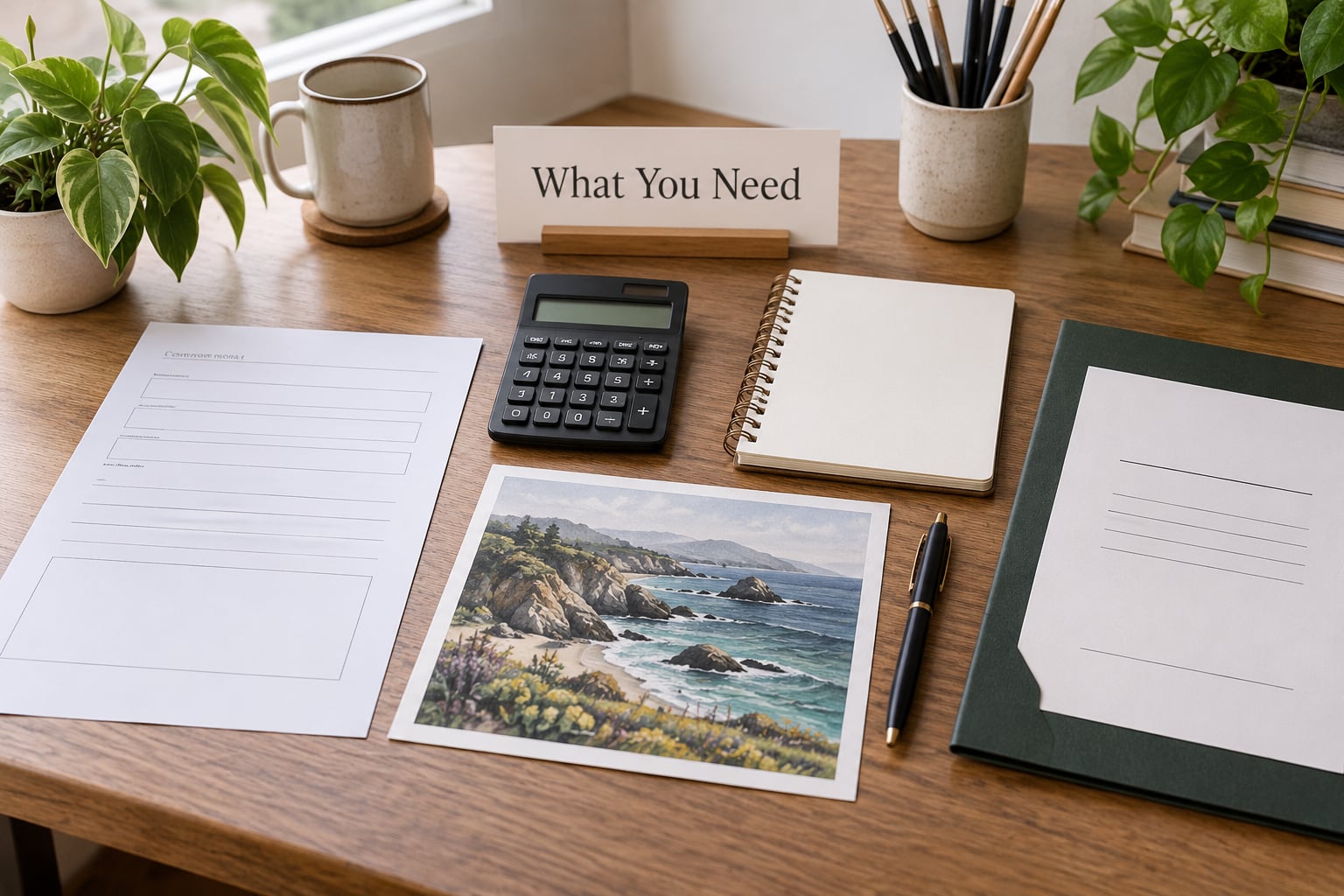
You need nine things in place before you answer your first inquiry, and most of them take an afternoon to build.
- A one-sentence services statement. Something like “I take personal-use portrait and pet paintings in oil and acrylic, up to 24 by 36 inches.” Vague descriptions attract vague briefs.
- A commission policy. One page that says what you do not take, how many slots you open, your turnaround, and what happens when a project runs long.
- A pricing method. Decide how you calculate a quote before a client asks, so you are not inventing a number under pressure.
- A short intake question set. The seven questions in step 2, ready to paste into an email or a form.
- A written agreement template. A reusable contract or terms of service covering scope, price, deposit, revisions, dates, delivery and rights.
- A payment schedule. Which proportion you take up front, when the balance is due, and what the deposit buys you.
- Portfolio examples. Finished work in the medium and size range you accept, so clients can point at something concrete.
- Delivery and rights terms. Who packs the piece, who arranges carriage and insurance, and whether the client gets personal use, commercial use, or full copyright.
- A records system. A spreadsheet or board with one row per commission: client, stage, amount paid, amount due, deadline.
If you only build three of these today, build the commission policy, the pricing method and the written agreement. Those three stop most problems before they start.
Step-by-Step
The process of taking art commissions is the same shape every time, whether it is a digital illustration or a hand-stitched wall hanging. Here is how to accept art commissions in seven steps, with a clear signal for each one so you know it is finished.
1. Define the kinds of commissions you accept
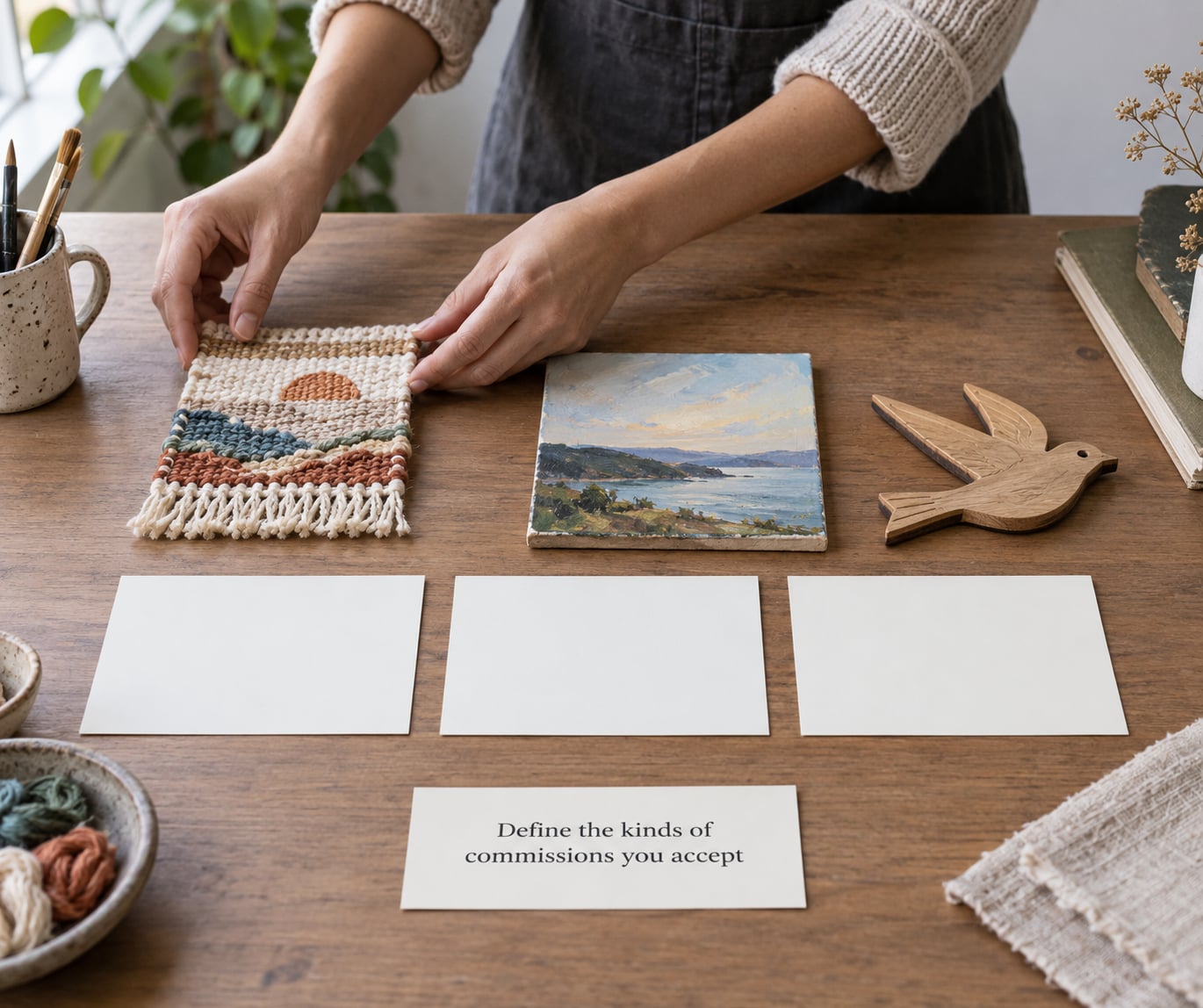
Write down the boundaries of your work in plain language: medium, size range, subject matter, minimum budget, turnaround and current availability.
The fastest way to answer an inquiry is to have already answered it. If a client asks for a 40-inch mural in six days and you only take pieces under 30 inches with a three-week window, you have your answer before you open their email.
You will know step one is complete when a stranger could read your services statement and tell whether their idea fits.
2. Create a commission inquiry process
Ask these seven questions in writing before you discuss price, and make every client answer all of them:
- What is the piece for, and where will it live or be shown?
- What are the finished dimensions?
- Do you have reference photos, and are they clear and well lit?
- Is this for personal display or for commercial use?
- What is your budget range, not a single number?
- What is your ideal date, and is it fixed?
- Who gives final approval, and who else will see it along the way?
That last question prevents the most common late surprise, which is a second person appearing halfway through with new opinions. Artists on r/artbusiness repeatedly point out that the projects that go wrong are the ones where the decision-maker was never named at the start.
You will know step two is complete when you have answers to all seven questions in writing, saved somewhere you can find again.
3. Review whether the project is a good fit
Compare the request against three things: whether you can actually do this well, whether you have capacity in the window they need, and whether the budget clears your minimum.
Most artists say a commissioned piece takes roughly two to three times the effort of self-directed work, because of the interruptions, the reference hunting and the admin. If a quote feels thin, that multiple is usually the reason.
Declining is a normal part of the job, not a failure. Something like “I am not the right fit for that subject, but I can point you to two people who are” costs you nothing and keeps your name clean. Declining out-of-scope work protects a reputation better than delivering a weak result and collecting a bad review.
You will know step three is complete when you can say yes or no in one sentence, without negotiating with yourself.
4. Prepare a clear written proposal
Turn the approved brief into a short proposal that fixes every variable you could otherwise argue about later.
A proposal should cover: the scope of work in plain sentences, the deliverables, the materials, the price, the payment schedule, the number of revisions included, the timeline with dates, the delivery method, and what happens if the project changes. If a client asks for a change after signing, that last line is what you point to.
Separate personal use from commercial use in the price. Personal display for the client’s own wall is one thing; logos, packaging, advertising and resale are another, and they should never share a line item. Commercial rights should be priced as an add-on, decided before the deposit, never assumed.
You will know step four is complete when the proposal could be handed to a stranger with no memory of the conversation, and they would still know exactly what they are buying.
5. Confirm terms before accepting payment
Get explicit written approval in reply to your proposal, then have a contract or written agreement signed before the money moves.
The order matters. Signature first, deposit second, creative work last. A deposit that arrives without a signed scope document is not protection, because there is nothing yet to point at when the scope is disputed.
Take a non-refundable deposit before any sketch, mockup or test piece begins. Free preliminary work is how artists end up three evenings deep into a job nobody has committed to. If the client goes quiet after paying, the deposit covers the time you already spent, and the slot returns to your queue.
You will know step five is complete when you have a signed agreement, a paid invoice for the deposit, and a calendar entry for the delivery date.
6. Manage the project and communication
Set a milestone schedule in the agreement: kickoff, one progress update, one proof stage, final sign-off, then delivery.
Keep a single channel for decisions, usually one email thread or one chat server channel. Set a stated response time, such as 48 hours for feedback, so silence is never treated as approval and you are never answering messages at midnight.
Progress photos are the cheapest insurance in the business. Sending a work-in-progress image mid-job surfaces corrections while they are still a small change instead of a repaint. Some artists run a queue board with queued, in progress and near completion columns, which makes your workload visible to clients and stops you promising more dates than you can hold.
You will know step six is complete when you can open any commission and see its stage, its next deadline and its next action without digging through email.
7. Deliver the artwork and close the commission
Inspect the piece, photograph it properly, document it, then release it against the final payment.
For traditional work, a signed certificate of authenticity or a provenance note travels with the piece. For digital work, deliver the layered source files only after the balance clears; sending watermarked low-resolution previews before that is the standard protection against a payment dispute, and clients accept it easily when it is written into the agreement at the start.
Agree who packs, who insures and who arranges carriage in the proposal, because it is the single most reliably forgotten item. Hand over the physical piece at handover for local work, or use a tracked, insured service and photograph the packing process.
Then close the file: record the rights you granted, keep the invoice and receipt for your tax records, save the final reference photos, and send a short archive message confirming what was delivered and what the client may use it for.
You will know step seven is complete when the record shows the balance paid, the rights noted, and the commission closed.
Common Mistakes
Six mistakes account for most failed commissions, and each has a straightforward fix.
Accepting a vague brief
The client says “something like that post I liked” and expects you to guess. Fix: require written answers to the intake questions and a deposit before any sketch. If they cannot describe what they want, the sketch is where you will find out, at your expense.
Quoting from a single message
A price built on one text message has no scope behind it, so any later change reads as a price increase. Fix: send a written proposal every time, however small the job.
Skipping the deposit
Payment on delivery means you fund the entire project, and you have no leverage if the client disappears. Fix: a non-refundable deposit before work starts. Half up front is the common baseline for standard jobs; larger or milestone-based projects can use a smaller first instalment with further payments tied to approvals.
Allowing unlimited revisions
A cap of two rounds on the sketch and two on the final piece is generous and standard practice. Fix: write the cap into the agreement and price each additional round, or switch to a flat “one round of changes” tier at a higher rate.
Overlooking rights and reproduction
The client buys the physical painting, then wants a marketing licence, prints for a shop, and the source files, all at the original personal-use price. Fix: decide the rights tier before the deposit and list it in the proposal. Copyright transfer is a separate, separately priced conversation.
Starting before written approval
Beginning on a friendly promise is the most expensive goodwill you will ever extend. Fix: nothing starts until the agreement is signed and the deposit is recorded.
One tip that settles most arguments before they happen: put every term in the agreement that you would be annoyed to discuss twice.
Frequently Asked Questions
How much should I charge for an art commission?
Work out your real hourly rate first, including the unpaid hours: admin, sourcing references, revisions and packaging. Commission work commonly takes two to three times the effort of self-directed work, so price the job on hours and materials, not on materials alone. Quote a range rather than one figure, state whether it covers personal or commercial use, and add a rush fee when the deadline is short.
Should I require a deposit for an art commission?
Yes, always, and make it non-refundable. Half up front is the common baseline; larger or milestone-based projects can use a smaller first instalment with later payments tied to approvals. The deposit covers work you have already started and keeps a slot reserved, so a client who walks away does not cost you the evening. Collect it before any sketch or mockup, never after.
How many revisions should I include in a commission?
Two rounds of changes on the sketch stage and two on the finished piece is generous enough to win work and bounded enough to protect your time. State the cap in the proposal and price any extra round, or charge a premium for a single-round tier. Feedback consolidated into one written message per stage is what makes that number workable.
What if the client changes the design after we agree?
Handle it with the change clause you wrote into the agreement: revised scope gets a revised price and a revised date, and work pauses until both are confirmed in writing. Quote the difference rather than absorbing it, and keep the change log with the contract. A client who routinely reopens the brief is telling you the original scope was never real.
Who owns a commissioned artwork?
The client normally owns the physical piece once it is paid for and delivered, while the artist keeps the copyright and the right to reproduce the work in a portfolio. Buying commercial use or the full copyright is a separate, higher-priced agreement made before the deposit. Decide which of those three you are selling, write it down, and both sides avoid a dispute later.
How do I politely decline a commission request?
Reply within a day or two, thank them for the inquiry, say plainly that it is not the right fit, and give one honest reason such as subject matter, size or turnaround. Offer a referral if you know a suitable artist. Keep it short, keep it kind, and do not offer a discounted trial version, because that turns a clean no into a long negotiation.
Conclusion
Start today by writing one page: what you take, what you charge, how many revisions, when the deposit lands and when the balance is due. Add the seven intake questions beneath it, then run your very next inquiry through all seven steps in order. Doing that once, properly, is what turns accepting art commissions from something you cross your fingers about into a business you can repeat.