
A commission client disappears when they stop answering your messages after a quote, a deposit, an approved sketch or final delivery, and the work simply stalls. Here is the short version: check the agreement, send one polite follow-up after a few days, save every record, and if nothing comes back, close the commission out in writing and free up your slot.
First, the part nobody says plainly enough. This is not a verdict on your art. Artists on commission forums describe the same spiral — did I price too high, is my work not good enough, did I write something weird — and the honest answer is that most of the time the client ran out of money, got distracted, changed their mind, or found the piece somewhere cheaper. Ghosting is a manners failure far more often than it is a quality judgement.
Table of Contents
- What You Need
- Step-by-Step: What to Do When a Commission Client Disappears
- Step 1: Review the commission agreement
- Step 2: Confirm whether the client is truly unreachable
- Step 3: Send one clear, professional follow-up
- Step 4: Protect the work and payment records
- Step 5: Set a final deadline and choose a next step
- Step 6: Escalate professionally if payment is still unresolved
- Common Mistakes
- Frequently Asked Questions
- How long should I wait before following up with a commission client?
- How many follow-ups should I send before giving up?
- Should I keep working on a commission for a client who won’t respond?
- Is a commission deposit refundable if the client cancels?
- Does this mean my prices are too high or my art is not good enough?
- What if a commissioner ghosts me after I paid?
- Conclusion
What You Need
Before you send a single message, gather the paper. Ten quiet minutes now saves weeks later, when you need to show someone exactly what was agreed and exactly when.
- The agreement itself — the terms they accepted, the intake form they filled in, or the message thread where scope and price were confirmed.
- Invoices and receipts — every invoice you sent, every payment that cleared, with dates and amounts.
- The full message history — exported or screenshotted, including the last thing you said and the last thing they said.
- Progress evidence — dated files, photos of work in progress, sketches sent and approved, colour-step screenshots.
- Delivery records — shipping confirmations, tracking numbers, courier receipts, or a note of the date you sent final files.
- Contact details they gave you — email, phone, postal address, invoicing account, and the platform where you agreed to work.
- A place to keep it all — one folder per commission. Not your inbox scroll.
If you never had any of this in writing, note that too. It changes which options remain open in Step 6, and it is the single thing worth fixing before the next commission.
Step-by-Step: What to Do When a Commission Client Disappears
Step 1: Review the commission agreement
Read the terms before you react emotionally, because they decide almost everything that follows. Look for the scope of work, the turnaround time, the payment schedule, what happens on cancellation, how many revision rounds are included, and who owns the finished piece.
Then look for the exit clause: a deposit that is non-refundable, a kill fee if the client cancels mid-project, a policy on unfinished work, and any mention of dispute resolution or a required notice period. If they clicked to accept terms on a platform, those terms travel with the commission and are far stronger than a casual email promise.
Step 2: Confirm whether the client is truly unreachable
Check each channel once. Email for a bounce or an auto-reply, phone for a disconnected number, the invoicing system for an unpaid or failed payment, and the shared project platform for last activity.
If you have a postal address, a polite card asking for a reply can be worth it, since it reaches people whose phones are on silent. Skip anything invasive: no digging through old accounts, no tracking anyone’s family, no showing up uninvited.
Step 3: Send one clear, professional follow-up
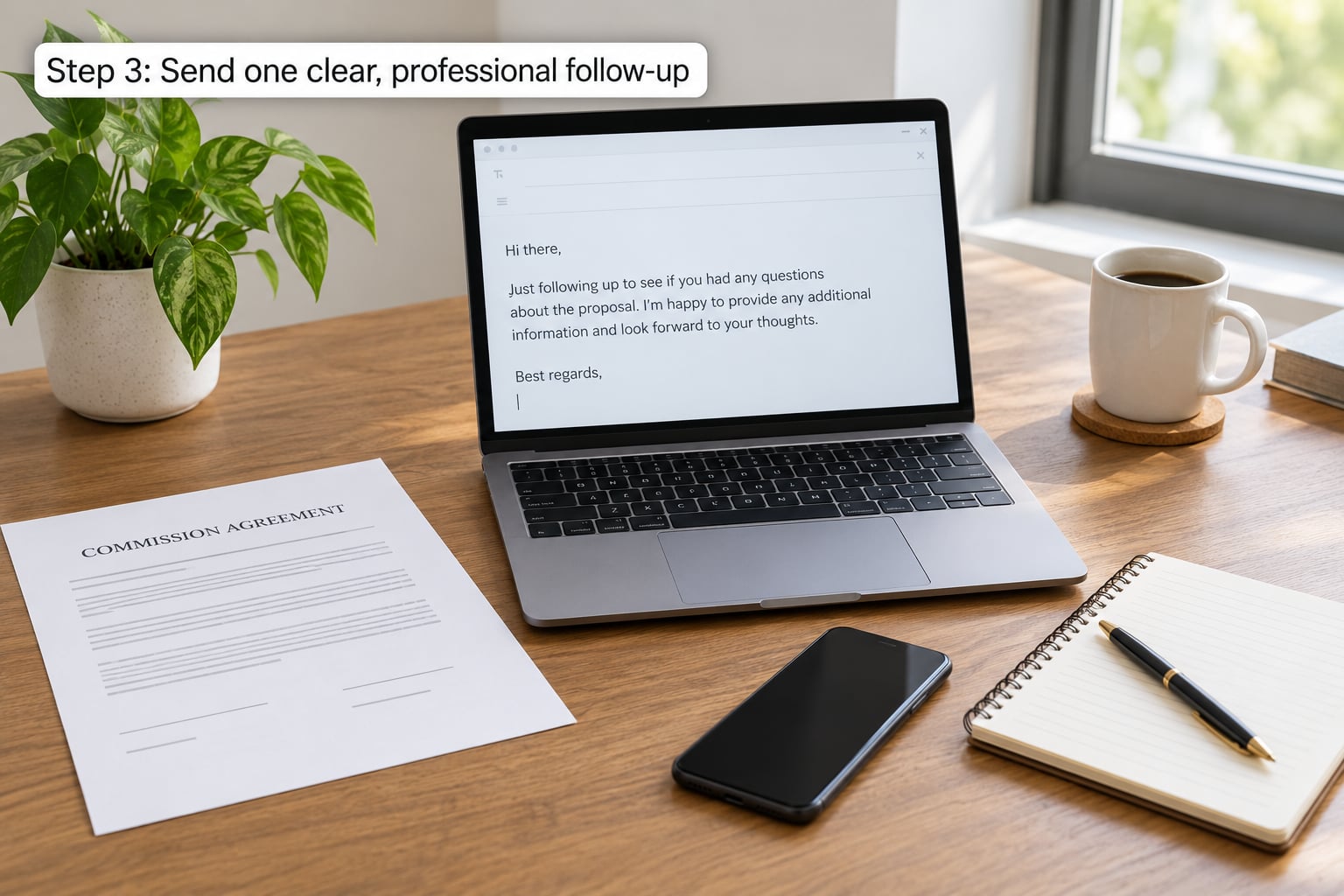
One message, sent three to seven days after the silence, is the right move. Keep it short, name the commission, give a specific reply-by date, and say what happens next if you hear nothing. Here is a template you can copy:
Hi [Name], checking in on the [project] commission. I last heard from you on [date], and I have your deposit of [amount] and approved [sketch / colour step] on file. I can hold your queue slot until [date, 10 days out]. If I do not hear back by then I will release the slot and apply the deposit per our agreement. If timing is the issue, a short reply telling me what you need is plenty.
Tone matters more than you think. Neutral, unbothered, and businesslike reads as professional. Anxious or over-apologetic reads as chase, and it makes the second message harder to send.
Step 4: Protect the work and payment records
Save everything now while it is still easy: email threads, invoices, payment receipts, dated progress photos, files sent, and any delivery confirmation. Keep original file dates intact and work on copies, so nothing looks edited after the fact.
Write a one-page timeline of the commission as you remember it, with dates. Screenshots and exported records keep their own timestamps; a personal timeline does not, and it is the thing you will forget in three months.
Keep it private. Public posts naming the client, passive-aggressive status updates, and public accusations are the fastest way to turn a recoverable situation into a permanent grudge on both sides.
Step 5: Set a final deadline and choose a next step
About fourteen days after your first follow-up, send a brief status check with a firm reply-by date. Around day twenty-one, send the close-out. Here is a version that works:
Hi [Name], this is my last note on the [project] commission. I have not had a reply since [date], so I am closing the file today and reopening the slot for [date]. Your deposit of [amount] stays applied per the agreement, and I am happy to refund it if you reply within 14 days and we agree that is cleaner. The files are yours on full payment. If you are still there and this is a timing problem, say so and I will work with you.
That last line is worth keeping. Plenty of people come back after a close-out because it gave them a clean, face-saving way in.
While you wait, stop production. Artists routinely burn hours finishing pieces for clients who never return, and unfinished work in progress still has options — sold as-is, sold as a smaller piece, or released to your shop once the terms allow it.
Step 6: Escalate professionally if payment is still unresolved
If money is still outstanding, work up the ladder slowly and in order.
- Platform support — if you worked through a commission platform, open a case. Platforms generally act on their own terms and their own timeline, usually weeks rather than days.
- Payment provider — if a payment is authorised but not captured or was reversed, your provider’s own dispute process is the fastest legitimate route.
- Card chargeback — card networks allow a dispute window that commonly runs around 60 to 120 days from the transaction. Records, delivery proof and a clear timeline are what hold up. Chargebacks are also a relationship-ending move, so use them once, deliberately.
- Formal demand — a short letter on letterhead, sent to a known address, stating the amount, the dates and the deadline. It often works where another email did not, because it changes the register.
- Small claims court — commonly available up to a modest ceiling in most US states. Filing costs and your time are real costs, so it only makes sense for amounts where the likely recovery beats the effort. Multiple artists on commission forums reach the same conclusion: small amounts usually are not worth pursuing.
Before step four or five, talk to a qualified attorney or a small-business adviser in your state. Rules vary by state and change, and nothing here is individual legal advice.
Common Mistakes
Sending message after message. Three unanswered emails tell you what you already know and cost you your composure. Fix: one follow-up, one status check, one close-out, spaced roughly a week apart.
Posting about it publicly. Naming the client, telling the story in a group, or posting your frustration does not get your money back and does cost you the relationship. Fix: keep the record private and the process professional.
Finishing unpaid work out of hope. Finishing “just in case” ties up materials and hours for a result that often never arrives. Fix: pause at the last completed milestone and hold the finished stages.
Deleting evidence. Clearing the inbox because it is painful removes the strongest thing you have. Fix: export or screenshot everything before you tidy anything.
Making threats you will not carry out. Statements about lawsuits or reporting usually achieve nothing except anxiety on your side. Fix: if you mean it, talk to a professional first and then act.
Dropping your prices for everyone. One ghost is not a pricing diagnosis. Community consensus across commission forums is consistent: do not cut your prices because a single person went quiet. Fix: change your intake process, not your numbers.
Giving up on money that was recoverable. Some deposits and cleared balances really are recoverable with documentation. Fix: send the close-out with a stated deadline and keep the records.
Frequently Asked Questions
How long should I wait before following up with a commission client?
Three to seven days after the last message is the right window. Long enough that you are not chasing someone at work or travelling, short enough that your queue slot is not blocked for long. If the silence lasts longer than the agreed turnaround time, follow up sooner and reference the deadline.
How many follow-ups should I send before giving up?
Three. One status check after a few days, one firm message with a reply-by date around day fourteen, and one close-out around day twenty-one. That sequence is enough for someone who genuinely got busy, and it gives you a defensible record if you later need to dispute payment or release the work.
Should I keep working on a commission for a client who won’t respond?
No. Pause production at the last completed milestone rather than investing more hours in an uncertain outcome. Keep the stages you have finished, hold the files, and continue only if the client replies and pays under the terms you agreed. Plenty of artists report wasted hours finishing pieces for clients who never came back.
Is a commission deposit refundable if the client cancels?
It depends entirely on what your terms say. A clearly stated non-refundable deposit is usually retained, especially once you have started or completed a stage. Without written terms, it is much harder to enforce and often not worth the cost of pursuing. Percentage-declining or milestone-locked policies, where the client gets more back earlier in the project, are fair and far easier to justify.
Does this mean my prices are too high or my art is not good enough?
Almost never. Ghosting is far more often a money problem, a distraction, buyer’s remorse, or the client finding the same work cheaper elsewhere. If your pricing were the real problem, you would see it in a different way: repeated requests to drop the price before they vanish, or silence after every price conversation. Judge the pattern, not the single message.
What if a commissioner ghosts me after I paid?
The same ladder works from your side: send one final message with a firm deadline, document everything including your payment records, then use the platform’s own dispute process if you used one. If the artist was a professional operation with signed terms, that is the strongest position you have. Artists Beware forum threads consistently treat a missed deadline or an unreturned sketch as a red flag worth acting on quickly.
Conclusion
If you are dealing with this right now, do three things in order. Read the agreement and find out what the deposit and cancellation terms actually say, save every thread, invoice and record in one folder, then send one polite message with a specific reply-by date and a named next step.
If they reply, the commission continues. If they do not, you have a clean close-out, a freed queue slot and a documented record — and a deposit-first intake form with a written scope in place before the next enquiry arrives. That habit is worth more than any one recovered ghosting.