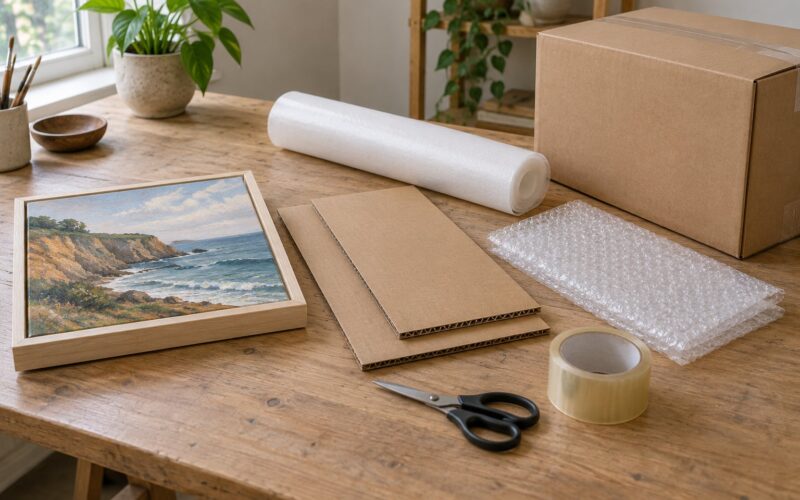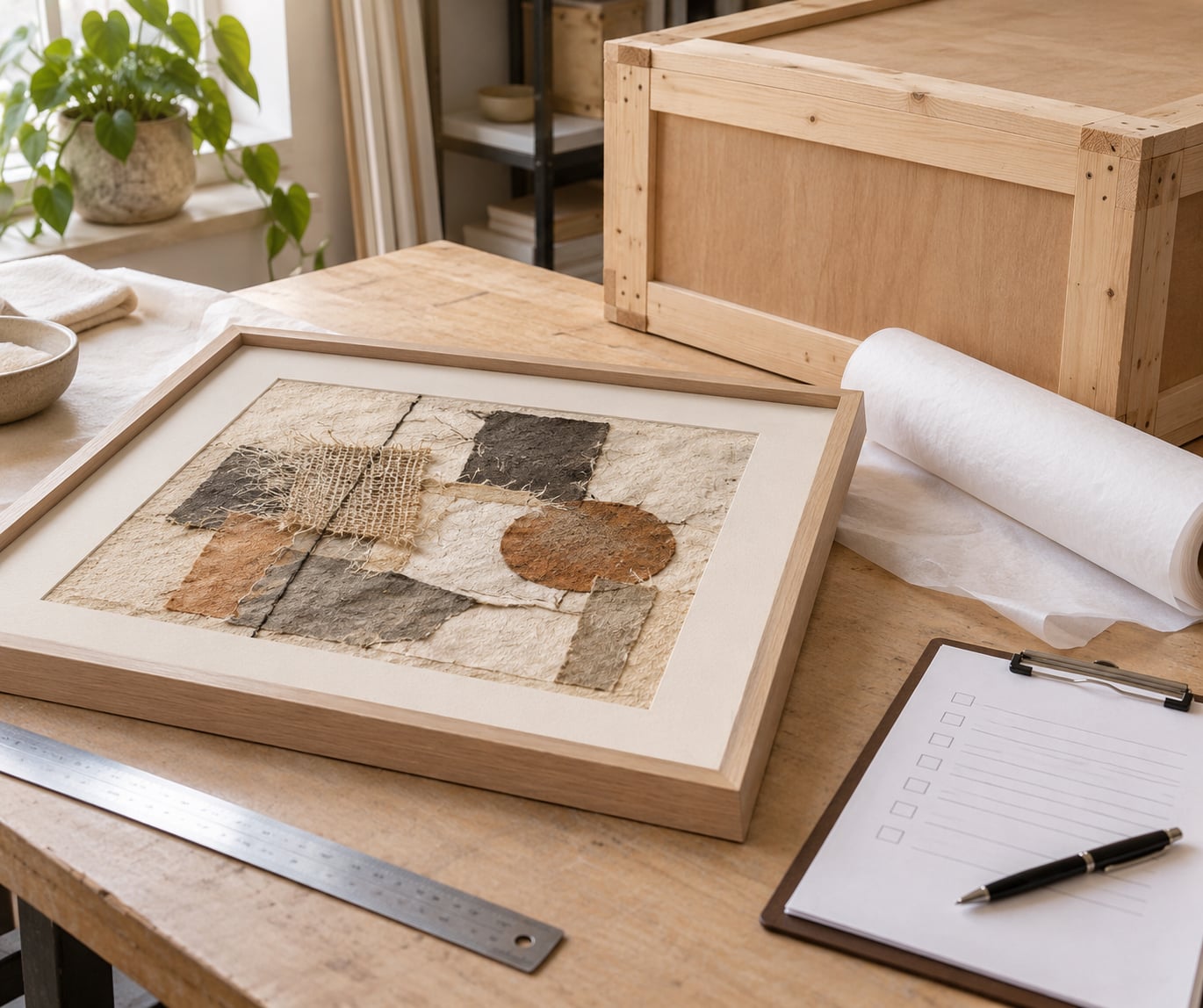
Knowing how to insure artwork for shipping comes down to four things: a defensible value for the piece, coverage that actually pays that value, packing that matches what the insurer requires, and a photo record made before the box is sealed. Get those right and a damaged painting becomes an annoying paperwork problem instead of a total loss you absorb yourself.
Most mishaps happen to good work in ordinary ways. A canvas takes a corner hit during a regional move, a quilt arrives with a split seam, a wood cutout arrives with a crack running through the grain. The insurance does not care how the damage happened. It cares whether the value, the condition, and the packaging were documented on the day it left your hands.
This guide is written for artists, teachers, galleries, and collectors in the US, and it applies to paintings, works on paper, quilts, mixed-media panels, and small wood pieces. Rules and rates vary by state and by carrier, and this is general information rather than insurance advice. For a high-value piece, talk to a broker or your carrier directly before you pack.
Table of Contents
- What You Need to Insure Artwork for Shipping
- Step-by-Step: How to Insure Artwork for Shipping
- 1. Identify the Artwork and Its Shipping Risks
- 2. Document the Artwork Before Packing
- 3. Establish the Value and Choose the Coverage That Pays
- 4. Select a Carrier and Shipment Service
- 5. Pack the Artwork for the Route
- 6. Complete the Insurance and Shipping Checklist
- 7. Inspect the Work and Handle Problems Promptly
- Common Mistakes
- Frequently Asked Questions
- Is USPS insurance enough to ship a painting?
- Is declared value the same as insurance?
- How do I value a one-of-a-kind artwork for shipping?
- What should I do if a package arrives damaged?
- Should an artist insure work being sent to a gallery or on approval?
- What to Do First
What You Need to Insure Artwork for Shipping
Assemble these before you arrange anything. Scrambling to find paperwork after a damage report is the single most common reason claims stall.
- Valuation records. A purchase receipt, an invoice, a gallery sales record, or a written appraisal from a qualified appraiser. A self-assigned number with nothing behind it is not a value.
- High-resolution photographs. Front, back, all four edges, signature, labels, and any existing damage. Full-frame shots plus close-ups.
- Measurements and weight. Height, width, depth of the piece, weight of the framed or mounted work, and the dimensions of the finished package.
- A materials and technique note. Oil, acrylic, watercolor, collage, dyed fabric, pieced textile, stain, print, found objects. Insurers ask, and it changes the value.
- A condition note. Craquelure, dents, a repaired tear, an old water mark, fading at the top edge. Write it down while the piece is in your possession.
- Framing and glazing details. Frame maker or type, whether the glazing is glass or acrylic. Itemize these separately from the artwork itself.
- Packing supplies. Rigid boards, interleaving tissue, corner protectors, foam, a sturdy outer box, and a crate or custom skid for anything large or three-dimensional.
- Shipment records. Tracking number, shipper and recipient details, declared value documents, delivery signature, and every photo taken at handoff.
One more item that people skip: a plain-language description of where the piece is going and why. Courier drivers handle boxes better when the contents are described honestly on the outside as framed artwork or fine art, and a mismatch between the description and the contents is a common reason a claim gets questioned.
Step-by-Step: How to Insure Artwork for Shipping
Run every shipment through the same seven steps, whether it is a small study going across town or a large canvas going overseas. The order matters, because the packing standard and the declared value both depend on decisions you make in the first three steps.
1. Identify the Artwork and Its Shipping Risks
Write down the artist name, title, date, dimensions, medium, materials, weight, condition, sale status, and destination. The destination matters more than people expect, since a cross-country carrier, a local van, and an international freight forwarder each handle a package differently.
Then name the realistic risks. Moisture from a wet loading dock, crushing from a stack of heavier boxes, abrasion against a corrugated wall, bending and splitting from pressure on a stretcher bar, cracking from temperature swings, theft from an unattended doorstep, and outright loss. Framed glass and acrylic are the most common surprise, and quilts and wood work fail differently than a stretched canvas does.
For a short local move, assume the same risks. Hand-carrying a painting to a client’s house across a parking lot is not automatically safer than a two-day carrier shipment, and most of the advice written for international freight skips the local and regional cases that hurt the most artists.
2. Document the Artwork Before Packing
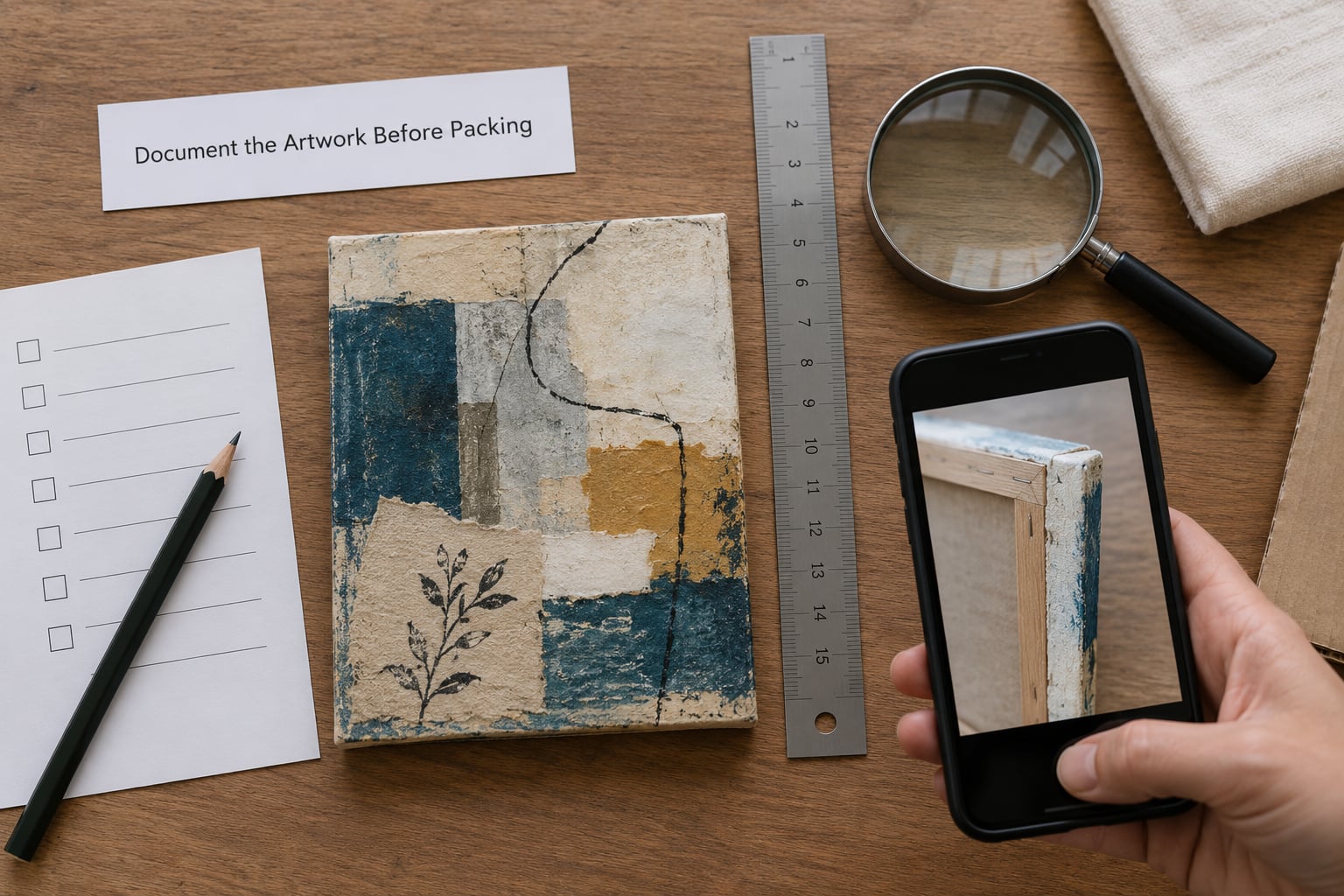
Build a condition record and a photo set before anything touches the work. Photograph the front in full, then close up the surface texture, the edges, the corners, the back, the labels, the hardware, the signature, and every existing flaw.
These images have one job: if damage is later reported, they prove what the piece looked like before it shipped. Without them, the burden of proof sits entirely on the recipient’s word, and that argument is expensive.
Keep the set in one folder, dated, and back it up somewhere that is not your studio laptop. Include a two-paragraph condition note: overall state, any pre-existing damage, and what is included in the shipment. Print one copy, sign it, and place it inside the package with the artwork.
3. Establish the Value and Choose the Coverage That Pays
There are four common valuation bases, and each answers a different question. The documented purchase price is the strongest evidence for a work you just sold. Replacement cost covers what it would cost to find a comparable piece today. Recent comparable sales, when you can document them, support both. A qualified appraisal is the right tool for older work, inherited work, or a piece you built your own price for.
Agreed value is the number you and the insurer both put in writing, and it removes the after-the-fact argument about what the work was worth. Actual cash value is built on depreciation, which is why it often pays less than a collector expects. Pick the basis deliberately and state it in the policy or certificate.
Then choose the form of coverage, because a carrier’s declared-value service is not the same product as a fine art transit policy.
- Carrier liability. Pays a small flat sum if the carrier loses or damages the shipment. The ceiling is fixed and low, and fine art is often excluded outright.
- Declared value. Pays a carrier-service amount you name at checkout, subject to that carrier’s published terms. Terms vary by carrier and by service, and proof requirements are strict.
- Named-peril transit. Pays loss only from the specific perils listed in the schedule. If the peril is not on the list, there is no payment.
- All-risk, nail-to-nail. Pays the agreed value for covered perils from pickup through delivery and installation. It costs more, and packing deviations can still threaten the payout.
Before paying, read the exclusions, the limits, the deductible, and any rule about shipment value. Nail-to-nail coverage extends the protection through installation, which is where a lot of real damage happens. Carriers and insurers revise their published terms often, so pull the current wording for 2026 rather than trusting a blog post, including this one.
4. Select a Carrier and Shipment Service
Choose on the artwork’s size, weight, destination, handling, tracking, insurance terms, and claims requirements rather than on rate alone. A budget ground service that spends two days in a depot is a worse choice for a large canvas than a shorter, more handled service, because every transfer is another chance for a corner impact.
Artists working internationally post regularly that carriers will only insure a shipment up to a modest flat figure, which is the same complaint that shows up repeatedly in shipping forums. That is exactly why declared value alone is a weak answer for a piece worth much more than the carrier’s ceiling.
Save the receipt, the tracking number, both addresses and phone numbers, the declared value documentation, the delivery instructions, and a note on who will sign. If the piece is going to a business, ask for a signature at the counter rather than a signature on a clipboard at the door.
5. Pack the Artwork for the Route
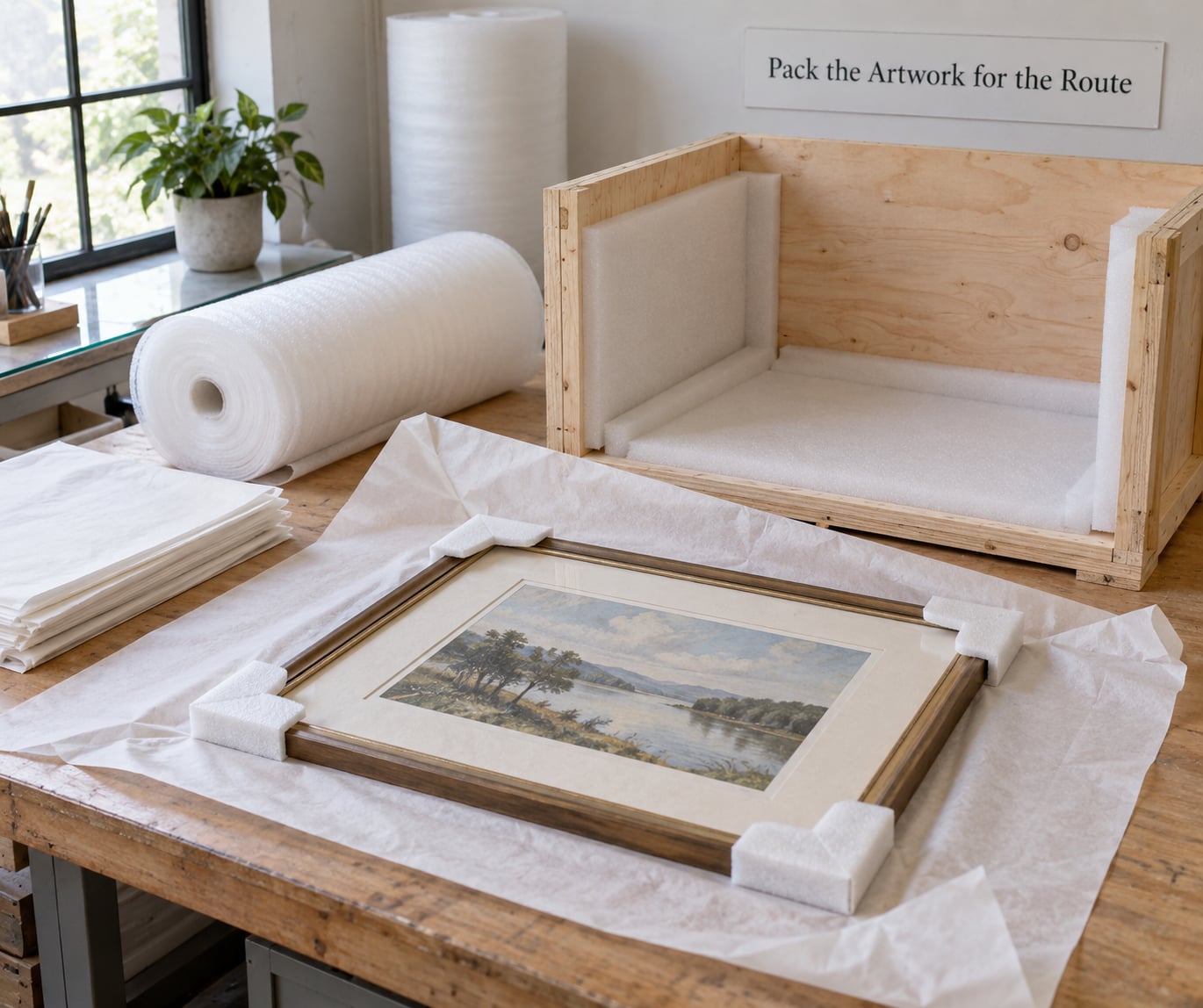
Paint, glue, and varnish need to be fully cured before packing. A piece packed the same day it was finished is a piece an insurer can point to when they decline.
Start with the surface. Cover the face with a protective layer that will not stick, then interleave with acid-free tissue or glassine. Never let foam, bubble wrap, or packing paper touch a painted or textile surface directly; the texture transfers and the value drops.
Sandwich the work between rigid boards so it cannot flex, then add corner protection to any framed piece. A frame with glazing gets its own cover over the glazing, and a stretched canvas gets its stretcher bars protected so nothing presses on the face. A quilt or pieced textile goes in a slightly oversized board-backed envelope with a moisture barrier, shipped flat rather than folded. Works on paper roll only when the media can take it, with an inner tube and a rigid outer tube.
Finish with a water-resistant outer wrap, cushion the empty space so nothing shifts, and use an outer box sturdy enough to be stacked on. Mark the orientation and mark the piece as fine art. Crate anything that exceeds what a box can safely carry: large canvases, three-dimensional work, and anything whose weight makes hand-carrying likely to be dropped.
Photograph the packed work before sealing. One shot of the fully wrapped piece and one of the box with the label visible, timestamped, is usually enough.
6. Complete the Insurance and Shipping Checklist
Before the tape goes on, confirm that the shipment value on the policy or certificate matches the value on the invoice, the packing list, and the carrier form. Inconsistent numbers are the fastest way to turn a covered loss into a dispute.
Walk the list: shipment value confirmed, coverage limit checked against that value, policy or certificate number recorded, named insureds correct, destination address matching the carrier label, declared value entered as instructed, packaging described accurately, date recorded, tracking number saved, and condition report enclosed. If any line does not match, fix it now.
A packing list naming the artwork, its dimensions, its value, and its condition travels inside the box and a copy stays with you. A bill of lading or equivalent receipt goes in your file. Chain of custody is easier to prove when the paperwork is complete.
7. Inspect the Work and Handle Problems Promptly
Open the package in front of the recipient if you can, or ask for photos before anything is unwrapped or discarded. Photograph the sealed box, the opened box, the packing layers, and the artwork itself from several angles.
Where there is visible external damage, photograph it at the door and note the time. You can ask the driver to wait while you look, and you can note damage on the carrier’s delivery receipt before signing. Keep every layer of packaging, cushioning, and box until the piece has been accepted or the claim is closed. Throwing away the crate is the most expensive habit in this whole process.
Notify the carrier and the insurer immediately, in writing if you can, and start a claims record: the date of the incident, the tracking history, photos, receipts, the condition report, repair or restoration estimates, and every email or call. Do not authorize repairs or cleaning before the insurer has had a chance to inspect, because the cost of undoing finished work is yours.
When damage is inside an intact-looking box, say so plainly and point to the condition report. Internal movement inside packaging that still looks fine on arrival is a documented and arguable claim; a surprise you never reported is not.
Common Mistakes
Undervaluing to save a fee. The premium is a small fraction of the work. Underdeclaring is the one decision that can cost you the entire piece.
Treating carrier liability as insurance. It is a low ceiling, often with fine art excluded. Read the exclusions, not just the price at checkout.
Working from old photos. A photo set from two years ago cannot prove today’s condition. Shoot the set on the day it ships.
Mismatched declared values. If the certificate, the invoice, and the carrier form say three different numbers, expect an argument. Make them match.
Packing that deviates from the stated guidelines. Insurers expect specific materials and, on some policies, a documented photo of the packed work. Cheap corner protection can cost the full value.
Packing paint that has not cured. Freshly finished work that sticks to its covering is treated as your packing failure.
Leaving a destination unattended. A signed delivery or a counter signature is a large part of theft protection.
Discarding packaging. The box, the foam, and the crate are evidence. Store them flat somewhere dry.
Waiting to report. Notice deadlines are short, and every day of delay weakens the claim. Report the day you know.
Two habits cover most of the rest. Keep a digital backup of every photo set, condition note, and policy document, sorted by piece, because a claim file you cannot find is a claim you cannot win. And when a work is unusual, unusually valuable, or unusually fragile, spend the money on a conversation with a qualified appraiser, a fine art broker, or a carrier art handler before the box is built. That single hour usually prevents every mistake listed above.
Frequently Asked Questions
Is USPS insurance enough to ship a painting?
Only for small, inexpensive work. USPS coverage is tied to a declared amount, collectible insurance has its own rules and eligibility requirements, and the service options differ from parcel insurance. For anything whose value would hurt to replace, treat the carrier amount as the floor and look at a fine art transit policy that pays the agreed value.
Is declared value the same as insurance?
Not really, which is why artists on shipping forums describe it that way. Declaring a value with a carrier creates a reimbursement obligation subject to that carrier’s published terms, exclusions, and proof requirements. Fine art transit insurance is a separate contract with an agreed value and defined covered perils. Read both sets of terms before you pay.
How do I value a one-of-a-kind artwork for shipping?
Start with what you can document. Use the sale price if the work has sold, recent comparable sales if you can support them, and a written appraisal from a qualified appraiser for older, inherited, or self-priced work. State the valuation method you used in writing, and itemize the frame and glazing separately from the artwork itself.
What should I do if a package arrives damaged?
Photograph the box, the packaging, and the artwork before anything is unpacked or discarded. Note visible damage on the delivery receipt, keep all packaging, and notify both the carrier and the insurer right away. Do not authorize cleaning or repairs until the insurer has had a chance to inspect the piece.
Should an artist insure work being sent to a gallery or on approval?
Yes, unless the gallery contract clearly assigns the risk to the gallery. Ask in writing who buys coverage, what the minimum coverage amount is, and what proof of insurance the gallery wants, usually a certificate of insurance naming them as an additional insured. If the gallery ships from their own premises, confirm whether their coverage covers the period before the piece is packed.
What to Do First
Start with the photo set and the condition note, because that takes twenty minutes and everything else depends on it. Then settle the value, match the coverage to it, and pack to the standard your coverage actually names.
Ship one piece this way before anything goes out. Once the paperwork, the photos, and the packing are a habit, the coverage decision takes minutes instead of an afternoon, and a damaged shipment becomes something you can prove rather than something you argue.