To price a quilt you want to sell, add up every dollar that went into it, value your hours at a real hourly rate, add a share of your studio and selling costs, then apply a markup of roughly two times. Once you have that number, check it against quilts of the same size and quality that have actually sold, and adjust. This takes about an hour of record-keeping the first time, then ten minutes per quilt after that.
Most quilters do not underprice because they lack skill. They underprice because nobody ever taught them what their time is worth, and because a hand full of finished quilts in a closet makes a number feel like a personal verdict rather than a calculation.
Here is the short version of the method, then the detail. Price equals materials plus labor plus overhead, multiplied by a markup. Everything after that is judgment about your market.
Table of Contents
- What You Need
- Step-by-Step
- How to calculate the materials and direct costs
- How to value your time and labor
- How to add overhead and profit
- How to compare the price with the market
- How to set and test your final sale price
- Common Mistakes
- Frequently Asked Questions
- How much should I sell a homemade quilt for?
- What is the average price for a handmade quilt?
- Should I include shipping in the price of a handmade quilt?
- How do I price a quilt I made years ago and want to sell now?
- Do homemade quilts actually sell well?
- What is the rule of 7 in quilting?
- Conclusion
What You Need
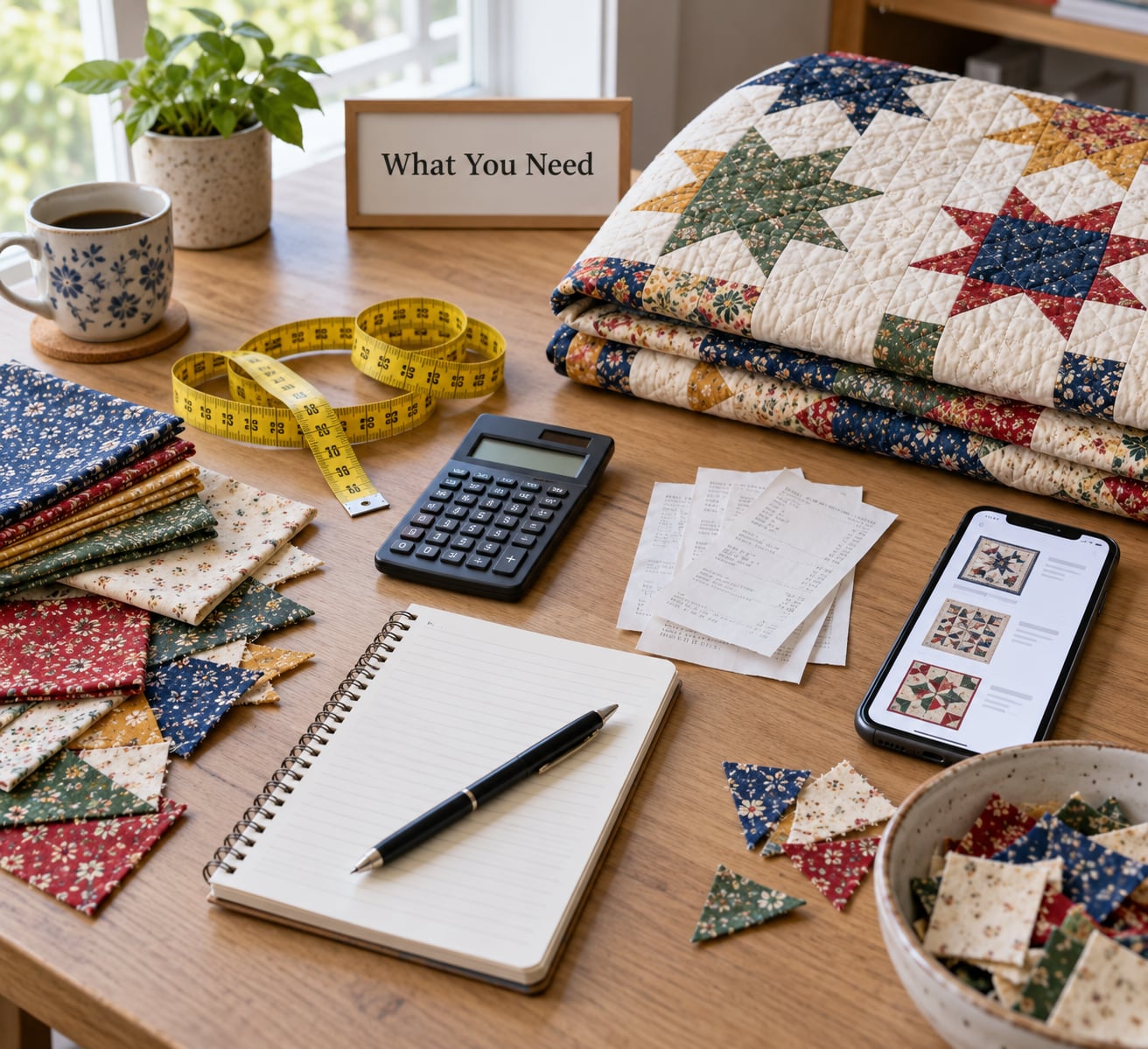
You need three things: a record of what the quilt cost, a record of what it took you, and a reference point for what comparable work sells for. The first two come from you. The third comes from outside, and it is the one most sellers skip.
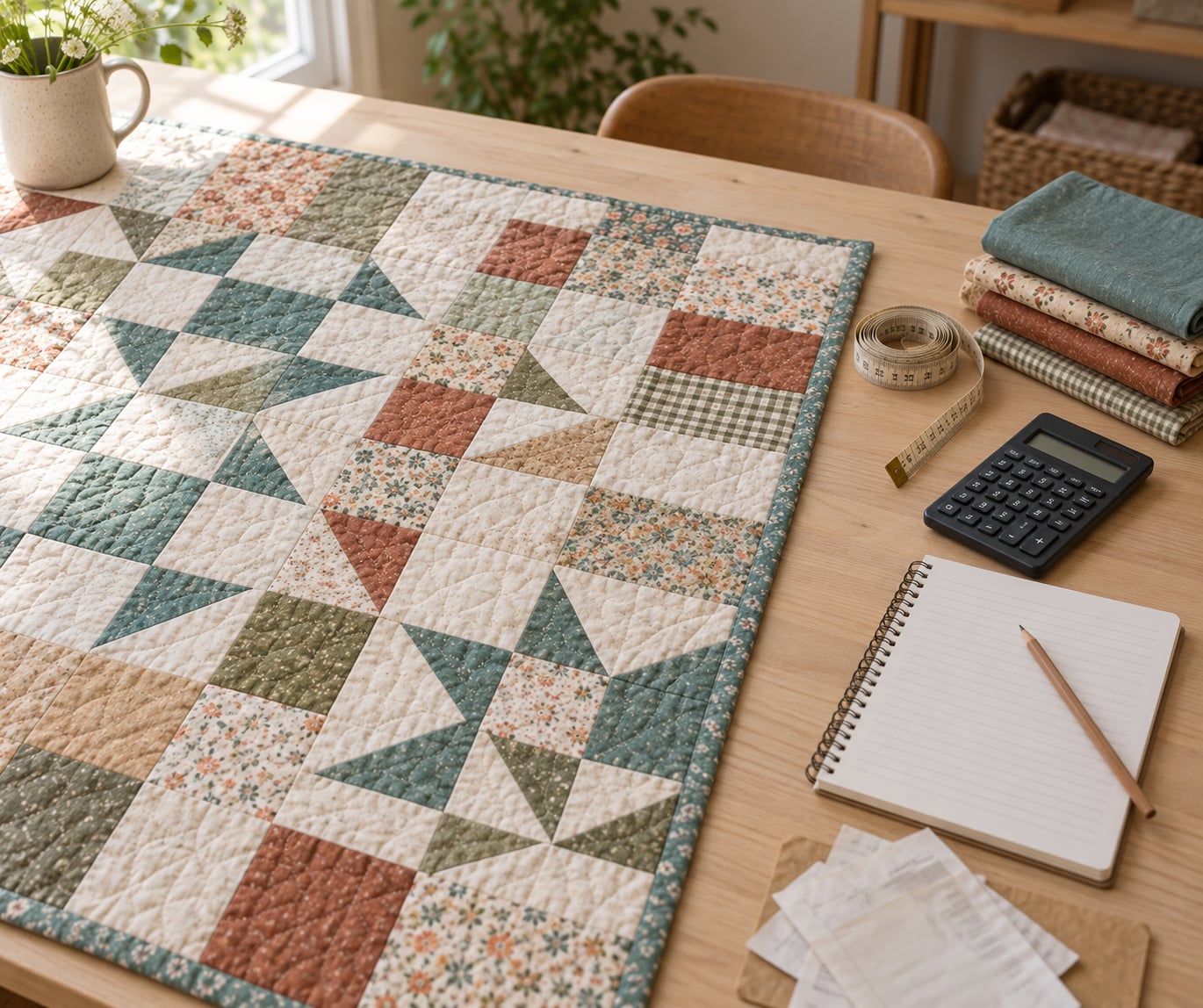
- Receipts or a running supply log. Fabric, batting, backing, binding, thread, notions, the ruler you bent, the rotary blade you replaced. Receipts beat memory every time.
- A tape measure and the quilt’s finished dimensions. Length and width in inches, measured flat, not the size on the pattern.
- An honest hours record. A phone timer or a notebook page. Include design, cutting, piecing, quilting, binding, pressing, and the photography and listing you do afterward.
- Your hourly rate. Pick one and write it down. If you have never chosen, start between 18 and 30 dollars an hour for your own time, and go higher for hand quilting, custom design, or work with a deadline attached.
- A list of comparable quilts. Search your size plus your technique on the marketplace you use, and note asking prices and sold prices separately. They are not the same number.
- Your channel costs. Marketplace listing and transaction fees, payment processing, packaging, shipping, and the booth fee or consignment split if that is where you sell.
If you do not have the hours record, write the hours down now, from memory, and treat it as an estimate. An estimate you improve each quilt is worth more than a perfect number you never start.
Step-by-Step
How to calculate the materials and direct costs
Start with the fabric and work outward. A typical mid-range quilt uses roughly 8 to 12 yards of quilting cotton for a crib, 14 to 20 yards for a throw or twin, and 30 to 40 yards for a queen, plus wide backing for anything over about 60 inches wide.
Here is what a single quilt’s materials usually run, in dollars:
| Material | Low | Typical | Premium |
|---|---|---|---|
| Quilting cotton, main fabric | 30 | 65 | 140 |
| Backing fabric | 12 | 28 | 60 |
| Batting | 15 | 32 | 75 |
| Binding, cut and made | 6 | 14 | 32 |
| Thread, needles, notions | 4 | 9 | 20 |
| Totals | 67 | 148 | 327 |
Allocating shared supplies is where most numbers go wrong. A queen quilt that uses a third of a bolt of fabric did not cost a third of the bolt unless you have already divided the rest. If you bought 12 yards at once, take the per-yard cost and multiply by the yards in this quilt, and put the remainder in a shared bin you draw from later.
Add two more lines most sellers forget. If you paid a longarm quilter to quilt the top, that is a direct cost, not a nicety. So is the fabric you ruined while learning the border on the first attempt, if you count that honestly at an amortized rate.
How to value your time and labor
This is the line that decides your price, and the one most people set to zero because charging for their own hours feels greedy. It is not. It is the difference between a hobby and a business that can replace a day of work.
Break the hours into stages so you can see where the time really goes. A simple pieced throw might run 18 hours. A queen with appliqué and custom quilting can pass 45. Hand quilting changes the math completely, since an hour of hand work produces far less visible area than an hour at the machine.
Multiply total hours by your hourly rate and add that to materials. On a queen quilt at 38 hours and 22 dollars an hour, labor is 836 dollars. That number will feel high the first time you see it. It is also the number that tells you whether the quilt is worth making at all, which is genuinely useful information.
A useful sanity check: divide your hourly rate by the number of square inches you quilt per hour. A machine quilter working at 800 square inches an hour at 22 dollars an hour produces about 2.75 cents per square inch. Hand quilting at 60 square inches an hour produces about 37 cents. That gap is exactly why hand-quilted work sits at the top of every price band.
How to add overhead and profit
Overhead is everything that is not fabric and not your hands. It includes marketplace fees, payment processing, packaging, shipping supplies, photography, the software you pay for, the portion of your electricity and heating that the sewing room uses, and the portion of your rent the studio occupies.
Keep overhead separate from profit, because they do different jobs. Overhead breaks even. Profit is what pays you for the risk and the years it took to get good at this.
The markup on the cost-plus method does both jobs at once, which is why hand-waving it is tempting. A 2x markup on materials plus labor is the most common starting point for makers selling finished work. A 2.5x markup is defensible for intricate piecing, appliqué, or a long custom quilting job. A 1.5x markup fits efficient, chain-pieced, production-style work where you intend to move volume.
Markup is not the same as margin, and sellers confuse them constantly. A 2x markup on a 300 dollar cost gives you a 600 dollar price, and your profit of 300 dollars is 50 percent of the price. Double the markup again to 3x and your margin is 67 percent. When you raise a price by a percentage, your margin rises faster than that percentage. When you cut one, it falls faster too.
How to compare the price with the market
Your cost-plus number is a floor and a reference, not the final answer. The market tells you whether your process is efficient enough to compete at that number, and whether buyers in your region are paying what you need to charge.
Search by size first, then narrow. A quilt search that returns cribs, throws, and kings tells you nothing. Look at what has actually sold rather than what sellers are hoping for, and note the details that separate the top of the range from the bottom: fabric quality, whether the quilting is dense or sparse, whether the binding was done by hand, whether the maker has a visible body of work, and whether the piece is a design or a one-off.
What you will find is a very wide spread, and the spread is the most useful thing on the page. In one Missouri Quilt Co. thread, a crib-size heavily pieced quilt sold for 30 dollars while another in the same category sold for 225. A separate thread there put a 72 by 72 quilt at 150 to 200 dollars depending on the fabric. A quilt guild charity auction saw a single quilt bid up to 300 dollars. Those are not contradictions. They are the same object priced by different people with different information, different materials, and different levels of confidence.
Here is a realistic band for a US seller building a small business, in dollars, and how I would describe each tier:
| Size | Entry | Mid | Premium |
|---|---|---|---|
| Crib or baby | 180 to 260 | 300 to 450 | 550 to 900 |
| Throw | 250 to 350 | 400 to 600 | 700 to 1200 |
| Twin | 300 to 450 | 500 to 750 | 900 to 1500 |
| Full | 400 to 600 | 650 to 950 | 1200 to 1900 |
| Queen | 500 to 750 | 850 to 1300 | 1500 to 2500 |
| King | 700 to 1000 | 1100 to 1700 | 1900 to 3000 |
Entry means simple construction, common quilting cotton, machine binding, and a maker without an established name. Mid means quality fabric, considered design, tidy finishing. Premium means hand quilting, custom or commissioned design, heirloom-level construction, or a maker with a reputation buyers follow. These are typical US ranges that shift by region and change over time; a quilt fair in a tourist town sits at the top of a band, a farm town at the bottom.
Two methods besides cost-plus are worth knowing. The per-square-inch method, common among longarm quilters charging for quilting services, runs around 10 cents per square inch for ordinary work and 15 cents for king and queen, and it is a service rate rather than a finished-quilt price. The per-block method, common for T-shirt quilts, is what members of the American Professional Quilters Society describe as 15 dollars per block for a straight setting and 17 dollars for a crazy setting, fabric and batting included.
How to set and test your final sale price
Round the number. A price of 578 dollars says you used a spreadsheet. A price of 575 or 600 says you decided something, and buyers read the second one as a decision they can argue with, which is a better position than one that is merely a calculation.
Then choose the channel price, which is a different number from the retail price. On a marketplace that takes a transaction fee, a listing fee, and payment processing, you need to divide by roughly 0.85 to 0.90 to land on the same money in your account. A consignment shop typically keeps about half, so a 600 dollar quilt needs to be listed near 1200, and that is rarely the right move. A craft fair booth fee plus card reader fees is a smaller cut, often 10 to 15 percent plus a fixed booth cost per sale.
| Channel | What comes off the top | Effect on your number |
|---|---|---|
| Own shop or direct sale | Payment processing only, a few percent | Set the price you calculated |
| Etsy | Listing fee, transaction fee, payment processing, offsite ads if enabled | Multiply by about 1.15 to 1.2 |
| eBay | Final value fee near 13 percent plus payment processing | Multiply by about 1.2 |
| Poshmark or Mercari | No listing fee; buyers cover most shipping | Multiply by about 1.05 to 1.1 |
| Consignment shop | Shop takes roughly 50 percent | Multiply by about 2, or skip |
| Craft fair | Booth fee, card reader fee, travel | Multiply by about 1.15 |
Redwood quilters on Reddit point out that Poshmark and Mercari charge nothing to list, which makes them useful for moving a quilt you want gone rather than for building a brand. Either way, test the listing before you commit. Put it up for two weeks at your number, watch the views and the favorites, and if it gets saves but no questions, the price is the problem. If it gets no attention at all, the photographs are the problem.
For commissioned work, write the scope down. Quote the same cost-plus number, take a deposit of roughly a third, set a number of revision rounds included in the price, and charge a rush fee when the client moves the deadline. A memory quilt, where the piece is made from a client’s own clothing and carries real sentimental weight, is usually quoted as a flat rate plus an hourly design fee rather than per square inch, and it should be priced on the hours, not on the blocks.
Common Mistakes
Pricing your time at zero. This is the big one, and the forum consensus is blunt about it: quilters routinely end up earning below minimum wage. The fix is simple and uncomfortable. Set an hourly rate, write it at the top of your worksheet, and treat every hour as a line item even when you enjoy the work.
Copying what a famous quilter charges. A well-known name prices reputation and a waiting list, not fabric and hours. Match the band for your skill and your visibility, not someone else’s following.
Forgetting the channel cut. Listing at 500 dollars on a marketplace that takes 15 percent is not the same as 500 dollars in your hand. Decide the net you need, then work backwards.
Eating the shipping. A queen quilt is heavy and bulky, and sellers routinely absorb the cost of getting it across the country. Build packaging and shipping into the price, or quote it separately to the buyer. And check the buyer’s framing on that box before you agree to ship something you cannot afford to send twice.
Underpricing complex work. Hours alone are a poor measure. A 40-hour quilt of simple nine-patch blocks is not the same work as a 30-hour quilt of curved appliqué, and a customer will notice the difference long before your spreadsheet does.
Discounting to close instead of adjusting the price. Cutting your number in half to make a sale trains buyers to wait for the sale. If a number is not working, change the price, the presentation, or the channel, and hold the line on the others.
Leaving finished inventory at old prices forever. If your hourly rate has gone up since the quilt left your machine, the quilt has not gotten cheaper to make. Re-price your storage pieces once a year against the current market and let the old number go.
When someone tells you a handmade quilt costs too much, do not defend the fabric. Show the hours. Written cost breakdowns with a materials line, a labor line, and an overhead line do more to close a sale than any description of thread count.
Frequently Asked Questions
How much should I sell a homemade quilt for?
A homemade crib quilt typically lists between 180 and 900 dollars, and a queen between 500 and 2500 dollars, depending almost entirely on complexity, fabric, and finishing. Work out materials plus labor at a real hourly rate, add overhead, and apply a 2x markup. Then check comparable sold listings in your size and technique to see where that number sits against the market.
What is the average price for a handmade quilt?
There is no useful average, because the spread within a single category is enormous. One Missouri Quilt Co. thread has a crib-size heavily pieced quilt selling at 30 dollars and another at 225. A 72 by 72 quilt in a separate thread was priced at 150 to 200 dollars depending on fabric. Locate yourself inside the band by your materials, hours, and finishing rather than aiming for a midpoint.
Should I include shipping in the price of a handmade quilt?
Build it in, or quote it separately, but do not absorb it. A queen quilt is heavy and bulky, and the packaging alone is a real cost. If you are on a marketplace where the buyer pays the postage, say so in the listing and add a small handling amount. If you ship free, raise the item price by the shipping cost you would otherwise absorb so your net stays the same.
How do I price a quilt I made years ago and want to sell now?
Price it as if you were making it today. Use the current price of your materials, a current hourly rate, and today’s market, not what you charged for similar work in the past. Quilters who made something during a season when they were not charging themselves tend to set the old feeling as their floor, then wonder why the quilt will not sell.
Do homemade quilts actually sell well?
They sell, but not the way most sellers expect. Buyers at craft fairs and in memory quilts convert well, while original designs with no clear use case sit. Baby and throw sizes move fastest because people know what to do with them. If your closet inventory is not moving, the problem is usually the mix of sizes and the photographs, not the pricing formula.
What is the rule of 7 in quilting?
The rule of 7 is a quick estimating shortcut rather than a pricing standard. It treats a crib quilt as roughly 7 yards of fabric, or a finished quilt as about 7 yards per width, which is a fast way to sanity-check yardage when you are at the cutting table. It has nothing to do with how much to charge, and it should never replace the hours record.
Conclusion
Do the first one properly and the rest gets easier. Pick the quilt in your closet you would be happiest to see sold, spend an hour on materials, hours, overhead, and a 2x markup, then look at five comparable sold listings before you commit to the number. Start with the price you can defend out loud, because that is the only price that will hold up when someone asks why.
Last updated October 2026.