How to price original artwork comes down to one repeatable calculation: your hourly rate multiplied by the hours the piece took, plus materials, plus a share of studio overhead, plus a profit margin. Apply that same formula to every piece, then sanity-check the result against what comparable artists actually charge.
The ranges below are typical US planning numbers, not a rate card. They vary by region, medium, and career stage, and they shift over time. Use them to orient yourself, then build your own number from your own costs.
Table of Contents
- How to Price Original Artwork: Typical US Ranges
- What Determines the Price of Original Artwork
- Key factors to consider when you set a price
- How to Calculate a Price for Your Artwork
- How to Price Different Types of Original Artwork
- Small paintings
- Large paintings
- Quilts and textile wall hangings
- Wood cutouts and relief panels
- Mixed-media installations
- Commissioned work
- How to Set Prices Without Undervaluing Your Work
- How to price original artwork without apologizing for it
- Ways to Save on Artwork Costs and Protect Your Margin
- Frequently Asked Questions
- How much should I charge for an original painting?
- What is the 70/30 rule in art?
- Is there a free art price database I can use?
- Why do artists underprice their work?
- How do I price a commission piece?
- Should I charge sales tax on artwork?
- Conclusion
How to Price Original Artwork: Typical US Ranges
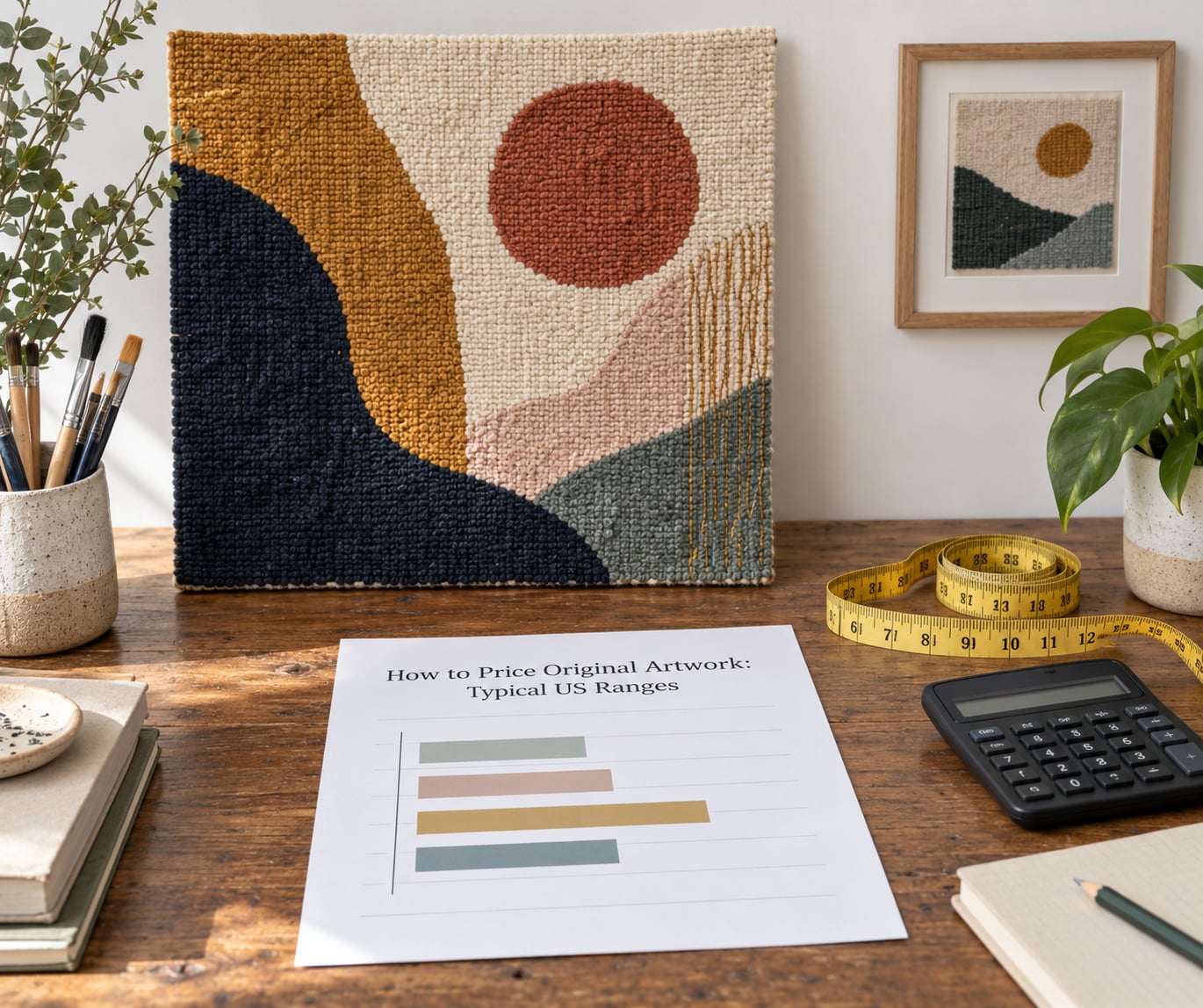
Most original work lands somewhere in the table below. These are the figures collectors see in studios and at group shows, and they give you a starting band for a first price list.
| Format | Common size | Typical US range (USD) |
|---|---|---|
| Small original painting | 8×10 in | 150 – 450 |
| Mid-size painting | 20×24 in | 400 – 1,400 |
| Large painting | 36×48 in | 1,200 – 4,500+ |
| Textile wall hanging | 24×36 in | 300 – 1,800 |
| Hand-stitched quilt | Throw to queen | 800 – 6,000+ |
| Wood cutout or relief panel | 12×18 in | 250 – 1,500 |
| Small mixed-media installation | 3 to 6 elements | 900 – 5,000 |
| Limited edition print | 8×10 in, edition of 25 | 60 – 250 |
| Commissioned piece | Varies by brief | 900 – 12,000+ |
These are typical US ranges that vary by region and change over time, so treat them as a sanity check rather than a quote. If your calculation lands far outside the band for your size and medium, one of the two is wrong.
Small work needs a floor. A 4×4 in piece priced at 25 reads as a trinket, and people will negotiate it down further the moment it hangs on a wall. Set a minimum and never list below it.
What Determines the Price of Original Artwork
Key factors to consider when you set a price
- Materials. Canvas, pigment, framing, hardware, and specialty supplies. Archival and hand-prepared materials justify more than student-grade.
- Size. Larger work costs more to produce and more to transport, and it occupies more wall space a buyer has to live with.
- Hours. The honest number, including sketching, layering, drying, and finishing.
- Complexity. A heavily layered surface costs far more than the dimensions suggest. Size alone is a poor proxy for labor.
- Skill and training. Formal study, years of practice, and technique an untrained buyer cannot reproduce.
- Reputation. Exhibition history, collections, awards, and press. This is the factor that moves fastest as your career develops.
- Uniqueness. One of a kind, an edition, or a reproduction changes the price logic completely.
- Subject demand. Portraits, local landmarks, and work in a style buyers already collect move faster than experimental pieces.
- Presentation. Framing, signature, certificate, and packaging are part of the perceived value.
- Sales context. A gallery takes roughly 30 to 50 percent, so your list price has to be built for the channel, not the other way around.
How to Calculate a Price for Your Artwork
Here is the process I would repeat for every piece, in the same order, so the numbers stay comparable across a collection.
- Set your hourly rate. Start near 20 to 35 USD for an emerging artist and raise it as you get faster and more in demand. Divide by your real working hours per year, not by 2,000.
- Log materials and hours per piece. Keep a simple sheet: date, size, medium, hours by stage, material total.
- Add overhead. Divide monthly studio rent, utilities, insurance, website hosting, and marketing by the pieces you finish that month. A shared studio is often quoted starting near 350 USD per month.
- Add framing, packaging, and freight. Crating and insurance are real costs, and buyers notice when they are handled well.
- Apply your markup, then check comparables. Multiply your total by your target markup, round to a clean number, and compare against the market before publishing.
Worked example: a 20×24 in mixed-media piece that took 32 hours at a 30 USD hourly rate, 145 USD of materials, 90 USD of framing, and 120 USD of overhead share. That is 960 plus 145 plus 90 plus 120, or 1,315 USD of cost. A 30 percent markup gives 1,710, so you would list it at 1,700 USD.
Markup and margin are not the same thing. A 30 percent markup on 1,315 USD leaves you about 395 USD of profit. A 30 percent margin means 30 percent of your final selling price is profit, so the same piece would need to sell at about 1,880 USD. Know which one you are using before you publish a number.
Then adjust for complexity. A 20×24 piece with forty hours of layered texture should not price the same as a 20×24 with eight. This is the single most common complaint in art business discussions, where artists report being asked to price by size alone.
How to Price Different Types of Original Artwork
Small paintings
Price these against the hourly calculation, then apply a floor. Small work carries the same studio overhead as a large piece, so it must not be priced as though the overhead disappeared.
Large paintings
Large work carries added cost in canvas, primer, studio wall space, and crating. Add a size premium on top of the hourly model rather than scaling linearly, because the extra inches cost you less per inch than the core of the painting.
Quilts and textile wall hangings
Price by the hour, not by the square inch. A hand-pieced quilt takes hundreds of hours that no dimension can predict, and fiber artists in the studio community consistently price quilts this way.
Wood cutouts and relief panels
Material cost and fabrication time both dominate. Add the cost of sanding, finishing, and mounting hardware, and price the surface treatment separately if it adds hours.
Mixed-media installations
Price each element plus a design and installation fee. Installation days are billable, and most artists who skip this end up eating that time.
Commissioned work
Price the quote hourly or on a flat rate with written milestones. Artists report taking 25 to 50 percent up front, with a rush fee for compressed deadlines. Put usage rights in the contract, and charge more for exclusive or commercial use than for a piece that hangs on a wall.
How to Set Prices Without Undervaluing Your Work
How to price original artwork without apologizing for it
Say the number, then stop talking. The silence after a price feels unbearable to you and completely normal to the buyer.
Build a ladder instead of pricing every piece alone. Define four or five size tiers, then place each work on a tier by its dimensions and complexity. When your whole collection reads as one catalog, buyers trust the numbers instead of testing them.
Raise prices at real milestones rather than on a whim: a solo show, a year of consistent sales, an accepted work into a public collection, or a move to a new market. A 10 to 20 percent increase at each milestone is easy to justify and easy to absorb.
On discounts: many artists in Reddit pricing threads deal with the same request, a friend or relative asking for a special price. Decide the policy once, in writing, and put it in your shop terms. If you give anything, make it a fixed thing, such as 10 percent for a first purchase, rather than a number invented in the moment. A policy costs you far less than a habit.
Ways to Save on Artwork Costs and Protect Your Margin
Cut production waste. Buy heavy-body pigment in larger containers once you know which ones you use, and mix your own medium at standard ratios.
Price freight into the work. Reused or flat-pack frames and simple packaging keep costs down without looking cheap to a collector.
Time-track honestly. Many artists underestimate by half, which quietly cuts their hourly rate every time they recalculate. Two weeks of logging is usually enough to see it.
Keep studio overhead flat. A second shared space often costs less than a larger one plus higher utilities, and the pieces you finish per month are what really move your per-piece overhead.
Discount once and in writing. A clear, published policy protects the price list better than any individual conversation.
Frequently Asked Questions
How much should I charge for an original painting?
Most mid-size originals fall between 400 and 1,400 USD, small work between 150 and 450 USD, and large pieces start around 1,200 USD. Those are typical US ranges, not targets. Your own number comes from hours times your hourly rate, plus materials, framing, overhead, and a markup, then checked against comparable artists in your market and medium.
What is the 70/30 rule in art?
The 70/30 rule is a gallery commission split: the gallery keeps roughly 30 to 50 percent of a sale. Some contracts use a straight 70/30, others 50/50. The practical version for pricing is that a gallery channel should change how you price, not just who you pay. Work out your target take-home first, then multiply by the gallery cut.
Is there a free art price database I can use?
There is no single free database with reliable prices, because most artists do not publish theirs. Free research comes from auction results, gallery price lists, local open studio and art fair receipts, and asking gallery staff what their artists charge in a given size range. Most artists in the community build their comparables from those conversations rather than from a tool.
Why do artists underprice their work?
The most common reasons are fear of scaring buyers off, imposter syndrome, and never tracking hours. Because costs like rent and materials are fixed, underpricing hits profit twice: you earn less per piece and you need more pieces to cover the month. Setting a floor price and a written discount policy fixes most of it.
How do I price a commission piece?
Quote the commission the way you would any freelance job. List the materials cost, your hourly rate times estimated hours, a design fee, and installation or shipping separately. Put the estimate, the number of revision rounds, the deposit, and any usage rights in writing. Artists report that taking 25 to 50 percent up front protects both the schedule and the relationship.
Should I charge sales tax on artwork?
It depends on where you sell and on the state rules where you and your buyer are located, and those rules change. In general, sales of tangible art are taxable in many states while some goods are exempt, and you may need a resale certificate for commission sales. Check with your state revenue department before quoting a net price to a gallery or dealer.
Conclusion
Start this week with a spreadsheet. Log hours and materials on the piece in front of you, divide the month’s studio costs by the pieces you finished, apply a markup you can live with, and write the number down.
Then build a ladder, set a floor for small work, and put your discount policy in writing. That is how to price original artwork in a way that survives your first slow month.