No, most artists do not need a blog to have a professional website. Yes, you should add one the moment your next opportunity might arrive through a search engine, an inbox, or a referral you cannot control. The honest answer is conditional, and the condition is whether a blog supports something you are already trying to do.
After ten years of running my own mixed-media site, I have watched this question get answered badly in two directions. Some artists are told a blog is a sales machine and feel betrayed when nothing sells. Others are told they are behind the times and start posting out of guilt, then abandon it in four months.
This guide covers when a blog earns its place on an artist website, what to write about, how long each post actually takes, and when to skip it entirely.
Table of Contents
- Do Artists Need a Blog on Their Website?
- Three situations where a blog pays for itself right away
- The minimum viable version
- What Does an Art Website Blog Do?
- How Does a Blog Help Artists and Art Students?
- For collectors, galleries, and curators
- For students and enthusiasts
- How Does a Blog Help Artists Sell Their Work?
- How Artists Can Benefit From Regular Art Posts
- When an Artist Does Not Need a Blog
- How to Choose Between a Blog, Newsletter, and Social Media
- What Should Artists Write About on Their Blog?
- How Often Should Artists Publish Blog Posts?
- What Should an Artist Measure After Starting a Blog?
- Frequently Asked Questions
- Is a portfolio enough, or do artists really need a blog?
- How often should artists publish blog posts?
- Do artist blogs actually help with SEO?
- Should artists write about sales and pricing on their blog?
- What if I do not enjoy writing?
- Do I need both a website and a newsletter?
- Start With One Post
Do Artists Need a Blog on Their Website?
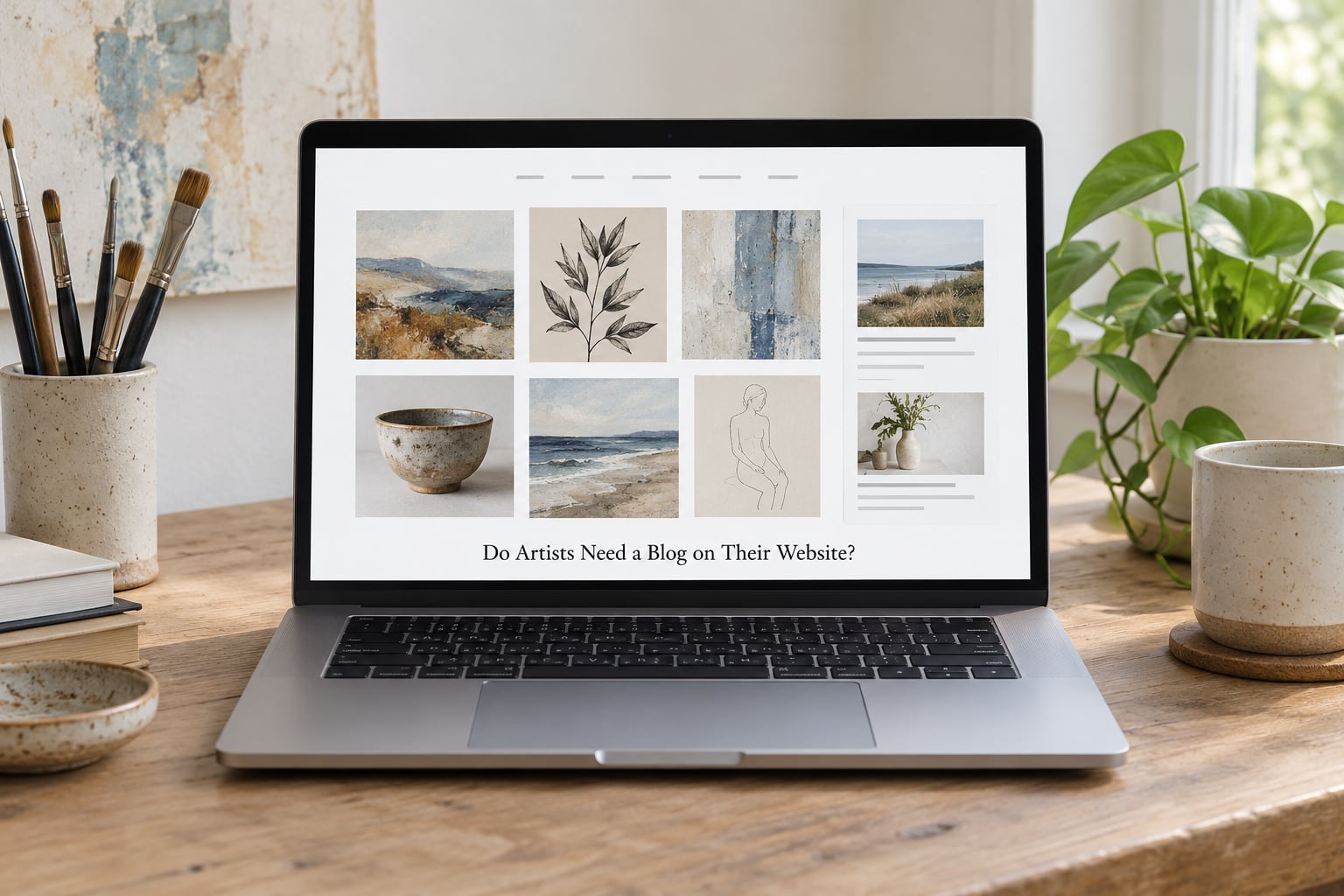
An artist website needs four things before a blog matters: a portfolio page with your strongest work, an about page with a real artist statement, a contact page, and a shop or commissions page if you sell direct. Get those right and your site is already credible. A blog is what comes after.
The distinction trips people up. Your portfolio is a gallery: it shows finished work and lets someone decide quickly. A blog post is a room where you talk. One is browsed in under a minute, the other is read.
Three situations where a blog pays for itself right away
If you sell direct, take commissions, or run open studios, a blog answers the questions that arrive before anyone presses buy. Sizing, framing, shipping to a specific country, lead time on a custom piece, whether you work in a particular material.
If you apply to fairs, residencies, grants, and gallery submissions, a website with dated, written process work reads as an active practice. A portfolio of finished pieces looks the same whether you made it this year or three.
If you want collectors in a specific place to find you, a blog is the only place on your site where you can write the sentence a person actually types: mixed media textile artist in Taos.
The minimum viable version
Four posts a year is a real blog. One per season, each roughly 400 words, each containing one photograph from the studio and a link to your portfolio. That is enough to exist, to be indexed, and to grow. The common failure is not too few posts. It is quitting in March of the second year.
What Does an Art Website Blog Do?
An artist blog is a section of your own website, separate from the portfolio and the shop, where you publish written posts about your work, process, materials, and studio life. Its practical job is to give search engines and visitors words to find.
That matters more than it sounds. A crawler can read text. It cannot read your paintings. A portfolio page with fifty images and a sixty-word bio offers a search engine almost nothing to work with, which is why two artists making comparable work can end up in completely different positions on a results page.
On my site, a post about hand-stitching a linen piece has brought more genuine inquiries than any single piece of finished work. Nobody searched for the finished piece. They searched a process.
Beyond discovery, a blog does four useful jobs:
- Documents work in progress, so a body of thinking accumulates over years instead of vanishing into a feed
- Explains technique honestly, which attracts other makers and occasionally teaches
- Answers the same buying and commission questions over and over so you stop answering them from scratch in DMs
- Creates a body of owned pages that keep working long after publication
How Does a Blog Help Artists and Art Students?
Two different audiences read artist blogs and they want different things, which is why a single blog can feel confusing to write.
For collectors, galleries, and curators
These readers are deciding whether you are serious and whether the work holds up. A blog shows how you think, how you handle a problem that does not go well, and whether you finish what you start. Three of those five questions cannot be answered by a photograph.
The language matters here. A curator reading a process post is learning how you describe your own work, which tells them whether you can write a wall label and an application statement.
For students and enthusiasts
This audience wants the how. A post explaining why you switched from one binding method to another, or what a specific pigment does on linen, brings readers who will actually follow your next post. That audience does not buy original work, and chasing them instead is a common mistake.
Both groups can live on one site if you label things clearly. A student who reads your material guide and a collector who reads your exhibition notes should both get what they came for on the same domain.
How Does a Blog Help Artists Sell Their Work?
A blog supports sales indirectly. It shows your thinking, which builds trust, answers buying questions, and guides people toward the portfolio, the commissions page, or the shop.
A blog is not a sales page. It does not display prices, availability, or shipping terms, and a post that tries to do all three usually does none of them well. The moment a reader is ready to buy, they need a shop with clear products. The blog’s job is to make them trust you before that click.
The practical sequence looks like this: a reader finds a post about a commission process, reads how you handle a difficult brief, follows the link to your commissions page, and sends an enquiry. No single post closed the sale. The post made the enquiry feel safe.
My shop conversion is low. My enquiry quality is high, and that is what the blog has done for my business. If your problem is that nobody contacts you, that is a blog problem. If your problem is that people contact you and then hesitate at the price, fix the shop page instead.
How Artists Can Benefit From Regular Art Posts
Regular posting works because each post connects to something you were going to do anyway. The table below maps the goal you actually have to the website action a post supports.
| Goal | What to publish | What it does on the site |
|---|---|---|
| Get found in search | A post naming your medium, your location, and one specific process | Creates a page targeting a long-tail phrase a collector would actually type |
| Build trust before contact | A post about a piece that did not work and what you learned | Shows problem-solving, which is what galleries screen for |
| Answer repeated questions | A materials or sizing guide | Cuts down on the same email you answer weekly |
| Grow an email list | A post on something specific enough that only your work covers | Gives people a reason to subscribe rather than a generic newsletter promise |
| Support applications | An exhibition recap with an image list | Adds dated evidence of an active practice to a portfolio page that never changes |
| Feed your social accounts | One long-form post with six usable details inside it | Produces weeks of short posts without writing them from scratch |
The last row is the one people miss. A single post about a pigment test produces six posts: the test itself, a before, an after, a question about it, a thumbnail, and a short paragraph on why you tried it. The blog is not competing with your social feed. It is the source material.
When an Artist Does Not Need a Blog
Some of the strongest advice in this whole subject is negative. Skip the blog if any of these are true about your situation right now.
You sell exclusively through one gallery that has a waiting list and fills your work. Your reputation is being made through in-person relationships and curatorial introductions, and no blog post will accelerate that. A strong portfolio page does this job better.
You have no time. Not no enthusiasm, no time. If making the work is the part that keeps you sane and blog posts are stealing from it, the blog is costing you more than it returns.
Your audience genuinely lives somewhere else. A newsletter to 400 people who already buy from you is worth more than a blog that reaches nobody. Newsletters are a different instrument: you own the list, nobody ranks your inbox.
You hate writing and will write reluctantly for years. This is the most common reason blogs die. A category page for each body of work, plus a good FAQ on your contact page, delivers most of the practical value with none of the strain.
You already post several times a week and get real enquiries from it. Then your attention belongs on the thing that works. Note that this is a different claim from having a large follower count. Volume without enquiries is not a reason to skip a blog.
There is one more honest case: a portfolio-only site with strong written context on each work can rank perfectly well for a while. Add the blog when you have something to say, not because a checklist said so.
How to Choose Between a Blog, Newsletter, and Social Media

Pick the format that matches your reason for writing. These three do different jobs, and using all three is a choice rather than a requirement.
| Format | Best for | Time per piece | How long it lasts | Who controls it |
|---|---|---|---|---|
| Social media | Fast visibility, community, showing finished work now | 15-45 minutes | Days, occasionally longer with a good pin | The platform, not you |
| Newsletter | Reaching people who already chose you | 1-2 hours | As long as you keep sending | You, and your list |
| Blog post | Being found by strangers, and permanent reference | 2-5 hours | Years, often a decade | You |
Blog posts are the only one of the three that get indexed. That is their whole argument. Social posts reach people you would have reached anyway, newsletters reach people who opted in, and a blog post is the one format where someone who has never heard of you can find you years later.
The practical order for most artists: use social for the immediate work, run a newsletter for the people who follow along, and write the blog when you have a month of studio time to describe.
What Should Artists Write About on Their Blog?
Write about what you did, not what you intended. Specific finished process beats broad philosophy every time. These post types work for mixed-media and textile practice in particular.
- Process journal — one piece from first mark to final mounting, with the decisions you reversed. Example: cutting a piece apart after the third layer and rebuilding it.
- Material guide — what a specific pigment, thread, or ground actually does. Example: how four different stabilisers behave when you dye over them.
- Technique demonstration — one small method, explained for someone who has never done it. Example: a resist technique with wax, photographed in steps.
- Studio rituals — the boring infrastructure that keeps you working. Teas, bench arrangements, the storage system you swore you’d build.
- Failed pieces — what went wrong and what it cost. This is the most trusted post type on my site and the one I write least often.
- Exhibition notes — where the work hung, what you saw in it once it was on the wall, and who else was showing.
- Commission walkthrough — with client permission, how a brief became an object. This answers buying questions before a buyer asks them.
- Collection care — how to store, clean, or display a textile piece. This brings owners to your site and keeps them contacting you for years afterwards.
Choose topics that answer a real question or reveal something only you know. A quota will produce posts nobody reads, and posts nobody reads are what makes people quit in the second year.
How Often Should Artists Publish Blog Posts?
Once a month is a comfortable target for a working artist. Never zero is the only rule that matters, because search engines and readers both treat a dead archive as a dead site.
Here is how the three cadences actually feel:
| Cadence | Time per month | Suits | Risk |
|---|---|---|---|
| Seasonal, about 4 posts a year | One concentrated weekend | Full-time makers with a steady supply of finished work to describe | Slow, but it compounds and costs almost nothing |
| Occasional, 2-3 posts a year | Sporadic | Artists at fairs or residencies with nothing left to write about in between | Gaps read as inactivity to both readers and curators |
| Regular, monthly or more | 3-6 hours | Artists who teach, sell prints, or want steady search visibility | Burnout is near certain if the writing is not already happening |
A quick note on the time cost, because nobody quotes it honestly. Photographing and selecting images takes longer than writing the words, usually by a factor of two. Budget roughly three hours for a short process post with good images, and five or six for a piece with a studio walkthrough. Anything faster than that produces something I have regretted.
The useful test is whether you have material to say. If you have been in the studio for three months, you have six posts in you and no problem. If you have been away, publish one honest post about being away rather than three thin ones.
What Should an Artist Measure After Starting a Blog?
Measure the things that connect to your work: email sign-ups, contact-form enquiries, shop visits from the blog, sales or commissions you can trace, saves and bookmarks, and search appearances for your name and your medium.
Ignore pageviews. They reward you for a post that made a stranger scroll and nothing else, which is a feeling that does not pay a material bill. I deleted my analytics years ago and made better decisions, because I stopped asking what content I should make and started asking what enquiries I actually received.
Give it a fair trial: check quarterly, not daily. Look for enquiry sources in your inbox, ask visitors where they found you, and search your own name to see what comes up. If six months in, nobody has ever arrived from a blog post and you have no newsletter sign-ups from it, that is real data and you can stop without failing.
The other half of measuring is pruning. Delete or update the posts that confuse people, especially anything with wrong prices, old exhibition dates, or dead links to work you no longer make.
Frequently Asked Questions
Is a portfolio enough, or do artists really need a blog?
A portfolio is enough if you sell through one gallery or from a single in-person following. Add a blog when you sell direct, take commissions, teach, or apply to fairs and residencies, because those readers arrive with questions a gallery page cannot answer. Most artists who start a blog keep it for the search traffic and the inquiry quality rather than for direct sales on the post itself.
How often should artists publish blog posts?
About once a month is a comfortable target, and four posts a year is a genuine minimum. The rule that actually matters is never zero, because readers and search engines both read an abandoned archive as a dead site. Publish when you have studio material to describe rather than on a schedule you cannot keep.
Do artist blogs actually help with SEO?
Yes, mainly because of what a portfolio page cannot do. Search engines read words but not images, so a gallery of fifty pieces with a short biography gives a crawler almost nothing to index. Blog posts add indexable pages targeting the long-tail phrases real collectors type, and internal links from those posts pass authority to your portfolio and shop pages.
Should artists write about sales and pricing on their blog?
Write about how you work and how a commission unfolds, not about price lists. Pricing and availability belong on the shop or commissions page, where they stay accurate. A post explaining how you scope a brief, or what makes a piece original rather than a print, reassures buyers without turning into a sales page that goes out of date.
What if I do not enjoy writing?
Then write the way you document, not the way you publish. Short factual posts, photo captions you would say out loud, and materials notes are all legitimate and all indexable. If writing still feels like a chore, category pages for each body of work plus a solid contact page will carry most of the practical value without it.
Do I need both a website and a newsletter?
No, and they are not redundant. The blog is where strangers find you and the newsletter is where the people who already found you stay in touch. A newsletter can be a plain weekly note with one image and no design work at all. If you can only do one, keep whichever one you will genuinely still be doing in a year.
Start With One Post
If you take one thing from this: write a single post about one piece you finished this year, roughly 400 words, with a link to that piece in your portfolio and a link to your contact page. Publish it. Then decide in six months whether anything came of it.
That single post answers the question better than another month of planning will, because the only thing standing between most artists and a useful blog is the first one.