If you have ever stood in front of your own finished piece and had nothing to say, this guide is for you. Knowing how to describe your own artwork in words comes down to one habit: point at something real, then say what it is. Most artists can write a page about a painting by someone else and freeze completely when the canvas is theirs.
So this guide is built around a repeatable process. You start by looking, not by explaining, then you move through five short steps to produce a sentence, a caption, a wall label, or a full artist statement. You can describe one finished piece in about twenty minutes once you know what to look for.
The reason this matters is practical. A gallery manager, a juror, or a person scrolling your feed has never stood next to you at the workbench. Your words are all they get.
Table of Contents
- What You Need
- Step-by-Step: How to Describe Your Own Artwork in Words
- How to describe your own artwork: start with a specific first impression
- Name the materials, techniques, and formal choices
- Connect the visual details to your intention
- Choose a structure for your intended audience
- Edit for clarity, specificity, and your own voice
- A worked example, start to finish
- Common Mistakes
- Frequently Asked Questions
- How do I describe my own art?
- What is typically included in an artist statement?
- What are the most common mistakes in artist statements?
- What is the 70/30 rule in art?
- How long should an artist statement be?
- Start With One Piece Today
What You Need
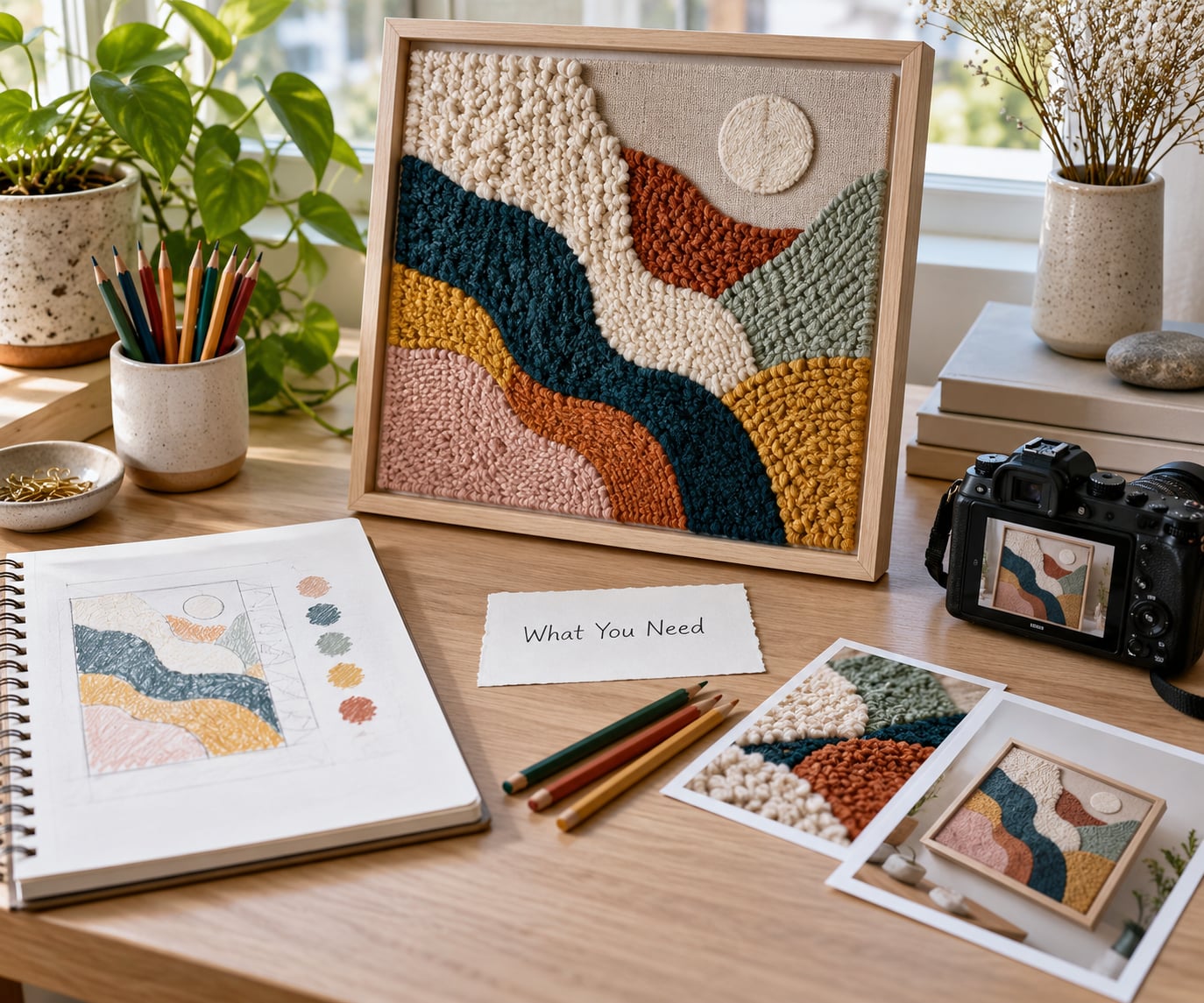
You need very little: one finished piece, a phone or camera, and about twenty minutes. Having the piece physically in front of you matters more than it sounds, because you will look at it six or seven times during the exercise and you cannot do that from memory.
Before you write anything, run these three warm-ups. Each one is meant to be done with the work in sight, out loud or in a notebook, not on a screen.
- The inventory. Write down every material you can identify without guessing. Cotton, rusted steel, hand-stitched thread, oil on linen, screen-printed paper.
- The five-second look. Look at the piece, then look away, then write the first four words that come to mind. Do not edit them. This usually surfaces the honest first impression you will build the whole description around.
- The colour list. Name ten colours that are actually there, not colours you would have chosen. Name them plainly, the way a friend would describe them out loud.
If you make textile, quilted, or mixed-media work, keep your technique notes nearby while you do this. Recording what you actually did in the studio is the raw material for everything that follows.
Step-by-Step: How to Describe Your Own Artwork in Words
The method runs in three passes, and the order matters. First you describe the piece as a physical object. Then you describe how you made it. Last, and only last, you say what it is about.
Most bad artist statements fail because they skip to pass three on sentence one. A reader who has not been given anything to look at has no anchor for your meaning, so it floats away.
How to describe your own artwork: start with a specific first impression
Open with one concrete observation, not an evaluation. The word to delete first is beautiful, then interesting, then different. Those words carry no information because everyone who has ever looked at anything has used them.
Replace them with a measurement, a texture, or an action. Instead of a striking composition, you might write that three wide bands of indigo run diagonally across the piece and stop short of the lower edge. Instead of interesting texture, you write that the surface stays smooth until the bottom quarter, where it breaks into open stitching.
Now compress that into three sentences: what it is, what dominates, and what happens at the edge or corner. That trio becomes the opening of anything you write about the piece, and it doubles as a finished caption when the format needs only a line.
You will know the first sentence works if a reader who has never seen the work can point at roughly where you would place it in a room.
Name the materials, techniques, and formal choices
Choose the two or three details that actually carry the piece, not every supply you touched. An inventory reads like a recipe and tells the reader nothing. The reason you chose hand stitching over machine stitching is a fact worth 15 words; the fact that you bought the thread at a shop is not.
Use the vocabulary that names a visible result rather than a process you assume everyone knows. Say pieced and hand-quilted, layered and sanded, torn and restitched, screen-printed over an underpainting. Then add one formal observation about how those marks sit in the frame: the density of the marks, where the contrast is highest, how much empty ground you left.
Formal analysis, simply put, is describing the work with its own visual elements rather than its supposed meaning. In practice you are covering four things: line and shape, colour and value, texture and surface, and composition and scale. You do not need a paragraph on each. One sentence that touches two of them is usually enough.
Two or three well-chosen material details beat a full inventory every time. The inventory is the part most people end up deleting anyway.
Connect the visual details to your intention
Only now do you write about meaning, and the rule is simple: tie every claim to something you already described. If you wrote about the sharp break between smooth and open stitching, then you can say that break is where the piece changes key. If you never described it, you cannot claim it.
Watch the difference between describing and justifying. Describing says this is what is there and this is what I think it is doing. Justifying says this work deserves your attention because of how innovative, significant, or groundbreaking it is. Readers notice the second kind instantly, and they stop trusting the first kind you wrote.
Then let the piece keep some of its secrets. A sentence that admits your uncertainty reads as more honest than a clean claim you cannot support. You can write that the piece keeps returning to a shape you first drew by accident, without explaining what the shape means, and let the viewer finish that thought.
Choose a structure for your intended audience
Here is where most people go wrong, because they write one version and try to use it everywhere. A wall label and a grant application are different registers, and the length difference is large.
| Where it goes | Length | What it leads with |
|---|---|---|
| Social media caption | 20 to 40 words | The piece, named. One specific detail, then the materials. |
| Online listing or shop description | 60 to 100 words | Object facts first: size, medium, then one line of intent. |
| Portfolio introduction | 100 to 150 words | Practice-level. What your work is about across the body of it. |
| Gallery submission statement | 150 to 200 words | How, then what, then why. First person throughout. |
| Exhibition wall text | 60 to 90 words | One idea. Physical description, no argument. |
| Curatorial text or essay | 300 to 500 words | Context, process, and the questions the work raises. |
| Grant or residency application | 300 to 400 words | Your intent and your track record, in that order. |
Whichever row you are writing for, keep the same internal order and change only the length. Concrete first, process second, meaning third. That single rule survives every format, and it is the part most writers forget the moment they start adapting a statement they already wrote.
For a social caption, write the three-sentence version from step one and stop. For a gallery statement, write the same three sentences, add the material sentence, then add two or three sentences on what the piece is doing, and stop at 150 to 200 words.
Edit for clarity, specificity, and your own voice
Read the draft out loud. Your ear finds problems your eye skips over, especially long sentences that nobody would say in conversation. Anything you stumble on gets split into two.
Next, cut undefined jargon. If you keep a technical term, it either appears with a plain-language gloss in the same sentence or it goes. Critical-theory vocabulary that you cannot explain in ordinary words makes a description sound borrowed rather than observed.
Then check for claims with no visible support. Read your draft with a finger on every sentence that starts with this work explores, this piece challenges, or this series reflects, and make sure each one points back at something on the surface.
Finally, hand it to one person who makes nothing and ask them to read it back to you. If their version differs from yours by more than the amount of detail, your writing was not specific enough. The gap between your meaning and their summary is the measurement you were after.
A worked example, start to finish
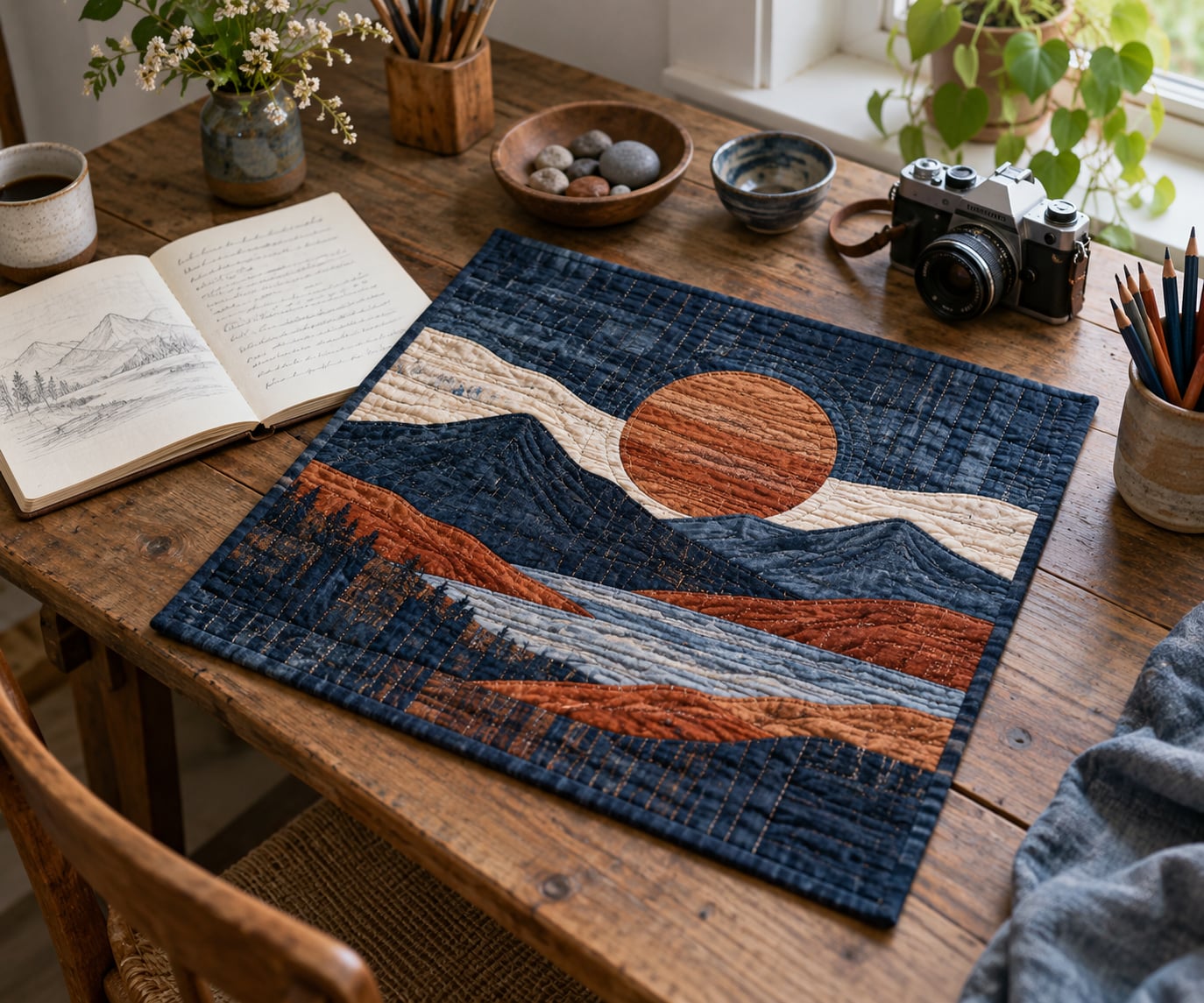
Here is a fictional piece so you can see the whole method in one place. The work is a quilted wall hanging: hand-stitched indigo cotton and rust-dyed linen, 90 by 120 centimetres, made from three panels that were cut apart and restitched slightly out of register.
Starting with the first impression, the description opens on fact: three wide bands of indigo cross the surface diagonally, and the lowest band runs past the stitched edge so a strip of raw linen shows. That is 24 words and it does all the work.
The material sentence adds only what carries meaning: pieced from hand-dyed cotton and linen, quilted in a single running stitch, then sanded back on the lower third so the surface breaks from smooth to open. Nothing about thread brands or hoop sizes.
The intent sentence stays tied to what came before: the misaligned seams are where the piece changes key, because the stitch was meant to hold things straight and here it visibly does not. That is a claim with a visible anchor, and it stops there rather than announcing what the misalignment symbolizes.
Total length: 96 words. That works as a listing, and the first two sentences alone work as a caption.
Common Mistakes
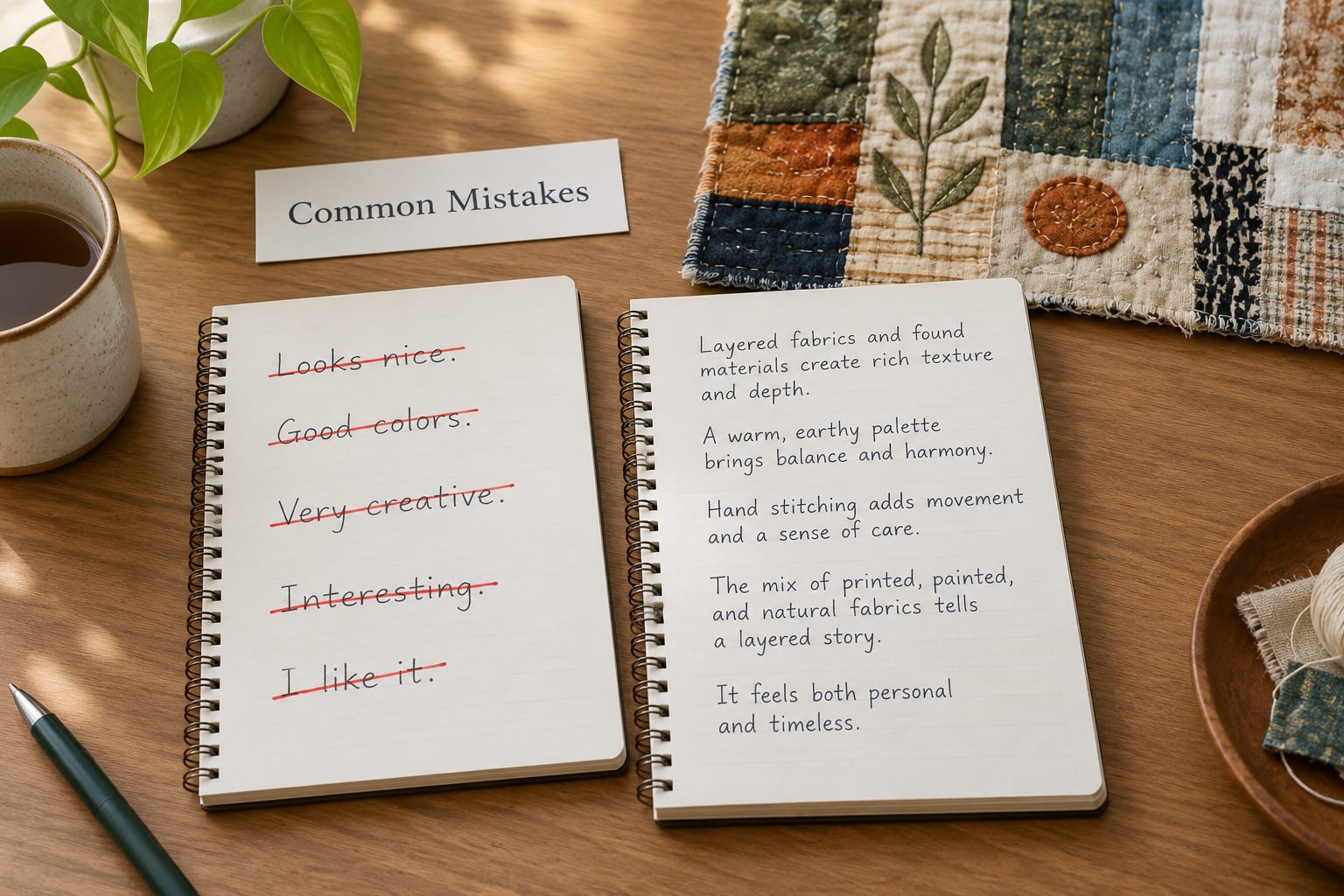
These six failures account for most weak descriptions I have read, and each has a straightforward fix. The table shows the weak phrasing beside a rewritten version.
| Weak phrasing | Strong phrasing |
|---|---|
| My painting is very unique and different from anything else. | The three panels are cut so the seams never quite line up, so the grid reads as almost-but-not-quite ordered. |
| I painted using various techniques and materials. | I laid a thin underpainting in three colours, sanded two of them back, and redrew the lost edges in charcoal. |
| This piece explores the human condition and our inner struggles. | I wanted to see how much structure a surface can hold before it starts to drift, so I let the seams go out of register on purpose. |
| The viewer will experience something deeply personal. | The lower third is rougher than the rest. People tend to look there first, and that is where I wanted their eyes to land. |
| It is inspired by nature and the beauty of the world. | The rust dye came from ironweed gathered along a ditch behind the studio. |
| This is a very experimental and innovative new direction. | This is the first piece where I let the fabric edges stay unfinished. |
Empty adjectives. Fix: replace each one with a measurement, a texture, an action, or a place. If you cannot, delete it.
Writing the process instead of the piece. Beginners often explain the hours spent rather than the object produced. Fix: cut the labour narrative unless it changed the result.
Undefined jargon. Fix: gloss every technical term in plain words or remove it. A reader outside your field is your default audience, not the exception.
Vague inspiration. Saying a work is inspired by nature or memory is close to saying nothing. Fix: name one specific thing, one place, one event, or one object. Specificity is the whole trick.
Claiming how viewers will feel. Promising an emotional response is unprovable and it reads as arrogance. Fix: describe what you built and let the viewer decide.
Writing only for experts. Fix: read the draft aloud to someone outside the arts. When they need a definition mid-sentence, add one.
Two smaller ones worth naming. Describing work you no longer feel close to is a normal late-career situation, and the same rules apply: stay with what is visible rather than borrowing a meaning you have moved past. And if you are not a native English speaker, write the first draft in your strongest language and translate last, rather than simplifying the ideas themselves.
Frequently Asked Questions
How do I describe my own art?
Describe it in three passes, in order: what the piece physically is (materials, size, marks, colour), how you made it, and what you think it is doing. Start with one concrete observation rather than an evaluation, because a reader needs something visible before any meaning can land. Write in the first person and stop each pass at the point where you can still point to something on the surface.
What is typically included in an artist statement?
Three things: how you made the work, what it looks like or contains, and what is at stake for you. In practice that means the materials and process, a description of the visible content, and your reason for making it. Keep it to 150 to 200 words for a gallery submission, write in the first person throughout, and leave out any claim you cannot support with something visible on the surface.
What are the most common mistakes in artist statements?
The usual four are empty adjectives like beautiful and interesting, lists of materials instead of a description, undefined technical jargon, and claims about how viewers will feel. A fifth is describing how you made it while forgetting what it looks like. Fix them in one pass: replace each vague word with a measurement, a texture, or an action, and delete anything you cannot point to on the work.
What is the 70/30 rule in art?
The 70/30 rule is a working guideline about balance. About 70 percent of a composition is the dominant, positive, or active element, and roughly 30 percent is negative space, rest, or counterpoint. Use it as a check rather than a formula, since plenty of successful work deliberately inverts it. If you want to describe a piece in these terms, name the dominant element and then name what the empty area is doing.
How long should an artist statement be?
Match the length to the use case. A social caption needs 20 to 40 words, an online listing 60 to 100, a portfolio introduction 100 to 150, a gallery submission 150 to 200, and curatorial text or a grant answer 300 to 500. Keep the internal order identical each time: concrete description first, process second, meaning last. Cut from the middle rather than the opening when you need to shorten.
Start With One Piece Today
Pick the piece you finished most recently and write three sentences about it tonight. One for what dominates the surface, one for the material and technique that shaped it, one for what you think it is doing.
Then read those sentences aloud. If a stranger could point at roughly the right spot on the wall afterwards, you have a description that works, and you can expand it to any length on the table above when you need to.