Short answer: yes, for most work you sell direct to collectors, and no for everything else. The question is really about which channel gets which number, not whether you own a public price at all. Working artists who publish clearly tend to get qualified inquiries instead of tire-kickers, while the ones who quote everything in private lose hours to conversations that never close.
That is the whole argument in miniature, and the rest of this guide is the detail underneath it: which works get a number, which get a band, which get a quote, how to keep the same piece from reading as two different values, and what to say when someone asks for a discount.
Table of Contents
- Should Art Prices Be Listed Publicly? What to Consider
- List price vs. price on request vs. quoted price
- What Are the Main Reasons Artists List Prices
- Originals, editions, prints, and commissions behave differently
- When Public Pricing May Not Be the Best Choice
- How to Decide Which Works Should Have Public Prices
- When should art prices be listed publicly for editions and prints?
- How to List Art Prices Without Giving Away Too Much
- A channel-by-channel recommendation
- Phrasing that does not sound evasive
- How to raise a price that has already been public
- What Should You Include With a Public Price
- How to Handle Questions, Offers, and Commissions
- When someone asks for a discount
- When someone asks what your costs were
- When someone finds the same work cheaper elsewhere
- When someone wants a custom piece
- Frequently Asked Questions
- Should artists list prices on their websites?
- Do public art prices help sell more work?
- Should artists list a price range instead of exact prices?
- How should artists handle commission pricing?
- Should collectors expect to negotiate an artwork’s listed price?
- How do taxes, delivery, and framing affect the listed price?
- Conclusion
Should Art Prices Be Listed Publicly? What to Consider
Should art prices be listed publicly? The direct answer is that published prices work best for originals, prints, and anything with a repeatable specification, and that quotes work best for custom work, large installations, and pieces whose cost changes with the buyer. Neither model is the professional one. They are just different tools for different shelves.
A published number does three things at once. It qualifies the buyer before they write to you, it sets the anchor for the conversation, and it creates a written record of your asking point. Hiding the number does not remove the negotiation. It moves it into a channel where you have less leverage and where the buyer cannot tell whether the piece is a fair buy.
List price vs. price on request vs. quoted price
| Model | What it signals | Who it suits | Main risk | Best use |
|---|---|---|---|---|
| List price | Professional, established, confident | Artists with a repeatable product line | Anchors low if the number is wrong | Originals, prints, editions, shop inventory |
| Price band | Transparent without boxing you in | Series work at similar sizes | Reads as vague if the basis is not stated | Small series, wall groupings, online galleries |
| Price on request | Curated, possibly exclusive | High-demand or gallery-contracted work | Reads as gatekeeping or uncertainty | Solo show work, one-off large pieces |
| Quoted per project | Professional services practice | Commissions, murals, corporate clients | Scope creep and unpaid revisions | Custom pieces and design clients |
One phrase deserves a warning. “Price on request” is not mystery. On a well-run shop it filters for serious buyers who want to spend an afternoon on a conversation rather than an afternoon on a purchase. On a thin site it reads as someone who has not decided what the work is worth. The difference is entirely in what surrounds the phrase.
What Are the Main Reasons Artists List Prices
Transparency is not a moral virtue here. It is a time-saver with a measurable effect on how many inquiries turn into real conversations.
First, a price qualifies the buyer. Someone who already knows the number is not going to email you asking what it costs, which means the first thing you learn about them is what they actually want to know.
Second, a published number saves you the same explanation twelve times. Over a season that adds up to more hours than most artists budget for, and it is the kind of invisible labor nobody notices until it stops happening.
Third, collectors need a band before they commit time. Someone considering a textile wall piece for a stairwell is not going to book a consultation for a piece they suspect is priced like a poster. Knowing the range first is what makes the appointment worth their afternoon.
Fourth, comparable pricing helps a serious collector buy. Somebody assembling a group of five pieces for one wall wants to see how your work relates across sizes, and a public list makes that comparison possible without a spreadsheet of email replies.
Fifth, consistency makes you easier to trust. In a comment thread on r/artbusiness, newer artists described exactly the anxiety this solves: no published number means no accountability, and no accountability means every quote starts from zero.
Originals, editions, prints, and commissions behave differently
Originals and one-of-one pieces are the easiest to publish because the value is attached to one object with known dimensions and materials.
Limited editions need one extra line: the edition number. Buyers of editions care more about scarcity and size than they do about medium, so “Edition of 25, number 4, 16 by 20 inches” does more selling work than a paragraph about process.
Prints and digital files are almost always a published price. The buyer knows what they are getting, the file or paper size is fixed, and there is nothing to quote individually unless you offer custom framing on top.
Commissions are the reverse. The top answer in an r/graphic_design pricing thread was blunt about the distinction: you do not publish a price for custom work, you send a quote, because every project is different. That logic transfers straight to custom painting and textile commissions.
When Public Pricing May Not Be the Best Choice
Some work is genuinely better held back. Not out of secrecy, but because a number is only useful if it stays true.
Works with variable costs are the clearest case. A piece priced by the square foot behaves very differently at 20 by 24 inches than at 20 by 60, and a single number on a series that spans both is misleading even when you mean it kindly.
High-demand series should stay unpublished until you can control the channel. Once a work sells out at a number you set publicly, that number becomes the reference point every later collector measures against, and it stops being yours to move.
Gallery-contracted work is a legal question, not a preference. Many consignment agreements govern how prices are displayed and who sets them, so check your agreement before you list anything the gallery is showing.
Small editions held at a very low number can also do damage, because the anchor is permanent. A single original at one end of a scale teaches the market what you charge before they see anything above it.
Then there is the risk nobody enjoys thinking about. Public listings and images get copied. A written ask of a nonexistent buyer, a demand to pay by wire, a insistence on a third-party carrier: those patterns show up again and again in artist comments on artsyShark, and the same threads make the point that a public listing with a stated price and availability is also what gave those artists a paper trail to check against.
The useful conclusion is not that visibility is safe. It is that hiding and verifying are not the same thing, and verification habits solve more fraud than obscurity does.
How to Decide Which Works Should Have Public Prices
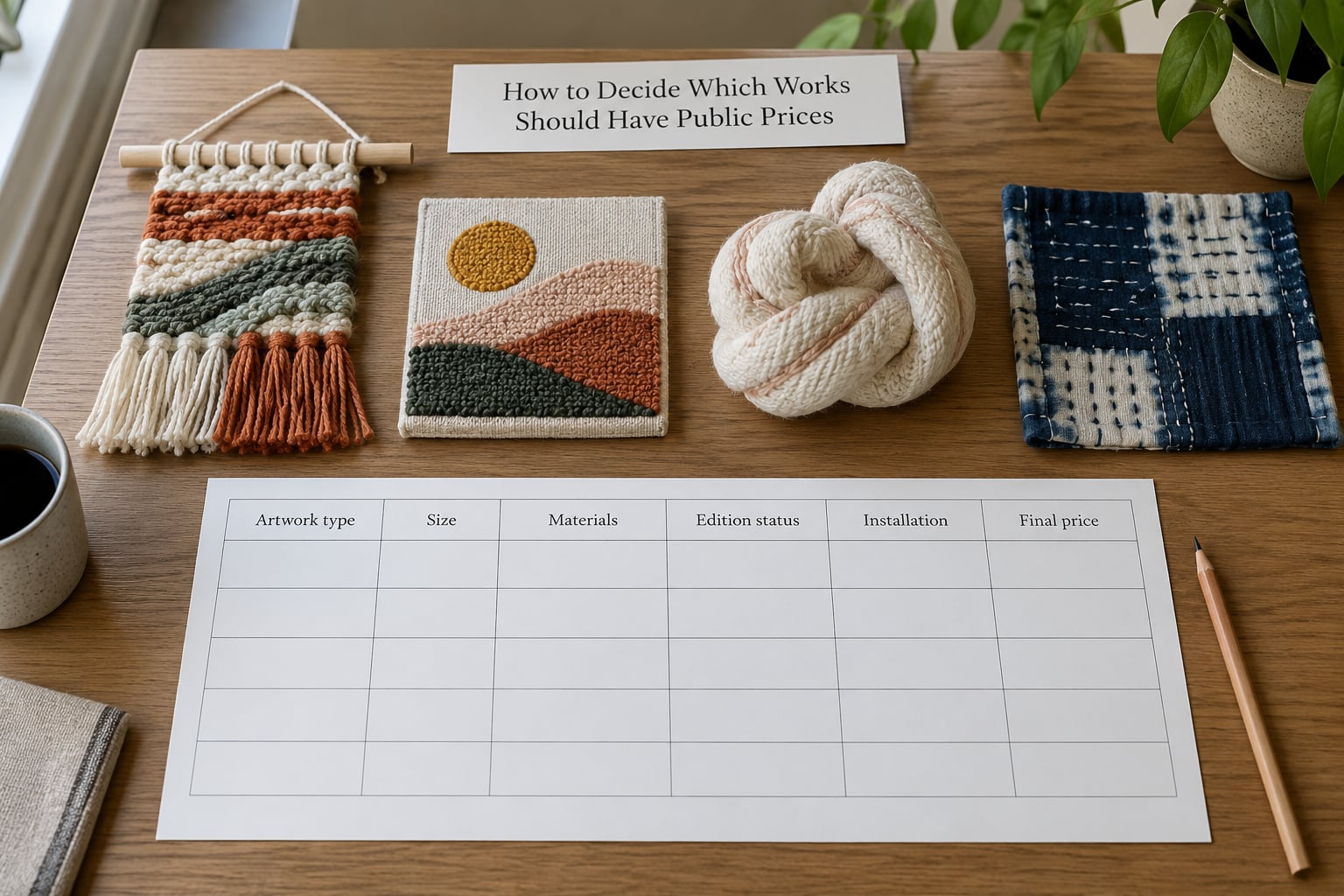
Work through six questions per piece or per series. If four of the six come back stable, publish the number. If they come back mixed, publish a band instead.
When should art prices be listed publicly for editions and prints?
Publish as soon as the specification is fixed. Edition size, paper or format, dimensions, and framing options settle the cost, and a settled cost deserves a published number. The remaining variables are terms, not price.
Step one, identify the product type. Original, edition, print, digital file, and custom commission each get a different policy, and mixing them in a single shop page is the fastest way to confuse a buyer and lose a sale.
Step two, check whether the price will still be true in six months. If your material costs swing, if the piece takes twenty hours or three, or if the edition size is still shrinking, you do not have a number yet. You have a guess.
Step three, look at installation. Anything that needs a site visit, a custom frame, hardware, or a crew is priced per project, not per shelf.
Step four, count your channels. One place to publish means a price. Four places means a price plus a written policy for how it changes.
Step five, write the number down before you publish it, with the basis in one line. “Sized at 16 by 20 inches, framed, unframed is 120 less” tells a collector more than the number alone.
Step six, pick the raise schedule before the sales start, not during your first quiet month.
How to List Art Prices Without Giving Away Too Much
The goal is never to hide the number. It is to publish the number plus the terms that make it mean something, and to keep those terms identical everywhere the work appears.
A channel-by-channel recommendation
| Channel | Recommended | Why |
|---|---|---|
| Your website | Exact price, or a band with a stated basis | The one place a collector checks before writing to you |
| Instagram and other social | Exact price on available work | The feed is where the buying happens, and a caption survives a scroll |
| Etsy and other marketplaces | Exact price, always | Platforms built around the number, and they penalise vagueness |
| Gallery or consignment | Whatever the agreement allows | Terms first, and check the contract before the website |
| Art fair booth | Exact price, plus a printed list at the back | People need time to look, and the list ends the haggling |
| Commission and client work | Quote per project | Scope drives cost, so a public number would be fiction |
Channel parity is the rule that prevents trouble: the same piece should not read as a different value on your site, in your caption, and at your booth. Drift happens quietly, and the first person to notice is usually the person you least want to hear it from.
Phrasing that does not sound evasive
If you must hold a number back, write the reason into the line. “Price on request for this series” is neutral. “DM for price” reads like a sales tactic, and “email for pricing” gives the impression that the price is a secret rather than a conversation.
For editions and prints, the better move is a band with its basis written down: “8 by 10 inch prints, 90 to 140 depending on edition and framing.” That is more useful than a single number and it still reads as confident.
How to raise a price that has already been public
Raise at the natural break, and say so out loud. Prices usually move between seasons rather than mid-show, because a piece that changed price three weeks after you posted it looks like a reaction rather than a policy.
Keep old sold work at the price it sold for, with a sold or archived mark. That archive becomes your record of where you have been, which is more persuasive to a collector than any statement about how much your work has grown.
Never discount a public number to move a single piece. Lower one piece and you have taught every collector on your list to wait for the sale, which is the opposite of what a public price is for.
What Should You Include With a Public Price
A number alone makes the buyer guess. These additions cost you nothing and each one removes a reason to walk away.
- Currency and tax status. Say whether the figure includes sales tax or whether that is added at checkout.
- Dimensions and medium. Size drives perceived value more than almost anything else in a textile or mixed media piece.
- Edition status. Edition size, the piece’s number, and whether it is the last one available.
- Availability. Available, on hold, or sold. This is the single most useful line on a listing.
- Framing. Whether the price includes a frame, and what upgrades cost.
- Delivery terms. Who arranges transport, who insures it, and roughly how long it takes. Never a guarantee, always a range.
- Payment terms. Deposit, balance, and when payment is due.
- What is not included. Installation, hanging hardware, or site visits, if those cost extra.
A listing line that works: “Torn silk and hand-stitched cotton, 22 by 34 inches, framed in walnut, 640, unframed 585, plus local sales tax. Ready to ship, signature required on delivery.”
A gallery inquiry line that works: “Thank you for asking about the ladder series. The pieces are 340 to 480 depending on height, framed, and each is one of a kind. I can hold one for you for seven days while you decide. Would you like images of the two smaller ones in a room setting?”
Notice what both lines do. They carry the number, the basis for the number, and the next step, all in a form the buyer can answer.
How to Handle Questions, Offers, and Commissions
Most price trouble is not haggling. It is vagueness, in either direction, and it goes away once your terms are written down.
When someone asks for a discount
Say no, and say it the first time without softening it. A price that visibly moves after one email teaches the buyer your number is a starting position, and it teaches every other buyer the same thing.
“The listed price is the price. If it helps, I can offer payment in two installments.” That gives the buyer something real to say yes to without moving the number.
When someone asks what your costs were
You do not owe a cost breakdown. Materials, studio time, and market rates are not secrets, but the invoice to your own suppliers is not part of the conversation. “I price from size, materials, and hours in the studio” closes it politely and completely.
When someone finds the same work cheaper elsewhere
Check whether it is the same object before you react. Prints get listed at different prices by different sellers legitimately, and an original resold by a previous owner at a different number is not your problem.
Where it genuinely is your work, one calm explanation beats an argument. Editions have a set price, originals are one of a kind, and your terms are consistent across your own channels. If a marketplace listing of yours undercuts your site, fix the listing rather than the site.
When someone wants a custom piece
Quote in writing, in writing you send immediately after the call. State what is included, what counts as a revision, how many revisions, what the deposit is, when the balance is due, and whether the piece is yours to photograph and list.
That last line gets skipped by almost everyone, then gets remembered the moment a commissioned piece sells twice. Commission terms differ from sale terms and should be written as such.
On the math, be clear-eyed about the split. A gallery taking half means your site number and the gallery’s number are not the same transaction, and pretending otherwise is how channel conflict starts.
Frequently Asked Questions
Should artists list prices on their websites?
For most direct sellers, yes, at least on your own site. Published prices for originals, editions, and prints filter out casual inquiries and stop you repeating yourself. Hold back only where the cost genuinely varies per buyer, such as custom commissions, large installations, or work under a gallery contract that governs pricing.
Do public art prices help sell more work?
They usually help, though nobody publishes a clean number on this. What changes is the quality of the inquiry: people who already know the range come to a conversation ready to decide, while people who cannot tell if the work is in their range never write at all. Expect fewer messages and a higher share of them that go somewhere.
Should artists list a price range instead of exact prices?
A range is the best middle path when a series varies by size or edition. Publish the range and the rule behind it, such as 90 to 140 depending on edition and framing, so the buyer can place themselves in it without asking. A range with no stated basis reads as evasion rather than flexibility.
How should artists handle commission pricing?
Quote per project rather than publishing a number, because scope drives cost. Send the quote in writing straight after the consultation, covering what is included, how many revisions are included, the deposit, when the balance is due, and whether you may photograph and list the finished piece. Include that last clause from the start.
Should collectors expect to negotiate an artwork’s listed price?
A listed price is treated as final, and holding that line is what makes public pricing work. Discounting one piece teaches everyone on your list to wait for a sale. If a buyer needs help, offer something that does not move the number, such as splitting payment into two installments or holding the piece for a set period.
How do taxes, delivery, and framing affect the listed price?
State each one explicitly so nobody has to reconstruct it. Say whether sales tax is added at checkout, whether the price includes a frame and what upgrades cost, and who arranges transport and insurance. Framing usually moves the number most, so publish framed and unframed prices together rather than listing one and hoping.
Conclusion
Should art prices be listed publicly? Publish them for everything with a fixed specification and a repeatable cost, use a stated band for series, and quote individually for custom work. What makes public pricing work is not the number itself but the terms wrapped around it and the discipline to keep the same price in every channel.
Start with one page this week. Write down your six answers for a single series, publish the terms beside the number, and decide your raise schedule. Then hold the line, because a price that stays put is the only pricing tool you own.