Yes, you can sell art without social media, and plenty of working artists never post at all. The key is to use channels that already have buyers in them: art fairs and local venues, marketplaces that bring their own traffic, and direct relationships with collectors, curators and businesses.
Most artists trying to sell art without social media fall into one of three groups:
- Selling locally and in person through markets, group shows, cafe and brewery walls, and consignment shops, where you keep most or all of what you sell.
- Using marketplaces that supply their own traffic, so buyers come to the listing instead of the other way around.
- Selling direct to collectors, through an email list, a portfolio page, and steady outreach you control from start to finish.
That last group is the one that compounds. Everything else gives you a single afternoon of sales.
The honest version: this takes longer at the start than posting does, and it takes more admin. What you get back is a sales system that keeps working on a week you are not making anything.
Table of Contents
- What You Need
- Step-by-Step: How to Sell Art Without Social Media
- How to sell art without social media through galleries
- Build a portfolio page that works without a social audience
- Use art marketplaces as a practical discovery channel
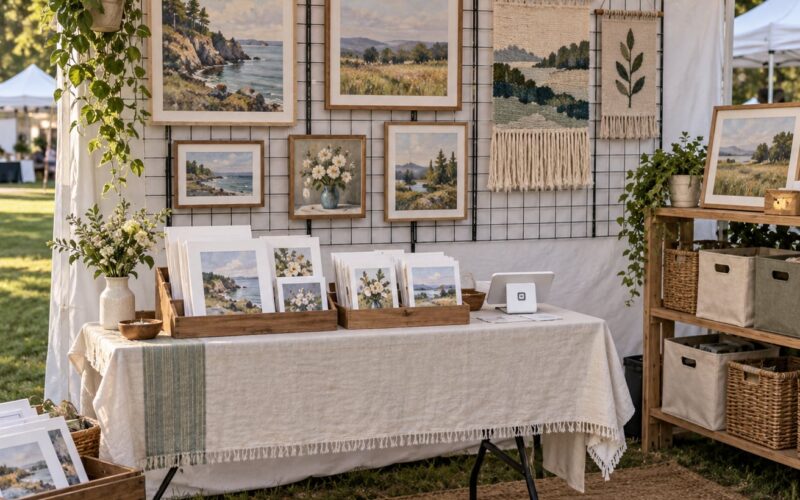
- Prepare for art fairs and local group shows
- Contact collectors, studios and businesses directly
- Make every inquiry easy to turn into a sale
- Package, deliver and document the sale
- Common Mistakes
- Frequently Asked Questions
- Do I need a website to sell art without social media?
- What is the best place to sell art when I have no social following?
- How should I price my art when selling without social media?
- How do I find art collectors without using social media?
- How should I pack and deliver quilts and mixed-media artwork?
- Conclusion
What You Need
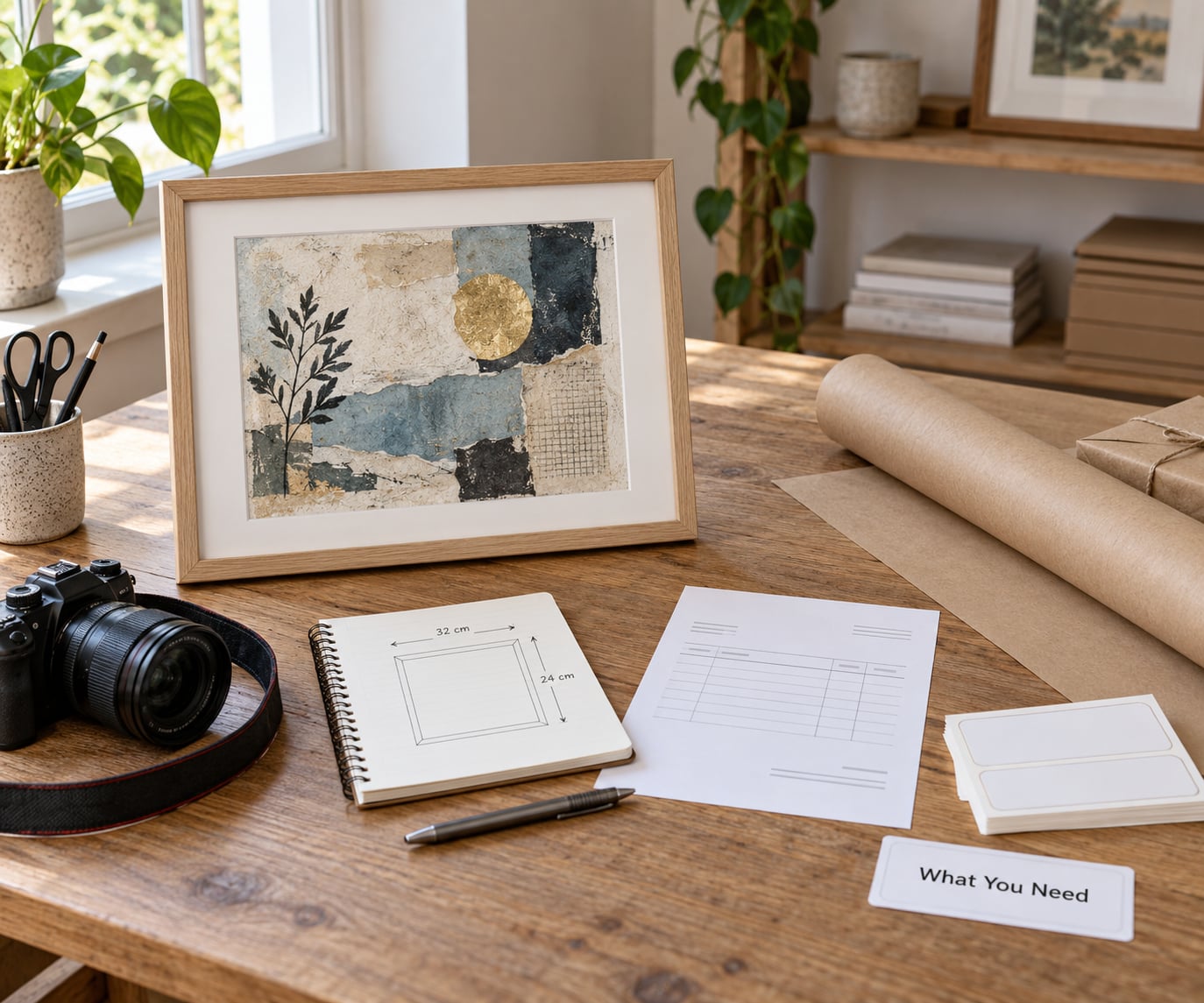
You do not need a large catalog. You need a small amount of finished work that is accurately recorded, clearly photographed, and honestly priced.
- A sellable body of work. Six to a dozen finished pieces is enough to start. Unsold work in a closet is not inventory until it is photographed, measured and priced.
- One artist statement. Three sentences you can paste into any application or email without rewriting it.
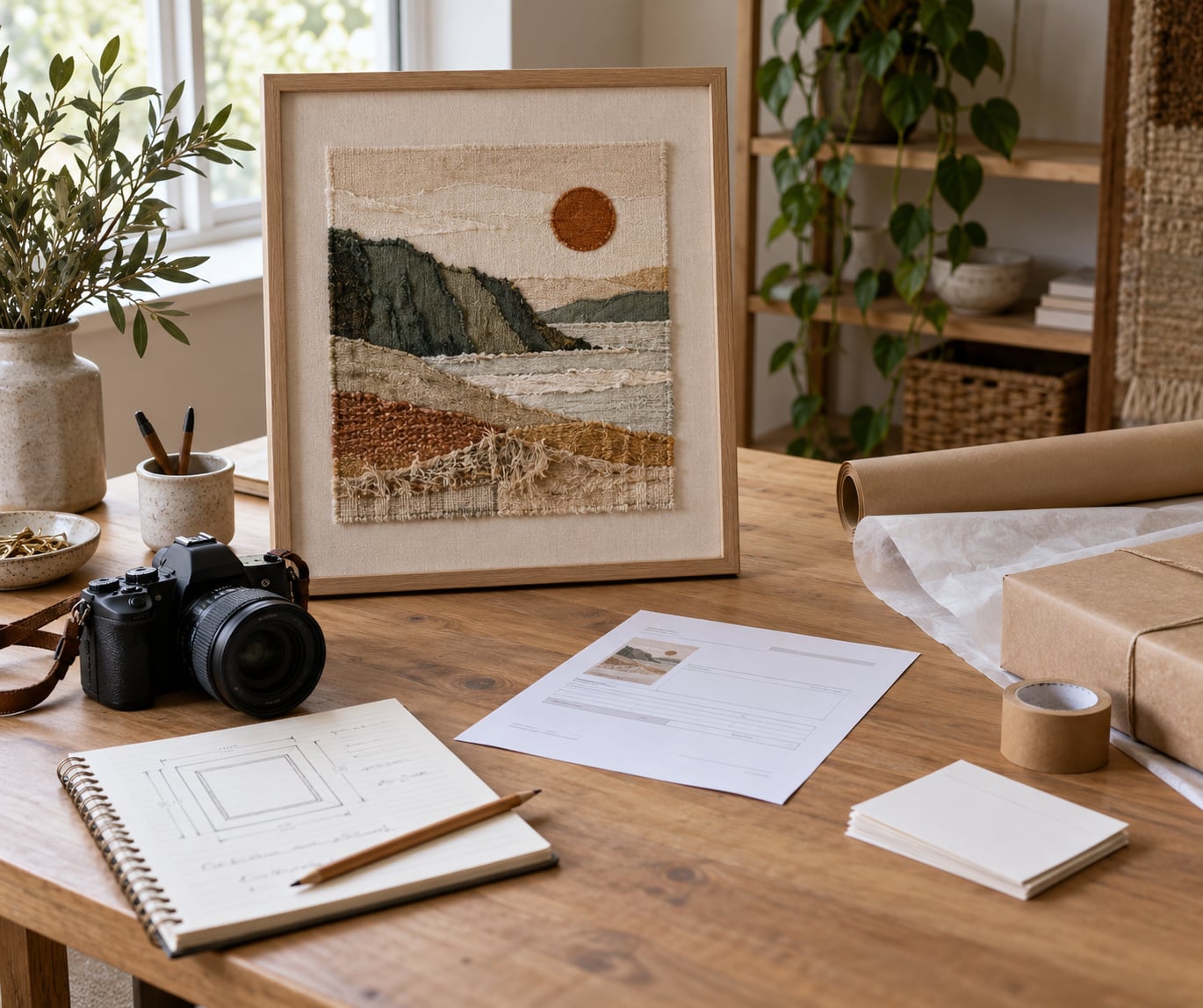
- Accurate records for every piece. Title, medium, dimensions, year, materials, edition size. Write this once, carefully, because wrong dimensions cause returns.
- Good images. One full shot straight on, one detail shot, and one shot in a room where you can judge scale.
- A pricing method and a written price list. Numbers on paper, so you quote the same figure in person, in email and on an application.
- Payment and delivery procedures. How you take money, what you issue as a receipt, and who pays delivery charges.
- Packaging matched to your medium. Glassine and tape for drawings, a proper case for framed work, a plastic tote in the rain for textiles.
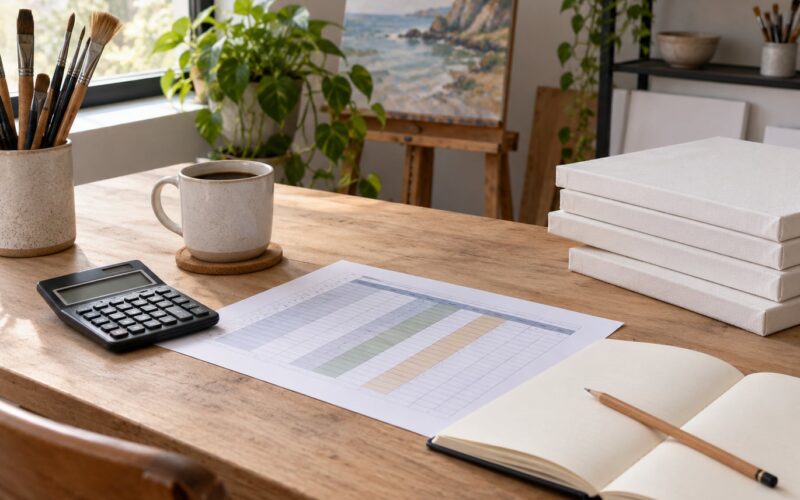
- A contact system. A dedicated email address and a spreadsheet or folder where every name you meet goes.
Artists who skip the records part regret it. A buyer who receives a piece with one missing dimension remembers that when they decide whether to buy a second.
Step-by-Step: How to Sell Art Without Social Media
Here is the whole process in nine steps. Before you start, it helps to see the channels side by side, because the difference in commission and in repeat-buyer potential is larger than most people expect.
Where to sell art without social media at a glance
| Channel | Upfront cost | Commission | Effort to first sale | Repeat-buyer potential |
|---|---|---|---|---|
| Art fairs and markets | Booth fee plus travel | You keep nearly all of it | Medium, one event to three | Good, if you collect names |
| Group shows and open calls | Entry fee, sometimes entry plus a hanging fee | Varies by organiser, ask in writing | Low to medium | Good through the organiser’s list |
| Consignment shops and cafe walls | Usually none | Commonly 30 to 60 percent to the shop | Medium, depends on footfall | Moderate |
| Open marketplaces | Listing and transaction fees | Listed percentage per sale | High, you supply the traffic | Low |
| Curated art marketplaces | Membership or application | Higher percentage, higher visibility | Medium to high | Low to moderate |
| Gallery representation | Mostly none, sometimes a production cost | Traditionally half, often 70/30 | High | High, they introduce you to collectors |
| Direct outreach to collectors | Time only | None | Slow, then steady | Highest |
| Local businesses and studios | Frames or prints supplied by you | You agree a rate, often half | Medium | High if the wall stays up |
| Email list and portfolio page | Small monthly hosting cost | None | Slowest to start | Highest |
Percentages vary by venue, city and agreement, so treat these as working ranges and confirm the current terms in writing before you commit.
Step 1: Pick one positioning. Decide what you make and for whom in a single sentence. “Small stitched landscapes for people furnishing a hallway” is a positioning. “Art” is not. Success check: a stranger could read your statement and roughly guess what hangs on their wall.
Step 2: Get the work ready to sell. Photograph everything, measure it, list the materials, and write the artist statement once. Success check: you can answer any question about any piece without checking.
Step 3: Set prices and write them down. Choose one method and apply it to every piece. A common approach for makers is to price by materials and studio hours, then add a margin for framing, packaging and delivery, then round to a clean figure. Success check: you can quote a price instantly and defend it in one sentence.
Step 4: Choose two channels, not eight. Pick one offline venue and one owned channel, then give both real attention. Spreading yourself thin across five half-run channels is the most common way this stalls. Success check: you can name your two channels without hesitating.
Step 5: Build a contact list you own. Every name, every email, every follow-up date, in one place. Success check: you could hand the file to someone else and they could take over.
Step 6: Contact curators, collectors and businesses. Short, specific, one ask. Success check: a response rate you can measure rather than a vague feeling.
Step 7: Make every inquiry easy to close. Fast replies, clear specifications, one clean next step. Success check: nobody has to ask you twice where things stand.
Step 8: Complete secure transactions. Written agreement, tracked delivery, insurance where the value warrants it, and a condition record. Success check: you can reconstruct the sale from your files a year later.
Step 9: Follow up after every sale. A thank-you note, a delivery confirmation, a nudge for reviews or referrals, and the next sale offer. Success check: your repeat rate is something you can quote.
Those nine steps work everywhere. The rest of this section is the detail on the channels that carry the most weight.
How to sell art without social media through galleries
Gallery representation is the slowest door to open, but it is the one that puts your work in front of people who already buy art. Research first. Look at what a gallery actually shows, not at its website language, and target places whose roster overlaps with your medium and price range.
Submit concisely: five to ten images, a short statement, dimensions and prices, and a CV with any exhibitions or collections. Ask directly what the commission and consignment terms are before you discuss anything else.
For textile and mixed-media work, a good example is a gallery that represents contemporary fibre and collage artists in your region. You would write to the director, mention that you saw a specific exhibition there, attach a small PDF, and ask whether they review submissions from artists outside the region. Keep it under fifteen lines.
Ask these in writing and get the answers in writing: commission percentage, who insures the work, what happens to unsold work and when, how long the arrangement runs, whether you can exhibit elsewhere, and how the gallery handles a sale after the term ends.
Keep your own inventory sheet current. Galleries cannot represent work they cannot locate, and a duplicate listing in two shows is an avoidable argument. Success check: every piece you have placed is marked with its location and date.
Build a portfolio page that works without a social audience
You do not need a complicated site. You need one page a collector can land on from a search result and understand in under a minute, and that page has to load properly on a phone, because most people will arrive there from an email on a phone.
Organise it around work that is available. Each listing should show the title, medium, exact dimensions, price, edition information where relevant, and a clear way to ask about it. Put your best six to ten pieces at the top rather than your entire archive.
Add a short about section, a way to see prices without a login, and a contact form that asks for name, email and which piece they are asking about. That last field alone doubles how useful your inbox becomes.
Offer a downloadable PDF for people who prefer email. Name the file with your name and medium, not “portfolio-final-v3”, and keep it current. A stale PDF is worse than none.
Success check: you can send one link in an email and a stranger can tell what you make, what it costs and how to reach you.
Use art marketplaces as a practical discovery channel
Marketplaces fall into three useful groups. Open marketplaces give you volume and near-total competition. Curated platforms review submissions and offer more visibility in exchange for a higher percentage and often a membership fee. Local online directories and curated shop walls put your work in front of people in one city, which is usually where repeat buyers live.
Each suits different work. Open marketplaces handle prints, small paintings and digital downloads, where search filters do the discovery. Curated platforms suit coherent bodies of work where presentation matters more than volume. Local directories suit anything you can deliver by hand.
Check the tradeoffs before you list. Fees change, and platform terms change with them, so read the current fee and return policy rather than trusting a blog post, including mine. Then weigh three things: how much of the sale the platform takes, how much control you keep after the sale, and who handles delivery damage.
List a small number of pieces well instead of forty pieces badly. Ten strong listings with accurate dimensions and honest descriptions will outperform forty thin ones, because thin listings get buried and bad descriptions generate returns.
Success check: your first listing is live with complete details, and you know the current commission figure without guessing.
Prepare for art fairs and local group shows
Local events remain the most reliable offline route, and the practical details are where most first-timers get caught out. Find events through organiser directories and local arts council listings, and check the submission requirements early: entry deadline, hanging fee, insurance requirements, size limits, sales commission, and whether the organiser handles payment or you do.
Price consistently across every event. A collector who sees two different prices for the same piece will assume something is wrong with it.
Display dimensions and materials plainly, and hang the strongest work at eye level. A label is enough: title, medium, size, price, and a card or QR code that opens your page or your email list signup.
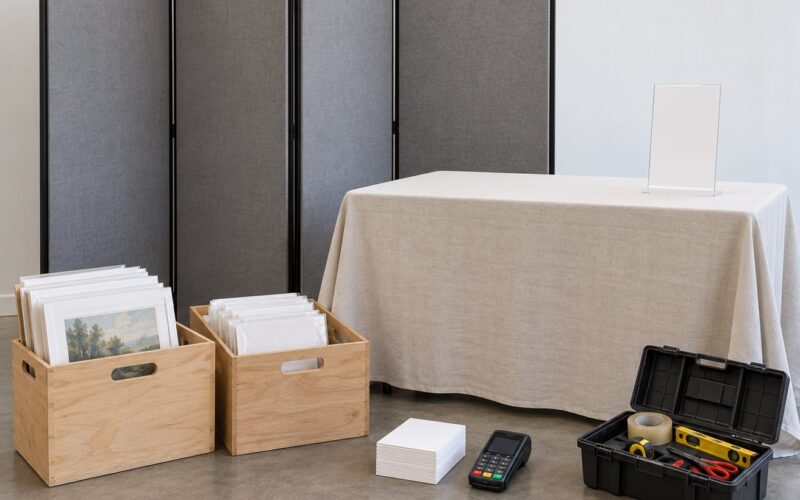
Take safe payments: a card reader or a card machine that issues a receipt, plus an invoicing option for larger pieces. Keep a duplicate of every receipt.
Follow up with serious collectors within a day or two, while the visit is still fresh. A short note with the piece they liked and a link is enough.
A booth conversation sounds like this: they mention liking a small stitched piece, you say it is one of six in that series and offer to send the details of the series rather than pushing the one in front of them. Then you write the follow-up the next day.
One caution: expensive events are a gamble. Try a smaller local market or a group show first and see how the work actually behaves in front of people before committing to a big booth. Success check: you have sold or offered at least one piece in person and recorded what people asked about.
Contact collectors, studios and businesses directly
Direct outreach is how to sell art without social media and still build something you own. The message is short: who you are, one link, the reason you are writing to this particular person, and one clear ask.
Here is the shape of one:
Hello, I’m Josiel, a textile and mixed-media artist working from [your town]. I saw that [studio or business] recently opened a second wall, and the pieces you showed there are the kind of work I make in a similar scale. My portfolio is here: [link]. I’m looking for two or three local spaces to show work this winter. Would you be open to a short conversation about what that would involve? Either way, thank you for reading.
Keep tracking in your contact sheet: name, date, channel, what you offered, what came back, and when you will follow up. One follow-up is reasonable. A third email is noise.
Local buyers do tend to pay more for an artist they can find in their own city, and a business owner who has met you is not browsing a catalogue. That is the whole advantage of this route, and it takes a few dozen conversations to see it. Success check: you send a small number of specific messages and log every one.
Make every inquiry easy to turn into a sale
Reply quickly, even if the answer is “not available, but I have something similar.” Confirm availability before you talk about anything else, then give the dimensions, medium, materials and price in one message.
Answer the question that was actually asked. If someone asks whether a piece will fit a specific wall, answer with measurements rather than adjectives. If the work is commissioned, talk about size, materials and a written scope first, and be careful with delivery dates until you know what is realistic.
Send a written receipt for every sale, including the piece, the agreed price, delivery responsibility and the condition it left in. For higher-value work, a short signed agreement protects both of you and reassures a nervous buyer.
A time-limited hold is useful in a small, honest way: offer to hold a piece for a few days while someone decides, and say plainly what happens after that. Artificial pressure reads as pressure. Success check: every inquiry ends with a clear next step and a date.
Package, deliver and document the sale
Preparation is what stops a sale turning into a complaint. Framed work travels with glassine or acetate over the face, corner protectors, and a rigid outer box. Quilted and stitched pieces go in a clean plastic tote or a purpose-made bag, never bare cardboard that lets in damp. Wooden panels and stretchers need corner protection and a rigid wrapper.
Mixed media with beads, wire, or anything that can snag gets a tissue-paper layer first. Nothing decorative touches the face of the work.
Use tracked delivery and insure the piece for its full value when the value warrants it. Photograph the piece before it leaves and again on arrival if there is any doubt, and note its condition in the receipt.
Get the item right. An original, a numbered print and a reproduction are three different products, and shipping the wrong one is the most common and most expensive mistake in this business. Editions need their number and edition size on the paperwork.
Local hand delivery is worth offering for framed or textile work. It removes the damage question entirely and buyers often accept a slightly lower figure for it. Success check: every sale has a receipt, a delivery record and a condition note.
Common Mistakes
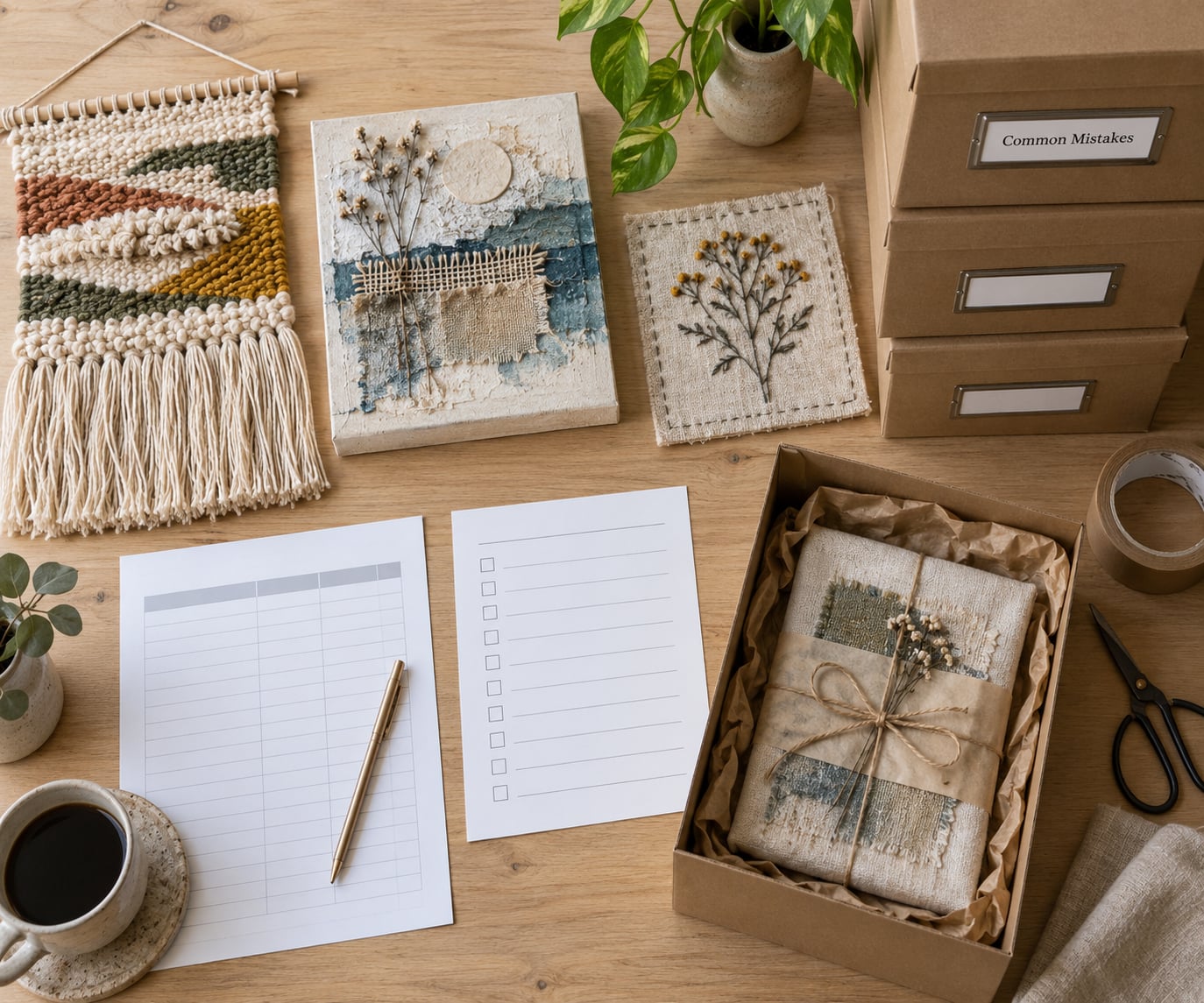
Most stalled art businesses are not stalled because of talent. They are stalled because of one of these habits.
Waiting until the work is perfect. It never arrives, and the pieces that sat in a closet for two years are the ones buyers ask about. Finish a body of work, list it, and let the market tell you what to make next.
Pricing every piece differently. If two similar works have prices that make no sense together, buyers notice and assume the higher one is inflated. Set a method, apply it, and only change prices when the method changes.
Relying on one channel. A single consignment shop can go quiet for a month and leave you with nothing. Two offline venues plus one owned channel is a sensible base.
Sending mass emails. Blasted inquiries to forty unrelated businesses get deleted and can damage a name. Twenty careful ones get replies.
Underselling the story. Buyers in shops say again and again that they want provenance and process, not just a wall space. One paragraph about why the piece exists, included, is worth more than another five works on the wall.
Neglecting follow-up. The buyer who asked a question and got silence simply goes to the next artist. This is where most quiet sales are lost.
Using poor images. A yellow photograph of a painting on a floor loses the sale before it starts. Natural light, a straight-on shot, and no filters.
Skipping receipts and records. A spreadsheet with the piece, buyer, price, date and destination protects you at tax time and during any dispute.
One more, specific to selling offline: consignment walls and craft fairs can fill with cheap prints and imported reproductions, and shoppers have told me they are tired of guessing what is handmade. Say plainly what you made and what the materials are. That sentence does more for you than any display trick.
To keep momentum, work in a rhythm rather than in bursts. Batch your packaging supplies, photograph a set of pieces in one session, and put a date in the calendar for outreach. If a piece has not moved in four to six months, retire it, repaint it or hold it for an annual studio sale, the way a painter I know did after a shelf of work stopped moving.
Frequently Asked Questions
Do I need a website to sell art without social media?
No, but a simple one helps. Offline sales, consignment and group shows need no website at all. What a site does is give an interested buyer somewhere to look after they meet you, with dimensions, medium, price and the series around the piece. A single page that loads on a phone is enough to start, and you can add pages later as you find out what people actually ask you.
What is the best place to sell art when I have no social following?
Local venues are the practical answer for most artists starting with no audience: art fairs, group shows, consignment shops and cafe or brewery walls, where you typically keep everything or hand over a third to a half. Marketplaces with built-in traffic are the second choice, since buyers come to them rather than the other way round. The best answer is one offline venue plus one owned channel.
How should I price my art when selling without social media?
Choose one method and apply it consistently. A common method is materials plus studio hours, plus a margin for framing, packaging and delivery, then rounded to a clean figure. Keep a written list so the number you quote in person matches the number on your site and in an application. Without a following, consistency and a clear explanation of the materials are what justify the price.
How do I find art collectors without using social media?
Collectors are found in rooms and in inboxes, not feeds. Go to group shows and fairs, bring a card or QR code for an email signup, and log every name with a follow-up date. Approach local studios, cafes, salons and small hotels with a specific offer. Then send short notes from your list every few weeks. One visitor who leaves with your email is worth more than a week of posting.
How should I pack and deliver quilts and mixed-media artwork?
Wrap stitched and quilted work in a clean plastic tote or purpose-made bag so damp never reaches the fabric, and never lay cardboard directly on the surface. Add tissue over anything with beads, wire or loose texture so it cannot snag. Use tracked delivery, insure higher-value pieces, photograph the work before it leaves, and note its condition in the receipt.
Conclusion
Start smaller than feels reasonable. Pick three pieces you could sell tomorrow, write one price for each, take three good images of each, and send one message to one gallery, one group show or one local business that fits your work.
Then do the same next week. Learning how to sell art without social media is not about finding the perfect channel, it is about having a small, reliable system you repeat: one venue, one list, one set of records, and a follow-up note after every sale.