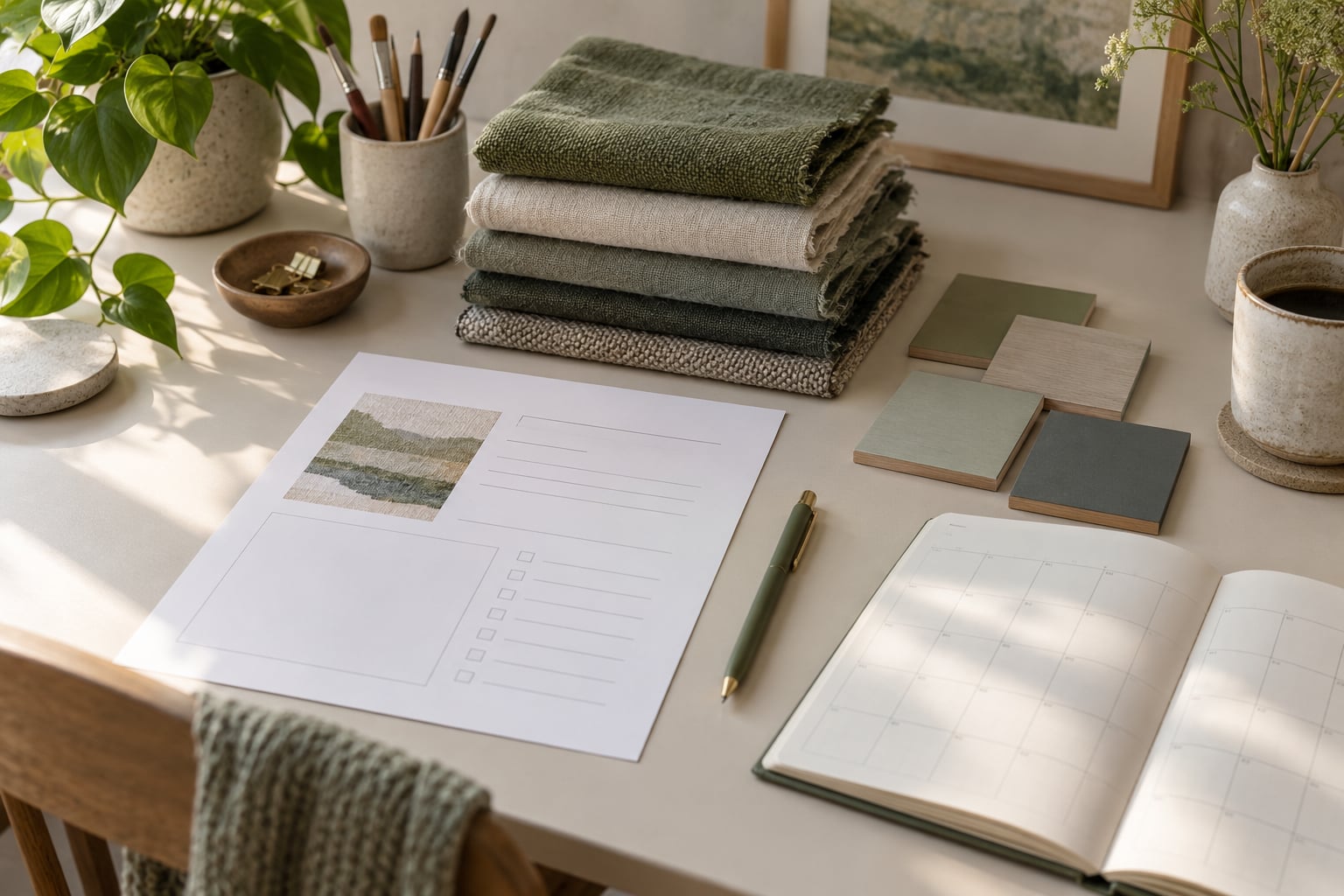
Interviewing a commission client means running one structured conversation, before you accept the job, to pin down what they want, how the project runs, what it costs, and whether the fit works for both of you. It is the step most artists skip, and it is the step that separates a project you enjoy from one you quietly resent. For textile and mixed-media artists taking paid custom work, the whole process takes about 45 minutes if you prepare it properly, and it works the same way for illustrators, designers, photographers, and writers.
Most difficult commissions are not caused by weak art. They are caused by vague scope, and scope gets vague because nobody asked. A good interview fixes that in one sitting.
Table of Contents
- What You Need
- Step-by-Step: How to Interview a Commission Client
- 1. Prepare the Project Framework
- 2. Ask Open-Ended Questions First
- 3. Define the Artwork’s Scope
- 4. Discuss Budget and Payment Structure
- 5. Confirm Decision-Making and Approval Expectations
- 6. Review Contracts, Ethics, and Practical Logistics
- 7. Close With a Clear Written Next Step
- Common Mistakes
- Frequently Asked Questions
- How many questions should I ask a commission client?
- What should I ask first in a commission client interview?
- How do I handle a client who cannot describe what they want?
- How do I tell a client their budget is too low?
- When should I send a commission contract?
- What if the client changes the brief after I start?
- Conclusion
What You Need

Everything you need is paper or a screen. None of it takes more than an hour to set up, and most of it you build once and reuse for every project that follows.
A short intake form. Ten to fifteen fields, the ones you need to quote anything: subject, size, medium, deadline, display location, budget range, intended audience, and how they found you. Sending this before you speak filters out anyone who has not thought past a one-line message.
A portfolio selection, narrowed to the work that fits this brief. Ten pieces is plenty. Pulling examples live during a call while the client waits is disorienting, and relevant examples do more work than a long reel.
Your pricing notes and availability. Know what your materials cost, where your open weeks sit, and what your going-in rate is for each size band. You cannot talk calmly about scope when you are doing arithmetic in your head.
A question list in the order you intend to ask it, so you follow the same sequence every time. The step-by-step process below is that order.
A scope-of-work template or a written agreement you already trust, ready to send the same afternoon. If it takes you three days to draft, you will find reasons to skip it.
Step-by-Step: How to Interview a Commission Client
1. Prepare the Project Framework
Read the inquiry twice before you reply. Decide what type of project it is: a piece on paper, a wall piece, a mural, a digital file with print rights, or a variation of something you already make. That decision changes everything downstream, so do it first.
Ask for the reference images they mention before the call, not during it. Three or four references tell you more about the direction than twenty minutes of describing. Then look at the wall, the room, the light, the dimensions if they gave them, and work out which two or three portfolio pieces genuinely fit. A useful answer sounds like: they sent photos of their living room, the ceiling height, and two dark botanical pieces from my archive. Those fit. Everything else is filler for this project.
Also note the constraints early: a hard deadline, an insurance requirement, a landlord, a board meeting in April. Constraints shape price and schedule more than style does.
2. Ask Open-Ended Questions First
Open the call with questions that require sentences, not numbers. What is happening in your life that prompted this piece? Who is it for? What should it feel like when you walk into the room? Which pieces of mine made you reach out?
This ordering matters. Jump straight to dimensions and money and you get a spec sheet that both of you regret. Ask why first and you learn the part that cannot be negotiated away: this is an anniversary, this is a memorial, this is meant to soften a hallway nobody likes.
You are listening for contradictions too. If someone says they want something calm and uncluttered and then shows you four maximalist paintings, that gap is worth naming out loud in the moment rather than at month three.
3. Define the Artwork’s Scope
Move to specifics: subject, format, exact dimensions, medium and surface, colour direction, installation needs, deadline, and whether this is a concept, a variation of an existing piece, or a fully original work.
Say the last one plainly. A lot of clients commission before they commission, meaning they found a piece you already sold and want the same one with their dog in it. Tell them early that you do not produce replicas. If they want that, they have found the wrong artist and better to know before the deposit clears.
For digital work, cover resolution, file format, and the largest print size they need. For anything physical, cover surface, framing, and whether it has to fit an existing moulding.
Set a real timeline. Community consensus in art business forums keeps landing on the same point: custom work takes roughly a third longer than your normal baseline for a similar piece, because every decision costs extra time. Quote the longer number, then beat it.
4. Discuss Budget and Payment Structure
Budget questions go last in the conversation, not last in importance, and they work best framed around the project rather than your worth. A workable opening: for a piece at this size and in this medium, my work typically starts in a certain range, and I want to know whether that fits what you had in mind so we can adjust scope rather than force something that will not work.
If the gap is real, the fix is scale, not quality. Reduce dimensions, simplify the composition, drop an element, or move to a less expensive medium. That is the approach regulars on r/artbusiness recommend, framing it as could this work at a smaller size rather than arguing about numbers.
Then set the payment structure. The widely used benchmark is a non-refundable deposit of 25 to 40 percent up front, with the balance due before the work ships. State what the deposit buys: a reserved slot in your schedule and the materials already committed.
Define what happens when scope changes. Extra revisions beyond the included number get priced, either as a flat fee or at an hourly rate. A change in subject after work has started is a new project with a new quote, and saying that in advance is not being difficult. It is being specific.
5. Confirm Decision-Making and Approval Expectations
Ask who approves the work and who else will see it. A piece commissioned by one person and approved by a partner, a family group, or an office manager has a longer approval chain than you were told about.
Settle how many feedback rounds are included, usually one to three, and define what counts as a revision. A revision is a change to the agreed scope. A new idea discovered halfway through is a change to scope, and it is priced differently.
Agree on progress updates. On a longer project, a simple rhythm works: a proof sketch at about 30 percent, a composition or colour check at 60 percent, a near-final at 90 percent. That maps onto the 30-60-90 approach people borrow from project management, and it stops the client from reacting to a half-finished piece for the first time.
Finish by naming the channel and your response time. Email for decisions, one thread only, and a stated turnaround for replies. That single detail prevents most of the late-night messaging friction artists complain about.
6. Review Contracts, Ethics, and Practical Logistics
Cover ownership and permissions directly. You retain copyright. Ask whether they want reproduction rights for print, web, or marketing, and price those separately because a commercial licence for a brand changes the deal completely. If the piece is of a private person, ask about consent and how the image will be used online.
Three useful terms to be ready to define: scope of work, the specific list of what gets delivered; milestone, a stage you both check off before payment; and carte blanche, total creative freedom, which you only grant if the subject and subject matter are safe.
Logistics come next. Delivery, shipping or pickup, who arranges installation, and insurance for an expensive piece in transit. Confirm you do not ship until final payment clears, and say so plainly.
Also decide how the project ends. Cancellation terms, whether a partial fee is owed if they stop midway, and the fact that nothing begins without a signed written agreement and a paid deposit.
7. Close With a Clear Written Next Step
End the call by summarising out loud: the piece, the size, the materials, the timeline, the total, the deposit, the revision count, and the date you will send the proposal. Ask them to correct you if anything is wrong.
Then send the recap the same day, while it is still accurate. Something close to this works:
Thank you for the call today. Here is what we agreed: a 40 by 60 cm layered textile piece in muted greens and greys, for the hallway wall you photographed, completed within six weeks of the deposit. The price is the full project fee, with a non-refundable deposit to hold the slot and the balance due before dispatch. Two revision rounds are included; further changes are quoted separately. I will email the written agreement by Thursday. Does that match what you have in mind?
That email is the interview’s real output. It exists, both sides read it, and every dispute about scope has a document behind it. Then schedule the next conversation before hanging up, even if it is just your usual weekly update.
Common Mistakes
Accepting a vague brief because the client seems enthusiastic. Enthusiasm is not scope. Send your intake form and ask for reference images before you quote anything.
Quoting from incomplete information and treating the estimate as a fixed price. Say in writing that the quote holds while the scope holds, and any change reopens it.
Skipping the budget conversation to avoid discomfort. Discomfort now is cheaper than a project that pays less than it cost. Naming your range early saves both of you time.
Promising unlimited revisions. Set a number, price the extras, and repeat it in the agreement every time.
Leaving ownership unstated. Copyright, reproduction rights, and image usage belong in writing, because memory is not a contract.
Running the whole project on a verbal agreement or a messaging app. If the terms only exist in a scroll-back thread, they do not exist.
Letting over-sharing run unchecked. When an occasional client starts sharing personal details or messaging at all hours, a short, warm redirect works: you are glad to hear it, and you keep project decisions in email so nothing gets lost. Artists on r/ArtistLounge describe this as a recurring thread rather than a rare one, and a short non-accusatory message handles it without damaging the relationship.
Three habits cover most of the rest. Ask the question you are actually afraid to ask. Write the agreement before you start rather than after the first problem. And set your timeline long enough that you can beat it, which reads as reliability rather than delay.
Frequently Asked Questions
How many questions should I ask a commission client?
Twelve is plenty for a standard project. More than that and the client starts giving short answers. Group them as scope, process, money, and fit, and spend most of your time on scope. If you only have fifteen minutes, ask about size, medium, deadline, budget range, and revision rounds, because those five change the price more than anything else.
What should I ask first in a commission client interview?
Ask why they want the piece before you ask what it should look like. Questions about the occasion, the recipient, and the feeling they want produce sentences that reveal constraints you would never think to ask about. Starting with dimensions or price gets you a spec sheet. Starting with purpose gets you a brief, and a brief is what makes the rest of the interview useful.
How do I handle a client who cannot describe what they want?
Stop interviewing and switch to references. Ask for five images they like and two they dislike, and ask what specifically appeals in each one. Then offer two or three of your own directions as options rather than open questions. People can react to a choice far more easily than they can invent an answer, and the dislikes usually tell you more than the likes.
How do I tell a client their budget is too low?
Do not tell them their budget is wrong. Tell them what that budget supports at your current rates, then offer a smaller version: reduced dimensions, a simpler composition, or a less expensive material. Most clients will accept the reduced scope happily because they still get something they like. The ones who insist on the full scope at the lower number are telling you they will be difficult for the whole project.
When should I send a commission contract?
Send it as part of your recap, ideally the same day as the interview call. It should arrive before the deposit and before any materials are ordered. A short written agreement covering scope, dimensions, medium, timeline, revision count, deposit, final payment, and copyright is enough for most single pieces. Longer projects with milestones benefit from a fuller document, but the rule does not change: nothing starts until it is signed.
What if the client changes the brief after I start?
Stop and price the change before doing any of it. Remind them in writing what the current scope and price are, describe what the change costs in time and materials, and let them decide. If the change falls inside the included revision rounds, absorb it. If it replaces the agreed subject or adds new elements, treat it as new work with a new quote. The only thing to avoid is quietly absorbing changes until you resent the piece.
Conclusion
Knowing how to interview a commission client comes down to a fixed order of questions, a clear look at whether the project fits your capacity, and a written record the same day. The interview is not a test the client has to pass. It is the moment you both find out whether the work is real before either of you commits to it.
Start with one action: write your question list on a single page, in the order laid out above, and request a written project brief before you discuss final scope or begin any work.