An artist about page is the page on your portfolio site that tells a visitor who you are as a maker: your background, why you make the work, what you have shown, and how to reach you. Most people land there from Instagram, an exhibition opening, or a friend’s recommendation, and they read it before they contact you.
So knowing how to write an about page as an artist is less about polish and more about order. Gather your facts, decide who you are talking to, write one honest sentence about your practice, then build outward from there. Most working artists get through a first draft in an afternoon and spend the rest of the year trimming it.
Table of Contents
- What You Need
- Step-by-Step
- How to Write an About Page as an Artist: Set the Direction
- Choose a Central Artistic Identity
- Write a Concise Opening Bio
- Explain Your Work and Creative Process
- Add Context Without Writing a Full CV
- Make the Next Step Unmistakable
- Edit for Voice, Proof, and Page Fit
- Common Mistakes
- Frequently Asked Questions
- How long should an artist about page be?
- What is the difference between an artist bio and an artist statement?
- Should an artist about page include education and exhibitions?
- How personal should an artist about page be?
- What should visitors be able to do after reading an artist about page?
- Conclusion
What You Need
Drafting goes much faster when the raw material is in front of you. Collect these seven items before you open a blank document.
- One sentence on your artistic identity — what you are and what you make, in plain words.
- A short biography — where you trained or where you learned your materials, and how you got to working on your own.
- An artist statement in plain language — what the work is about, not what it means to you in a private way.
- Education and exhibition facts — degrees, residencies, group shows, solo shows, awards, collections, teaching, press. Dates included.
- Studio and process details — the materials and hand processes a stranger could not guess from a photograph.
- One clear call to action — the single thing you want a visitor to do next.
- Up to three representative works or project links — pieces that show the range you actually want commissions or sales in.
Accuracy matters more than completeness. You do not need to publish everything you know, and you should not publish anything you cannot stand behind. An about page that leaves out a decade of work is still honest; one that overstates is a problem you inherit later.
Step-by-Step
A finished about page answers four questions in this order: who the artist is, what they make or explore, how the practice developed, and what a visitor can do next. Seven steps get you there without the page turning into a resume or a confession.
How to Write an About Page as an Artist: Set the Direction
Start by naming your primary audience. Most artist about pages are aimed at one of five groups: collectors, galleries and reps, teachers or workshop organizers, collaborators and commissions, or other artists.
Only one can be primary. A page written for galleries reads as professional and considered; the same page written for fellow artists tends to get technical, and a page written for collectors gets warm and personal. You cannot serve all five equally, and readers can feel when a page is hedging.
Write down one sentence naming the visitor’s goal and one sentence on how the page supports it. Something like: My primary reader is a collector looking for a textile piece for a domestic interior, and this page exists to make my hand process and my availability clear enough that she can email me without guessing.
That sentence is the filter. Any sentence that does not serve it is a candidate for cutting, no matter how much you like the phrasing.
Choose a Central Artistic Identity
Most struggling drafts are lists of interests. Textile, printmaking, collage, natural dyes, the coast, a grandmother’s garden, small wood forms — five pulls, no center. Visitors want one thing they can repeat to someone else.
A useful formula is: role + medium or process + subject + distinctive concern. Applied to a mixed-media practice it produces something like: I build small hand-sewn and carved objects from recycled coastal cotton, working from tide charts and hand-dyed scraps to make pieces that hold the marks of repair.
Notice what that sentence does. It says what the work is made of, what it comes from, and what the maker is actually interested in — all in twenty-five words, no adjectives required. Test yours by reading it aloud to someone outside your field. If they can say it back to you, it works.
Write a Concise Opening Bio
Your first paragraph has one job: name the artist, locate the practice, and say what they make. Sixty to ninety words is plenty.
There is a difference between an artist bio and an artist statement, and the first paragraph is where people blur them. A bio is factual and outward-facing — training, place, trajectory, current work. A statement is about the ideas, and it usually reads in the first person. A statement that lands on a professional about page often sounds like a defence of the work, which is exactly the wrong register when a gallery is trying to decide whether to return your email.
Keep the statement on its own page or as a clearly labelled short section, and let the opening paragraph be a bio. Lead with whatever matters to your chosen audience rather than with the year you were born.
The test is whether the paragraph works on its own. Screenshot it, read it away from the images, and ask whether you could still tell what you make.
Explain Your Work and Creative Process
This is the section most artists skip and most visitors want. The purpose of art exhibitions, group shows, and open studios is that the person is missing. Your about page is the only place they can ask what took months and what you were thinking about.
For a practice that spans textiles, painting, wood cutouts, and collage, describe the actual sequence. How does a scrap of fabric get chosen, dyed, layered, cut, and stitched? How many attempts fail before a print works? What does the hand do that a machine could not?
Be specific rather than evocative. “I use natural dyes for their unpredictability, and each batch shifts with the water temperature and the season it was picked” tells a reader something a photo cannot. “My work is deeply rooted in the earth and the healing power of nature” tells them nothing at all.
Recurring research is worth naming too. If you return to tide tables, seed catalogues, or family photographs, say so once. It gives a curator a thread to follow, and it lets you write about new work without starting from zero every time.
Add Context Without Writing a Full CV
Credentials earn their place only when they answer a question your reader already has. An award signals external validation. A residency signals someone thought you were worth supporting for a month. A teaching role signals you can explain your process. A collection signals your work travels.
Keep only the ones that do that work. Three or four well-chosen lines beat a fourteen-entry list, and a list reads as a reference document rather than a person.
Turn resume bullets into sentences where you can. “Selected exhibitions: Harbor Light Annual, 2024; Ridge Valley Biennial, 2023” becomes “Her work has recently appeared in the Harbor Light Annual and the Ridge Valley Biennial.” The facts are identical; the second version sounds like someone you could email.
If you are early in your career and have almost no exhibition history, substitute. Studio visits, open studios, online sales, self-initiated projects, workshops you have taught, memberships, and a consistent posting rhythm are all real evidence of a working practice. Say what you are doing now, not what you hope to have done.
Make the Next Step Unmistakable
Every page needs one primary action. What that action is depends on Step 1: view the available work, email the studio about a commission, book a studio visit, or download a portfolio.
Then add no more than two secondary options, and label them in plain words. “See the current collection” beats “click here.” “Commission enquiries” beats “contact.”
For smaller practices, a real email address reads better than an empty contact form. Visitors on r/artbusiness threads have said the same thing repeatedly: an address a person can actually answer is itself a trust signal, while a form with no reply for six weeks quietly sends them elsewhere.
Once the page is written, reuse the copy. A gallery submission wants the same core facts in third person, formatted a little longer. A press kit needs the short version plus a current image list. Your Instagram bio and an interview introduction are the same sentences, cut down. Writing it once and adapting it beats writing five separate versions badly.
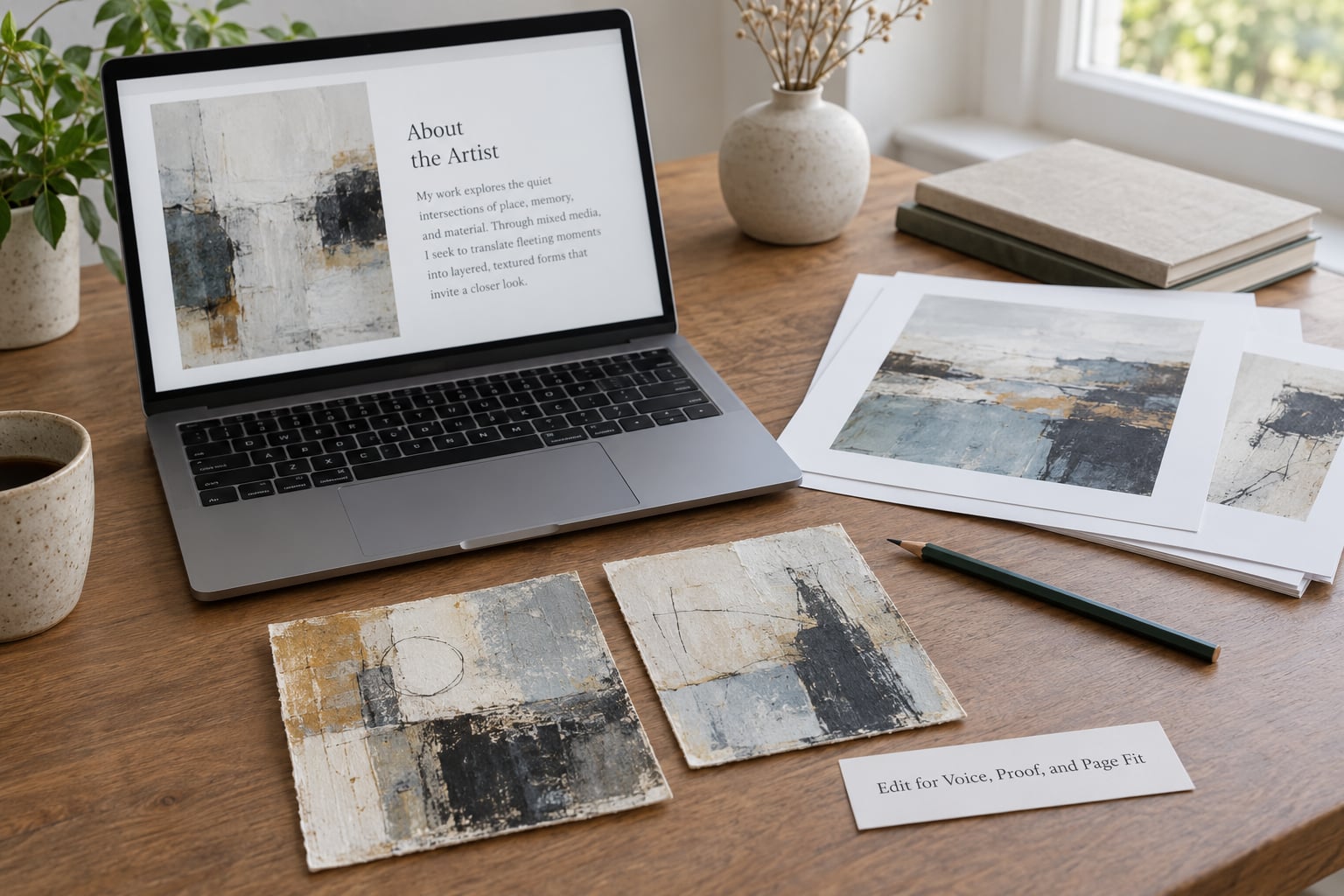
Edit for Voice, Proof, and Page Fit
Read the draft aloud. Anything you stumble on is too long, and anything that sounds like a press release needs cutting. Your voice is a tool here — recognizable, not performed.
Check the facts line by line. Dates, gallery names, titles, years, spelling of a curator’s name. A single wrong date on a page you asked to be a credibility source undoes the whole thing. Then remove the words doing no work: passionate, unique, journey, deeply, vibrant, timeless.
On the technical side, keep the page title under about 60 characters and put your name and the word artist in it. Write a meta description in one plain sentence. Use one H1 and let your section headings do the navigating. Give any portrait real alt text describing the photograph, and link from the about page to your shop, your selected works, and your exhibition page where it makes sense.
Then open it on a phone. Most people who read your about page will read it on a phone, and a wide paragraph of grey text with a heading that disappears off-screen is a page people abandon. If a visitor cannot tell who you are, what you make, and what to do next within ten seconds on a small screen, the rewrite is not finished.
Common Mistakes
Opening with a generic statement. “Art is a universal language” tells a visitor nothing and costs you the first ten seconds. Open with the specific: what you make, from what, and why.
Writing only for other artists. Technical process detail is useful in moderation and exhausting as the main event. If your primary reader is a collector, they care about the object, its hand, its scale, and whether it fits a room.
Pasting in a resume. A CV belongs on its own page as a dated list. About pages written as resumes read as applications, and they put the work second, which is backwards.
Mixing the bio and the statement. Two different jobs, two different voices, usually two different pages. Label them so a reader knows which one they are reading.
Making claims nothing supports. “Internationally recognized” is the kind of line that costs you credibility with exactly the person you wanted to impress. Specific and verifiable beats impressive-sounding every time — and artists on art business forums keep repeating the same advice: honest details about what you actually make, not a claim of uniqueness.
Offering four competing actions. Shop, newsletter, commission, follow, donate, join the class. Choose one primary and at most two more, or none of them land.
Leaving the page untested on mobile. Check the image weight, the paragraph length, and whether the contact link works in a thumb.
Two editing habits help more than the rest. Read the draft aloud, and cut ten percent. Then ask a friend who is not an artist to tell you what you make, using only your page. Whatever they say is what your page is — not what you meant it to be.
Frequently Asked Questions
How long should an artist about page be?
Most artist about pages land between 200 and 400 words, which reads in about two minutes. Emerging artists can be closer to 150 if the work is doing the talking. If you are over 600, split it: keep the biography and process on the about page and move the dated record to a separate CV page.
What is the difference between an artist bio and an artist statement?
A bio is factual and outward-facing: training, place, exhibitions, current practice, usually in a few paragraphs. An artist statement explains what the work is about and how you think about it, usually in the first person. Many artists keep the bio on the about page and label the statement separately.
Should an artist about page include education and exhibitions?
Include only the credentials that build credibility for your primary reader. A degree matters if teaching or critique is part of your work. Group shows, residencies, awards, and collections matter if you want gallery and fair attention. Deep in a career, the dated detail belongs on a separate CV page linked from the about page.
How personal should an artist about page be?
Personal enough to sound like a person, disciplined enough to stay on topic. Your influences, your materials, your research, and the honest reason you make work all belong there. A short mention of the life that shaped the practice can help. Long digressions about family, pets, or unrelated jobs tend to pull the reader away from the work.
What should visitors be able to do after reading an artist about page?
One thing, clearly. That is usually viewing available work, emailing about a commission, or booking a studio visit, depending on your practice. Add at most two secondary options with descriptive link text. A visitor who leaves knowing your next step is worth far more than one who finishes unsure what you want from them.
Conclusion
Two moves first. Choose one audience and write down what you want that person to do. Then write a single sentence about your artistic identity and build the page outward from it.
Everything after that is revision: trim to what serves the visitor, keep only the facts you can defend, and leave one obvious next step. An about page that does those three things does its job quietly, which is exactly the effect you want.