An artist resume with no exhibitions is built by substituting: you map what you genuinely have onto the standard headings, label every item honestly, and never leave a section empty or invent one. Classes, mentors, assistantships, sales, commissions, online juried shows, teaching, guild roles and press all count as professional evidence.
It takes most artists an afternoon once they know what to gather. The hard part has never been the typing, it is the feeling that a resume without an exhibition list is somehow incomplete. It isn’t.
Updated for October 2026. Every example below is written so you can copy the structure and swap in your own facts.
Table of Contents
- What You Need Before You Start
- Step-by-Step: How to Write an Artist Resume With No Exhibitions
- Set the resume’s purpose and format
- Create a concise professional introduction
- List education, training, and studio development
- Show creative practice without exhibitions
- Highlight collections, commissions, and sales
- Add teaching, workshops, and professional service
- Finish with awards, memberships, and links
- Edit for clarity and proof
- Common mistakes and how to fix them
- Frequently Asked Questions
- Do I need an artist resume if I have no exhibitions?
- What do I put on an artist resume when you have just started out?
- Is a CV the same as a resume?
- How long should an emerging artist resume be?
- Should I put my art classes on my resume if I am self-taught?
- Can I list upcoming shows on my artist CV?
- Start With Your Inventory, Not Your Shortcomings
What You Need Before You Start
Curators skim. The fastest way to write this document is to stop guessing what “counts” and start with an inventory of what has already happened in your practice. Gather these first, and the writing takes an hour.
- Contact details. Name, city and country, email, phone, and your website or portfolio link. A working email on your own domain looks more settled than a free one, though that is a nicety, not a requirement.
- A short bio or summary. Three lines at most: medium, current focus, and where your training came from.
- Education records. Degrees, incomplete degrees, diplomas, plus the workshops, short courses, crits and mentorships you can name and date.
- Dates for everything. A spreadsheet with two columns, what and when. Reverse-chronological order is impossible without this, and getting it wrong is the most common formatting fault.
- Sales and commission records. Receipts, invoices, licence agreements, the name of the company or person who bought the work.
- Teaching, assisting and volunteer records. Class names, organisations, dates, whether you were paid or not.
- Awards, grants, memberships and press. Even a shortlist or a finalist placement is a real credit with a real date attached.
- Two tools. A word processor for the master copy and a design tool for the PDF, because applications almost always want a PDF and you will want to re-export it for years.
Write the inventory as a plain list first. It will look long and chaotic, which is exactly what you want before it becomes a formatted document.
Step-by-Step: How to Write an Artist Resume With No Exhibitions
Set the resume’s purpose and format
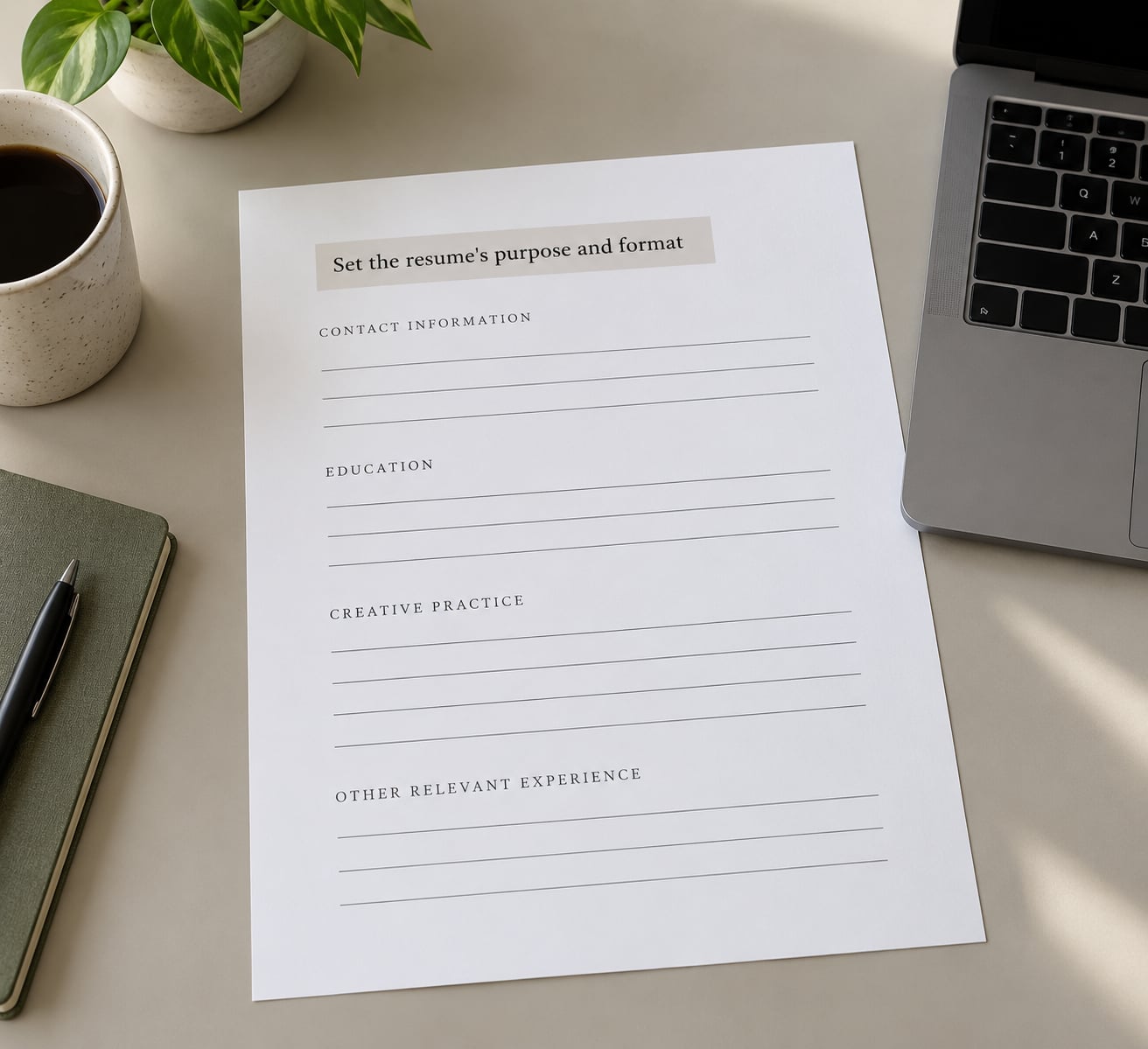
Decide what this particular document is for before you write a word, because a gallery submission and a residency application want different lengths. A resume is one to three pages, tailored and selective. A curriculum vitae is the full record of everything, with nothing edited out.
For a juried show, a gallery submission or an open call, send a resume. For a residency, a grant or a teaching post, send a CV, or a resume that is effectively a CV. If the call names the document, follow the call to the letter; jurors do not enjoy a format surprise.
Then set up the file itself. One column, one typeface at 10 or 11 point, 2.5 cm margins, section headings in plain text rather than coloured boxes, and enough white space that a section with two lines still looks deliberate. Check the College Art Association’s recommended conventions for visual artists if you want an outside reference point.
Create a concise professional introduction
Two or three lines under your name, describing your medium, what you are working on now, and where your training came from. This is where you introduce yourself as an artist, and it is the only part of the resume written in full sentences.
Here is a real example from a self-taught painter with no group shows:
Painter working in oils and cold wax, based in Leeds. My practice looks at domestic interiors as sites of quiet labour. I trained through evening classes at [college] and a two-year mentorship with [artist name]. My work has been sold directly from the studio and through two online juried exhibitions.
Notice what it does not do. It does not apologise, it does not claim an experience level, and it does not mention a gallery that has never shown the work. It states medium, subject, training and what has actually happened.
List education, training, and studio development
Start with formal education if you have it, then immediately follow with everything else that taught you to make. Self-taught and part-trained artists should not skip this heading, because leaving it out is what makes the resume look empty.
Use a sub-heading of Studied under or Workshops and training and list named people and institutions with dates. Workshops, residencies, artist talks, crit groups, apprenticeships and regular studio visits all belong here. A year of weekly critique sessions with a working painter is more relevant to a juror than a degree you finished a decade ago.
If you did not finish a degree, list it truthfully as “BFA Painting, [college], 2019 to 2021, not completed” and then build the rest of the section. Applicants read that line every day and it carries no penalty. A master’s degree in an unrelated field is a genuine credential too: name the field, then make your art training explicit underneath it.
Show creative practice without exhibitions
This is the section that decides whether the resume reads as thin or as early-stage. You never leave it empty. Instead you show the work, the bodies of work and the showings that have happened under any label at all.
Anything in which your work has been presented to an audience is exhibition history, provided you name it accurately. Juried online exhibitions, open call placements, a group show in a church hall, a school or university show, a site-specific installation you mounted yourself, a stall at a makers market, and a holiday sale in a museum shop are all real. The only rule is that the label tells the reader exactly what happened.
Here is a working list of things that count, with the honest label to use for each:
- Juried online exhibition — label it “online juried exhibition”, never “solo show”.
- Open call placement — label it “group exhibition” and name the organiser.
- Group show in a non-gallery venue — a church hall, library, café or community space is still a group exhibition. Name the venue.
- School, college or university show — list your degree show, your first year group show, your final show. It is how most artists start.
- Self-initiated installation — a site-specific piece you mounted in a shop window, a stairwell or an empty lot. Label it “site-specific installation, self-initiated” and be clear that you presented it yourself.
- Makers market or art fair stall — this is sales, so it belongs under collections and sales, though juried markets that select vendors are worth naming as juried.
- Museum or gallery shop holiday show — a seasonal group presentation of work sold through a shop. It counts; describe it accurately.
- Member or group show at an art society — open membership shows are real exhibition history, and the open submission process is worth noting once.
Where a show is still to happen, mark it forthcoming rather than dropping it. Once a jury has accepted your work, the commitment is real and the omission is what makes a resume look out of date.
You will also see “finalist” and “shortlisted” asked about constantly. If you were shortlisted for an artist-in-residence programme, list it under awards with the year. Finalists were judged on their work, so the credit is genuine.
Highlight collections, commissions, and sales
Sales count more than most beginners assume. A single work bought by a real person is evidence, and a resumed practice is built from exactly that.
Write private collections as “Private collection, [City]” and do not use the same city twice. Public and institutional collections get their full name. For commissions, name the commissioner, the year, the scale of the project and what you produced. Corporate and editorial licences, such as a photograph licensed for use in a film, go under sales and licences with the company named and their permission if you want it.
If you sell through your own website or a third-party marketplace, say so plainly under a “Selected sales” or “Online practice” heading, with the number of works and the year started. Nobody will hold that against you. An honest line beats a silent gap.
For privacy, ask before naming a collector. Most are happy to be listed and will say so when asked; some would rather not be, and “private collection” is a perfectly standard way to write it.
Add teaching, workshops, and professional service
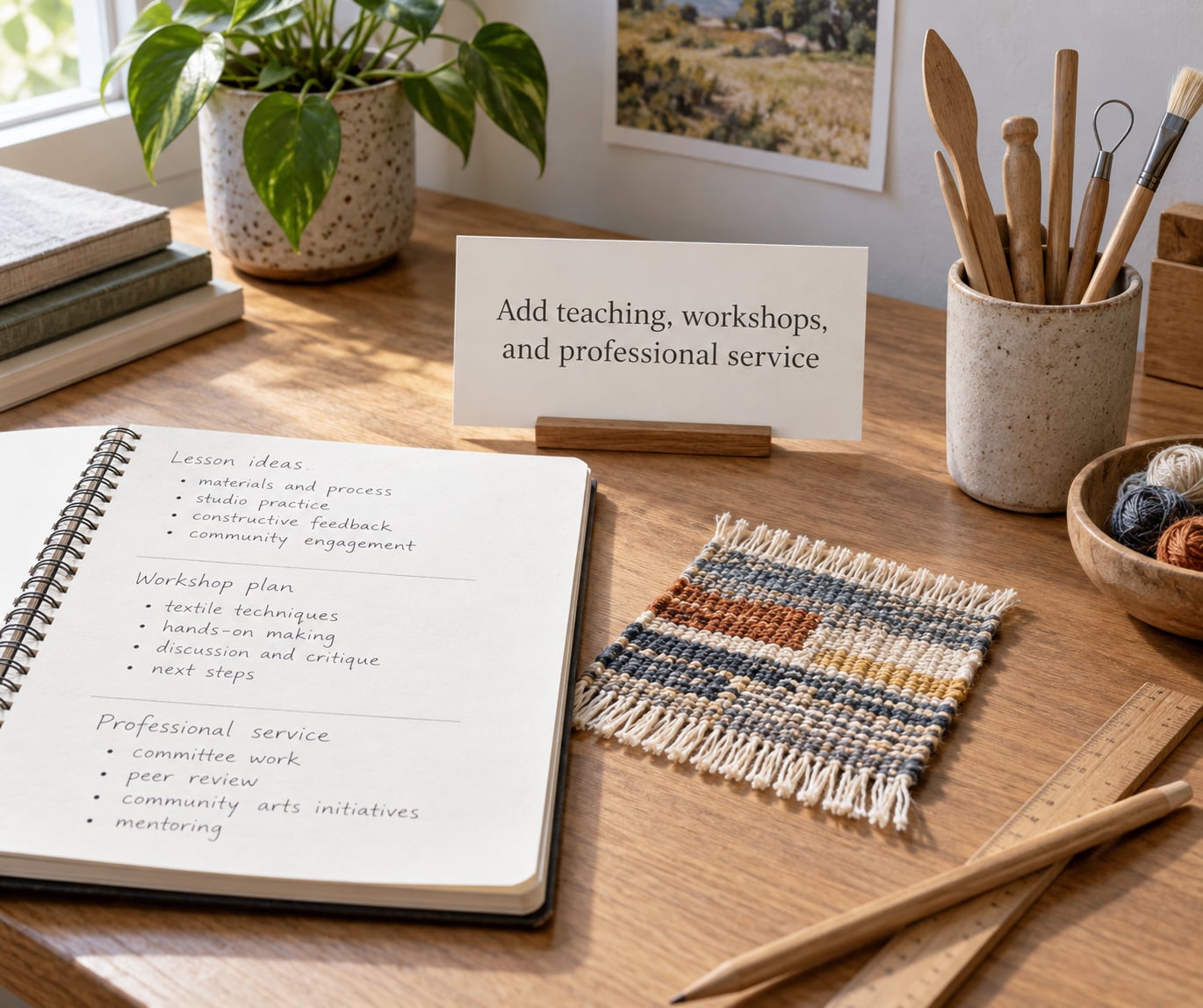
Art-adjacent work is professional experience and belongs on the resume. Assistantships are the most underrated entry on any emerging artist’s document: “Assistant to [Artist], [City], 2022 to present” tells a juror that another working artist trusts your hands and your judgement.
The same goes for studio assistant roles, invigilation, workshop facilitation, teaching assistant work, running an art society or open studio, crit facilitation, volunteer coordination and committee or guild leadership. Use a custom heading such as “Professional Experience” or “Teaching and Community Work” so the juror knows where to look.
Say whether each role was paid, freelance or voluntary. Volunteers are not a weakness; running a community drawing group every Saturday for two years says something about commitment that no exhibition list can.
Finish with awards, memberships, and links
Awards, grants and memberships take up four lines and give the top of the resume weight. Include fellowships, residencies applied for and received, competition wins, art society prizes and any grant you hold. Mark each clearly: received, finalist, or forthcoming.
Memberships count too, especially the ones that require a portfolio or a nomination. Guild or art society membership, professional associations, and a place on a mailing list or artist database are legitimate lines. Being listed in a curated artist’s directory is closer to a credential than most new artists assume.
Close with your website and any writing or press that mentions you. Include non-English features with a translation in brackets; curators read them. Then a single line for your Instagram or other platform if it is genuinely where your work is documented, described as what it is rather than dressed up as a publication.
Edit for clarity and proof
Read the finished document the way a juror would: top to bottom in under a minute, looking for who you are, whether you make work, and whether you finish things. Anything that does not answer one of those three questions either moves lower on the page or comes out.
Check that every section is in reverse-chronological order, dates are consistent, and there are no gaps a reader will stumble over. A career break, a career change or fifteen years away from the studio is not something to hide. In the summary, describe the current practice in the present tense and let the older work sit where the dates put it. Jurors read hundreds of these; a change of direction is unremarkable, concealment is not.
Then get a second pair of eyes. Give the file to a teacher, a crit partner or a mentor and ask one question: what did you assume I could do? The answers show you exactly which evidence is missing. Save this version as your master copy, keep it in one folder, and export a fresh PDF for every application.
Common mistakes and how to fix them
Almost every weak artist resume fails in the same handful of ways, and all of them are fixable in an afternoon. Here is the short list.
| Instead of this | Write this |
|---|---|
| “Solo exhibition, [unrelated field], 2024” for a group show of twenty artists | “Group exhibition, [venue name], [City], 2024” |
| A blank “Exhibitions” heading with nothing under it | No heading at all; the training, sales and practice sections carry the page |
| “As I have not yet exhibited, I am an emerging artist” | Deleted. Nothing on a resume apologises. |
| “Private collection, London” repeated three times | “Private collection, London” once, plus “Private collection, Manchester” if the cities differ |
| A family member’s purchase listed as a collection | Deleted. Direct sales to friends do not belong on the document. |
| “BFA Painting, [college], 2019 to 2021” implying a completed degree | “BFA Painting, [college], 2019 to 2021, not completed” |
| Ten years of unrelated employment listed line by line | Deleted, unless a single line ties the work to the arts |
| A two-paragraph artist statement pasted under your name | Three lines of medium, focus and training, with the statement sent as its own document |
- Leaving a section blank. Never add a heading you cannot fill. Remove the heading instead, and let the sections you do have carry the weight.
- Apologising for having no shows. No “as I have not yet exhibited” anywhere. The document states facts, not feelings.
- Inventing or stretching anything. Fabricated credentials are the one unforgivable error in this field, because anyone can pick up a phone. It ends the relationship rather than the application.
- Listing family and friends as collectors. A parent who bought a print is not a collection. Leave them out.
- Padding with unrelated day jobs. A decade of office work is not art history. A decade of graphic design might be, under a clearly labelled design heading, if the role touched the arts.
- Over-designing the document. A designed CV with sidebars and skill bars costs you the ten seconds you have. Plain is faster to read.
- Sending an unfocused three-paragraph bio instead of three lines. The statement belongs in a separate document, not in the resume header.
- Reusing one file for every application. Pull the call’s own language into the summary and reorder sections to match what that juror cares about.
One last habit: the same week you apply, enter two or three juried open calls. It is the fastest route from an empty exhibitions section to a real one, and it costs nothing but the entry fee and the work.
Frequently Asked Questions
Do I need an artist resume if I have no exhibitions?
Yes, if you are applying anywhere. Open calls, gallery submissions, residencies and teaching posts almost always request one, and a resume is how you get read at all. Send a short, well-organised document rather than nothing. An empty document is read as no commitment, while a two-page document with education, training, sales and studio practice is read as a practice in progress.
What do I put on an artist resume when you have just started out?
Put your training, your named mentors and workshops, the work itself, and any evidence that people value it: sales, commissions, teaching, crit facilitation, memberships, online juried shows and press. Write a three-line summary of medium and current focus. Order sections so the strongest evidence sits highest. A clear, dated list of real activity beats a padded one every time.
Is a CV the same as a resume?
Not quite, though many artists use the words interchangeably. A resume is one to three pages, selective and tailored to the opportunity you are applying for. A curriculum vitae is the complete record of your training and professional activity, with nothing cut. Send a resume for a juried show or gallery submission, and a CV for a residency, grant, teaching post or academic application.
How long should an emerging artist resume be?
One to two pages for an emerging artist, three at most. If yours is under a page, that is a formatting problem rather than a content problem: expand the training, sales, teaching and practice sections with dates and detail. A short document that looks deliberate beats a long one padded with every class you ever took. Never add material just to fill the page.
Should I put my art classes on my resume if I am self-taught?
Yes. Workshops, short courses, crit groups, artist talks and mentorships all belong under a training or studied under heading, named and dated. Self-taught artists regularly work alongside formally trained ones, and jurors read this section closely. Lead with it rather than hiding it, and describe the depth of your work alongside the list, such as a year of weekly critique with a named painter.
Can I list upcoming shows on my artist CV?
Yes, and you should. Once a show is accepted, it is a professional commitment and most artists list it with the word forthcoming or upcoming in brackets so nobody mistakes it for past work. The same applies to residencies, fellowships and grants you have been awarded but not yet started. Keep them visually separated or lower down, and update the date the show has happened.
Start With Your Inventory, Not Your Shortcomings
The artist with no exhibitions and a dated list of training, sales, teaching and honest practice is far easier to say yes to than the artist who sends nothing. Build the master copy today, update it every time something happens, and reuse it rather than starting over each time an open call lands.