An artist statement is a short written explanation, usually 100 to 300 words, that tells people what you make, how you make it, and why you make it. Written in the first person, it gives a viewer context they cannot get from looking at the piece alone.
Knowing how to write an artist statement is mostly a matter of gathering the right material before you start typing, then cutting hard. Give yourself an hour for a first draft and another hour for editing, and plan on three drafts anyway. It feels harder than it is, mostly because the art has to do the talking and you have to write it down.
If you have never written one, you are in good company. On r/ArtistLounge a painter applying to a local gallery asked the plainest possible question: what even is an artist statement. Nobody was mocking it, which tells you how many working artists feel the same way.
Table of Contents
- What You Need Before You Start
- How to Write an Artist Statement, Step by Step
- Step 1: Define What the Work Is About
- Step 2: Describe the Process and Materials
- Step 3: Explain Your Choices and Point of View
- Step 4: Draft the Statement in a Clear Structure
- Step 5: Edit for Clarity, Voice, and Audience
- Common Mistakes and How to Fix Them
- Frequently Asked Questions
- How long should an artist statement be?
- Should I write an artist statement in first person or third person?
- How do I write an artist statement for a group exhibition?
- What should I include when my work is textile art or mixed media?
- Can I use the same artist statement for my website, portfolio, and grant applications?
- How do I make an artist statement sound personal without sounding informal?
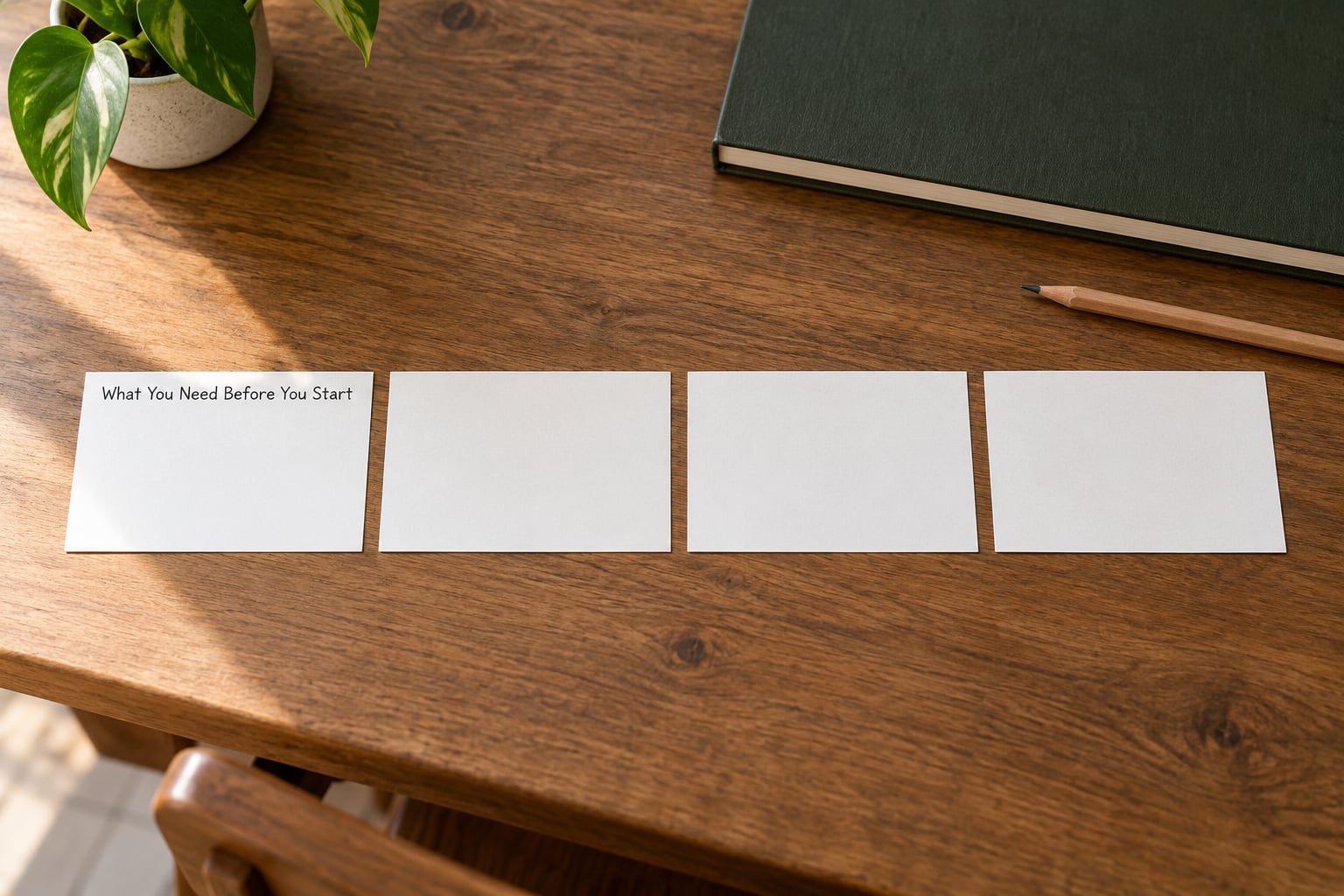
What You Need Before You Start
Gather these seven things before you write a sentence. If you have them laid out, the drafting itself takes about an hour.
- One body of work. A statement covers the series or body of work in front of you, not your entire career. Ten unrelated projects get you a list, not a statement.
- Your intent, in one breath. Before any detail, say what the work is about: a question, a memory, a tension, a visual concern. You will refine this later.
- Your process and materials. Note how you actually work, not what you bought. Linen, hand-dyed cotton, hand-carved wood panels, oil and cold wax, found paper.
- One or two influences you can name honestly. A place, a person, a memory, a book, another artist. Vague names do more harm than none.
- Your reader. A gallery director, a grant panel, a student portfolio reviewer, a collector standing in front of the piece. Each wants a different amount.
- The format rules. Word counts, character limits, whether first person is welcome. Check the submission page rather than guessing.
- One trusted reader. Someone who will tell you that your third sentence is decoration.
None of this needs specialist language. If a high school art teacher could follow it, a curator will.
How to Write an Artist Statement, Step by Step
Step 1: Define What the Work Is About
Write one sentence that completes this prompt: “This series explores…” Fill it with a question, a memory, a social context or a visual problem rather than an appearance. “This series explores how a family remembers a house it no longer lives in” gives you somewhere to go. “This series explores houses” gives you a caption.
Keep going until the sentence is something you would say out loud to a stranger at an opening. If it sounds like a thesis title, it is still too abstract.
Step 2: Describe the Process and Materials
Now connect the technique to the idea, and only the technique that matters. A quilter who hand-dyes and stitches worn clothing from her family might write that she repeats the shapes of garments her mother sewed before illness made it difficult, so the cloth carries an argument about care that a new bolt of cotton cannot.
The test is simple: could you delete the material list and the statement would lose something? If yes, it belongs. A wood carver who removes only the negative spaces between branches is saying something about how a tree holds itself up, and the carving is the evidence. A painter who layers oil and cold wax until the earlier image resurfaces half-visible is describing memory as a physical process.
Be careful with mixed media. Listing acrylic, graphite, thread, sand and varnish reads as a receipt. Naming the one relationship between them, such as thread stitching over a wet ground so the pigment creeps into it, reads as practice.
Step 3: Explain Your Choices and Point of View
This is where the work stops being a description and starts being a position. Talk about the decisions you actually made: composition, colour, scale, texture, where the materials came from, what you tried and dropped.
A sculptor might explain why the figures are shown at child height rather than eye level. A photographer might say she works only within her own zip code because familiarity is the point. Specificity here is what separates your statement from a template with your name on it.
Step 4: Draft the Statement in a Clear Structure
Four parts, in this order, and it works for almost any practice:
- What you make. One sentence, concrete. Name the medium and the size of the body of work.
- What you are exploring. The idea from step one, in plain language.
- How you approach it. Process, materials and the choices that carry the idea.
- Why it matters. What you hope a viewer notices or feels. One sentence, not a moral.
A model paragraph you can adapt: “I make small quilted works from cloth my family has worn out. They are about the way care is stored in objects long after the caring stops. I hand-dye the fabric first, then stitch without a pattern, so the shapes come from the cloth’s own weight. I want viewers to recognise the effort in the stitching before they notice the image.”
Read that aloud. It takes about forty seconds, which is roughly how long you have when someone asks about your work at an opening.
Step 5: Edit for Clarity, Voice, and Audience
Cut in this order: jargon, repetition, inflated claims, then vague abstractions. If a word would be hard to explain to a curious twelve-year-old, replace it or delete it. Delete “unique”, “intriguing”, “explores the human condition” and any sentence that only says the work is important without saying why.
Then read it aloud. Sentences you stumble over are usually too long, and length is where good statements go to die.
Finally, match it to the reader. A gallery submission wants the body of work and the intent. A grant panel wants the intent plus what the project will do. Your website wants the short version with a link to the long one. A wall label wants two sentences, present tense, no craft history. Write the master version once, then cut it down honestly for each place.
Common Mistakes and How to Fix Them
Starting with biography. “I was born in 1986 and have exhibited widely” belongs in your bio, not your statement. Fix: open with the work.
Listing every material. Inventory reads as a supply list. Fix: keep the one material that carries the idea and drop the rest.
Making claims you cannot support. “My work interrogates every social structure” is not a claim you can defend in a five-minute conversation. Fix: name one thing you are actually looking at.
Copying gallery language. Sentences like “I am discovering a technique which at first glance might be confused with the known” turn a reader off fast. People who write artist statements on forums mock exactly this kind of line. Fix: write like you talk.
Describing only appearance. “Bright colours on rough texture” tells a blind reader nothing about the idea. Fix: add one sentence on why the surface behaves the way it does.
Ignoring the prompt. A form asking for 150 words and 300 words means the reviewer reads forty submissions between coffee and a committee meeting. Fix: obey the limit exactly.
Before you submit, run this checklist: the first sentence names the work, one specific memory or place appears somewhere, no sentence could be pasted into another artist’s statement, the length matches the request, and a stranger could read it once and tell someone what you make and why.
Artists on r/learnart often suggest learning the statement well enough to say it out loud in conversation, because that is where it gets tested. Memorising the short version is not vanity. It is preparation.
Frequently Asked Questions
How long should an artist statement be?
Most working statements run 100 to 300 words. A gallery submission or open call usually asks for 100 to 200. Wall text needs two or three sentences, sometimes under 60 words. A website or portfolio can carry a longer 400-word version. Write one master draft, then cut it to each request rather than writing new versions from scratch.
Should I write an artist statement in first person or third person?
First person, almost always. Use I and my, in the active voice. The statement speaks in your voice about your own work, and shifting to third person makes it read like someone else wrote it or a gallery did. Third person belongs in an artist bio, a press release or a curatorial statement written about you by someone else.
How do I write an artist statement for a group exhibition?
Tie the statement to the shared theme or curatorial idea, not only to your own series. Open with one sentence connecting your work to the exhibition premise, then spend the rest on what you make and why. Keep it shorter than a solo statement, often 100 to 150 words, and confirm whether the gallery wants one statement or a short one per piece.
What should I include when my work is textile art or mixed media?
Name the technique and one material relationship that carries meaning, such as hand-dyed cloth stitched without a pattern, or thread pulled through wet pigment. Mention scale and repeat if they matter, since fabric invites people to touch it and your statement should say whether to. Skip the full materials inventory and the conservation or sourcing details unless they are the point.
Can I use the same artist statement for my website, portfolio, and grant applications?
Use one master draft as the source, but adapt it. Your website can hold the full version. Grant panels want the intent plus what the funded project will produce or change. Portfolio reviewers want clarity about process. Submitting one untouched paragraph everywhere usually means it is tuned for none of them, and word limits make sharing one version impossible anyway.
How do I make an artist statement sound personal without sounding informal?
Use your own concrete detail: the actual place, the real family object, the specific material, the mistake you made and corrected. Those specifics read as personal because nobody else had them. Keep the sentence structure clean and the voice plain, and leave slang, jokes and self-deprecation out unless you genuinely want a casual audience such as a studio blog or a student handout.
Start tonight with one sentence: this series explores. Fill it in, read it aloud, and leave it somewhere you will see it tomorrow morning. First person, plain language, one specific detail nobody else could have written, and cut everything else.