Most artist statements land between 100 and 200 words. Grants, residencies and graduate programme applications usually want more, in the 300 to 500 word range, and rarely beyond one page.
That is the honest answer to how long should an artist statement be, and it is also the least useful one on its own. A 150-word statement submitted to a residency programme is too short. A 500-word statement pasted into a gallery submission box is too long. Length follows the request in front of you, not a universal rule.
Art school libraries and career centres such as NYFA and the RISD Career Center tend to give the same guidance: write a clear, short, first-person statement, then adapt it. What they rarely publish is the arithmetic. This guide fills in the numbers by channel, shows how to build a longer version from a shorter one, and gives you an editing pass that cuts without emptying the writing.
Table of Contents
- How Long Should an Artist Statement Be?
- How to Find the Right Length for Your Situation
- How Long Should an Artist Statement Be for Each Use?
- What an Effective Artist Statement Should Include
- How to Adapt One Statement for Different Audiences
- How to Edit an Artist Statement Down Without Losing Meaning
- Common Length Mistakes to Avoid
- Frequently Asked Questions
- What is the standard length of an artist statement?
- Do art teachers and students need a different statement length?
- How do I shorten an artist statement for a submission with a word limit?
- How long should an artist statement be when no word count is given?
- Should an artist statement include a biography or exhibition history?
- A Simple Final Check Before You Submit
How Long Should an Artist Statement Be?
100 to 200 words covers the majority of what artists actually need: website overviews, open call submissions, gallery enquiries, art fair panels and self-published portfolios. When a submission is formal and asks you to explain your practice, your process and your direction, 300 to 500 words is fair. Past one page, most reviewers stop reading closely, and the padding starts showing.
The table below breaks that down by where the statement is going. Where a call states a word limit, that number wins every time.
| Where the statement goes | Typical length | What it needs to do |
|---|---|---|
| Website or portfolio overview | 100 to 150 words | Say what you make and hook a visitor in two paragraphs |
| Instagram or social profile bio | 40 to 75 words | Name the medium and the subject, nothing else |
| Online shop or print marketplace listing | 60 to 120 words | Describe one piece or series for a buyer, not a juror |
| Gallery submission or exhibition proposal | 150 to 250 words | Focus, context and a clear reason for this particular venue |
| Open call or competition entry | Match the stated limit, usually 150 to 300 words | Fit the box. Check the character count before you start |
| Cover letter for a sales or fair enquiry | 100 to 150 words | Practice plus what you are looking for from the venue |
| Grant or residency application | 300 to 500 words | Motivation, process, outcomes, public value |
| Graduate programme application | 300 to 500 words | Research questions, method, and where the work is heading |
| Exhibition catalogue or press release | 300 to 400 words | Curatorial framing of a specific show, written to be read at a table |
| Wall label | 25 to 75 words | One work, a few concrete facts, one idea |
Notice the spread. The same artist might need three documents this month: a 60-word marketplace description, a 200-word open call entry, and a 400-word residency proposal. Those are not competing drafts. They are the same argument at three depths.
How to Find the Right Length for Your Situation
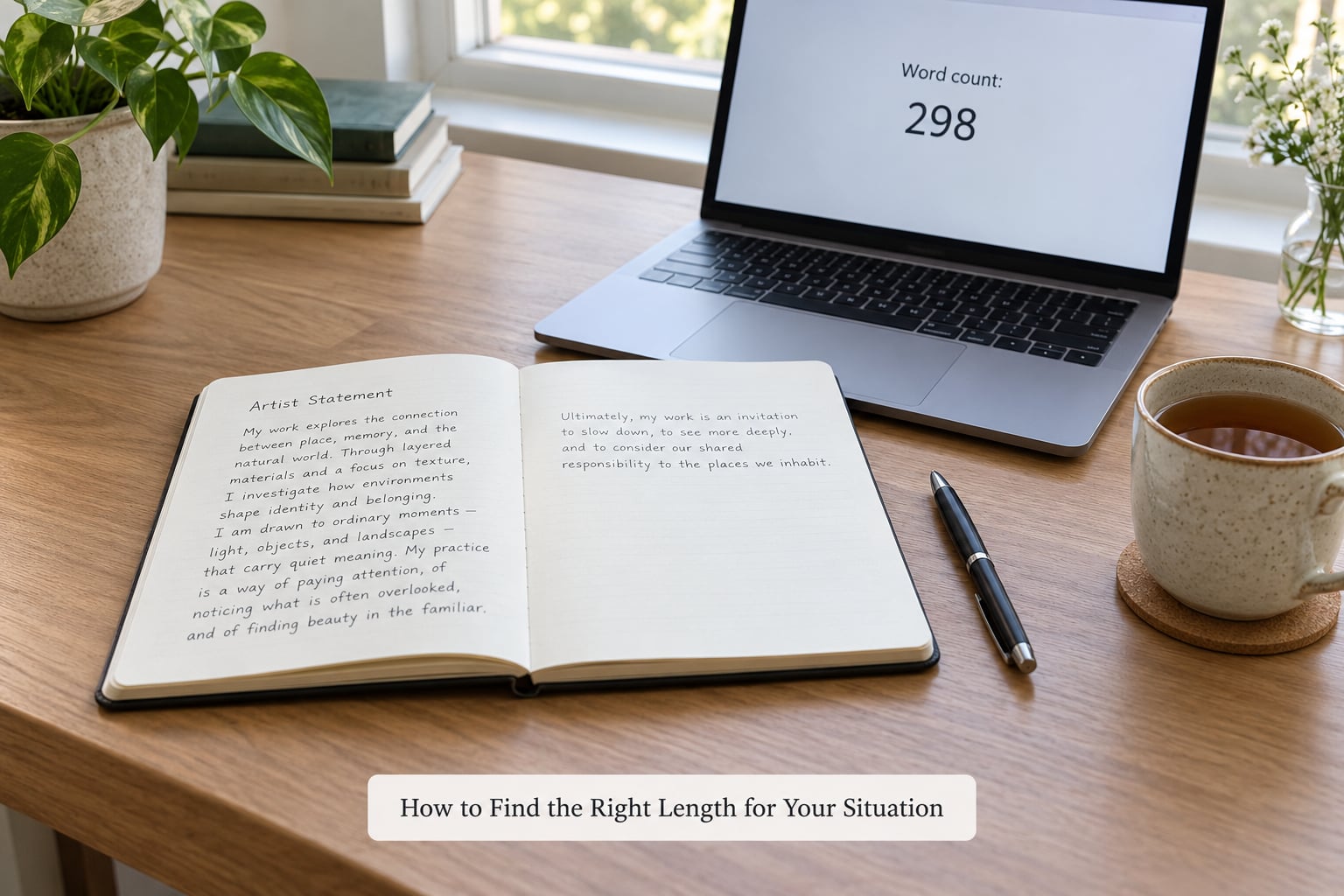
Work through these five steps in order. It takes about ten minutes and saves you from submitting into a box that was never going to hold what you wrote.
- Identify the reader. A curator reading forty submissions, a grant panel scoring on a rubric, and a person browsing a shop at a fair all need different things.
- Find the stated limit. Open call forms usually give a word or character cap in the field label itself. Read it before drafting, not after.
- Decide what they must learn. Pick the two or three facts that make the work legible. Everything else is optional.
- Cut the background. Degree, training and previous exhibitions belong in the CV, not the statement.
- Edit to the count. Use the word counter your form already shows you.
Artists on art forums keep describing the same problem: the advice they find online contradicts itself, one source saying a full page and the next saying three paragraphs. That contradiction dissolves once you stop asking for a general answer and start asking what the reader has to decide.
It also helps to keep the neighbouring documents straight. Mixing them up is the most common reason a submission reads as filler.
| Document | Written in | Typical length | Job |
|---|---|---|---|
| Artist statement | First person, present tense | 100 to 250 words | Explain the work and where it is going |
| Artist bio | Third person, past and present | 50 to 150 words | Introduce you, credentials, exhibitions |
| Artist CV | List form | 1 to 3 pages | Record education, shows, collections, awards |
| About page | Either | 150 to 300 words | Hold your statement plus your bio in one place |
| Wall label | Third person usually | 25 to 75 words | Name, date, medium, one idea |
How Long Should an Artist Statement Be for Each Use?
Look at how length actually changes between contexts. A portfolio overview and a curatorial statement cover similar ground but operate at different speeds.
A short portfolio overview opens with what you make and closes with why. Two paragraphs is plenty because a visitor deciding to stay has already looked at three pieces.
A curatorial statement for a catalogue or a longer proposal does more work. It situates the work, names the influences that actually shaped it, describes process, and ends with the direction of the practice. That is where 300 to 400 words earns its place.
The technique for building longer versions is additive, never repetitive. Start from your 150-word version and add one new layer at a time: process and materials, then influences and context, then current questions and goals.
If the same sentence idea shows up twice after that, one of the layers is redundant. Cut the weaker one. A reader who meets the same thought in paragraph two and paragraph six stops trusting the rest.
What an Effective Artist Statement Should Include
Seven building blocks cover almost any statement. You do not need all seven at every length, but a short version that keeps only your focus and your direction is going to feel thin.
- Artistic focus — the single question or pursuit your practice keeps returning to.
- Subject or personal inquiry — where the question comes from, in plain language.
- Materials and techniques — what you actually work with, and why that choice.
- Process — how a piece gets made, in enough detail to be interesting.
- Influences and context — the references, histories or places that shaped the work.
- Current questions — what you are unsure about right now.
- Direction — where the work goes next, in one sentence.
Here is a fill-in-the-blank version that fits almost anyone:
I make [what]. My work is about [the idea]. I build it by [process, using these materials]. I started from [influence or experience]. Right now I am trying to [current question]. Over the next year I want to [direction].
A worked example helps more than instructions. Take a mixed-media and textile practice. The same artist writes three different statements from the same core.
Wall label, 48 words: Woven Boundary, 2026. Hand-dyed linen, rusted steel thread, horsehair. This piece maps the edge between two stitched fields, where one material stops behaving like itself.
Open call entry, 180 words: I make hand-dyed textile pieces that treat cloth as a record rather than a surface. I dye linen in small batches, then stitch through it with rusted steel thread and horsehair, letting the corrosion mark where tension changed. The stitching follows maps of shorelines I have walked, not drawings. Working this way, the material keeps correcting me: a seam I planned flat buckles as the cloth dries, and that buckle often becomes the most honest part of the piece. My work asks what soft materials can hold once you treat them as structural.
Residency proposal, 420 words: opens with the same shoreline mapping, adds the dye chemistry and where the work sits relative to industrial land use along the coast, then closes with a residency goal and a public workshop component.
Same artist, same practice, three lengths. Nothing was invented for the longer versions, only added context.
How to Adapt One Statement for Different Audiences
Deciding how long should an artist statement be for any given call comes down to a habit: draft the longest version once, then cut down to the request. Rewriting from scratch every time is how the voice drifts and the deadline gets missed.
Keep three working versions in a single document:
- 100-word version — website About page, marketplace listings, quick enquiries.
- 250-word version — open calls, gallery submissions, fair applications.
- 500-word version — grants, residencies, graduate programmes, catalogue essays.
Then adjust emphasis, not facts. The voice stays first person and present tense across all three.
Collectors and buyers respond to specificity. Name the material, the scale, the time it takes. A buyer deciding whether to spend an afternoon at your booth does not need your influences; they want to know what hangs on the wall.
Educators and workshop hosts want process and the learning behind it. How do you teach someone to dye and stitch without wrecking the cloth? What did you get wrong the first ten times?
Curators want context and intent. Why this subject, why this material now, and what does the work argue rather than depict?
Grant panels score against criteria. Goals, outcomes, audience, public value. Write so each requirement has a sentence you can point at.
Keep the sentence about your central question in every version. That sentence is the constant, and it is usually why someone remembers you afterward.
How to Edit an Artist Statement Down Without Losing Meaning
Cutting is the skill that separates a 200-word statement from a good one. Read the draft once as a curator who has already read thirty others today.
Here is a 215-word paragraph and its edited version, both for the same textile practice.
Before, 215 words: My artistic journey really began when I began, honestly, and everything I have done since has been a journey towards understanding the world around me. Growing up near the coast, surrounded by fishing boats and industry, I have always been fascinated by the tension between the two, and this tension informs the work. I work with textiles because textiles are intimate and because of the history of cloth. I use natural dyes because they are beautiful and because of the history of natural dyes. In my practice I explore form, colour, texture and the relationship between the viewer and the work, and I believe that the viewer brings their own experience to the piece. I am currently interested in climate and I hope that my work can contribute to a wider conversation about our relationship to the sea. Moving forward, I plan to explore large scale installation work and continue to develop my technical skills in this area.
After, 88 words: I make hand-dyed textile pieces about the tension between fishing communities and industry on the coast I grew up beside. I dye linen in small batches and stitch it with rusted steel thread, following maps of shorelines I have walked. The cloth corrects me constantly: a seam I plan flat buckles as it dries, and that buckle often becomes the most honest part of the piece. Right now I want to push the work into large-scale installation, where the stitching can hold a whole room.
What went in the bin: the opening that says nothing, three uses of “journey” and “fascinated”, the vague list of abstract nouns, the vague promise about contributing to a wider conversation. What stayed: place, material, process, one honest difficulty, one direction.
Seven techniques did most of that work. Cut every sentence that only introduces itself. Replace general claims with one concrete observation. Delete any idea that appears twice. Use stronger verbs and cut adverbs. Read it aloud and cut whatever you stumble on. Keep one main idea and let the rest serve it. Finally, check the count against the limit one last time.
If your statement still feels too long after this pass, the fix is usually one more sentence about your childhood rather than one more paragraph about theory. Most statements that overshoot the limit are not short of material. They are short of an editor. Move on.
Common Length Mistakes to Avoid
The biography in disguise. A statement listing your degree, your 2019 solo show and your teaching posts is a CV with adjectives. Correction: delete every credential and keep the work.
Too short to orient anyone. Forty words tells a curator you make something and nothing else. Correction: aim for the shortest version that still answers what, how and why.
Hitting an arbitrary number. “I have to write exactly 250 words” wastes time on padding or panic trimming. Correction: draft naturally, then measure and adjust.
Repeating the CV. Awards and group exhibitions belong in one document. Correction: keep the statement about practice only.
Jargon nobody outside the studio parses. Reviewers say the same thing constantly: clarity beats vocabulary. Correction: if a term needs a second sentence to explain, cut it or define it.
Maintaining seven unrelated drafts. The classic trap is a different statement per version. Correction: one master text, three lengths, saved in one file and updated when the work changes.
One more practical habit: date your master statement. When the practice shifts, the old text quietly stops being true, and you will not notice until a juror points it out.
Frequently Asked Questions
What is the standard length of an artist statement?
The standard length is 100 to 200 words for most uses, including website overviews, gallery submissions and open call entries. Grants, residencies and graduate programme applications usually take 300 to 500 words. Art school career centres and university libraries tend to advise a page at most for these longer versions. When a form states its own limit, follow that instead.
Do art teachers and students need a different statement length?
Yes. A student applying to a MFA programme usually has a longer, more research-focused statement of 300 to 500 words, because the panel wants your questions and method. A teacher seeking a teaching post often needs a shorter 150 to 250 word statement about their practice, plus a CV for credentials. The deciding factor is the reader, not your job title.
How do I shorten an artist statement for a submission with a word limit?
Cut in a fixed order: your opening framing sentences, background detail, repeated ideas, then abstract adjectives. Keep the sentence naming what you make, one concrete detail about process or material, and one sentence about where the work is going. Check the character limit, not just the word count, since many online forms cap characters. If you are still over, remove a layer rather than trimming every sentence.
How long should an artist statement be when no word count is given?
When nothing is specified, write 150 to 200 words. That is long enough to explain your focus, process and direction, and short enough that a tired reader finishes it. This is the range most curators and gallery staff expect from an unsolicited submission. If the opportunity is formal, such as a residency or grant, go longer and aim for 300 to 500 words.
Should an artist statement include a biography or exhibition history?
No. Your statement explains the work; your bio introduces you and your CV lists your record. Mixing them is the most common reason a statement reads as filler. Keep your degree, group exhibitions and awards in the CV, and keep your statement focused on what you make, the ideas behind it and where it is heading. You can link to a longer bio at the end.
A Simple Final Check Before You Submit
Start with the request. Read the stated limit, pick the range from the table above, draft around one central idea, then edit once for length and clarity.
A good artist statement is not the shortest version you can manage. It is specific, cut to what this reader needs, and honest about where the work is right now.