If you are searching for how many pieces should be in an art portfolio, the working answer is 10 to 15 finished pieces for most situations. That number is a baseline, not a rule. A college application panel, a gallery open call and a freelance client pitch each want something different, and the school’s own published requirement always wins over any general advice you read online, including this.
I’ve sat on both sides of this. The folders that land well are never the biggest ones. They are the ones where every image earns its place, the range reads as intentional, and nothing in the middle makes a reviewer stop caring.
Below, you’ll find a piece-count table by purpose, a ceiling argument most guides skip, and a selection checklist you can run on your existing folder this week.
Table of Contents
- How Many Pieces Should Be in an Art Portfolio?
- The short answer: 10 to 15 finished pieces
- Check the stated requirement before you count anything
- Why fewer, stronger pieces beat a longer folder
- What Is the Best Portfolio Size for Different Goals?
- How Does Piece Count Change by Medium?
- How Many Pieces Is Too Many?
- How Do You Choose Which Art Portfolio Pieces to Include?
- Range without randomness
- A selection checklist you can run today
- Should an Art Portfolio Include More Than One Type of Medium?
- What Not to Put in an Art Portfolio
- How Should You Arrange and Present Your Portfolio?
- Sequencing: strongest work first and last
- Image quality and file rules
- What Is the Step-by-Step Process for Building an Art Portfolio?
- What If You Only Have Three to Five Strong Pieces?
- What Is the Best Number of Pieces for a Digital Art Portfolio?
- Frequently Asked Questions
- How many pieces are usually in an art portfolio?
- How many pieces is too many for a portfolio?
- Is 5 pieces enough for an art portfolio?
- What should I leave out of my art portfolio?
- Should I include unfinished or process work in my art portfolio?
- Do art school portfolios have a maximum number of pieces?
- Conclusion
How Many Pieces Should Be in an Art Portfolio?
The short answer: 10 to 15 finished pieces
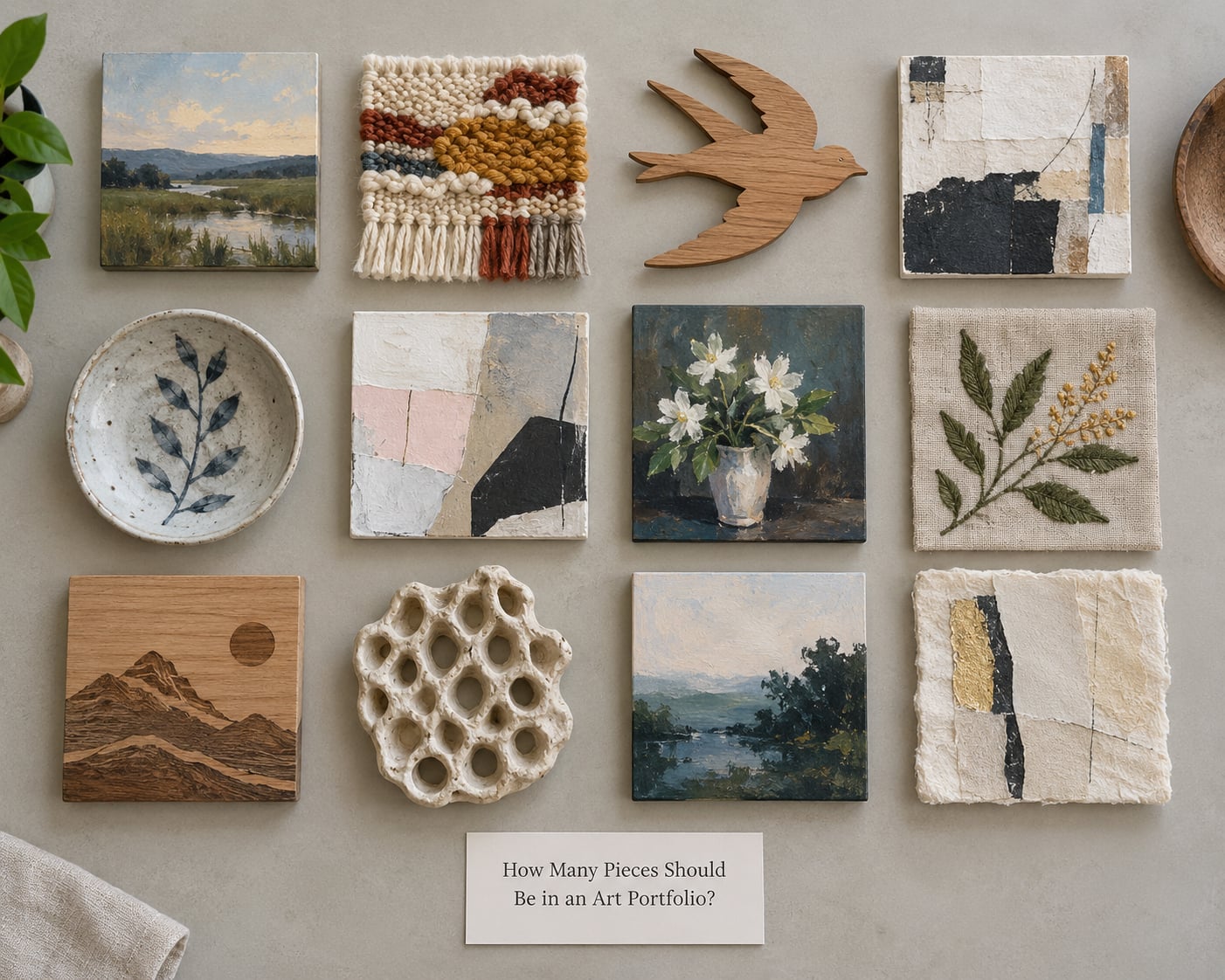
Ten to fifteen finished pieces is the range most portfolios land in, and it works because it is long enough to show range and short enough that a tired reviewer reaches the end.
Below 8 pieces, reviewers struggle to read a range. They’ve seen your favorite thing twice and started guessing. Above 20, attention thins out fast, and the average piece gets less time than your best work deserves. Somewhere in the middle, you get both.
Check the stated requirement before you count anything
Before you sort a single image, find the exact wording where you are applying. Programs like CCA, CCAD, RISD, Ringling and UAL publish their own specifications, and those numbers are the only ones that matter for that submission.
Look for three specific things: a hard minimum, a hard maximum, and whether process or development work counts toward the total. If the requirement says “at least 10 pieces,” then ten is your floor and everything above it is your choice. If it says “no more than 15,” your best fifteen are the portfolio.
Students running applications to a dozen schools end up with twelve different rule sets. Keep a simple spreadsheet: school, count, format, deadline. It takes ten minutes and it prevents the classic mistake of building a beautiful portfolio for a program that wanted something else entirely.
Why fewer, stronger pieces beat a longer folder
Reviewers judge a portfolio by its weakest entry, not its best one. That idea comes up constantly in portfolio-review conversations, and it’s true for a reason: the piece you’re unsure about is the piece they will remember, because it’s the one that raised a question you did not answer.
Adding a fifth mediocre study does not lower the bar for that study. It raises the question of why it is there, which quietly drags down how the reviewer reads the four strong pieces beside it.
What Is the Best Portfolio Size for Different Goals?
Every use case has its own range, and the counts are closer together than people expect. What changes most is not the number but what each slot has to do.
| Purpose | Minimum | Ideal | Maximum | What each slot needs to do |
|---|---|---|---|---|
| Art school or college application | 8 | 10-15 | 20 | Show range across mediums, plus observational drawing |
| Scholarship or grant submission | 5 | 8-12 | 15 | Demonstrate commitment and a sustained body of work |
| Gallery or open call submission | 5 | 8-12 | 15 | Match the call’s theme or medium, and read as one body of work |
| Freelance or client pitch | 4 | 6-10 | 12 | Prove you can solve the client’s specific problem |
| Online portfolio site | 8 | 15-24 | 30+ | Fill the gallery, but curate the homepage to the strongest dozen |
| Portfolio review or critique session | 6 | 10-15 | 20 | Give the reviewer enough to diagnose patterns, not a museum show |
| Tattoo apprenticeship application | 8 | 12-20 | 25 | Variety of subject matter and placement, held at a consistent level |
| Early career, before a body of work exists | 3 | 5-8 | 10 | Quality and promise, clearly framed as a starting point |
Two notes on the table. The online range is higher simply because a website has no forced ending, so the burden shifts to curation and design. And the last row exists because the honest advice for a beginner is not “make more filler,” it’s “start smaller and say what it is.”
How Does Piece Count Change by Medium?
A painter’s fifteen works and a 3D artist’s fifteen pieces are not the same object. What counts as “one piece” changes the math more than the number does.
| Medium | How one piece is counted | Typical range | What a reviewer looks for |
|---|---|---|---|
| Painting | One finished painting | 10-15 | Consistent quality across sizes, a visible hand |
| Drawing | One sheet or one series on one theme | 12-20 | Observational accuracy and mark-making control |
| Sculpture and ceramics | One object, plus one installation view shot | 8-12 | Form, material handling, and how it sits in a space |
| Textile and fiber art | One wall piece or one stitch-based work | 8-15 | Surface, stitch control, and scale relationships |
| Photography | One series of 3-5 related frames | 4-6 series | A tight edit with an unmistakable point of view |
| Graphic design | One case study, not one image | 6-10 | Problem, process, result, and reasoning |
| Animation and video | One reel of 60-90 seconds | 2-4 pieces | Timing, acting, and range of movement |
| 3D and game art | One scene with two or three detail views | 6-10 | Modeling, lighting, and both technical and artistic control |
The multi-part problem comes up constantly. A three-scene 3D piece can be counted as one piece or three, depending on who is asking. Artists working in r/3Dmodeling have reported that splitting a single scene into separate pieces changed how their candidacy was judged, since it demonstrated both technical and artistic capability rather than one strength alone. The safest habit: submit the pieces separately unless the program explicitly asks for a series.
How Many Pieces Is Too Many?
Past roughly 20 pieces for a review context, you are usually adding work faster than a reviewer can absorb it. Here’s the attention math that nobody publishes.
A faculty reviewer going through an application folder gives each piece somewhere around 20 to 40 seconds. Twenty pieces at 30 seconds each is ten minutes of concentrated looking, and by piece fifteen their notes start repeating themselves. Twenty pieces for a website visitor is different again, since most visitors leave after three to five images no matter how good the rest is.
So the ceiling depends on the setting. For admissions panels, treat 20 as a hard ceiling and 15 as the comfortable limit. For an open call, 12 is plenty. For a portfolio website, 20-30 is fine in the full gallery as long as the homepage shows 10-12.
The other signal that you’ve gone over is editorial. If you’re adding pieces because the folder feels thin, you’re solving the wrong problem. Thin means the viewer hasn’t understood what you do, and the fix is a clearer statement and tighter sequencing, not more images.
How Do You Choose Which Art Portfolio Pieces to Include?
Range without randomness
Range means the viewer can see you working at a high level in more than one way. It does not mean a folder with twelve unrelated one-offs and no through-line.
A good 12-piece folder usually covers at least three of these: a body of related work that shows depth, one or two pieces that prove breadth into another medium, observational drawing that shows you can draw what you see, process or development shots that show how you think, and a self-initiated project with no assignment behind it.
The mix depends on the goal. Admissions panels reward observational drawing heavily and usually want finished work rather than process pages, though some programs ask for both. Gallery reviewers care most about whether the work reads as a coherent body. Clients care about whether it solves their problem.
A selection checklist you can run today
Lay your candidates out on one wall or in one folder, all of them, including the ones you’re unsure about. Then work through this.
- Stack test. Rank all pieces from best to worst without looking at their dates. Your portfolio is the top slice. If you can’t rank them, you need to spend more time with the work, not more time cutting it.
- Weakest piece test. Read your list top to bottom and find where quality drops. Cut from there downward, not randomly. You’ll lose the last two or three, and the folder gets stronger immediately.
- Redundancy test. Put pairs of pieces side by side. If two images make the same point, keep the better one. Near-duplicates read as one idea repeated, which reads as a small portfolio.
- Date test. If a piece belongs to a style you no longer work in and it isn’t strong enough to justify itself, leave it out. A dated piece in a folder otherwise built on current work is a distraction.
- Stand test. Hold the finalists away from the other work. Do they still hold your attention a week later? Passion fades fast during editing; use it as a signal.
One worked example. A folder with 22 pieces from an art school application typically gets cut down like this: three near-identical observational drawings become one, four class exercises go entirely, two pieces from a style the student has moved on from come out, and one new self-initiated piece comes in to replace them. That’s 22 down to 12, and the resulting portfolio is markedly stronger than any version of the 22-piece original.
Should an Art Portfolio Include More Than One Type of Medium?
Usually yes, but the number of mediums matters less than how deliberately you move between them. Two mediums handled at a high level reads as focus. Eight mediums handled at a beginner level reads as someone sampling.
For college applications, breadth is a feature. Programs want to see that you can figure out unfamiliar material, so a folder that pairs a strong painting series with competent photography or printmaking work often beats fifteen paintings that all look the same.
For gallery and open call submissions, focus wins nearly every time. A reviewer filing work for a group show wants a body of work, not a survey. If the call is thematic, lead with what relates to the theme and keep the rest as supporting evidence.
The mixed-media case sits in between. For fiber and textile work, the strongest folders I’ve seen pair three or four wall pieces with a couple of smaller studies that show process and material experiments, so the viewer sees both the finished statement and the thinking behind it. If you want more on building a coherent mixed body, our mixed media techniques guides cover the studio side of that work.
What Not to Put in an Art Portfolio
This is the highest-engagement question in this space, and the answer is longer than “your weakest work.” These are the specific things that cost applicants spots.
- Unfinished work without permission. Most US programs want finished pieces. Process shots are fine when the brief asks for them, not as filler to reach a count.
- Near-duplicates. Three similar studies do not show range. They show one idea you made three times.
- Filler made to hit a number. This is the trap: needing 15 pieces leads to making weak 14th and 15th pieces. Ten excellent entries beat fifteen with two filler entries every time.
- Very old work in a past style. It reads as a portfolio with two authors.
- Copied, traced or fan work. Admissions staff and clients spot this immediately.
- Unrelated styles with no through-line. Every piece should be defensible as yours.
- Bad photographs of good work. A blurry, glare-covered or color-shifted image makes strong work look weak. This costs more portfolios than weak work does.
- A portfolio with no statement. Even a short written statement, or a caption on every piece, tells the reviewer how to read what they’re looking at.
On that last counting question: a series of five drawings on one theme usually counts as one piece with five views, or as five pieces, depending on the brief. Diptychs and triptychs count as one or two or three depending on who is asking. When the requirement is ambiguous, ask the program in writing and get the answer on record.
How Should You Arrange and Present Your Portfolio?
Sequencing: strongest work first and last
Order changes how the whole folder reads. Open with your strongest piece, put your second-best two positions later, and close with something that ends on a high note.
The middle is where quieter and more experimental work belongs. Pieces that are interesting but not your best get breathing room there, where the viewer’s attention is still deep enough to appreciate them. Group related pieces together so a series reads as a series, and put a single contrasting piece at the turn between groups to keep the eye moving.
Image quality and file rules
Shoot every piece straight-on with even light and a neutral background. No glare, no perspective distortion, no visible color casts from a nearby window.
For digital submissions, check each program’s file size and resolution limits before you export. Naming conventions matter more than people expect: use consistent, readable names with title, medium, dimensions and year, so a reviewer sorting ten portfolios at midnight can find your files.
For physical portfolios, plan the page so each work is the same size across spreads where possible, or varies deliberately with the work’s scale. Leave margins. Cramming pages is the fastest way to make careful work look careless.
What Is the Step-by-Step Process for Building an Art Portfolio?
Here is the sequence I recommend, and it works whether you’re starting from an empty wall or a 40-piece archive.
- Define the audience. Write one sentence naming who reviews this and what decision they make. An admissions panel and a client are different readers.
- Collect more than you need. Gather three times your target count. Editing from 12 candidates to 12 pieces is not editing.
- Find the exact requirements. Count limits, format, file rules, whether process work counts, and the deadline. Write them down.
- Rank everything. Best to worst, dates hidden. This ranking is your entire portfolio once you stop.
- Check coverage. Confirm the selection shows range: mediums, subject matter, scale, and at least one self-initiated piece.
- Cut to target. Remove anything weaker than your best. Expect to lose a third of what you brought in.
- Photograph or document. Straight-on, even light, neutral background, consistent scale.
- Sequence. Strongest first and last, related work grouped, quieter work in the middle.
- Write the captions and statement. Title, medium, dimensions, year, and one or two sentences on why each piece is in the folder.
- Run a final pass a week later. Look at it fresh, cut anything that no longer holds up, then submit early.
That last step catches more mistakes than the rest combined. Fresh eyes are the only editing tool that actually works.
What If You Only Have Three to Five Strong Pieces?
Then you don’t have a portfolio problem, you have a timing problem. Starting small is normal; most working artists had three or four pieces they were genuinely proud of before they had twenty.
Three to five excellent pieces can win an exhibition entry, a critique session, or a conversation with a curator. What’s missing is the evidence of range, and you cannot fabricate that by padding.
What you can do: put the five strongest pieces in front of people who will tell you honestly whether they read as a body of work. Apply to open calls where the fit is obvious, since curators judge interest as much as volume. If you want a website up now, publish the five and add a clearly labeled work-in-progress page, rather than filling a gallery with weaker pieces to look established.
Artists in r/TattooBeginners get told the same version of this advice in a different craft: a smaller number of strong, varied pieces beats a large body of similar work. Across every field, the pattern holds.
What Is the Best Number of Pieces for a Digital Art Portfolio?
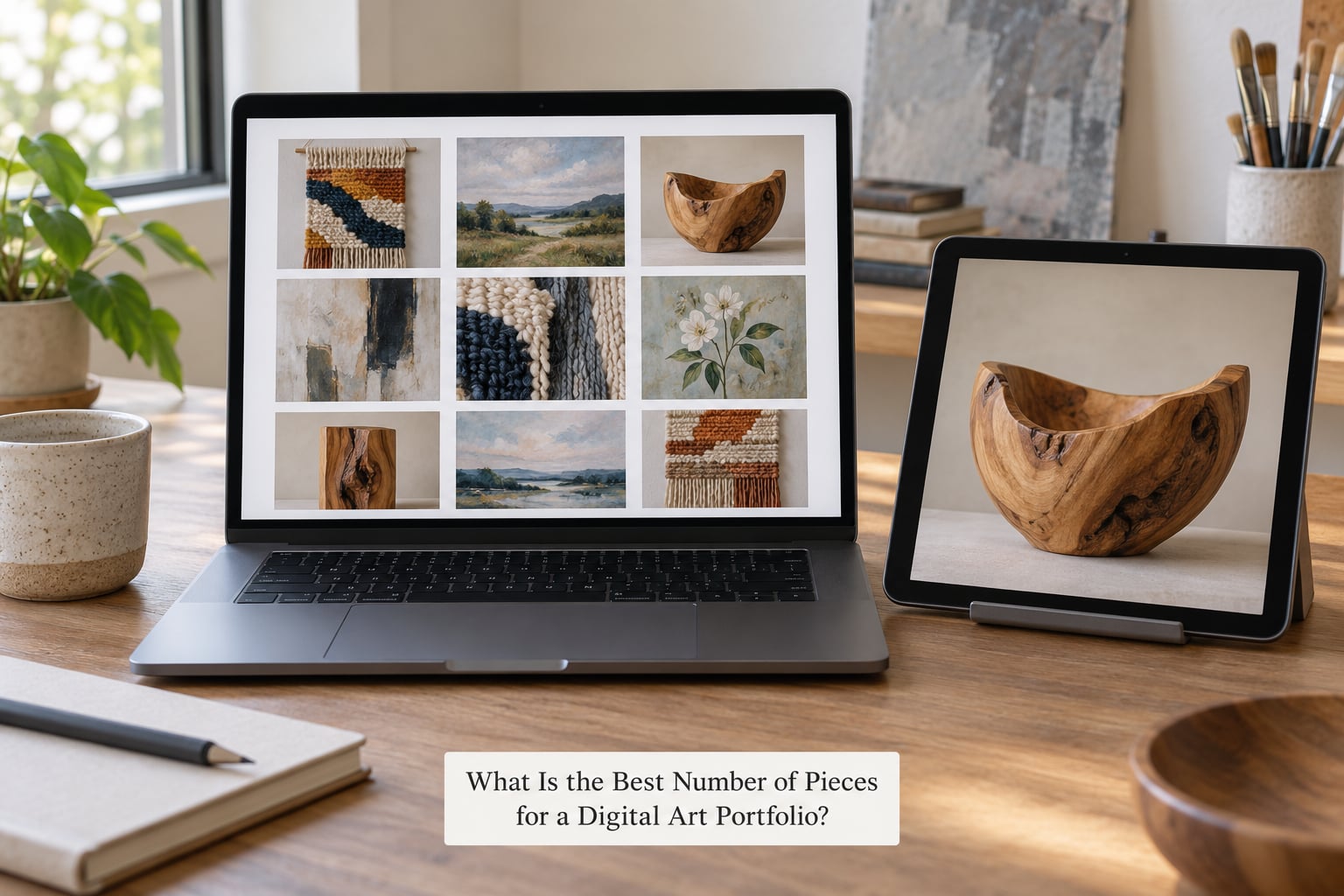
On a website, the full gallery can hold 20 to 30 pieces without harming you, because a visitor chooses their own depth. The risk is different: the homepage and the first two screens decide whether anyone scrolls.
Show 10 to 12 pieces on the homepage. Then group the rest by series or medium, so someone who wants depth can follow a thread instead of facing an undifferentiated grid.
For a PDF portfolio, keep it tighter than a website. Somewhere between 12 and 18 pages, one piece per page, with title, medium, dimensions and year beneath. If the PDF is going to a program that wants printed slides, that’s where your 10 to 15 applies directly.
On a portfolio meant for a client pitch, cut to 6 to 10. Long enough to show range, short enough that a busy person reads it before their next meeting.
Whichever format you pick, set a review date. Most portfolios rot because nobody removes the old work. Every six months, swap out two or three pieces for newer work and your count stays healthy without a rebuild.
Frequently Asked Questions
How many pieces are usually in an art portfolio?
Most art portfolios hold between 10 and 15 finished pieces. That range is long enough to demonstrate range across mediums and short enough that a reviewer reaches the end with attention left. College applications usually sit at 8 to 15, while a website gallery can run 20 to 30 because visitors choose their own depth.
How many pieces is too many for a portfolio?
For an admissions panel or an open call, past 20 pieces you are adding work faster than a reviewer can absorb it. At roughly 20 to 40 seconds per piece, a 20-piece folder takes about ten minutes of concentrated looking. Past that point notes start repeating and the average piece gets less attention than your best work deserves.
Is 5 pieces enough for an art portfolio?
Five excellent pieces can win an exhibition entry or a critique session, but they give a reviewer little evidence of range. If you only have three to five strong works, publish those honestly rather than padding with weaker pieces. Show them to people who will give you a blunt read, then build the critical mass over the following months.
What should I leave out of my art portfolio?
Leave out unfinished work unless the brief asks for process, near-duplicate pieces, filler made just to reach a count, very old work in a style you have moved past, copied or fan work, and badly photographed pieces. Reviewers judge the whole folder by its weakest entry, so every retained piece has to be defensible.
Should I include unfinished or process work in my art portfolio?
It depends entirely on the brief. Most US art programs want finished pieces, and process work can count against your total unless it is requested. Some illustration, animation and design applications specifically ask for process and development shots. Read the exact requirement, and when it is ambiguous, ask the program in writing before you build the folder.
Do art school portfolios have a maximum number of pieces?
Many do, and those published limits override any general advice you find online. Some programs set a minimum, some set both a minimum and a maximum, and some specify the format for each piece. Check the admissions page for every school you are applying to and record the count, format and deadline for each one before you sort any images.
Conclusion
Start with 10 to 15 pieces, then let the purpose set the real number. College applications follow the school’s published count exactly, open calls reward a tight body of work, client pitches want six to ten targeted examples, and websites need a strong dozen on the homepage with a deeper gallery behind it.
The work that matters is the editing. Pull up everything you have, rank it honestly, and cut back to the smallest number that still shows your range, your consistency and the clearest version of your point of view. Ten pieces that all earn their place will always beat fifteen with padding in the middle.