To title your artwork, work in a fixed order: describe what the piece physically contains, name the idea or memory behind it, pick one titling direction, generate at least ten candidates, test them, then record the winner everywhere it appears. That whole process takes about twenty minutes once you have a worksheet, and it removes the blank-page paralysis that sends most artists to “Untitled 7.”
A title is not decoration. It identifies the piece in a catalogue, tells a viewer how to approach it, helps a curator or search engine find it, and holds its meaning next to every other work in your portfolio. Most of the difficulty comes from trying to do all four jobs in three words on the first attempt.
Table of Contents
- What You Need
- How to Title Your Artwork Step by Step
- 1. Describe what the artwork contains
- 2. Identify the idea or story behind it
- 3. Choose a title direction — this is where you decide how to title your artwork
- 4. Brainstorm 10 to 15 possibilities
- 5. Test the strongest options
- 6. Record the final title consistently
- Common Mistakes
- Frequently Asked Questions
- How long should an artwork title be?
- Should artwork titles use title case or sentence case?
- How do I title an abstract or mixed-media artwork?
- Can I change an artwork title after it is exhibited?
- What if I borrow a phrase or line for an artwork title?
- How do I choose a title when several interpretations are possible?
- Conclusion
What You Need
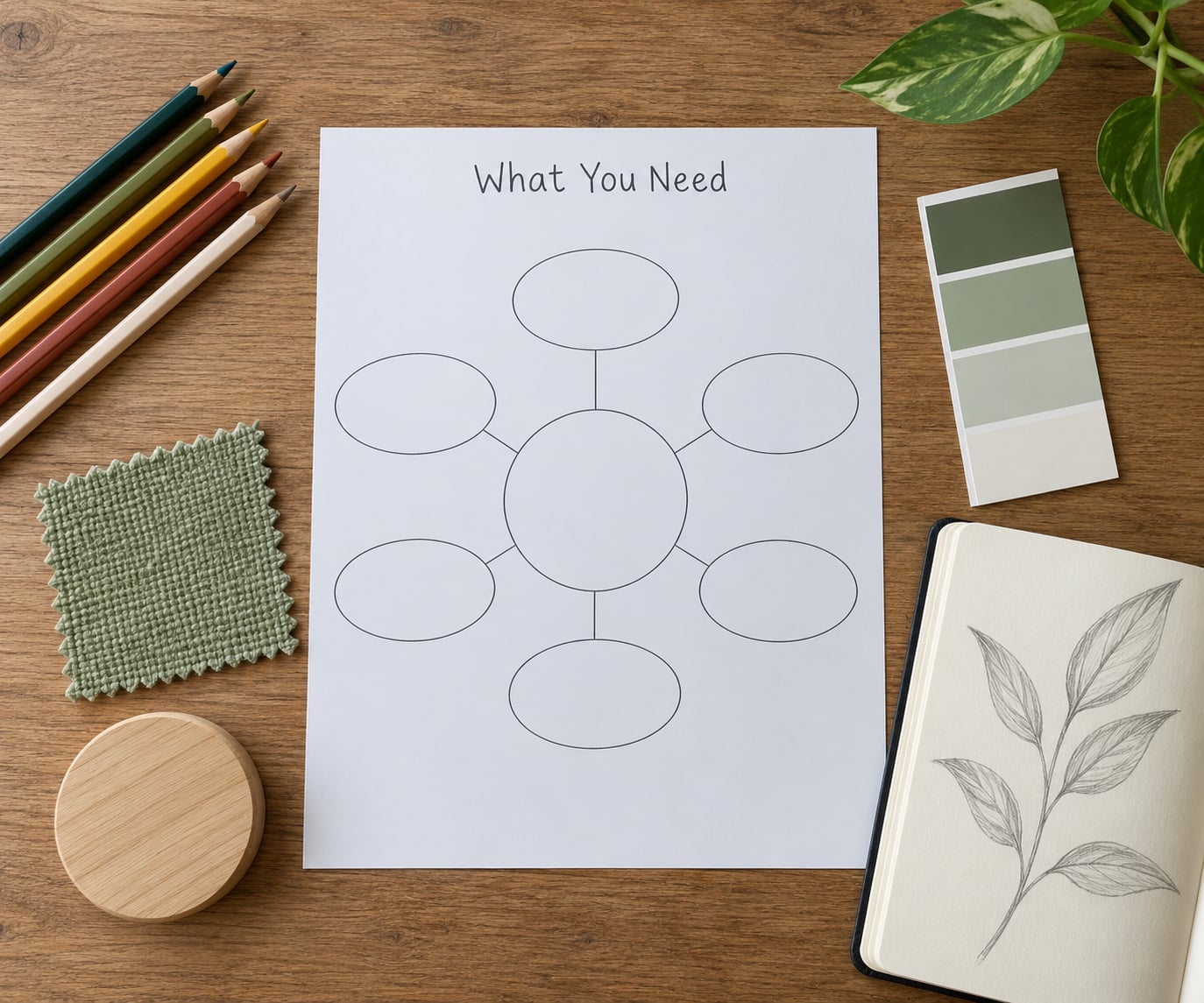
Five things, and nothing expensive:
- A title brainstorming worksheet. A single page divided into four boxes: what the piece contains, what it is about, keywords, and candidate titles. One sheet per finished work keeps titles from blurring together.
- Your project statement or exhibition brief. Even two sentences about why you made the piece. If it is for a juried show, the brief usually tells you what the selection committee is looking for.
- A list of visual and conceptual keywords. Five to ten words you can pull from cold: colour names, materials, verbs, place names, words from your research.
- Reference sources. Your sketchbook, field notes, a lyrics list, poetry you have marked, a thesaurus, or a painter you admire whose titles you have studied.
- A place to record the final title. One file or notebook where the approved title, the date it was approved, and the format rules live.
How to Title Your Artwork Step by Step
1. Describe what the artwork contains
Start with facts, not feelings. Write one plain sentence listing the central subject, the materials, the dominant shapes, the colours, the textures, and any action happening in the frame.
A hand-stitched linen piece with rust and indigo wool, running stitch in horizontal bands, frayed edge, might read: Hand-stitched linen with rust and indigo wool, running stitch in horizontal bands, frayed edge.
No judgement yet. This inventory is not the title; it is the raw material you will cut from. Descriptive titles built straight off this sentence are useful for studio references and inventory sheets, and they work well for online listings where someone is searching for exactly that thing.
2. Identify the idea or story behind it
Now ask what the piece explores, suggests, remembers, questions, or changes. This is the layer that separates a title that informs from one that stays with someone.
Useful prompts: Where was I when I made it? What in my life or the news does it touch? What does one shape do to the shape beside it? What did I want the viewer to feel first? If the work is stitched, what does the labour itself argue about — speed, patience, repair, care?
Write two or three sentences here even if they are rough. I keep notes from the day of stitching next to every piece, and a year later those notes are the difference between a title and a guess.
3. Choose a title direction — this is where you decide how to title your artwork
Direction beats inspiration. Once you know which kind of title suits the piece, generating names becomes a mechanical task rather than a creative one.
| Direction | Best for | Example | Main risk |
|---|---|---|---|
| Descriptive | Representational work, inventory, online listings | Study in Rust and Indigo | Reads like a file name |
| Evocative | Atmospheric paintings, portraits, fibre work | Stillness, Interrupted | Too many pieces end up poetic |
| Concept-driven | Work built around an argument or idea | Mending the Ledger | Meaning lands only on the artist |
| Narrative | Storytelling pieces, series with a plot | The Hour Before the Rain | Over-explains the work |
| Material-based | Textile, wood, mixed media, process pieces | Forty Rows of Indigo | Ignores the idea entirely |
| Place or memory | Work tied to a location or a person | Grandmother’s Table, North Window | Private to the artist |
| Borrowed text | Poetry, a song, a line from a book | Salt and Weather | Uncredited, or too familiar |
Most strong studio practices mix directions. Descriptive for the inventory sheet, evocative on the wall label. Pick a primary direction for the finished work and you are halfway there.
4. Brainstorm 10 to 15 possibilities
Generate volume, then judge. Editing at candidate three is how you end up back at “Untitled.”
From the linen piece above, one project can push out a descriptive title, a material title, a place title, and a conceptual one: Frayed Horizon, Forty Rows, Mending the Ledger, What the River Took Back. Four directions, four real options, all defensible.
Work fast and write everything down, including the bad ones. Combinations, contrasts and opposites work well: Blue Inventory, Repair Log, Something Held, Night Work, Counting the Rows.
5. Test the strongest options
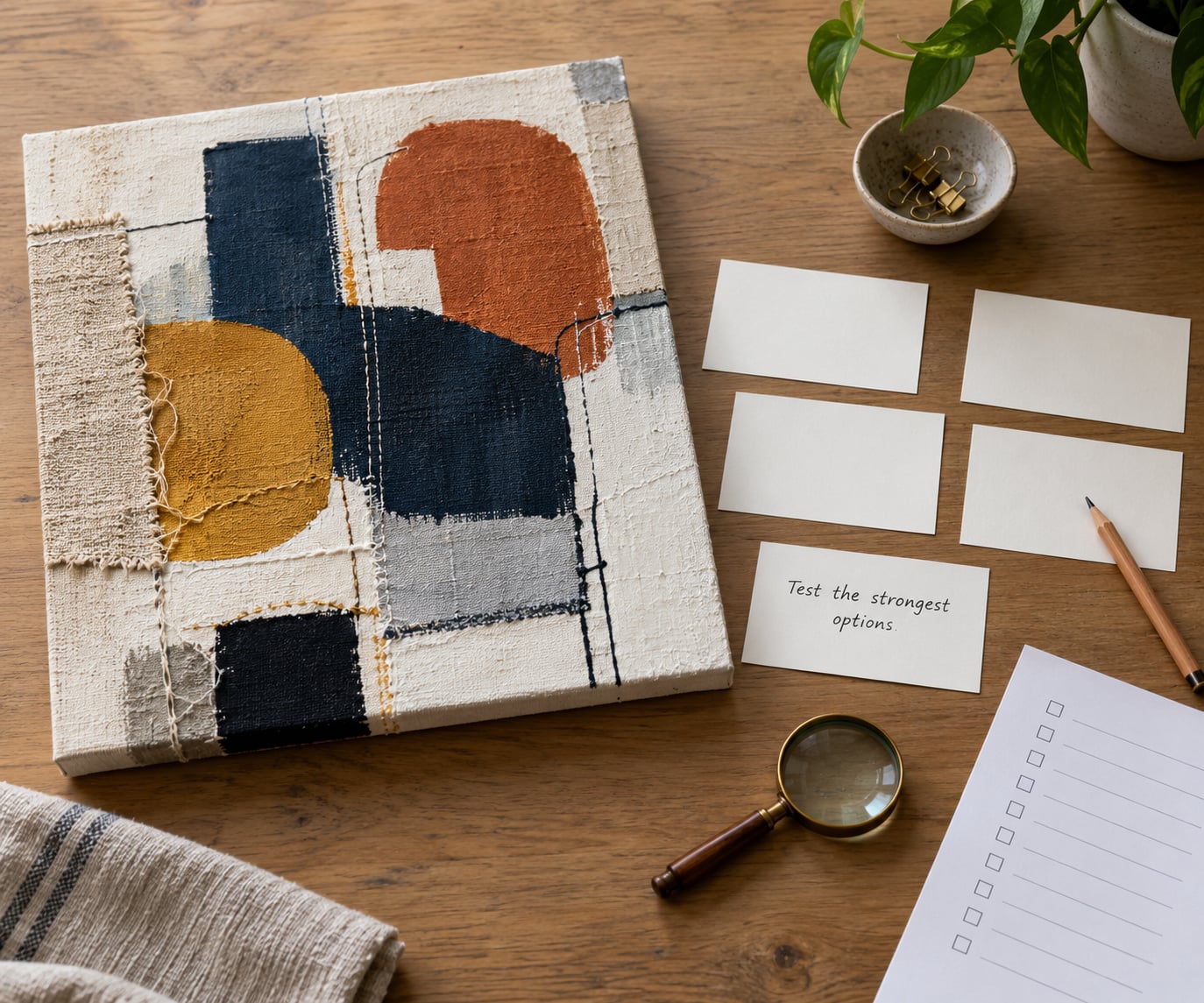
Cut to three and run them against seven questions:
- Accuracy. Does it describe something actually in the work? A wrong title is worse than a vague one.
- Memorability. Say it out loud three times. If you stumble, a stranger will too.
- Pronunciation. If you have to explain how it is said, simplify it.
- Interpretation. Does it open the work up or close it down to a single reading?
- Length. Three to seven words is the working range. Longer is fine for conceptual work, shorter for fibre and textile pieces.
- Audience fit. Does the juried show, gallery, marketplace, or portfolio want this register?
- Stand-alone use. Read it on the wall with no wall text and no you standing next to it. Does it still work?
The stand-alone test settles more arguments than any other. A title that only makes sense after you explain the piece has been shrunk to fit.
6. Record the final title consistently
Once you choose, freeze the format so the title looks the same everywhere: the digital file, the artwork catalogue, the label, the inventory sheet, the certificate, and every exhibition document.
Settle these details and write them down:
- Capitalization. Sentence case is safe and common in gallery writing. Title case works too, just be consistent within one body of work.
- Punctuation. Use a colon only when the second half genuinely adds something.
- Italics. Titles of standalone artworks are usually italicized in captions, listings, and essays.
- Foreign titles. Keep the original language, add a translation in brackets, and note the source credit.
- Borrowed phrases. Record where the line came from. Credit it in your catalogue even when the label stays short.
Log the approval date next to the title. Renaming is legitimate later, but only with the old version documented, so past exhibition records still make sense.
Common Mistakes
Over-explaining. A title that narrates the entire work in a full sentence belongs in the caption. Fix: cut to the shortest phrase that still holds the idea.
Unexplained private references. If the title only means something to you and your grandmother, it excludes the room. Fix: keep the reference if it matters to you, then let the statement do the explaining.
Copying a famous title. Reusing the exact title of a work you admire creates real confusion in search results and gallery records. Fix: find the idea behind the title, not the title itself.
Placeholder titles left in place. “Untitled,” “Study 3,” and “Abstract 7” are working labels, not final names. Fix: set a renaming date when the piece is finished.
Changing titles without a record. A silent rename breaks every catalogue entry that referenced the old name. Fix: keep both versions with dates in your inventory.
Titles that sound vague on purpose. Sounding poetic is not the same as saying nothing. Fix: run the stand-alone test — if the title could fit any piece in the room, it needs sharpening.
Borrowing names from cultures that are not yours. Taking a sacred, Indigenous, or religious term for decoration can harm people beyond the studio. Fix: use your own language, or research and credit the source properly.
Frequently Asked Questions
How long should an artwork title be?
Three to seven words is the useful working range for most finished pieces. Shorter works well for single evocative names in fibre, textile, and abstract work. Longer is acceptable when the title carries a concept, a quotation, or a question. The limit is not word count but whether the title can be read cleanly from a label, a thumbnail on a phone, or a search result.
Should artwork titles use title case or sentence case?
Both are accepted in gallery and catalogue writing. Sentence case, where only the first word and proper nouns are capitalised, is the safest default and reads well in listings. Title case is common in North American fine art contexts. Pick one and hold it across a body of work so your catalogue, labels, and website do not drift apart.
How do I title an abstract or mixed-media artwork?
Return to the process rather than the image. Write down the materials, the marks, the colours, and the physical action, then name the idea behind them: a memory, a tension, a question, a state of mind. Titles for non-objective work usually come from process or concept rather than subject, so keep a running word journal and treat placeholder names as temporary from the start.
Can I change an artwork title after it is exhibited?
You can, but document it. Keep the previous title, the date you changed it, and where it was used, so past catalogues, receipts, and loan records stay accurate. Avoid renaming a piece currently on show or listed with a gallery without telling them first. Once a work enters a printed catalogue or a certificate, treat the title as close to permanent.
What if I borrow a phrase or line for an artwork title?
Borrowing a line from a poem, song, or book is common practice, and it is fine when you credit it. Record the author, work, and version in your catalogue notes, and consider adding the credit to the wall label or statement. Be careful with phrases that are already the titles of well-known artworks, and avoid lyrics used commercially without checking usage rights.
How do I choose a title when several interpretations are possible?
Choose the one the work can best support, not the cleverest one you can defend. A title that fixes a single reading narrows the work; a title with enough precision to orient and enough openness to allow keeps viewers thinking. When two options stay close, show both to two or three trusted people without context and see which one they repeat back to you.
Conclusion
Start now, before the piece is finished and the title feels urgent. Write one sentence describing what it contains, choose five visual or conceptual keywords, and draft ten possible titles in the direction that suits the work best.
Then run those ten through the test: accurate, sayable out loud, open enough to invite a second look, and readable on a wall with no explanation beside it. Pick one, write it into the catalogue the same day, and let the rest go.