Writing an artwork description for a website comes down to three layers: the fixed facts, one concrete detail about what a visitor can actually see, and a short sentence on what the work is about. Most weak listings stop after the facts, which is why they read like an inventory sheet. This guide is current for 2026 and walks through the sequence I use when I draft copy for a studio catalogue.
It takes about twenty minutes per piece once the details are gathered, and the hard part is not the writing. It is deciding what a stranger standing in front of the work would want to know.
Table of Contents
- What You Need
- Step-by-Step: How to Write an Artwork Description for a Website
- 1. Start with the essential artwork details
- 2. Describe the materials and techniques accurately
- 3. Explain the subject or visual focus
- 4. Connect the artwork to its inspiration or process
- 5. Write for the website’s specific purpose
- 6. Edit for clarity, voice, and accessibility
- Common Mistakes
- Frequently Asked Questions
- How long should an artwork description be for a website?
- Should an artwork description include the artist’s personal story?
- What is the difference between an artwork description and an artist statement?
- How do I write an artwork description for SEO without sounding forced?
- What should I include when describing a mixed-media artwork?
- How can I describe an artwork when its meaning is open-ended?
- Conclusion
What You Need
Gather these before you type a word. Most artists already have all of it somewhere in the studio.
- Title exactly as it appears on the work, including any subtitle or bracketed note.
- Year the work was finished, plus a start date if it was a long project.
- Medium written the way a gallery would write it, for example oil on canvas or hand-dyed cotton, pieced and appliquéd, hand-stitched.
- Dimensions, height first, then width, then depth. Give metric and imperial if your visitors are likely to be outside your country.
- Techniques you can verify: layered glazing, resist dyeing, relief printing, machine quilting, hand stitching.
- Subject matter, in plain words. What is in the picture, or what moves through it.
- Inspiration and process: the photograph, place, conversation, sketch or material constraint the work grew from.
- Practical details a buyer asks about anyway: framing, care instructions, edition size, whether the piece is signed.
- Your images and records so you can check facts as you write rather than from memory.
A complete description does not require an art-history lecture. If a visitor cannot tell what the piece is made of, how big it is and what they would be looking at, the rest is decoration.
Step-by-Step: How to Write an Artwork Description for a Website
The order below is deliberate. Facts first, because that is what search systems and screen readers pull out, then what is visible, then what it means, then the edit.
1. Start with the essential artwork details
Open with identification rather than adjectives. This is the tombstone information that every gallery, auction house and catalogue carries in the same order.
Harbour Light, 2026. Oil on canvas, 60 x 80 cm (24 x 32 in). Signed and dated verso.
Keep the field order identical across every page on your site: title, year, medium, dimensions. Consistency is what lets a collector scan twenty listings in a row without re-reading each one.
Check the details against the physical label, your studio book, receipts for materials or an old inventory sheet before you publish. Dates drift, dimensions get measured once and never again, and a medium written from memory three years later is often the one field you got wrong.
One more consistency decision: pick one date style and one unit style and hold them. Mixed formats across a catalogue look careless even when the individual pages are fine.
2. Describe the materials and techniques accurately
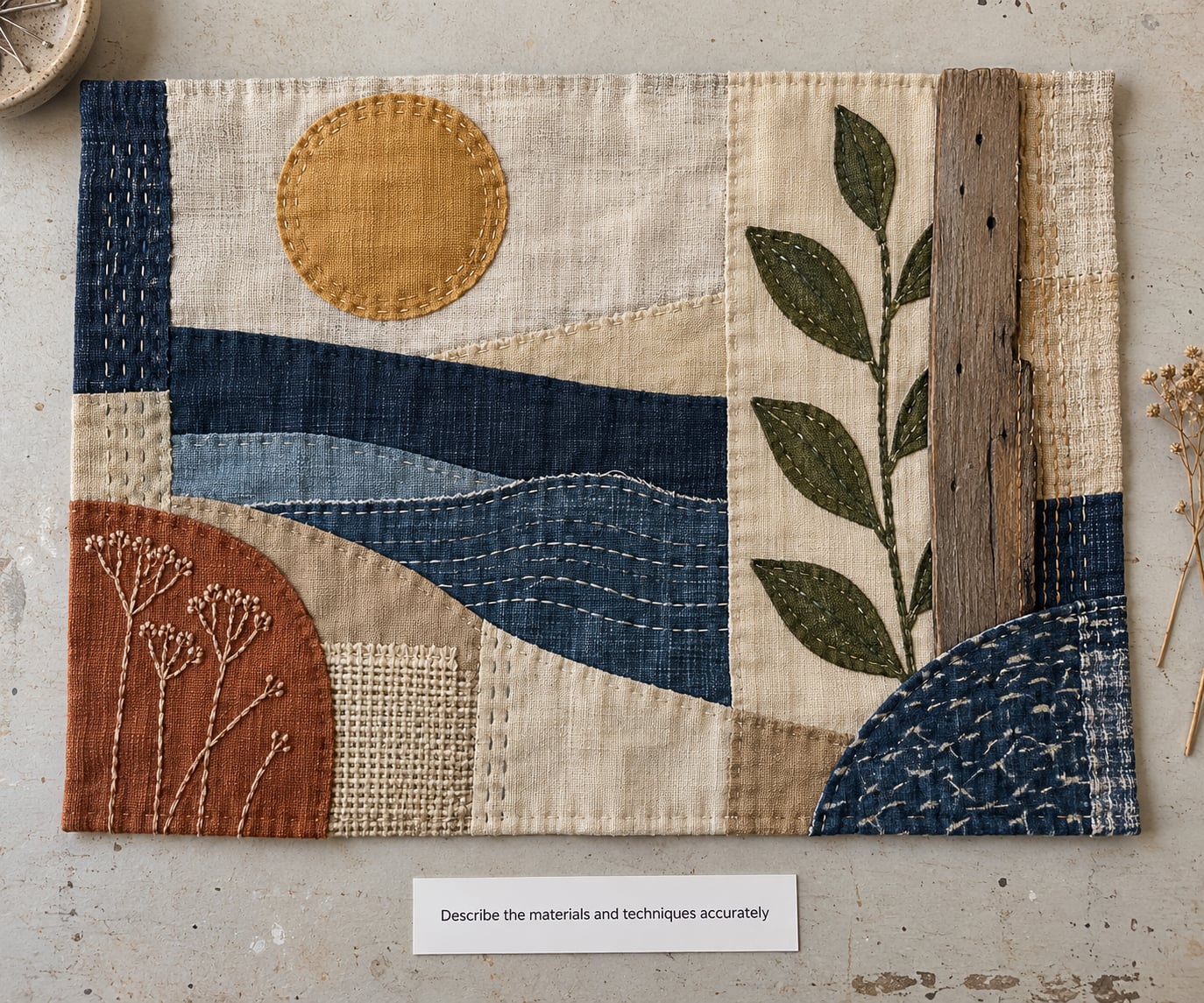
Name the material the way a gallery would, then add the process a visitor can see. Oil and cold wax on linen tells a reader more than a mixed-media painting. Hand-dyed cotton, pieced and appliquéd, hand-stitched tells a reader more than textile art.
Describe what is visible and verifiable: layered paint scraped back at the edges, stitched lines crossing the surface, woodcut forms printed in two colours, shapes appliquéd over a pieced ground. Those details let someone picture the work without opening the image.
Do not overstate. If you cannot name the binder, write acrylic paint. If you are unsure of the fibre, check the bolt or the offcut before you call it linen. And drop empty claims: intricate, masterful and stunning describe your mood, not the object.
3. Explain the subject or visual focus
Move in two steps. First, what a visitor can see. Second, what you think the work explores. Keeping those apart is what separates a description from a sales pitch.
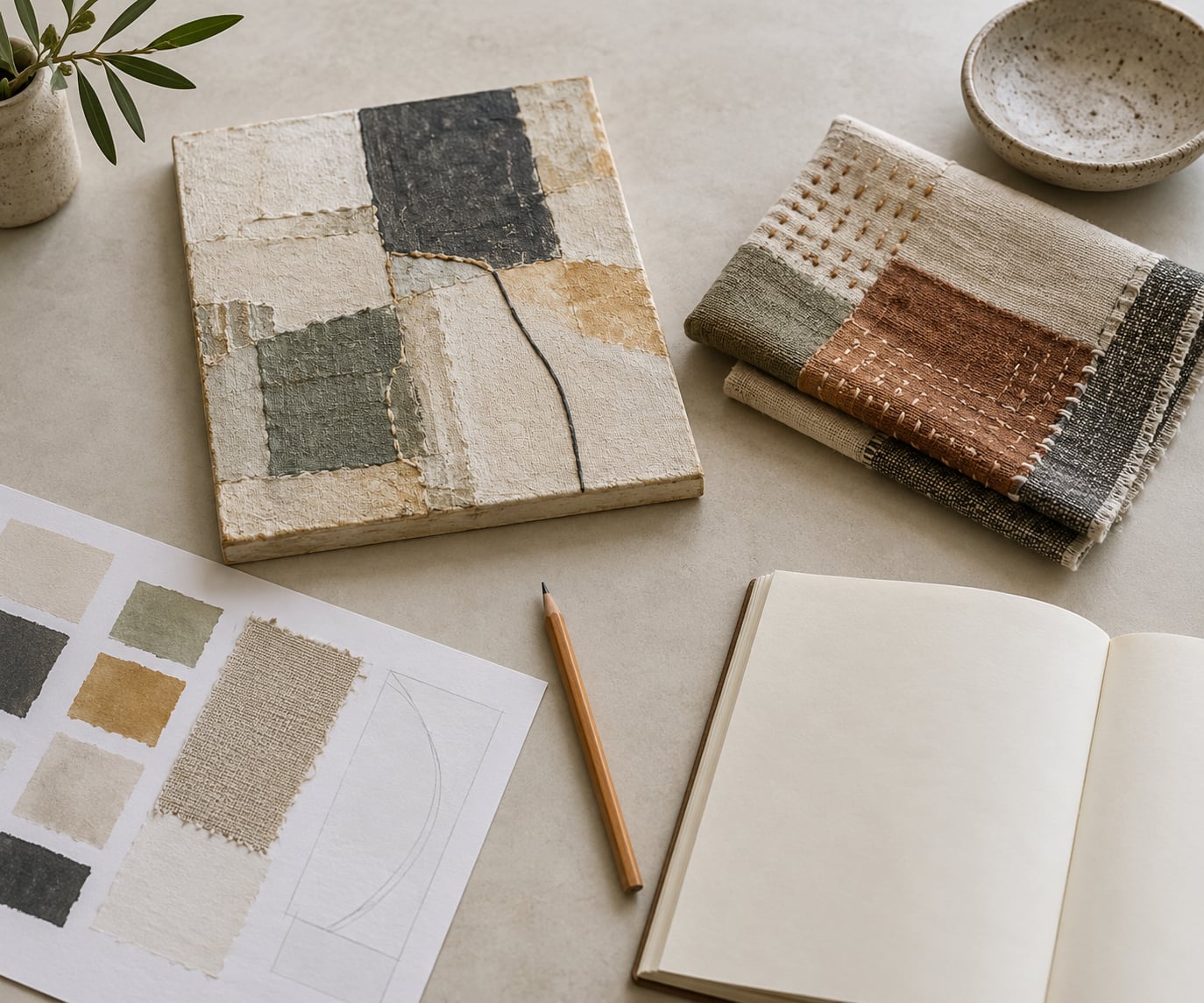
Objective: Overlapping shapes in rust and slate move from a dense centre out to open edges, and the stitched seams between them stay visible.
Interpretation: The artist describes the work as an attempt to hold on to a place that is already changing.
The first sentence works on its own. The second is a claim, so anchor it: I think of it as…, for me this is…, or the series came out of…. Readers forgive a stated point of view far more readily than an unearned claim about their own feelings.
Abstract and non-representational work needs a different starting point. Describe structure instead of subject: where the density sits, how the eye moves, what the edges do, how many colours are in play and where the quiet areas are. The heaviest marks sit just off centre, and a wide band of untouched ground runs along the bottom third. That sentence is about as useful as a subject would be.
4. Connect the artwork to its inspiration or process
One story hook is enough. It should tell the reader something they cannot get from the image, and it should come from a real source: a photograph, a coastline, a newspaper clipping, a sketchbook page, a conversation, or a limitation of the material itself.
Artists on art forums keep reporting the same thing. Descriptions built around process and the moment a piece came from connect far better than descriptions built around technique. Eight hours of stitching went into the lower third, where the pattern breaks apart. That is the kind of line people remember.
Keep it to two sentences. Test it by asking whether the sentence would still make sense pasted onto a different painting. If it would, it belongs to the artist, not the work, and it should go in your artist statement instead.
5. Write for the website’s specific purpose
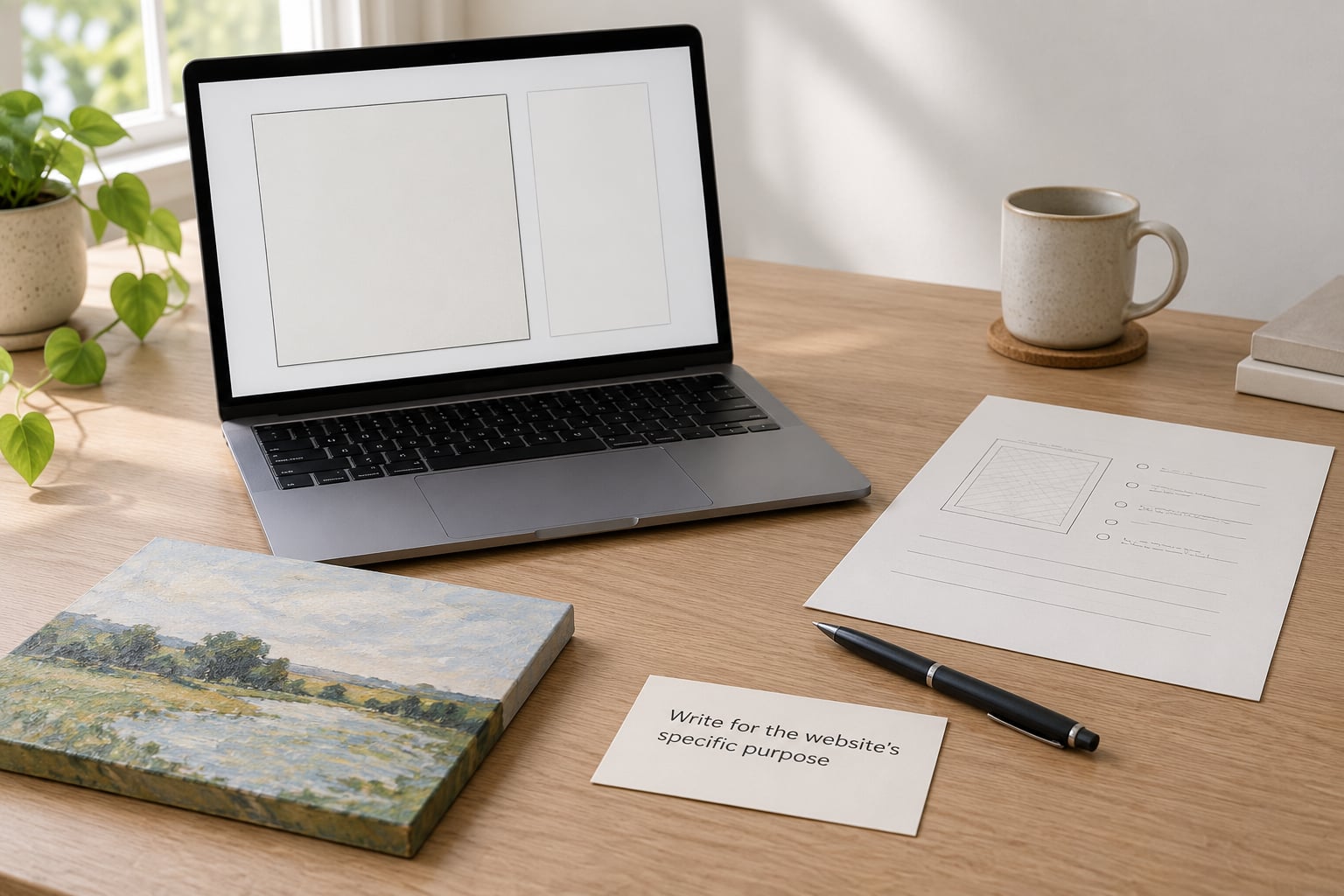
Write the long version once, then cut it. The same facts support every placement; only the emphasis changes.
- Portfolio page: 70 to 100 words. Full detail block, then the visual focus, then the process hook. Let the reader’s eye reach the image quickly.
- Gallery or museum-style listing: 40 to 60 words, factual and neutral, no first-person selling language. This is the format curators expect.
- Online shop listing: the facts first, then everything practical a buyer would otherwise have to email you about. Keep one clear route to an enquiry or purchase.
- Exhibition page: the works share a theme, so let the connection between pieces do the talking.
- Classroom or archive: keep the technical notes and add your process notes. Precision matters more here than persuasion.
Because the factual block never changes, you are not rewriting the work each time. You are choosing a length and a tone, which takes about two minutes per placement.
6. Edit for clarity, voice, and accessibility
Read the finished draft out loud. If you run out of breath, the sentence is too long for a website.
- Replace vague praise with something a camera can confirm.
- Use active verbs: the layers overlap, not overlapping are found.
- Cut jargon a first-time art buyer would have to look up. If you cannot define a word in nine words, drop it.
- Use second person where it helps: hang it where you have space to see the whole surface.
- Keep the same field order you used in step 1.
- Write alt text that describes the picture in plain words, so it works for screen readers and for search engines at the same time.
- Name your image file after the work, the artist and the year rather than IMG_2043.jpg.
- Add structured data for the artwork, using the VisualArtwork or Product markup your platform supports.
- Move exhaustive specifications into a separate table so the narrative stays readable.
Common Mistakes
Starting with vague adjectives. A beautiful, evocative piece… tells a reader nothing and reads as filler. Fix: open with title, year, medium and dimensions, then move to what is visible.
Mixing interpretation with fact. Stating that a work evokes something reads as the reader’s reaction, not yours. Fix: mark interpretation as yours with I think of it as… or the artist describes it as…
Omitting dimensions or the medium. These are the two fields buyers scan for first, and a missing measurement is the most common reason an enquiry stalls. Fix: treat them as mandatory and check them against your records before publishing.
Overloading the description with biography. An artwork page is not an artist statement. Fix: move background material to a separate page and link to it once.
Repeating the same details. If the dimensions appear in the heading, the opening line and a specifications table, the reader notices the repetition rather than the work. Fix: each fact appears once in the narrative, and once in the table.
Failing to distinguish the work from the practice. In my usual style I explore… describes a body of work, not this piece. Fix: name what is different or specific about the artwork in front of the visitor.
Writing for a peer instead of a buyer. A lot of artists describe beyond the basics and stop at size, medium and year, which leaves the listing flat and hard to buy. Fix: add one concrete visual detail and one process detail. That is usually enough.
Frequently Asked Questions
How long should an artwork description be for a website?
For a portfolio page, 70 to 100 words is the sweet spot: enough for the fact block, one visible detail and one process sentence. A gallery-style listing needs only 40 to 60 words. Marketplace listings often cap you lower, so save the long version for your own site and cut from there.
Should an artwork description include the artist’s personal story?
Only one sentence of it, and only when it connects to the specific work. A memory that produced the palette or the composition is useful. Your childhood, your training and your artistic philosophy belong on an artist statement or about page, not on an artwork page.
What is the difference between an artwork description and an artist statement?
An artwork description covers one piece: title, year, medium, dimensions, what is visible, and what it is about. An artist statement covers your practice as a whole, written in the first person, usually 150 to 300 words. A statement is not edited down per work; a description is.
How do I write an artwork description for SEO without sounding forced?
Use the words a buyer would actually type, once, in plain sentences: the medium, the subject, the size and the artist’s name. Put the title in the heading and the image file name. Write alt text that describes the picture for someone who cannot see it. Skip keyword lists entirely; repetition reads as spam to both people and search engines.
What should I include when describing a mixed-media artwork?
List every material in the order it was applied, then describe how they meet. For example: hand-dyed cotton, pieced and appliquéd, hand-stitched, with painted pine elements attached at the edge. Name only what you can verify, note any section that can be seen from both sides, and say whether the surface is textured enough to need a shadow gap frame.
How can I describe an artwork when its meaning is open-ended?
Describe the structure instead of the message: where the density sits, how the colours relate, where the quiet areas are and how the eye travels through the piece. Then state your reading as your reading, not as fact. Viewers are comfortable with a labelled interpretation; they are not comfortable being told what they should feel.
Conclusion
Start with the factual inventory and check every field against your records. Then add one sentence about what a visitor can see, one sentence about where the work came from, and one about what it means to you, marked as your reading. Cut to the length your placement needs and read it out loud once before you publish. That last step catches more weak descriptions than any template will.