How to ship a quilt to a buyer comes down to five moves: press it clean, fold it loosely with tissue supporting every fold line, seal it in a plastic bag, box it in a USPS flat rate or Regional Rate box, then insure it for its full sale value and require a signature. The whole job takes about 30 minutes of packing plus a trip to the counter, and the hard part is not the packing. It is resisting the urge to cram the quilt into a smaller box.
I have shipped enough quilts to know where things go wrong. A seller once squeezed a queen quilt into a box meant for a baby quilt, then paid the dimensional-weight surcharge and the box still arrived dented. Another shipped a wall-hung show piece folded with no tissue at all and got a complaint the piece had arrived with fold lines already set.
What follows is the process I use, in the order I use it. Adjust for your own pieces, but keep the order.
Table of Contents
- What You Need
- Step-by-Step: How to Ship a Quilt to a Buyer
- Confirm the Order and Delivery Details
- Clean, Inspect, and Photograph the Quilt
- Protect the Quilt in a Quilt-Safe Package
- Choose a Shipping Box or Quilt Mailer
- Seal, Label, and Insure the Package
- Choose the Carrier and Buy Tracking
- Complete the Handoff and Confirm Delivery
- Common Mistakes
- Frequently Asked Questions
- What is the most affordable way to ship a quilt?
- Should I roll or fold a quilt when shipping it?
- What box size do I need for my quilt?
- Do I need to insure a quilt when shipping it?
- How do I ship a quilt internationally?
- What should I do if the quilt arrives damaged?
- Conclusion
What You Need
Gather everything before the quilt comes off the design wall. Hunting for tape with a folded quilt in your arms is how loose threads end up back on the front.
- A fresh box sized for the folded quilt. A USPS Priority Mail flat rate box or a Regional Rate Box, both free from USPS.
- Acid-free tissue paper. Enough to make a roll at every fold. Brown kraft paper works in a pinch, but tissue is better against a dark or light fabric since it will not print through.
- A large clear plastic bag or a polypropylene sack. A clean, unscented bag works; skip anything perfumed.
- A tape roller for lifting loose threads, lint and pet hair off the surface.
- Packing material for void fill. Crumpled tissue, kraft paper, or air pillows. Not packing peanuts. They pour out of a torn seam and settle, leaving the quilt loose in a box that then gets crushed.
- Tape, ideally clear packing tape run along the full seam.
- A printed shipping label or a prepaid label you bought online.
- Your camera or phone for condition photos.
Step-by-Step: How to Ship a Quilt to a Buyer
Confirm the Order and Delivery Details
Read the address off the order twice, out loud. Then check three things people tend to skip: whether the buyer wants the quilt signed, whether they asked for gift wrap, and whether they gave you a delivery window rather than a date.
Message the buyer before you pack, not after. A short note that the quilt is finished and ships in two to three business days does more for your reviews than any packaging choice you make.
If the buyer is in a different time zone or the shipment is going somewhere with unreliable delivery, that is the moment to mention it. Surprise about a late package turns into a complaint every time.
Clean, Inspect, and Photograph the Quilt
Lay the quilt flat on the table with the back up and run a tape roller across the whole surface. That one pass removes the loose threads, lint and hair that buyers otherwise find the moment they unwrap the quilt.
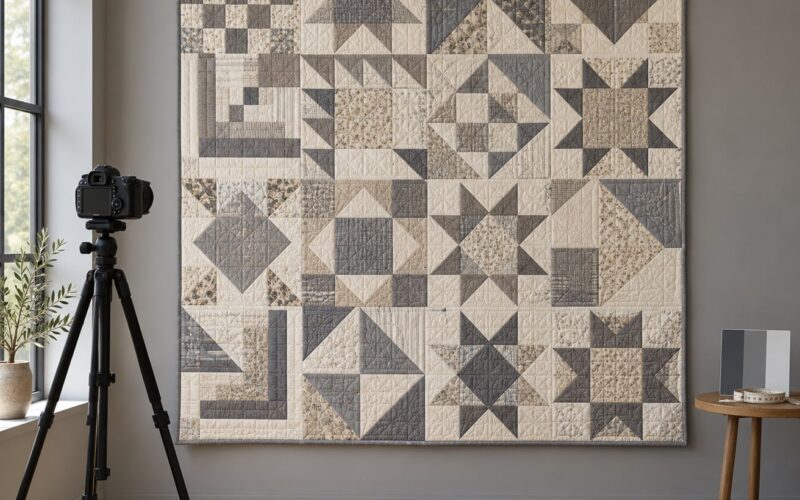
While it is flat, photograph the front, the back, the binding at each corner, and any area with a known flaw. Send a note if something is imperfect. Buyers forgive an honest flaw; they do not forgive discovering it on their own.
Block and press first if the quilt is new or has been stored rolled. Creases pressed out now do not come back. Creases from shipping do, but they relax out of most quilts within a day of being spread flat, which is a much smaller problem.
Protect the Quilt in a Quilt-Safe Package
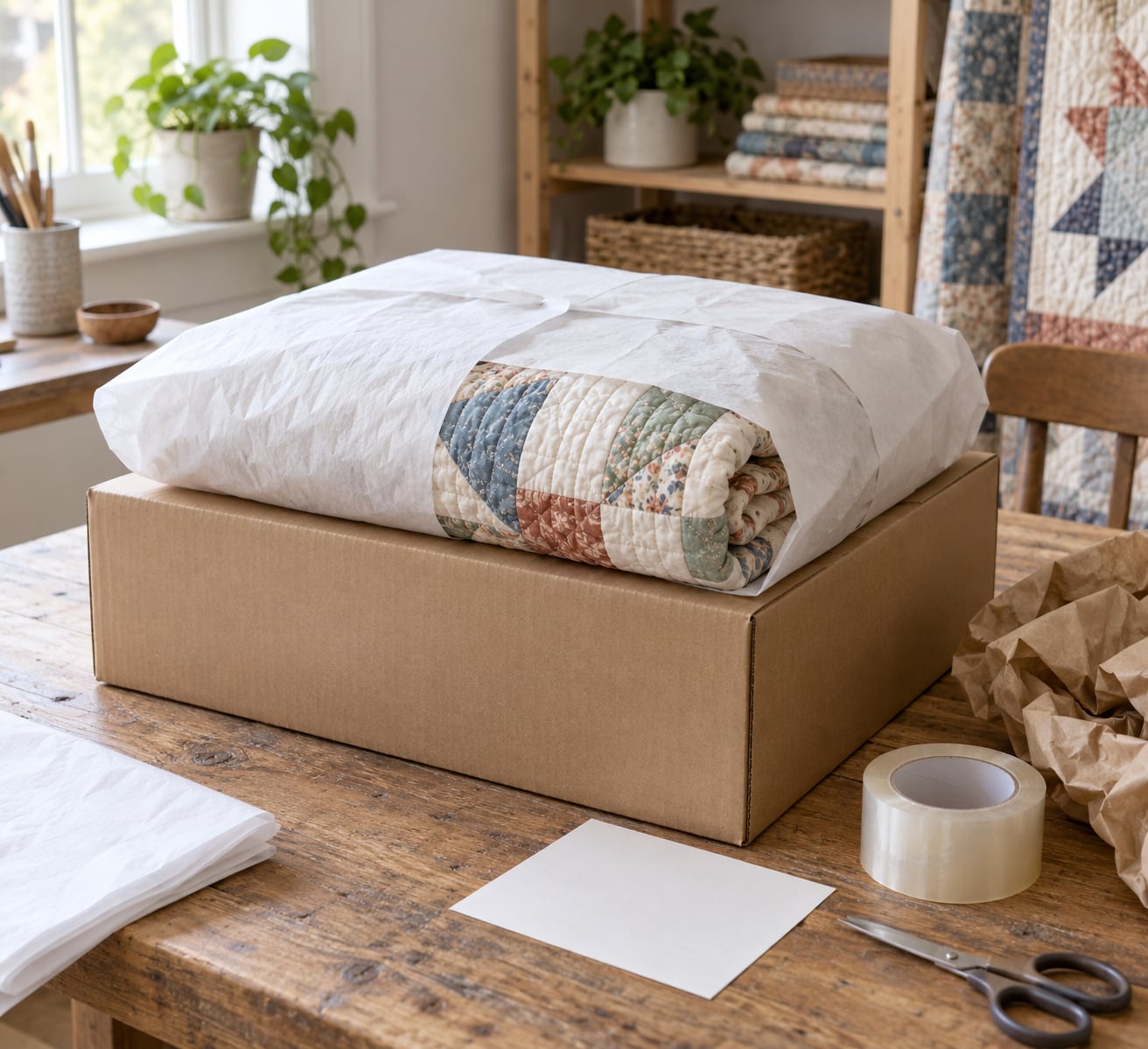
Fold it in quarters or thirds, whichever keeps the finished edge from taking the most stress. Loose folds, not tight ones. You are aiming for a package that reads as soft, because a soft package does not get thrown.
Roll a length of tissue into each fold line so the crease rests on a cushion rather than on the fabric. Repeat the check after each fold; a thread you miss now is a thread you find in the box later.
The bias fold gets shared constantly on video. The honest answer from the quilting forums is that it does not meaningfully outperform a straight fold, and it takes twice the table space. Use a straight fold, support the lines, and move on.
Slide the folded quilt into the clear plastic bag and seal it. This is the single most useful step in the whole process. It blocks rain, road spray and warehouse damp, and it stops a leak in someone else’s box from reaching your quilt.
Tuck the order form, care instructions and your contact details into the bag alongside the quilt. Do not tape them to the outside where they sit in the dirt.
Choose a Shipping Box or Quilt Mailer
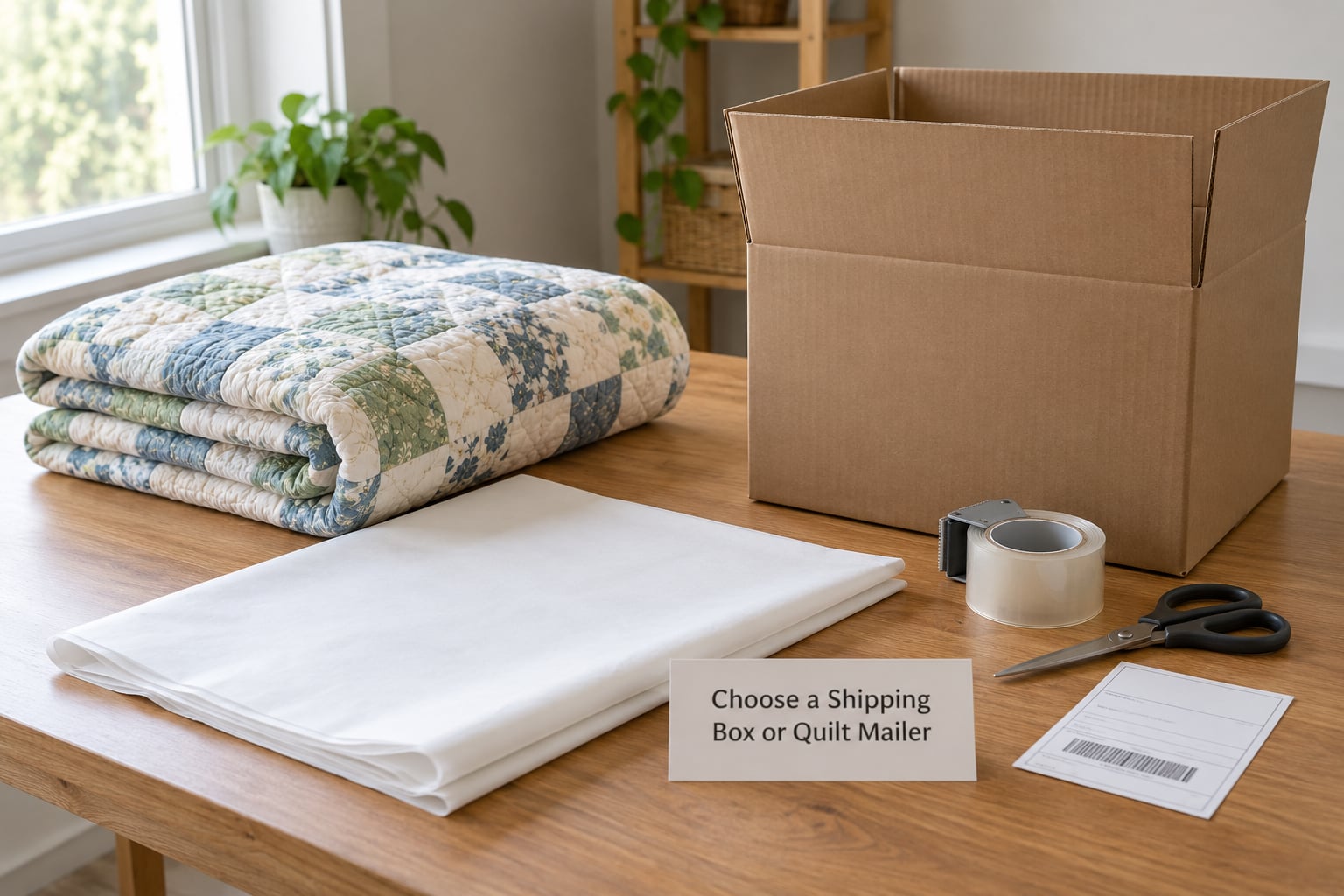
Pick a box the folded quilt fits into with a couple of inches to spare, then fill that space. An under-filled box is the most common reason a quilt shipment gets damaged.
| Quilt size | Container to reach for | What it handles well |
|---|---|---|
| Crib or wall hanging | Small flat rate box or a Poly Mailer-style Tyvek envelope | Light pieces with no batting bulk; note the envelope may be delivered to the mailbox |
| Throw or lap | Medium flat rate box or Regional Rate Box | The workhorse size, and the one most sellers ship |
| Twin | Large flat rate box or Regional Rate Box | Standard folded |
| Queen, king, or oversized art quilt | Largest flat rate box, Regional Rate Box, or two boxes and a second layer of packing | Bulky pieces; anything hanging on a wall gets its own corner protection |
Box sizes matter more than people expect. Quilts are bulky and light, so carriers price them by the space they occupy as much as by weight, and a flat rate box charges one rate regardless of what is inside. The box you choose is the single biggest lever on your shipping bill.
Regional Rate Boxes are cheaper still and also come free from USPS, but they are not stocked at post offices. Order them online well ahead of time and keep a couple on the shelf.
Skip the shipping tube for anything large. The quilting community consensus is firm on this: tubes crush, and a quilt that is 60 by 80 inches does not belong in one. A pool noodle inside the tube turns up occasionally as an idea, but nobody in the threads I read swears by it.
Also skip paper shipping bags. They tear on sorting equipment, and whatever is inside ends up wet or returned.
Seal, Label, and Insure the Package
Fill the empty space with crumpled tissue, kraft paper or air pillows so the quilt cannot slide when the box is turned on its side. Seal along the full seam with tape, not just the flaps.
Put your return address on the label, not written across the top of the box. Keep the outer box clean and unmarked. Writing the word quilt across the lid is the one piece of advice every experienced seller repeats, and they repeat it for the same reason: it does not change how the box is handled, it only changes what happens if the box is opened.
Declare the full sale value. Declared value is the amount on your label and the ceiling on what a carrier will pay out on a proven claim. Insure anything above roughly the price of the box itself, which in practice means almost every quilt you have ever sold.
Request a signature on delivery for expensive work. A signature converts a package that vanished between the truck and the door into a delivery with a named recipient, and that single scan settles most arguments.
Choose the Carrier and Buy Tracking
USPS Priority Mail is the default for quilt shipping in the United States. The boxes are free, the flat rate pricing is predictable, and home pickup is available for Priority Mail packages, so a pickup scan can save you a counter trip on a busy week.
UPS and FedEx work fine if the buyer prefers them or if you are already set up with a business account. What matters is that the service you buy is tracked, insured and, for high-value work, requires a signature.
Skip untracked service entirely, even to save a little. An untracked quilt shipment gives you no scan history, no delivery confirmation and no useful starting point when you need to file a claim.
Compare rates on the carrier’s own rate chart at the time you ship. I deliberately do not quote figures here, because flat rate prices and surcharge rules change several times a year and a stale number in a guide is worse than no number at all.
Complete the Handoff and Confirm Delivery
At the counter, hand the clerk the sealed box and point out that you have declared a value and want a signature. Ask for the receipt and keep it. That receipt is your proof of the declared amount and the date.
If you are shipping from home, leave the box where pickup instructions require and keep the pickup confirmation email, which usually includes a scan and a start time.
Watch the tracking for the first scan. A package that has not moved within a business day sometimes means a label problem, and finding that early is far easier than finding it a week later.
When the buyer confirms arrival, ask how the quilt looked on arrival. If something went wrong, you want the conversation now, with your photos and receipt already in hand.
Common Mistakes
Cramming the quilt into the smallest box. This is the expensive mistake, because dimensional weight punishes you twice: once at the rate, and again when the box gets crushed. Leave room for void fill.
Folding with no tissue in the fold lines. Tissue rolls cost nothing and take a minute. A crease set into a quilt can take months to relax.
Packing peanuts. They shift, they pour out of a torn seam, and they leave the quilt loose in a weakened box. Crumpled paper or air pillows hold their position.
Skipping the plastic bag. It costs a few cents and it is the difference between a wet quilt and a dry one.
Under-declaring the value to save on the insurance fee. You are buying a policy that pays less than the thing you are protecting. Declare the full sale value.
Writing the word quilt across the box. It does nothing for handling and everything for a determined thief.
Tyvek envelopes for anything valuable. They are light, cheap and fine for a small wall hanging. They also land in the mailbox, which is unsafe for a piece priced in the hundreds.
Batching orders and mixing up labels. Photograph each label before you seal its box. It takes seconds and it prevents the single most embarrassing call you can get from a buyer.
Under-filling a Regional Rate Box. The box is priced as if full. Fill the void, and the money you spent on a bigger box comes back.
Quoting international shipping without reading the customs rules. Duties and handling fees get billed to the recipient, and a buyer who was not warned will not forgive it. Ask for the full address and state in writing who is responsible for duties before you accept the sale.
Frequently Asked Questions
What is the most affordable way to ship a quilt?
The cheapest safe route is USPS Priority Mail in a free flat rate box you fill properly, because the rate depends on box size rather than weight. Regional Rate Boxes cost less again but must be ordered online ahead of time. Avoid express service unless the buyer is paying for it, and never save money by using a Tyvek envelope for a high-value quilt, since it goes to the mailbox.
Should I roll or fold a quilt when shipping it?
Fold it. Rolling works for quilt tops going to a longarm quilter, but a finished quilt rolled tight can hold a spiral crease and cannot be stacked flat in a box. Fold loosely in quarters or thirds and roll tissue into each fold line. Creases from a few days in transit relax once the quilt is spread flat.
What box size do I need for my quilt?
Measure the quilt folded, then choose a box that leaves a couple of inches of space on each side for void fill. A throw usually fits a medium flat rate box, a twin needs a large box, and a queen or king often needs the largest box available or a double-boxed setup. If you cannot fill the box you picked, you picked wrong.
Do I need to insure a quilt when shipping it?
For anything above the price of the box, yes. Declare the full sale value on the label and purchase insurance, then keep your photos, the receipt and the tracking history. That combination is what a carrier needs to settle a claim. Request a signature on delivery for expensive work, since one delivery scan resolves most disputes.
How do I ship a quilt internationally?
Use a tracked, insured service and complete the customs declaration accurately, describing the item as a quilt or bed cover and entering the real sale value. Duties and import fees are normally the recipient’s responsibility unless you agree otherwise in writing before the sale. Tell the buyer in advance that a fee may arrive separately from the postage bill.
What should I do if the quilt arrives damaged?
Photograph the box and the quilt before unpacking anything further, keep all packaging, and file the claim with the carrier within their claim window. Send your pre-packing photos, the receipt showing the declared value and the tracking scans the same day. Carriers settle on documented condition, which is exactly what those pre-packing photos were for.
Conclusion
Start with the box, not the quilt. Measure the folded quilt, order a free USPS flat rate or Regional Rate box that leaves room to fill, and get it on the shelf before the sale closes.
Everything after that is repetition: press, tape roll, tissue in the fold lines, plastic bag, void fill, full-value insurance, signature required, receipt kept. Do those eight things the same way every time and a quilt shipment stops being the riskiest part of your week. Buyers in the quilting forums say the same thing over and over, and they are right: what earns the next order is a quilt that arrives flat, on time and exactly as it looked in the photos.