Writing an artwork provenance record takes about an hour for a single work when your paperwork already sits in one folder, and considerably longer when it doesn’t. What you are building is a dated, line-by-line account of who has owned, held and exhibited a specific piece, with every claim tied to a document that supports it and anything you cannot prove marked as unproven.
One clarification first, because search results for this word are cluttered with a different meaning of provenance. In art, provenance is the documented ownership, custody and movement history of an object. In editorial work it means something else entirely, the tracking of where a piece of content came from. Everything below uses the art meaning.
Here is the honest version of how to write an artwork provenance record: identify the work precisely, list every documented event in date order, cite the source for each line, and state your gaps plainly. That is the whole job. Nobody is asking you to reconstruct a history you never had.
Table of Contents
- What You Need
- Step-by-Step: How to Write an Artwork Provenance Record
- 1. Identify the artwork precisely
- 2. Establish the artist and creation details
- 3. Trace the first known owner or appearance
- 4. Record every documented transfer
- 5. Add exhibitions, publications, and other appearances
- 6. Verify sources and resolve contradictions
- 7. Write the final record and maintain it
- Common Mistakes
- Frequently Asked Questions
- Is a provenance record the same as authentication?
- Can an artwork have provenance if earlier records are missing?
- I bought a painting at a flea market. What should the provenance record say?
- I sell direct from my studio with no gallery paperwork. What should I keep?
- Do I need a provenance record to sell my art?
- Conclusion
What You Need
A provenance record is a dated, item-specific account of who has owned, held and exhibited a work, with each claim linked to a source document so that what is documented stays separate from what is only assumed. It is not proof that a named artist made the piece.
Gather these before you start typing:
- The work itself, in front of you. Signatures, stamps, labels and marks on the back, stretcher or frame often answer identification questions no document will.
- Every dated paper you hold. Invoices, receipts, bank or card records, studio logs, gallery contracts, correspondence, exhibition labels, fair catalogues, shipping paperwork, insurance schedules and appraisals.
- A high-resolution reference photograph. Front, back, edges, signature, inscription and any distinguishing marks. Name the file so you can find it again.
- A number for the work. Your own inventory or registration number. Studios that number works rarely have to reconstruct anything later.
- A written timeline, even a rough one. Pencil every remembered owner with a confidence mark: documented, likely, or hearsay.
- Research tools for older work. The Getty Provenance Index, auction house archives, catalogue raisonné volumes, library special collections and national stolen-art databases. They confirm names, dates and appearance; they do not research a fragmented history for you.
If the history is incomplete, that is the normal case for anything bought at a fair, inherited or found. Start at the earliest event you can actually document and write forward from there.
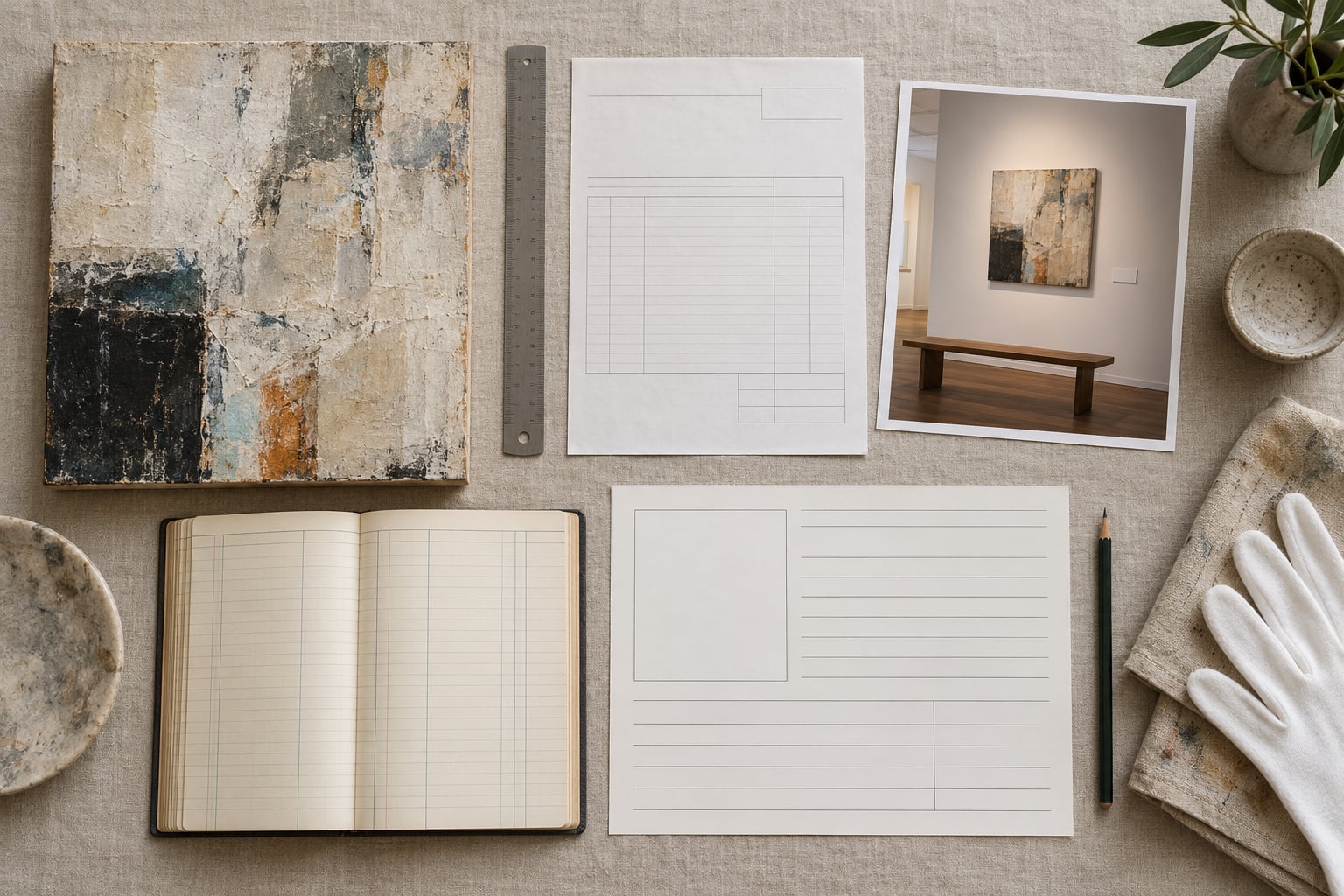
This is the field list, in the order you will fill it:
- Artist’s full name, including life dates.
- Title, or the working title with the artist’s status noted.
- Date of execution, or circa.
- Medium and support, written out.
- Dimensions: image, sheet, and framed where relevant.
- Edition number and edition size, for anything in editions.
- Signature, inscription and their exact location.
- Distinguishing marks and your registration number.
- Date and circumstances of acquisition.
- Exhibitions and publications, with year, venue and reference.
- Source for each entry, and a note on anything unverified.
Step-by-Step: How to Write an Artwork Provenance Record
1. Identify the artwork precisely
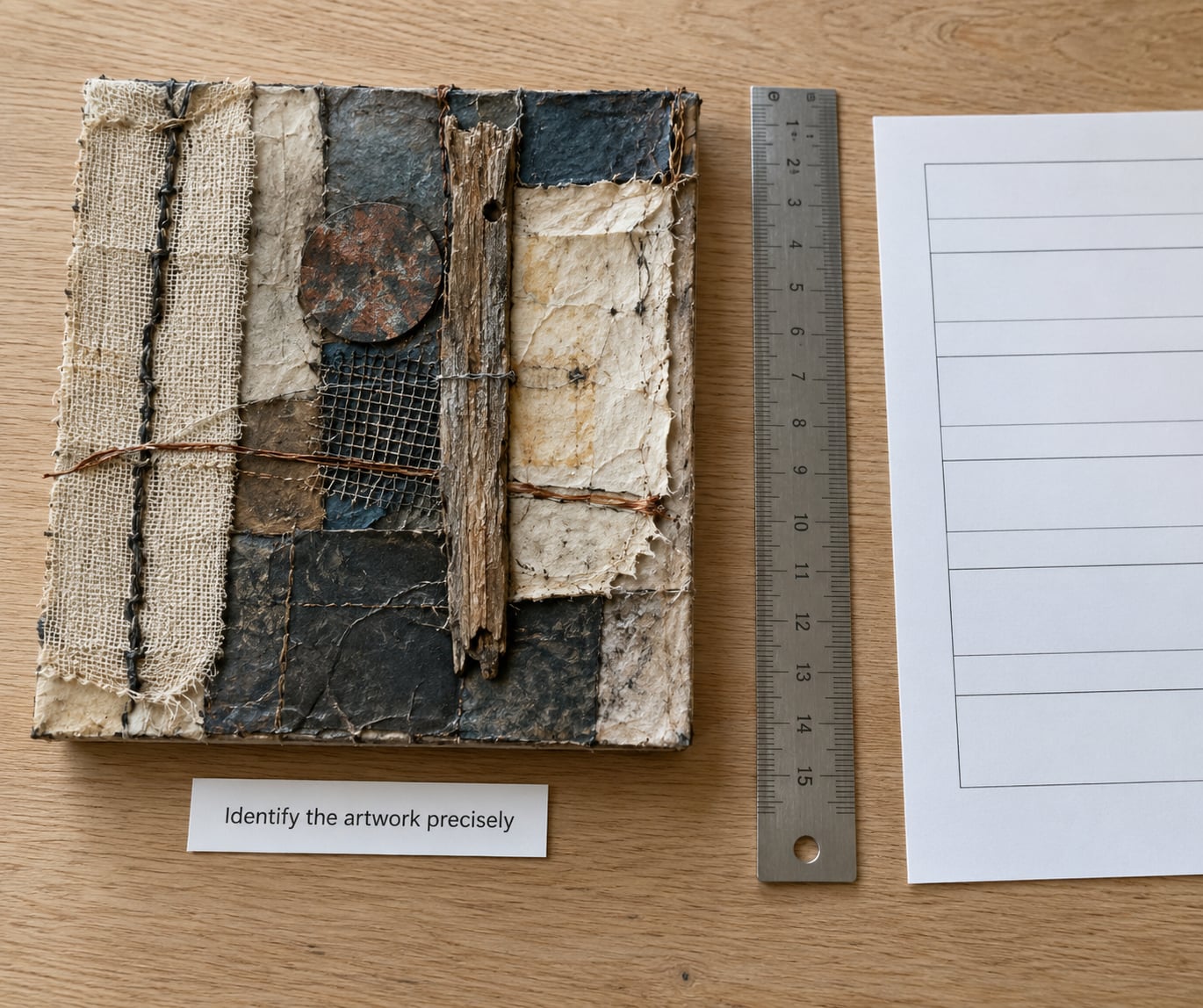
Start with fields that make this object impossible to confuse with another: title, date, medium and support, dimensions, edition number, signature and inscription position, distinguishing marks and your own registration number. Two paintings can share a title and a year. Dimensions plus medium plus a photograph of the signature usually settle it.
Media changes which fields matter most.
| Medium | Fields that carry the identification |
|---|---|
| Painting | Support and ground, dimensions unframed, signature location, date, any studio stamp or accession number on the stretcher |
| Print or edition | Edition number over edition size, sheet size, paper or substrate, printer or publisher, plate or image dimensions |
| Sculpture | Medium and casting method, edition number, height and weight, foundry mark, base stamp |
| Works on paper | Medium on paper, sheet size, signed in pencil, inscribed title and date |
| Mixed media and textile work | Every component listed separately with quantities, thread and fibre types, mounted or framed, dimensions of the support |
Write the medium out rather than abbreviating it. “Archival pigment print on Hahnemuhle Photo Rag, 310 gsm, edition 7 of 40” tells a reader far more than “print”.
2. Establish the artist and creation details
Record the artist’s full legal name and life dates, where the work was made, what it was based on, the materials and techniques, and anyone who helped. Assistants, fabricators, printers and workshops belong in the record because they explain why a work looks the way it does.
Keep two things apart. The studio ledger says the piece was completed in March. Your belief that it was a response to a show you saw in January is interpretation. Mark it as interpretation, or leave it out.
This is also where most readers get the document types confused, so here is the short version.
| Document | What it does | Who issues it |
|---|---|---|
| Provenance record | Documents ownership, custody, movement, exhibition and publication. Written by whoever is assembling the file, usually the artist, studio, collector, gallery or estate. | Artist, collector, studio, gallery or estate |
| Certificate of authenticity (COA) or statement of authenticity | States that a named artist made this specific work. It does not describe who owned it. | The artist, or the artist’s estate or foundation |
| Condition report | Describes the physical state of the object at a date, with photographs. It says nothing about ownership or authorship. | A conservator, gallery or registrar |
Many artists now write their own statement of authenticity alongside the provenance record, which is sensible. Your signature, your contact details, the date, and the exact title, edition and dimensions. A generic certificate covering an entire body of work, with no verifiable issuer, is what serious buyers distrust.
3. Trace the first known owner or appearance
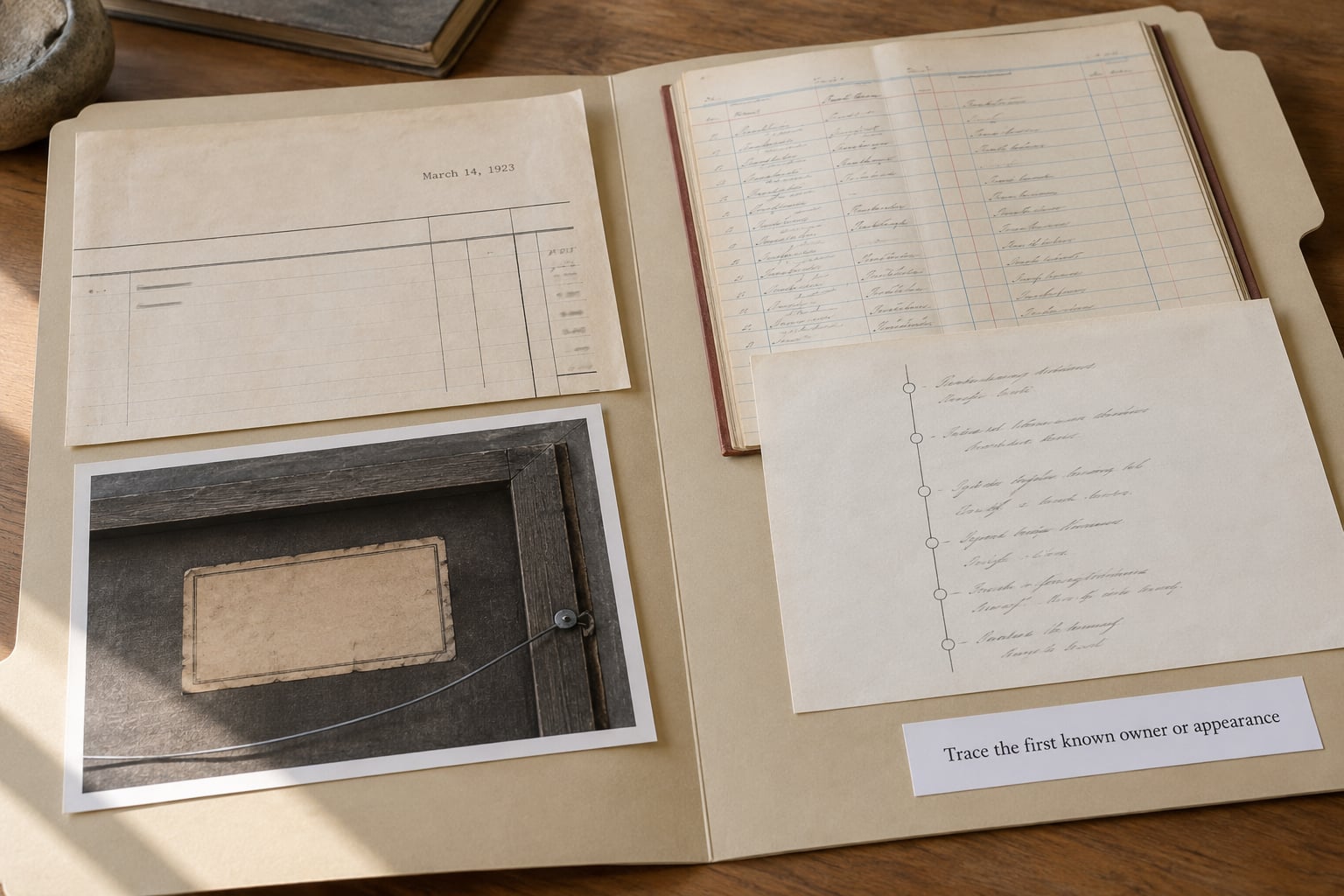
The chain starts wherever the earliest reliable evidence starts, and that is often not the artist’s studio. A dated invoice, a line in a studio ledger, an exhibition catalogue entry with a catalogue number, a photograph of the wall label beside the work, or a letter in an archive can all open the record.
Look for evidence of the transfer itself, not just for the person’s name. A consignment agreement shows the work left you. A carrier receipt shows where it went. A cancelled cheque or bank record shows money moved. A recollection from ten years later is worth something, but it is a different category of evidence and the record should say so.
Photographing artworks together with their wall labels, which experienced collectors do anyway, is exactly this habit applied to other people’s work. The label text is often the only surviving record of where a piece has been.
4. Record every documented transfer
Give every entry the same five parts: date, parties, what happened, location, source. Consistency is what makes a record usable by someone who was not in the room.
A completed example, for a mixed media panel:
- The artist. Mixed media on panel, 40 x 50 cm, signed and dated verso 2019, artist’s studio registration number 2019-114.
- Studio sale. Sold directly by the artist, 14 June 2019, to R. Alvarez, Tacoma. Source: dated invoice on studio letterhead, in the artist’s files.
- Exhibited. Harbor Light Gallery, Tacoma, “Low Tide”, 9 August to 26 September 2019, no. 7. Source: gallery checklist and installation photograph with wall label.
- By descent. To the family of R. Alvarez, Tacoma, on her death in 2013. Source: written statement from the executor, dated 4 February 2026.
- Acquired from the estate sale. By J. Whitfield, Seattle, 8 March 2026. Source: estate sale invoice in the buyer’s file.
- Provenance gap. February 2013 to the present is not documented. Whereabouts of the work between 2013 and 2026 are unknown to the present owner.
That last line is not a weakness. A record that labels its gaps gets trusted more than one that reads too smoothly, and researchers can work with an honest gap in a way they cannot work with a convenient invention.
Handle the awkward cases with standard phrasing and an honest qualifier: circa for an approximate date, by descent for family transfers, by or with the estate of when the transfer ran through an estate, acquired directly from the artist when you have the invoice, consigned and sold when a gallery handled it, private sale when you know the parties but no terms were recorded. Add the hedge where it belongs: “believed to be, according to a 2016 interview with the artist”.
5. Add exhibitions, publications, and other appearances
Exhibition history is not provenance, but it is part of the record and it is frequently the part a researcher can actually verify. Keep it as its own numbered section so nobody mistakes it for ownership.
For each appearance give the year, the exhibition title, the venue, the city, the catalogue number if there was a catalogue, and the page, plate or reproduction number where the work appears. Museum collections and permanent displays count. Published reviews, lookbooks and reproduced photographs count. A work shown in a group show and then reproduced in a magazine review a few months later is traceable in ways most ownership history is not.
One entry per line, same style as the ownership entries. Galleries change names, close and re-open, so write the venue as it was called that year.
6. Verify sources and resolve contradictions
Compare your primary sources, the ones created at the time, against your secondary ones, the ones written later from memory or from someone else’s account. Where they disagree, keep both and say so. An invoice that says October next to a ledger that says November is a discrepancy in the file, not a problem to smooth over.
Ask before you assume. Archives, estates and former gallery staff can often settle a conflicting date with one email, and the answer belongs in the record as a dated clarification with the person who supplied it.
Research tools have real limits. Provenance indexes and auction archives are excellent for confirming an artist’s name, a sale date and a catalogue entry. They cannot reconstruct a history that no document records, and a name appearing in an index is not proof of legal title. For works that may touch wartime displacement, illicit export or cultural patrimony questions, or where a gap is very large, the honest move is specialist research rather than a confident sentence written at a desk.
7. Write the final record and maintain it
Lay the finished record out chronologically, oldest first, with a short identification block at the top and a source note against each entry. Then treat it as a live file. When something changes, add a dated amendment and keep the original line visible. Never overwrite an old entry, never backdate a correction, and never edit a scan of a source document.
Naming conventions save hours later. Artist last name, title, year, document type is enough: ALVAREZ_2019-114_sale-invoice.pdf. Keep originals in one archive folder and working copies in a second, with at least one backup somewhere you do not work from. Photographs of every document are worth having; a burned folder takes years of work with it.
When the work is sold or given away, hand over a copy of the record with it. A short covering note is enough:
This work is accompanied by a provenance record listing its documented ownership and exhibition history as of [date]. The record notes one gap, between February 2013 and March 2026, which has not been resolved. Please add your acquisition details to the file when you receive it.
Before sending the file to a gallery, insurer, museum or buyer, check that every entry has a source, every date is either exact or marked as approximate, edition details are present, and any gap is written out rather than left as a silence.
Common Mistakes
Inventing a smooth history. A plausible previous owner is still a fabrication, and it is the one error that can follow a work for decades. If you do not know, write “unknown”.
Upgrading a recollection into a fact. Someone told you a story twenty years ago. Record it as a recollection, name who said it and when, and stop there.
Writing “private collection” six times. That phrase tells a buyer nothing and reads as a red flag. Name the collection, the city and the years if you can, or leave the entry open.
Folding exhibition history into provenance. Being shown somewhere is not being owned by someone. Separate sections, separate headings.
Dropping the edition details. An edition print without its number is not properly identified, and the number cannot be recovered later if the work is gone from your studio.
Treating the record as proof of authorship. It is not, and saying so plainly protects both you and the buyer. Provenance supports a history claim; authentication is a separate expert judgement.
Editing your sources. Annotate around a scan, never on it. A record whose documents disagree with the file damages the whole file.
A few habits that pay off: write each entry the day the event happens rather than reconstructing it years later, keep the invoice even when the payment was cash, and treat a wall-label photograph as evidence. Every one of those is trivial on the day and nearly impossible to recreate afterwards.
Frequently Asked Questions
Is a provenance record the same as authentication?
Provenance documents who has owned, held, moved or exhibited a work. Authentication is a separate expert judgement about who actually made it. A clean provenance record supports a work’s history and legal title, but on its own it never proves authorship. Artists issue statements about their own work; for an older or contested piece, an independent expert or the artist’s estate handles authentication.
Can an artwork have provenance if earlier records are missing?
Yes, though the record will be shorter and more qualified. Start with the earliest documented event and record everything after it, marking the missing stretch plainly as unknown. A gap limits what you can claim; it does not cancel the events you can document. Disclosing it protects you, since a buyer or researcher will find the gap anyway and will trust the rest of the record more.
I bought a painting at a flea market. What should the provenance record say?
Write what you actually know: the date and place of purchase, the seller’s name if you have it, the price if a receipt exists, and the physical description you noted at the time. Mark the earlier history as unknown rather than guessing at a fashionable previous owner. Photographs of the work, any labels or stamps on the stretcher or back, and your dated notes are legitimate sources.
I sell direct from my studio with no gallery paperwork. What should I keep?
More than most artists expect, and all of it easy to create. Keep a dated invoice or receipt for every sale, a numbered studio log entry, the reference photograph, and any exhibition label or fair catalogue. Record each buyer’s name and address if they consent to it. When the work leaves the studio, hand over a copy of the record so the next owner inherits the chain.
Do I need a provenance record to sell my art?
Not by law in most cases, and nobody will stop you. But serious buyers, galleries, insurers and museums all ask for one, and a work with clear documentation sells faster and holds value better. Insurers want enough detail to schedule it, and a museum loan packet cannot be assembled without ownership evidence. Writing the record at the moment of sale is far easier than reconstructing it later.
Conclusion
Make the identifying worksheet first, since it is the part you can still do today. Then find the earliest documented appearance of the work and build forward from that single date, citing a source for every line. Keep your receipts, ledgers, labels and photographs where you can find them again, and leave the gaps written down rather than filled in. A record that is honest about what it does not know is worth more than a smooth one that is not true.