How to write a grant proposal for an art project? Answer four things plainly: what you plan to make, who it will serve, what it will cost, and why it deserves funding. A proposal bundles those answers with an artist statement, work samples, a timeline, and an itemized budget, and a review panel scores it against a published rubric.
Here is the blunt part most guides skip: funders are scoring dozens or hundreds of files, and most of them never open your website. Your submitted text is the evidence. Arts Midwest put it as an 80/20 rule, and it is the single most useful idea in this guide.
That rule says 80% of a strong application comes from following the directions and keeping the writing concise, and 20% comes from the quality of your work and its community impact. Miss the word limit and the panel may never read your project description. Get the mechanics right and brilliance has room to land.
Set expectations early too. The Maine Arts Commission funded 34.15% of artist project applicants and 20.24% of organization project applicants in one recent cycle. Those are unusually good numbers for arts funding. Plenty of well-written applications get declined, and that is normal, not a verdict on the work.
Most applicants lose at eligibility screening, not at judging. The process below is designed to filter those out early so your hours go into applications you can actually win.
Table of Contents
- What You Need Before You Draft
- How to Write a Grant Proposal for an Art Project
- Step 1: Define the Project and the Community Need
- Step 2: Write a Clear Project Summary
- Step 3: Set Specific Goals and Measurable Outcomes
- Step 4: Describe the Activities, Artistic Process, and Timeline
- Step 5: Build a Realistic Budget and Justification
- Step 6: Show Evaluation, Sustainability, and Impact
- Step 7: Review, Edit, and Submit the Proposal
- Common Grant Proposal Mistakes and How to Fix Them
- Frequently Asked Questions
- What are the 7 main parts of a project proposal?
- What is the 80/20 rule for artists?
- How long should a grant proposal be?
- Can someone else write a grant proposal for me?
- Should I pay myself in an art grant budget?
- What not to say when applying for a grant?
- Conclusion
What You Need Before You Draft
Grant writing goes faster when the raw material is already assembled. Gather the following before you type a single narrative paragraph.
Project background. A clear account of the idea, the art form, the scale, and where the idea came from. Two or three honest sentences are plenty at this stage.
The funder’s guidelines and criteria. Download the full guidelines, not just the summary page. Eligibility rules, required attachments, word and character limits, deadline times and time zones, and review criteria all live there, and each one is a filter you either pass or fail.
Budget materials. Recent invoices or receipts for materials, quotes for venue rental and framing, a sense of shipping and crating costs, and a defensible rate for your own time. Numbers from a comparable past project beat round estimates every time.
A working timeline. Start dates, milestones, exhibition or event dates, and any lead time for fabrication, permits, or insurance. Three to five dates are enough to start.
Supporting documents. An up-to-date resume or CV, a short biography, five to ten strong work samples, and any letters of support you can realistically get from a venue or partner organization.
Evaluation information. How you will count participants, collect feedback, and document results. Funders increasingly want to know what success looks like after the money is spent.
Requirements vary by funder, and no two guidelines read the same. Read yours twice before you assume anything, especially about who is eligible to apply, since an ineligible file is usually discarded without being read.
How to Write a Grant Proposal for an Art Project
Every art grant application boils down to the same seven parts, in some order: the need, the project idea, the goals, the activities, the timeline, the budget, and the outcomes with an evaluation plan. The steps below follow the order that actually saves time, moving from research to definition to numbers to narrative to samples to submission.
Follow the funder’s exact prompts in their exact order, even when their sequence feels strange. Reviewers read with the rubric in hand, and a well-written answer in the wrong box reads as a misread application.
Step 1: Define the Project and the Community Need
Identify the specific people your project serves, the problem or opportunity it addresses, and why outside funding is necessary. Name one audience rather than saying everyone, because an answer of “everyone” tells a reviewer nothing.
A useful need statement fits in three sentences: who has the problem, what it costs them to keep having it, and what changes if your project happens. Write it in plain language with no art-world jargon.
Here is a worked example. A textile artist planning a free hand-stitching and natural-dye workshop series in a rural library district writes: “Teenagers in our county have no low-cost art programming after school. The nearest studio is 45 minutes away, and the county youth club has no arts staff. This series will give 30 teenagers six free Saturday workshops, and each participant will finish one dyed textile piece to take home.”
That paragraph works because it is specific about people, numbers, and location. It also makes the funding case obvious: the participants cannot pay for it themselves, and no commercial provider is filling the gap.
Many artists resist this section because it sounds like advocacy rather than art. Reverse the order and it reads better: state the artistic ambition first, then show who it reaches. The medium matters, but the public value is what gets funded.
Step 2: Write a Clear Project Summary
Summarize the project in one short paragraph of specific, direct language. Cover the artistic concept, the audience, the activities, the location, the dates, and the expected impact, in that order.
Try this structure: the work in one sentence, who it is for in one, what happens in one, and what it produces in one. Resist burying the main idea in the third sentence. Reviewers are scanning dozens of files, and many of them are not art professionals, so any phrase that only insiders would understand costs you points.
Cut any sentence that could be pasted into a proposal for a different project unchanged. If it applies to everything, it tells the reviewer nothing about yours.
Step 3: Set Specific Goals and Measurable Outcomes
Goals describe the change you want. Activities describe what you will do. Outcomes describe what will be measurably true when the project is over. Most rejected applications blur these three into one paragraph, which makes them impossible to score.
“Create art with the community” is an activity. “Thirty teenagers complete six workshops and each produces one finished dyed textile piece” is an outcome a reviewer can tick. Aim for that level of countability in every goal you write.
Strong outcomes for art projects tend to look like these: number of participants reached, sessions delivered, works created, skills demonstrated, exhibition attendance, repeat participation, partner organizations involved, or dollars of additional funding raised. Choose the measures that genuinely match your project rather than the ones that look biggest.
Two or three goals is plenty. A panel reading 80 files will not credit you for a list of twelve, and a long list usually signals that you have not decided what success means.
Step 4: Describe the Activities, Artistic Process, and Timeline
Explain what will happen, who participates, which methods and materials you will use, and how the work progresses from start to finish. Reviewers score clarity here, and vague process descriptions are a quiet rejection.
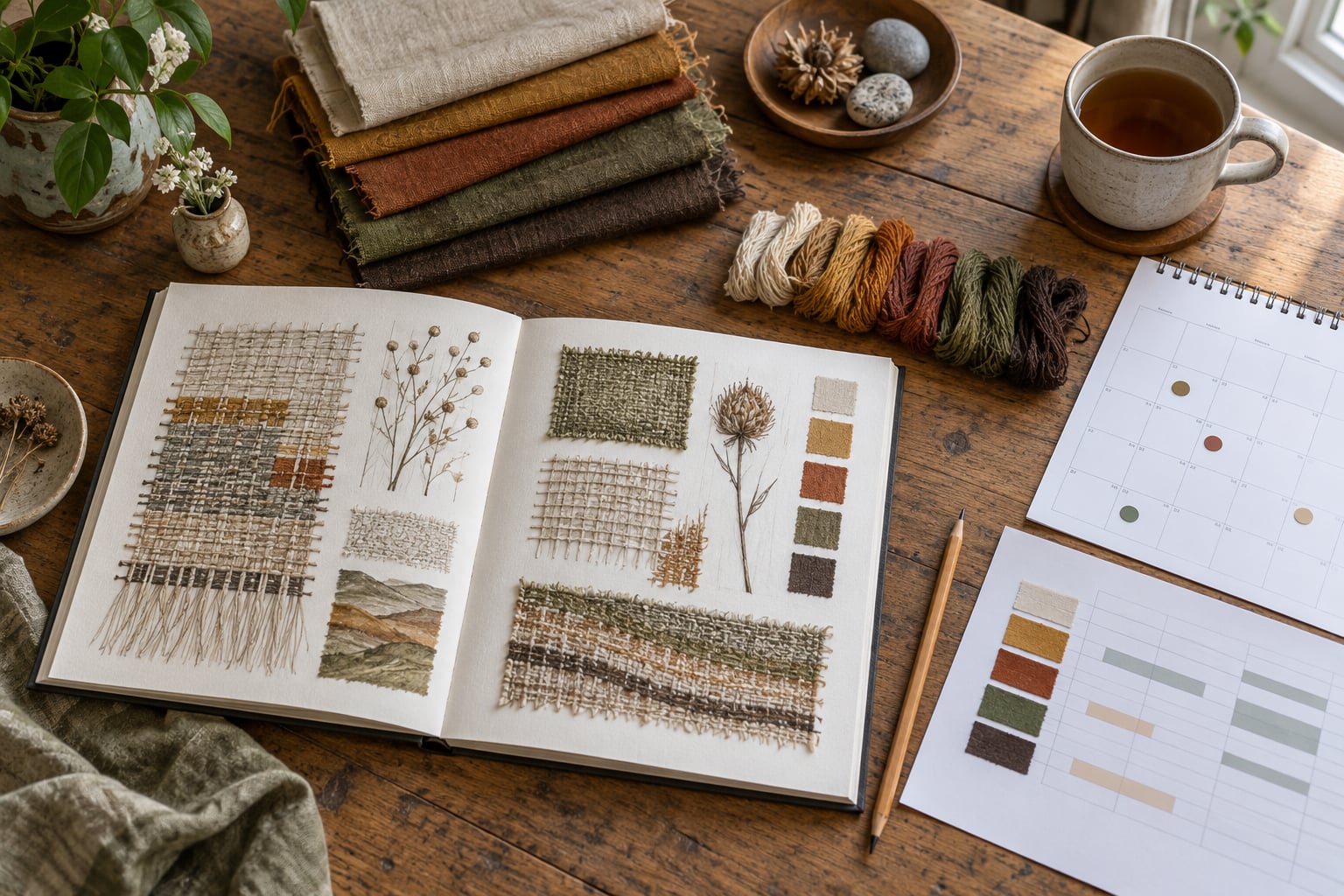
Be concrete about the artistic process. “Engagement with material culture and textile tradition” tells me very little. “Participants will dye cotton with onion skins, madder root, and indigo, then hand-stitch a pattern drawn from local topographic maps” tells me exactly what a Saturday looks like.
Name your materials, your collaborators, and the space. If you are applying before a venue is confirmed, say so plainly and describe what you have secured, such as a letter of intent or a confirmed alternate site. Panels respect honesty about what is still in motion and punish vagueness dressed up as certainty.
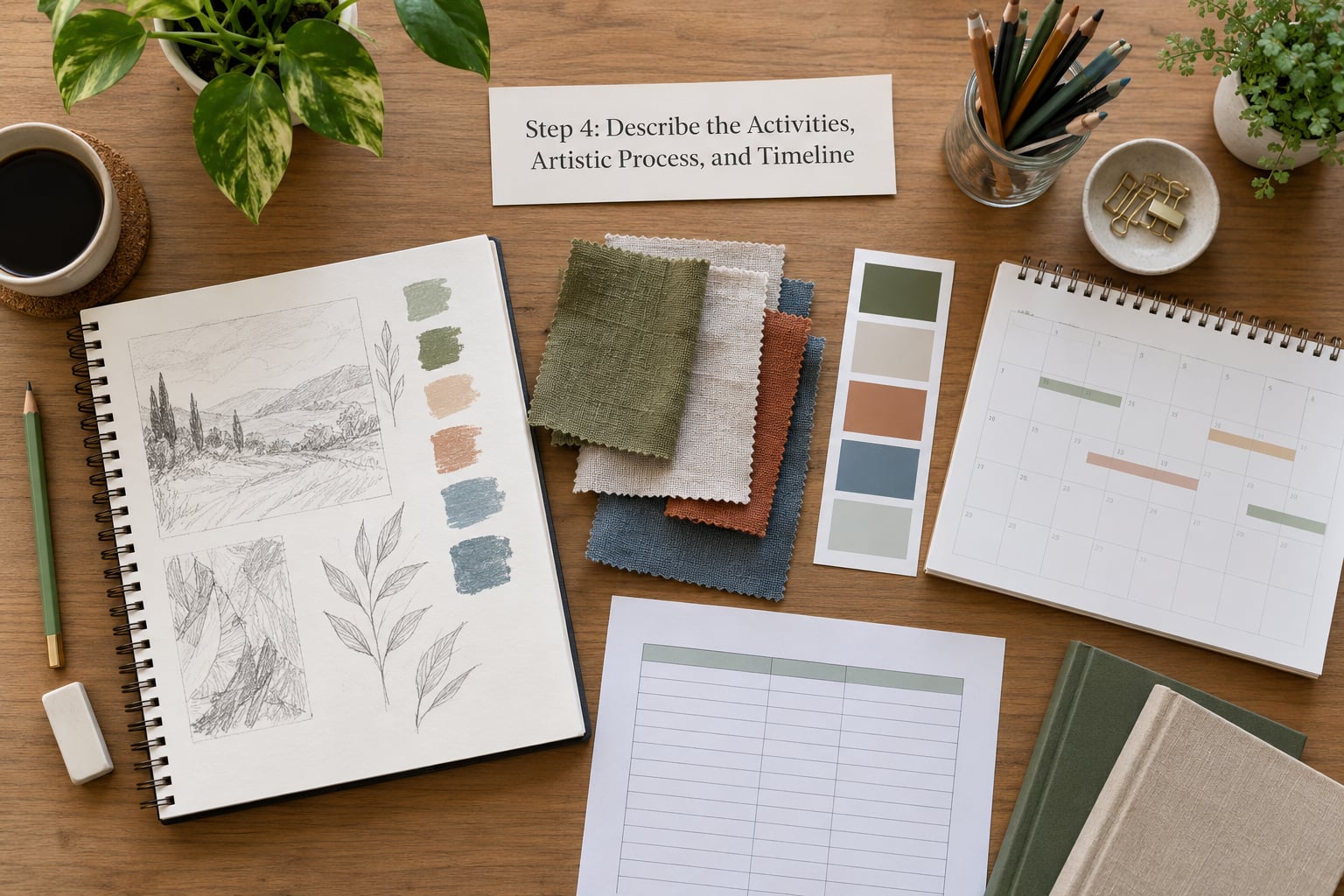
A timeline in milestones is more persuasive than a dense calendar. For the workshop series above, a reviewer could read: planning and material sourcing in month one, two rounds of participant recruitment across months two and three, six Saturday workshops from months four through six, and a final display plus evaluation survey in month seven. Fabrication time, permit timelines, and insurance lead times belong in the same milestone list.
Every date you list should connect to a budget line. If the timeline does not explain a cost, the reviewer sees an orphan expense. If the budget has a cost the timeline never explains, you get the same problem in reverse.
Step 5: Build a Realistic Budget and Justification
Budgets are the part artists dread most, mostly because the work has not happened yet and you are estimating costs from comparable past projects. That is exactly what a budget is meant to do, so treat it as a forecast rather than a confession.
Build the expense side by category first: artist fees and collaborator pay, materials, equipment rental, venue and production, accessibility, documentation, marketing, administration, and a contingency buffer. Then build the revenue side: the amount you are requesting, confirmed in-kind contributions, matching funds, earned income, and any other awards already in hand.
Here is a proportional example showing how a mid-sized community workshop project typically divides its costs. Use the shape, not the numbers, since your project will differ.
| Budget line | Share of total cost | What to include |
|---|---|---|
| Artist and facilitator fees | 30-40% | Your design, teaching, and documentation time at a documented hourly rate |
| Materials and supplies | 10-15% | Fabric, dye materials, thread, tools, and consumables for the participant count |
| Space and production | 10-15% | Venue rental, insurance, utilities, and setup or teardown |
| Accessibility | 5-10% | Assistants, translation, transportation support, adaptive materials, captioning |
| Documentation and marketing | 5-10% | Photography, printing, promotion, and mailing |
| Contingency | 5-10% | A buffer for material price changes, extra sessions, or repair |
Two things surprise first-time applicants. First, you should pay yourself. Committees read a budget with no artist fee as a sign that the artist does not value their own time, and many programs state plainly that fees are expected. Second, an unrealistically small ask reads as inexperience, while a large ask with a scope the narrative never mentions reads as a mismatch. Match the ask to the plan you described, and justify it in the same order the reviewers will.
Paying yourself is a recurring question, and the honest answer is that most art funders in the US expect a fee and some will not fund personal income for individual applicants. Check your guidelines for the exact wording, then use a recognized industry fee schedule or your documented past rate as the basis rather than a round guess.
In-kind contributions count, but only when you can document them. Donated studio time, a venue’s normal rental value, volunteer hours, and materials donated by a business all get valued differently, and some funders cap in-kind at a percentage of the request. Put a number and a source next to every in-kind line, and keep volunteer time in a separate category when the guidelines treat it differently.
If you have no matching funds yet, write zero in that row and apply for fewer programs with a match requirement, or ask a partner organization to confirm a match in a letter. Guessing at money you do not have is the fastest way to lose a funder’s trust after the award.
Give every major line a one-sentence justification that points back to the narrative. A budget that explains itself in the same voice as the project statement reads as one plan, which is what a panel is checking for.
Step 6: Show Evaluation, Sustainability, and Impact
Say how you will know the project worked, using methods you can actually carry out. Attendance sign-in sheets, short surveys at the final session, participant reflections, a photo record, and a count of finished works are all realistic for a small project. Pre-commit to a specific number, like 25 returned surveys out of 30 participants, so the plan is testable.
Sustainability does not mean the project pays for itself forever. For most applicants it means showing that the work leaves something behind: donated or discounted materials for the next cohort, a trained assistant who can lead sessions, documented curriculum another teacher can reuse, or a partnership that continues after your grant ends. One or two sentences on this is plenty.
Impact on the wider field is worth a sentence too. Will the finished pieces be exhibited, donated, or archived somewhere the public can see? A committed venue or a plan for a public display is evidence that your project is not a private studio practice with a grant attached.
Step 7: Review, Edit, and Submit the Proposal
Treat the guidelines as a contract and audit your draft against them line by line before anything else. Check every required attachment, every word and character limit, every deadline with its time zone, and the submission format itself, since portals reject files over a size limit or in the wrong format after you have done the work.
Then read the narrative against the budget and the timeline. A goal that promises six sessions with a budget covering four, or an exhibition date the timeline never reaches, is a mismatch a reviewer will spot immediately.
Read your own draft once for jargon and once out loud for rhythm. Replace abstractions with numbers and named places. Cut sentences that do not add information, since character limits reward density and reviewers reward clarity.
Have one person outside the project read it. A colleague who does not know the work will catch the paragraph that assumes too much and the sentence that means nothing. Then proofread names, dates, and figures once more, because a typo in a date can signal sloppiness to a panel that is looking for a reason to rank you lower.
Submit early if the portal allows, since technical problems cluster near the deadline. Then send a short thank-you note to the program officer, and if you are declined, ask for feedback. Programs that respond to applicants are the ones worth applying to again.
Common Grant Proposal Mistakes and How to Fix Them
A need statement that could describe any project. If your need paragraph could be swapped into another artist’s application without edits, it is not a need statement. Fix it by naming the people, the count, and the specific gap.
Art description with no public value. Long passages on influences and process read as a love letter to reviewers who may not know the field. Keep the artistic content, then add one or two sentences on who experiences the finished work and what changes for them.
Goals that cannot be measured. “Increase awareness” cannot be scored. Replace it with attendance, completion, participation, or a documented partner commitment.
A budget that does not match the activities. Narratives describing an eight-week residency against a budget covering two weeks of labor, or an exhibition with no framing or shipping line, are among the most common reasons a strong concept gets declined. Reconcile both directions before submitting.
No evaluation plan. If you cannot say how results will be gathered, you have not finished planning. Add sign-in counts, a short survey, and a documentation method.
Jargon and academic language. Review panels typically mix art specialists with people from other sectors. Write at the level of an intelligent adult outside the field, and test the draft on a non-artist reader.
An inconsistent timeline. Dates that contradict the narrative or the budget suggest you did not fully plan the work. Build one milestone list and use it everywhere.
Ignoring the instructions. Wrong portal, missing attachment, exceeded character count, or a late submission disqualifies an otherwise excellent file. This is where the 80/20 rule earns its keep.
Asking too little, or for an unbounded project. A tiny ask signals inexperience, and a five-year program for a small grant signals poor judgment. Scope the project to what the grant size actually pays for.
Hiding behind theory or modesty. Overstating credentials can read as inflated to experienced reviewers, while an application that apologizes for being a first-time applicant wastes characters. State the work, the plan, and the audience, and let the samples do the persuading.
A few habits fix most of these at once. Write every answer in a specific structure before you polish the language. Answer redundant questions completely instead of skipping ahead, since funders repeat prompts for readers who jump around. And keep one master document with the goals, dates, and figures, so the whole application can be checked against a single source of truth. Most of the trouble above traces back to one habit: writing how to write a grant proposal for an art project as seven disconnected answers instead of one plan the panel can follow from need to outcomes.
Frequently Asked Questions
What are the 7 main parts of a project proposal?
Most art grant proposals cover seven parts: the need, the project idea, the goals, the activities, the timeline, the budget, and the outcomes with an evaluation plan. Some funders merge or rename them, and some ask for a cover letter or work samples as well. Check your guidelines and map each required prompt to one of these parts before you start drafting.
What is the 80/20 rule for artists?
The 80/20 rule, popularized by Arts Midwest, says that about 80% of a strong grant application comes from following the directions and keeping the writing concise, and only 20% comes from the quality of the work itself. Word limits, required attachments, deadlines, and plain language do more for your odds than elaborate prose does.
How long should a grant proposal be?
Exactly as long as the funder’s limits allow, which is often far shorter than artists expect. Many narrative questions cap at 300 to 500 words, and some use character counts as low as 1,000. Write the full version for your own planning, then compress it to fit. A tight, specific answer always beats a long one that gets cut mid-sentence.
Can someone else write a grant proposal for me?
Yes, many artists hire a grant writer or consultant, and several national programs exist for that. It saves real time and often improves clarity. The project facts, budget numbers, and final voice still have to come from you, since a reviewer is funding your work and your ability to deliver it. Read every draft closely before you submit it under your name.
Should I pay myself in an art grant budget?
Usually yes. Most US arts funders expect a fee for the artist’s design, teaching, and documentation time, and a budget with no fee can signal that you undervalue your work. Some individual-artist programs restrict what they will fund, so read the guidelines. Use a documented hourly rate or a recognized industry fee schedule as your basis rather than a round guess.
What not to say when applying for a grant?
Avoid apologizing for being a first-time applicant, overstating your credentials, padding the project with theory that does not serve the plan, and leaving required questions unanswered. Skip vague claims about impact and unsupported budget figures too. Write plainly, answer every prompt fully, and show exactly who benefits from the work.
Conclusion
Start with the funder, not with your prose. Read the guidelines, confirm you are eligible, and list the project’s activities, outcomes, and costs on one page before you write a single narrative paragraph. When you know how to write a grant proposal for an art project, the document that follows is just that page made convincing, budgeted, and formatted the way the panel expects.