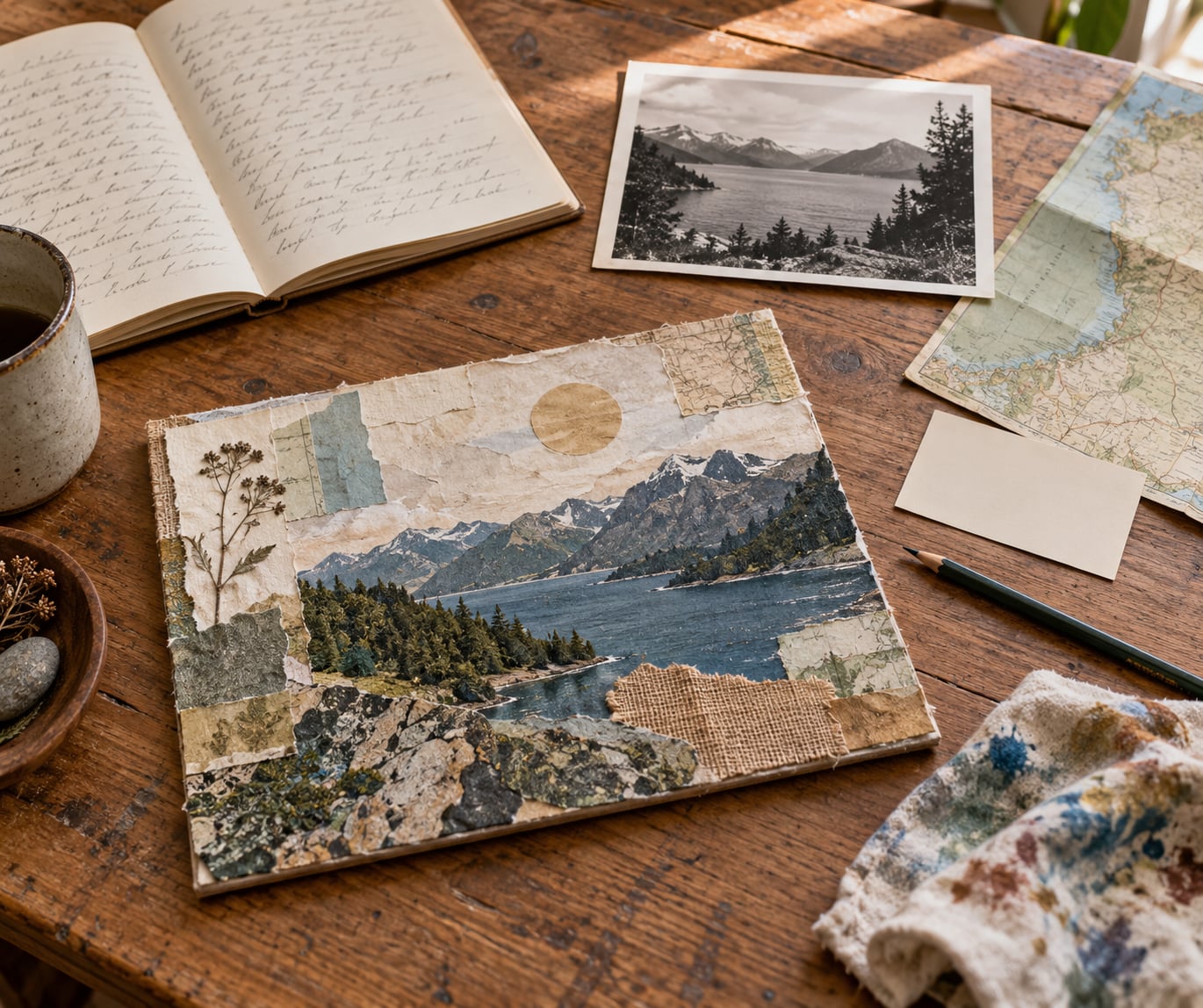
Most mixed media artists need to credit anything they did not make, and knowing how to credit sources in mixed media work takes about two minutes per source: record the creator, the title, where it came from, and the licence, then put that line somewhere a viewer can actually find it. The awkward part is rarely the writing. It is keeping the details straight while the glue is still wet.
Mixed media simply means combining two or more materials or techniques in a single work — printed paper with paint, fabric with photography, found objects with text. Because a finished piece usually contains other people’s work, documentation matters more in this field than it does in a single-medium painting.
This is general studio practice, not legal advice. Copyright rules differ by country, and where a use is genuinely unclear, ask a librarian, a rights officer at the holding institution, or a qualified adviser before you exhibit or sell.
Table of Contents
- What You Need
- How to Credit Sources in Mixed Media Work Step by Step
- Start with an inventory of borrowed or adapted material
- Record complete source details as you work
- Check whether the use is licensed, permitted, or public domain
- Choose the right credit format for the work
- Place credits where viewers can find them
- Review consistency before exhibiting, publishing, or selling
- Common Mistakes
- Frequently Asked Questions
- Where should I put the credit on a mixed media artwork?
- Does crediting an image make it legal to use?
- Do I need to credit public domain and CC0 images?
- How do I credit an image when you cannot find the creator?
- How do I credit multiple images in one collage?
- How do I write a photo caption credit for a social post?
- Conclusion
What You Need
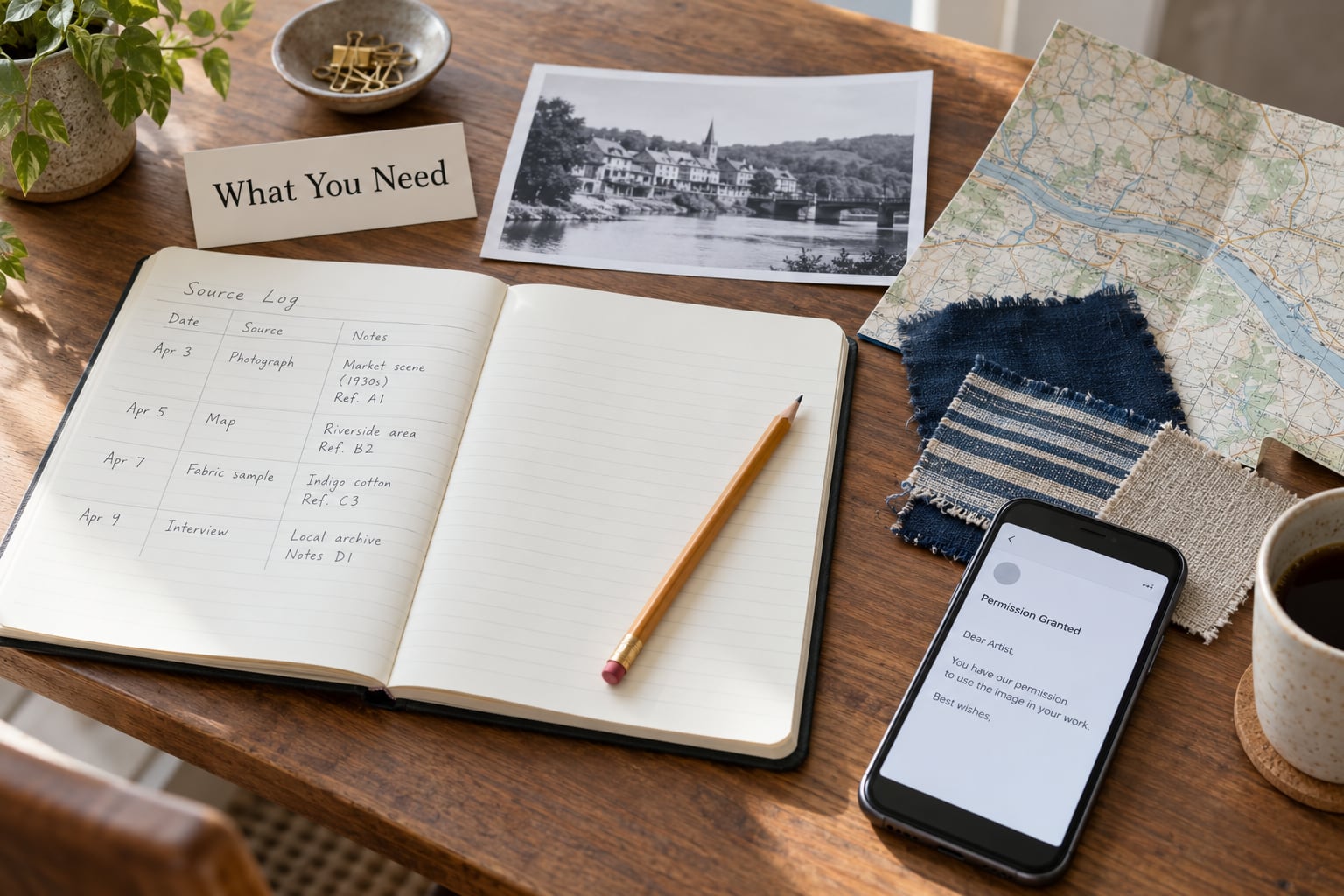
Four things, and three of them are just paperwork. Set them up at the start of a project and the credit-writing itself takes under a minute per source.
- A source log. A spreadsheet or a dedicated journal with one row per borrowed item: what it is, where it came from, the creator, and what you changed.
- A reference list. The formatted credit lines themselves, kept separate from the log so you can copy one straight into a label or a listing.
- Permission records. Screenshots of emails, licence pages and written grants, filed with the date you received them.
- Project notes. A photograph of the work in progress plus its final title and date, so the provenance stays attached to the piece instead of to your memory.
The log should cover anything borrowed: a traced photograph and its photographer, a map section and its atlas, a passage of text and the book with a page number, a fabric print and the designer’s name, a found object with no known origin, and a museum object with its accession number.
If you already keep a materials list or provenance notes for your own work, reuse that habit. A source log is the same record turned outward, pointing at other people’s work rather than yours.
How to Credit Sources in Mixed Media Work Step by Step
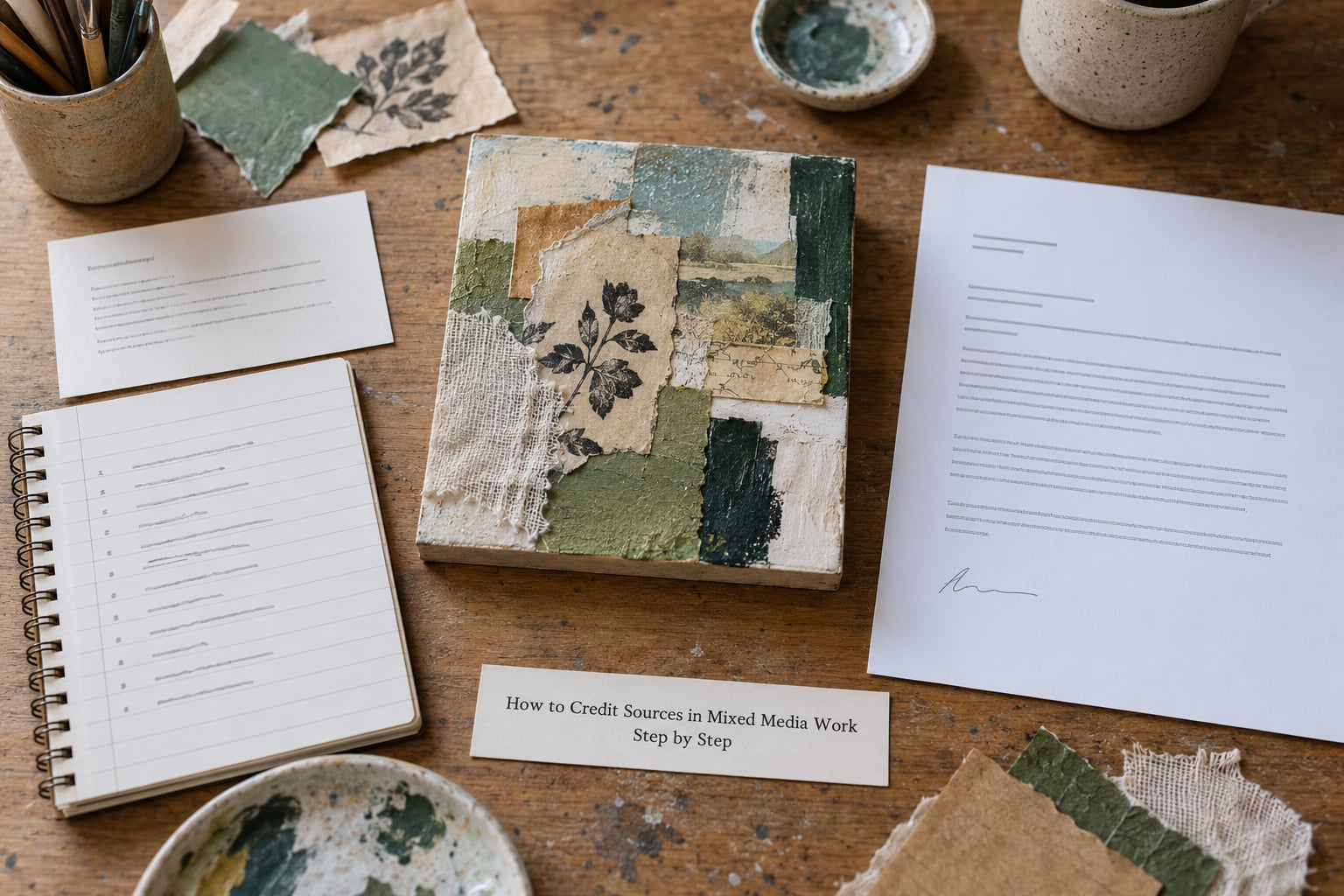
Start with an inventory of borrowed or adapted material
List everything you plan to incorporate before you start adhering: photographs, text passages, maps, printed patterns, fabric designs, museum objects and digital images. Add one line on how each one influenced the finished piece, whether through colour, layout, wording or technique.
Influence counts even when nothing was copied outright. A layout that came from a layout you admire belongs in the log, and so does a colour pairing you pulled from a textile swatch book.
Record complete source details as you work
Capture the creator’s full name, the title of the work, the date or publication, the website or collection, the URL, a page number where relevant, the date you accessed an online item, and exactly which portion you used.
Write each entry the moment you use the material. Reconstructing a source six weeks later, from memory, is where titles get dropped and creators get misspelled — and a credit with a wrong name is still a wrong credit.
Check whether the use is licensed, permitted, or public domain
Three situations are not the same. Material in the public domain — old photographs, pre-1929 works in the United States, works whose creator died more than 70 years ago in much of Europe — carries no licence restriction, so crediting is a courtesy. Work dedicated to the public domain with a CC0 waiver behaves the same way. Anything under a Creative Commons licence with a BY condition, or anything still under copyright, is a different matter entirely.
Credit and permission are two separate things. Naming the creator does not grant you the right to use the image, and a credit line will not stop a takedown notice. When a licence is unclear, ask the creator directly, choose a source with a clearer licence such as Wikimedia Commons, or leave the material out.
Choose the right credit format for the work
Most makers settle on TASL: Title, Author, Source, License. Give each element its own line if you have room, and always say what you changed — most Creative Commons licences expect modifications to be noted.
Single image under a Creative Commons BY licence
Title: Woman Reading in a Garden, 1931
Author: Elsie March Dawson
Source: Wikimedia Commons
License: Creative Commons Attribution 4.0
Modified: sepia tone applied, torn edge added by the artist
Multi-source collage
Sources used in Low Tide Ledger:
1. Herring Nets, North Sea, 1908 photograph, public domain, via Wikimedia Commons
2. Textile print Dune Stripe, designed by M. Halloran, used under CC BY-NC 4.0
3. Map section, Coastal Survey Series Vol. 2, 1961, public domain
4. Quote, page 44, Field Notes on Salt, 1978, used as a two-line excerpt
Vintage ephemera with no traceable creator
Text from an unattributed 1950s seed catalogue, publisher unknown. The clipped botanical image could not be traced to a creator through reverse image search. Reproduced as found, 2026.
Social caption
Art by me. Credit to M. Halloran for the Dune Stripe print, CC BY-NC 4.0, and to North Sea Archive for the 1908 photograph. Both found via Wikimedia Commons.
A short informal caption works fine for a social post. Artists in communities like r/ColoredPencils routinely write a plain “credit due to” line for a reference photograph they painted from, and that is community norm, not law.
Place credits where viewers can find them
One placement is never enough, because the same piece is seen as an object, as a photograph, and as a listing. Most artists end up using three of these:
- On the back, or the verso. The most permanent option. A typed list on a linen tag or a strip of acid-free card taped to the back survives shipping, framing and resale.
- On a gallery placard or wall label. The credit line sits under the title and year, beside your statement, where a wall reader will look.
- In the photo caption. Every post you make of the piece carries the credit, which is also where the alt text and the image description repeat it.
- In listings and shop descriptions. A short credit block at the end of the description travels with the work for years.
- In class handouts and slide decks. When you teach a technique using someone else’s material, credit that material on the slide.
Keep the list legible. Twelve sources do not need twelve sentences — a numbered list with short entries does the job without turning the back of the piece into a bibliography.
Review consistency before exhibiting, publishing, or selling
Run a final pass once the piece is finished. Check that creator names match the spelling used by the creator themselves, that dates line up with the record, and that every entry in the log has a matching line in the credit block.
Resolve anything still blank by the honest route: write what you know and mark what you could not find. Then send the gallery, teacher or collector a clean source packet — the credit list, the licence pages, and the permission emails — rather than a folder of screenshots with no labels.
Common Mistakes
- Vague labels. “Vintage image” and “found photo” tell a reader nothing. Fix: title, creator, source and licence, or a plain statement that the creator could not be traced.
- Mixing citation styles in one list. Three different formats in a single credit block looks careless. Fix: pick one order and run the whole list through it.
- Leaving the creator out. “Found online” is not attribution. Fix: find the creator’s name at the original source and use it as they write it.
- Assuming anything online is free to use. Search results say nothing about permission. Fix: check the licence on the source page, not the search page.
- Crediting only the visible materials. Fix: include the influence sources — reference photographs, layouts, colour sources and quoted text.
- Losing the permission record. A granted permission you cannot produce is hard to rely on later. Fix: screenshot the reply and store it with the piece on day one.
Two more that come up constantly. Crediting your own earlier work when you rework it into a new piece is good practice, since it traces the lineage for whoever buys or studies the piece next. And if a collage grows past a dozen sources, group the entries by type rather than forcing every one into a sentence.
Frequently Asked Questions
Where should I put the credit on a mixed media artwork?
Put it in at least three places. A typed list on the verso or a linen tag makes the credit permanent and survives shipping and resale. A wall label or placard carries it for gallery visitors. Every photograph you post carries it in the caption, and shop listings carry it in the description. One location is not enough because the same piece is seen as an object, as an image online, and as a listing.
Does crediting an image make it legal to use?
No. A credit names the creator and gives them recognition; it does not grant permission. Using a copyrighted image without permission or a licence can still be infringement even when the creator is credited by name, and a credit line will not stop a takedown notice. Where rights are unclear, ask the creator, pick a source with a clearer licence, or leave the material out.
Do I need to credit public domain and CC0 images?
Not legally, in most cases. Public domain works and images dedicated to the public domain with a CC0 waiver carry no attribution requirement, and crediting them is a courtesy rather than an obligation. Many makers still credit anyway, because naming the source helps anyone tracing the image back to an archive. Check the item page rather than assuming, since some sources label an image public domain incorrectly.
How do I credit an image when you cannot find the creator?
Say so plainly and describe what you did. A workable line reads: vintage botanical image, creator unknown, publisher not identified, reverse image search found no match, reproduced as found. Record where the material came from, such as a thrift store or an estate sale, and note the year. Honesty about what you could not trace reads far better than a vague invented attribution.
How do I credit multiple images in one collage?
Use a numbered list with one short entry per source, grouped by type if the list runs long. Each entry needs a title, creator, source and licence, plus a note for anything you changed. Keep it to the back of the piece, a separate typed sheet, or an image description rather than cramming it onto the front. A photo caption can carry an abbreviated version.
How do I write a photo caption credit for a social post?
Lead with your own authorship, then credit the sources, then name where you found them. For example: Art by me, credit to M. Halloran for the Dune Stripe print, CC BY-NC 4.0, and to the North Sea Archive for the 1908 photograph. Repeat the credit in the image alt text or description so it survives reposting, where the caption alone often gets lost.
Conclusion
Crediting sources in mixed media work comes down to three habits: write the details down while the material is still in your hand, check the licence before you fall in love with the image, and place the credit in more than one place. None of it takes more than a couple of minutes per source once the log exists.
Open a source log today, before the next piece starts. Add a column for what you changed and one for the licence, and the credit block writes itself at the end.