Preparing artwork for gallery delivery means getting each piece exhibition-ready and safe in transit: surface protected, packed in a rigid box or crate, labelled inside and out, shipped with a packing list and condition report, and delivered early enough to be unpacked and installed before the opening. Most of the work happens in your studio the week before the courier is booked.
The process takes about two to four hours per piece for the photography and paperwork, plus however long the packing itself takes. Difficulty sits in the middle: none of the individual steps are hard, but the sequence matters, because the photographs and condition report have to exist before anything goes in the box.
Table of Contents
- What You Need
- Records and documentation
- Packing materials
- Protective and handling equipment
- Step-by-Step: How to Prepare Artwork for Gallery Delivery
- 1. Confirm what the gallery actually requires
- 2. Document the condition of the work
- 3. Pick the packing tier and test the fit
- 4. Protect the surface and the materials
- 5. Label the package and assemble the paperwork
- 6. Arrange insured, trackable transportation
- 7. Inspect and hand over on arrival day
- 8. Keep the delivery record and the packaging
- Common Mistakes That Ruin Delivery
- Frequently Asked Questions
- How should I package artwork for gallery delivery?
- Do I need a custom crate for every artwork?
- How much insurance should I use when shipping artwork?
- How do I ship a quilt or other textile artwork safely?
- Who should unpack and install artwork at the gallery?
- Conclusion
What You Need
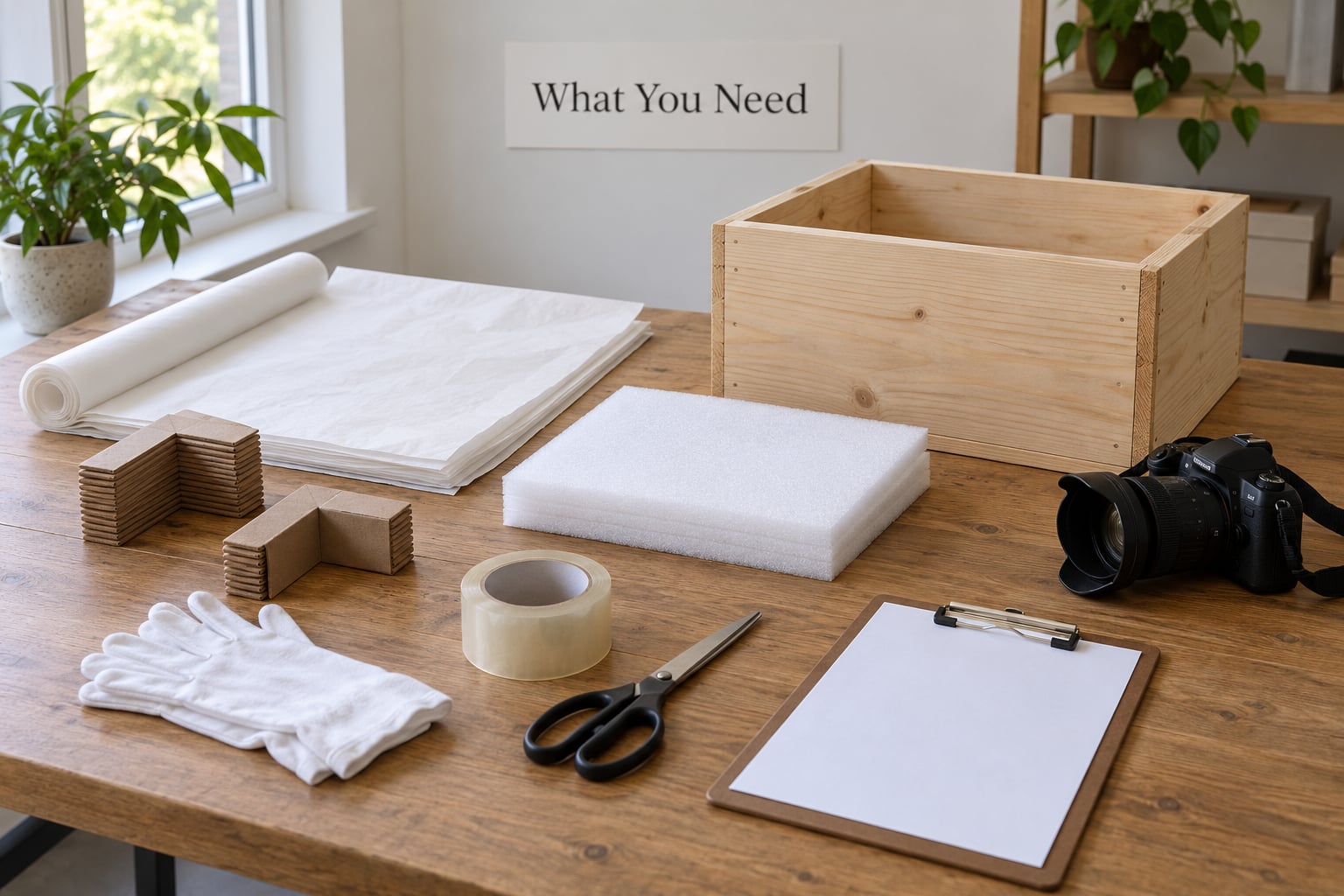
Most of what you need is boring and inexpensive. The expensive part, a crate, is often not needed at all, and artists regularly build one for work that would have travelled fine in a double-wall box.
Records and documentation
- A dated condition report for each work, plus front, back, edge and detail photographs taken before packing
- A packing list listing every item in the crate or box, with retail and wholesale values for sold work
- The loan agreement or consignment contract, with the venue’s packing, insurance and installation clauses read and initialled
- An insurance certificate covering the work in transit, at a value that reflects what it would cost to replace
Packing materials
- Glassine for surfaces that are stable and dry, Tyvek for painted canvases and anything with texture
- Acid-free tissue for works on paper, unbacked textiles and photographs
- Rigid corrugated board or foam core for sandwiching the work
- Corner protectors, foam padding, and a double-wall box or a purpose-made crate
- Glass tape for framed work under standard glazing, never for UV museum glass or acrylic
- Waterproof label pouches, a marker, and a tape gun for crates
Medium-specific notes matter here. Tissue is the wrong choice for tacky paint surfaces, because it bonds and then needs a conservator to lift it off. Tyvek or glassine is better there. Quilts and other textiles want acid-free tissue over the face and a rigid board behind them so the batting cannot crease in transit. Wood, panel, and cutout work is vulnerable along the edges and needs corner protection on every protrusion.
Protective and handling equipment
Clean cotton gloves inside the crate, a tape measure, a scale accurate to a pound, a camera with a plain background, and scissors you do not mind losing to the crate. If you are crating, you also want a staple gun, a drill, and a set of screwdrivers.
Step-by-Step: How to Prepare Artwork for Gallery Delivery
1. Confirm what the gallery actually requires
Read the prospectus or loan agreement before you buy anything. It should state the delivery deadline, who pays shipping, what insurance the venue carries on your work, whether the venue unpacks and installs, whether it wants the work glazed or unglazed, and what hardware it expects on the back.
Verification point: you can answer, in writing, how many works are arriving, on what date, and who will be on site to receive them. If the agreement is silent on insurance, ask before you commit.
2. Document the condition of the work
Photograph the piece flat and square-on: full front, full back, all four edges, the hardware, and close detail of any existing marks, creases, losses, or repairs. Write the same things into a dated condition report along with dimensions, weight, medium, support, framing, and surface condition.
Verification point: every mark visible in your photograph appears in the written report. This is the document that makes a damage claim defensible, and it has to exist before the work is wrapped, not after.
3. Pick the packing tier and test the fit
Three tiers cover almost everything. Match the tier to the work’s size, weight, value, and how fragile the materials are, then test-fit before you seal anything.
| Packing tier | Best for | Fragility handled | Reusable |
|---|---|---|---|
| Card pack | Works on paper, prints, small canvases, anything that fits a box | Surface and edge, not impact | Yes, the box is kept |
| Travel frame | Framed and glazed work, mirror-backed or vulnerable panels | Impact and glass failure | Yes |
| Crate | Large canvases, sculpture, mixed-media work, anything travelling by freight | Impact, vibration, and stacking loads | Yes, and most galleries return them |
Verification point: after the pack is closed, nothing inside shifts when you shake the box gently and turn it on each side. Also confirm the work does not touch the outer container anywhere, including at the corners. This is the rule the r/artbusiness artists keep repeating, and it is right: assume the package will be dropped and that nothing inside it may move.
4. Protect the surface and the materials
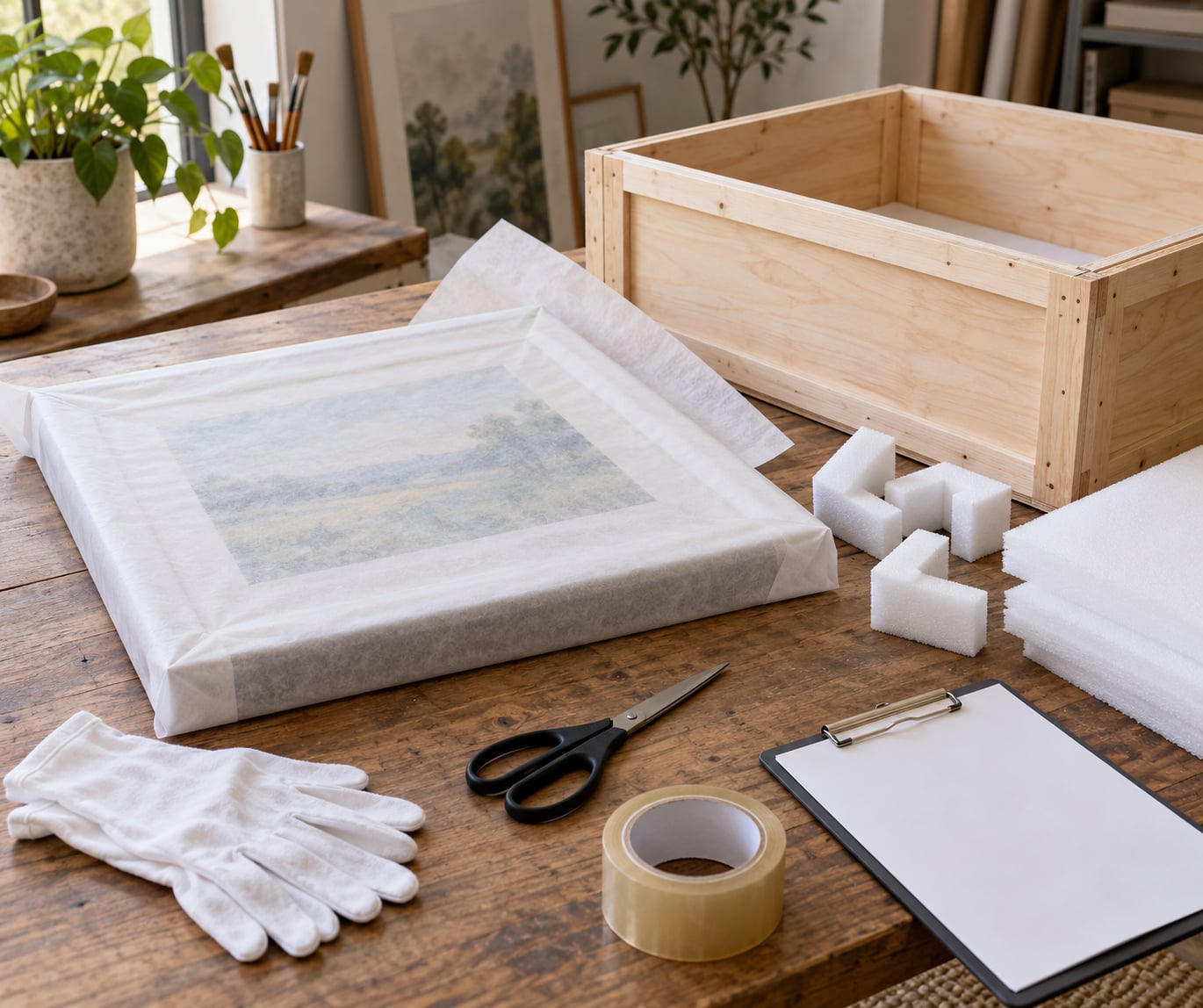
Wrap the work in the material that matches its surface, sandwich it between two sheets of rigid board, and add corner protection to every edge or projection that a handler could catch.
Canvases: glassine or Tyvek first, then a foam-core sandwich, then the outer box. Never tape anything onto the painted face.
Works on paper and prints: interleaved with acid-free tissue, or glassine for a smooth giclee surface, packed flat in a rigid box sized to leave no room to flex.
Framed work under glass: tape the glass in an X with glass tape so shards stay on the frame, then bubble-wrap bubble-side-out or card pack it. Never tape UV museum glass or acrylic; the adhesive permanently hazes it.
Quilts and textiles: acid-free tissue over the face, a board behind, and no pressure across the quilted surface. Rolled tubes are a bad idea for anything you care about, because the fold and the pressure ridge both show.
Sculpture and ceramics: foam-lined, wrapped individually, and separated so no two pieces can knock together.
Verification point: photograph the packed object from two angles before the outer container closes, so you can show the gallery what the packing looked like if there is ever a question.
5. Label the package and assemble the paperwork
Mark the outside twice, in waterproof labels, with the gallery name and address, your name and a phone number that reaches you during transit, the artwork title and medium, and orientation arrows. Say This Side Up and Do Not Crush. Repeat the identifying information inside the box in a sealed pouch, and glue or tape the unpacking instructions to the inside of the lid: which panel opens first, whether hardware is attached, who is authorised to handle it.
| Document | Who supplies it | When |
|---|---|---|
| Condition report | You, countersigned on arrival by the gallery | Before packing, again at handoff |
| Packing list | You | In the box and in the outer package |
| Loan agreement | Gallery, signed by both parties | Before the work leaves the studio |
| Insurance certificate | Your insurer | Before shipping, attached to the paperwork |
| Customs paperwork for cross-border shipments | You, with the gallery as importer | Well ahead, since permits take time |
Verification point: someone other than you can open the box, identify the work, and know what to do with it without phoning you. If they cannot, the labelling is not finished.
6. Arrange insured, trackable transportation
Choose the service by value, size, distance, and how much handling the piece will see. A general courier is fine for a boxed work on paper. A specialist art handler or fine art transport service is worth it for glazed frames, sculpture, and anything above the venue’s uninsured threshold.
Compare using three things: declared-value coverage and its deductible, who is liable for damage in the vehicle, and whether the service handles crates. Get tracking and a signature on delivery, and email the tracking number to the gallery the day it ships.
Verification point: the declared value on the shipment matches the insurance certificate, and the gallery knows the expected arrival date. Aim to have work in the building three to five days before the opening, because a shipment delayed in customs or on a loading dock should not decide whether your work hangs.
If you live within a short drive and the gallery accepts personal drop-off, that is often the cheapest and safest option, and it lets you hand the work over directly. Do it in daylight, bring the condition report, and photograph the crate in the van before it is closed up.
7. Inspect and hand over on arrival day
Be there if you can. Unpack nothing until the outer package is photographed, then open it in front of the gallery’s registrar or installer and compare the work against your condition report item by item.
Note any exception immediately, in writing, on the condition report before anyone leaves. Get a signature confirming the condition at handoff, and keep a copy. If there is damage, photograph it before the packaging is disturbed further, keep all packaging, and notify both the gallery and your insurer the same day.
Verification point: you have a signed, dated, condition-matching record for each piece. Once the crate is opened and the work is on the wall, that record is the only thing that proves the work arrived as described.
8. Keep the delivery record and the packaging
File the condition photographs, the signed report, the packing list, the insurance certificate, the shipping receipt, and the tracking confirmation with the artwork’s permanent records. If you photograph the installation, file those images too; they are what you use for the exhibition documentation afterwards.
Keep the crate, box, and foam core. Most galleries return reusable packaging with the work, and the reverse trip back to the studio is far easier when the original pack is still in the studio rather than at the other end of the country.
Verification point: your records folder for that show is complete and you can find it without searching your email.
Common Mistakes That Ruin Delivery
Using ordinary cardboard for a glazed frame. Cardboard crushes on a corner impact and the glass goes first. Card pack it properly or use a travel frame.
Letting something move inside the pack. Every scuff, crack and bruise in transit comes from internal movement. Fill every gap and test the fit before sealing.
Packing without photographing first. Once the work is wrapped, you cannot prove what a dent looked like before it shipped.
Labelling only the outside. If the outer box is separated from the inner one in transit, an unlabelled inner package becomes a mystery to somebody in a depot.
Under-declaring the value. Declaring low to save on carriage is the fastest way to have a claim reduced. Insure for what it would cost to replace, not what it cost to make.
Buying a crate before reading the loan agreement. Plenty of venues accept a double-boxed work. Check first.
Letting untrained hands install the piece. Hanging hardware failures and the crashes that follow are common. Ask who installs, and if the answer is whoever is nearest, be there yourself.
Shipping at the last minute. A delayed crate that misses the opening damages more than the artwork. Send early and confirm receipt.
Discarding the packaging after the show. Then the return trip is a fresh, rushed job with no photo record of the current condition.
Frequently Asked Questions
How should I package artwork for gallery delivery?
Wrap the surface in glassine or Tyvek, sandwich the work between two sheets of rigid board, add corner protection, and place it in a double-wall box or crate with no room for anything to shift. Label the outside with the gallery address, your contact details, the artwork title, and orientation arrows, and repeat the details inside in a sealed pouch. Include a packing list and condition report, and photograph the piece before you wrap it.
Do I need a custom crate for every artwork?
No. A crate is worth the cost for large canvases, sculpture, heavy mixed-media pieces, and anything travelling as freight, because it survives stacking and repeated handling. Works on paper, prints, and small canvases travel safely in a double-wall box, and framed work usually only needs a travel frame. Ask the gallery what it accepts, because plenty of venues are happy with a well-made box.
How much insurance should I use when shipping artwork?
Insure for what it would cost to replace the work, not for what it cost you to make it, and check that the declared value on the shipping paperwork matches the insurance certificate. Read the deductible and the exclusions before you book, since some policies only cover above a minimum value. For a loan, confirm in the loan agreement whether the gallery covers the work once it is in the building, and while it is in transit.
How do I ship a quilt or other textile artwork safely?
Cover the face with acid-free tissue and place a rigid board behind the quilt so the batting and seams cannot flex or crease in transit. Roll nothing; a fold and a pressure ridge both stay visible after unrolling. Pack it in a box with no room to move, mark the orientation, and photograph the quilt flat and fully extended before packing so the condition record is accurate.
Who should unpack and install artwork at the gallery?
Ask the gallery in writing before the show, and get the answer into the loan agreement. Most venues expect their own staff to unpack and install, and some require their installers specifically. If the work is valuable, glazed, or dimensional, being present at the handoff is worth the trip. Whoever does it should work from your unpacking instructions and check the work against your condition report.
Conclusion
Three things first, and the rest follows. Confirm the gallery’s packing, insurance, and installation requirements in writing. Photograph and document each work properly before a single sheet of tissue goes on it. Then pack and insure it to match its materials and its value, and ship early enough that a delay cannot decide whether your work hangs.