To make acrylic paint flexible on fabric, mix it with a textile or fabric medium before you pick up the brush — about 2 parts paint to 1 part medium — then lay it on in thin coats and heat-set it when dry. The medium loosens the hard plastic film that plain acrylic dries into, so the colour bends with the cloth instead of splitting at the first fold.
Mixing takes under a minute. The slow parts are letting each coat dry and testing a swatch first, which saves you from discovering a cracked t-shirt after the whole front is painted.
Plain acrylic is still fine on a wall hanging or a stiff panel that will never move. The moment the piece gets worn, washed, folded or sat on, you want the flexible version.
Table of Contents
- What You Need
- Step-by-Step: How to Make Acrylic Paint Flexible on Fabric
- The Basic Mix: How to Make Acrylic Paint Flexible
- Choose a Fabric That Can Flex
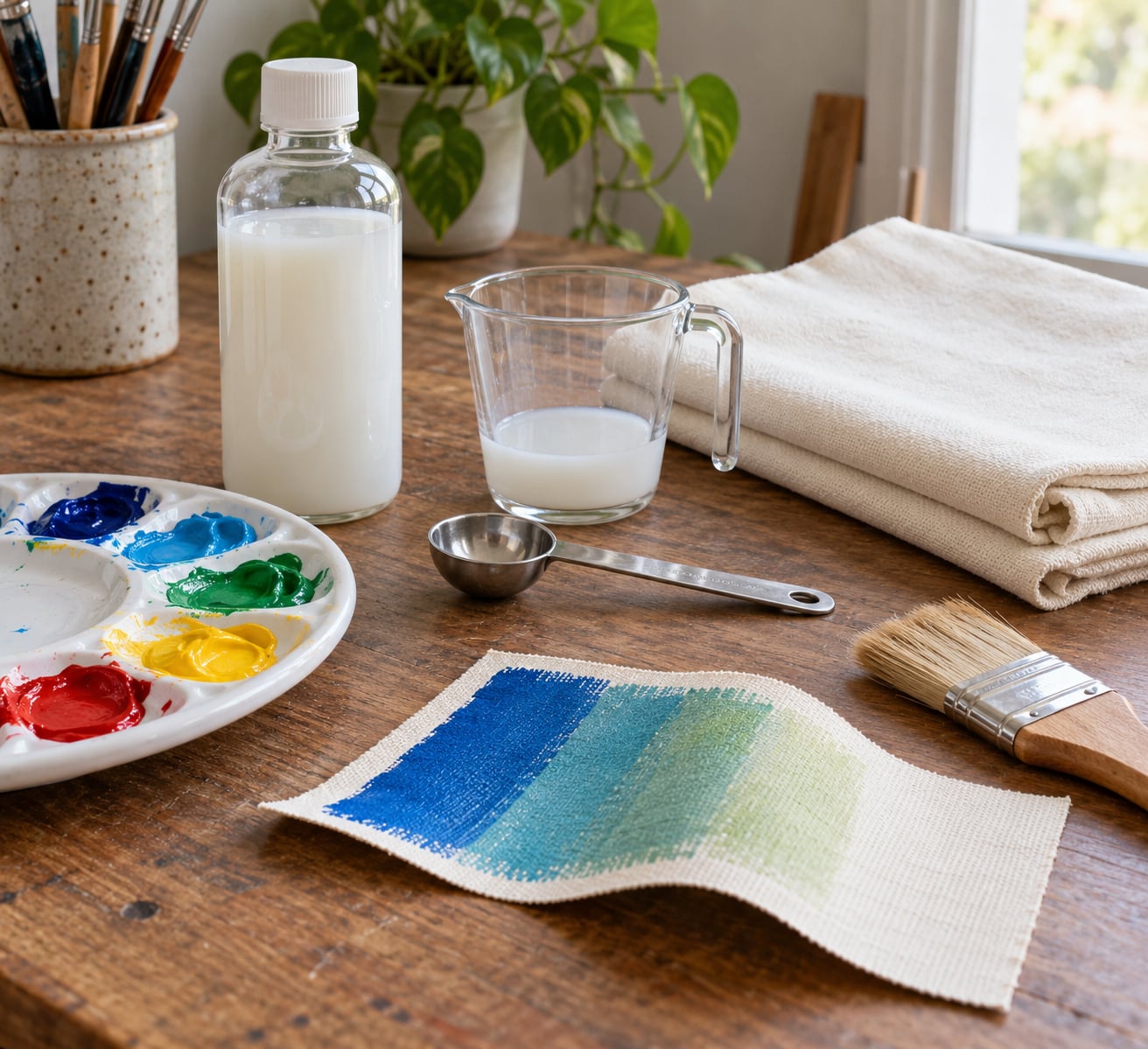
- Test the Mix on a Fabric Swatch
- Apply the Paint in Thin Layers
- Dry and Flex the Paint at the Right Time
- Seal the Fabric Without Making It Stiff
- Common Mistakes
- Common Mistakes and Fixes
- Frequently Asked Questions
- Can you make acrylic paint flexible just by adding water?
- What is the best additive for making acrylic paint flexible on fabric?
- Does glycerin make acrylic paint flexible after it dries?
- Will regular acrylic varnish or primer keep painted fabric from cracking?
- How long should painted fabric dry before it is bent or handled?
What You Need
You can do this with what’s already in most craft rooms. The only item that might need buying is the medium itself.
- Fabric — the exact fabric you plan to paint, plus a 10 x 10 cm scrap for testing.
- Acrylic paint — your usual colours. Mix your custom colours first.
- Textile or fabric medium — also sold under the name textile medium. One bottle covers several pieces.
- Water and measuring tools — a teaspoon, a tablespoon or two small cups. Ratios only mean something if you measure them.
- Brushes — a soft flat brush for broad areas and a stencil brush for edges.
- Palette or mixing jar — plastic or glass, so you can scrape the mixture back together.
- Heat source — an iron with a clean pressing cloth, or a tumble dryer on low.
- Optional — a flexible fabric sealer, a sponge or foam roller for even coverage, and masking tape for straight edges.
Step-by-Step: How to Make Acrylic Paint Flexible on Fabric
The Basic Mix: How to Make Acrylic Paint Flexible
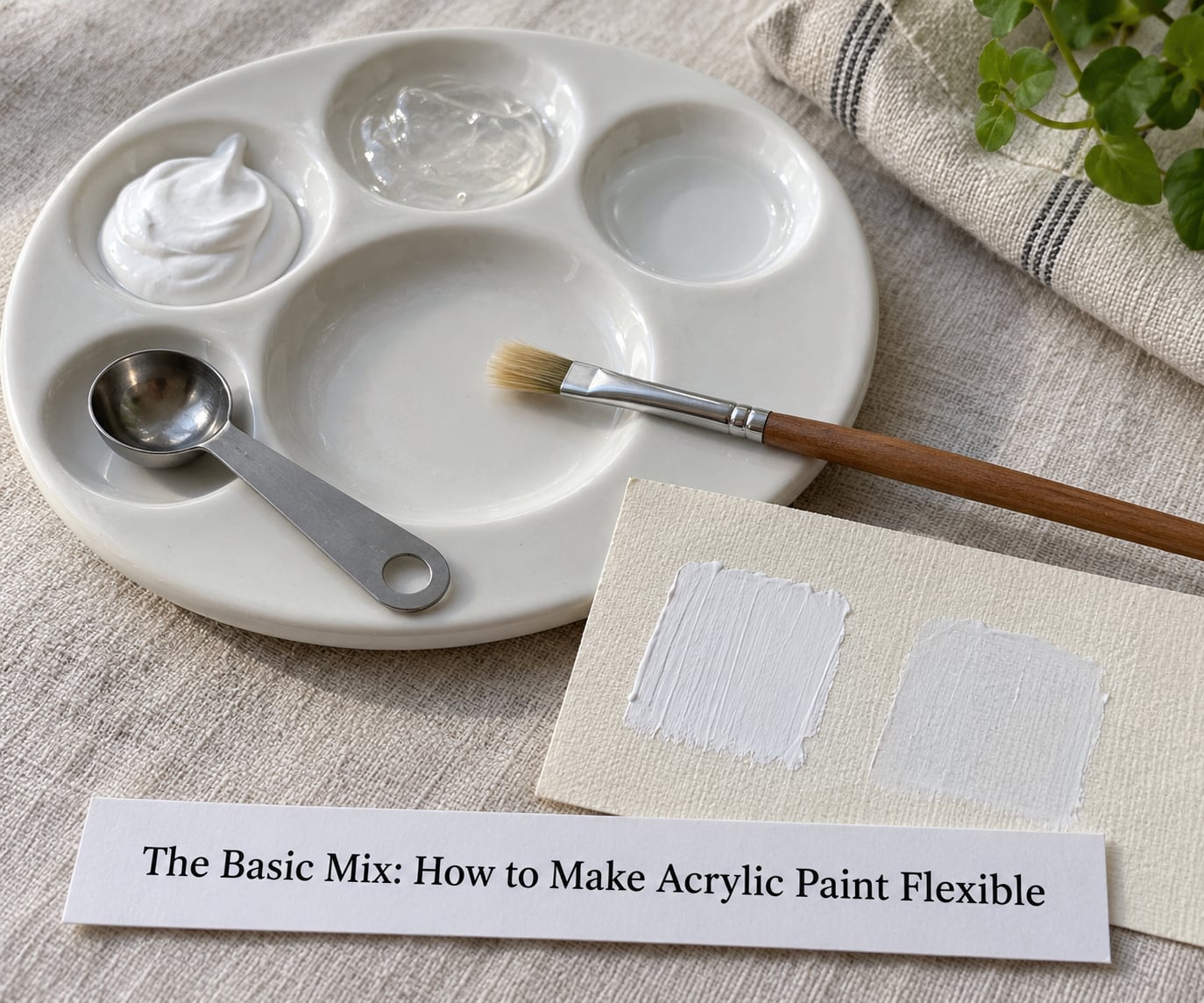
The commercial route is the one to trust. Mix your colours into a smooth acrylic first, then stir in 1 part textile medium to every 2 parts paint. That 2:1 ratio is the mixing instruction printed on the FolkArt Textile Medium bottle, quoted in the workshop thread on rotation.org, and it is the ratio most medium makers follow.
Order matters more than people expect. Tint your acrylic first, then add the medium, then adjust. If you dump medium into white paint and try to reach your colour with more paint, you will end up with a thin, watery mixture.
That thin look is the single most common complaint on r/arttools — 1:1 medium to paint leaves a mixture that runs like milk. Use less medium, or start from a heavier body paint such as a soft matte or gel base, and you keep the coverage.
If you would rather not open another bottle, glycerin is the best-performing homemade option. The most-corroborated recipe in the rotation.org workshop community is 1 part glycerin to 5 parts water, stirred into the acrylic. The Graphics Fairy uses a stronger version of the same idea: 1 part glycerin, 1 part water, 2 parts paint, with a splash of vinegar to slow moulding and keep the colour true.
Fabric softener works as a temporary softener, not a binder. Start with about a teaspoon of softener diluted in 4 parts water, stirred into 3 parts paint. It softens the hand, but expect it to move again after a wash or two, so it suits a cushion cover or a painted tote rather than a work shirt.
Choose a Fabric That Can Flex
Cotton, linen and quilting cotton behave best. They absorb paint into the weave, and they hold a flexible film without going slick. Denim works, though the tight twill needs a slightly heavier coat to cover.
Stretchy knits and synthetics — polyester, nylon, spandex — are the difficult ones. Paint them in several thin coats, and remember that the fabric already contains a plastic-like fibre that plain acrylic struggles to grip. r/Fabrics reports polyester working fine with thin layers and no luck with one heavy coat.
Always test on the actual fabric rather than a cotton scrap. Quilting cotton and a stretch jersey can take the same mixture and behave completely differently.
Test the Mix on a Fabric Swatch
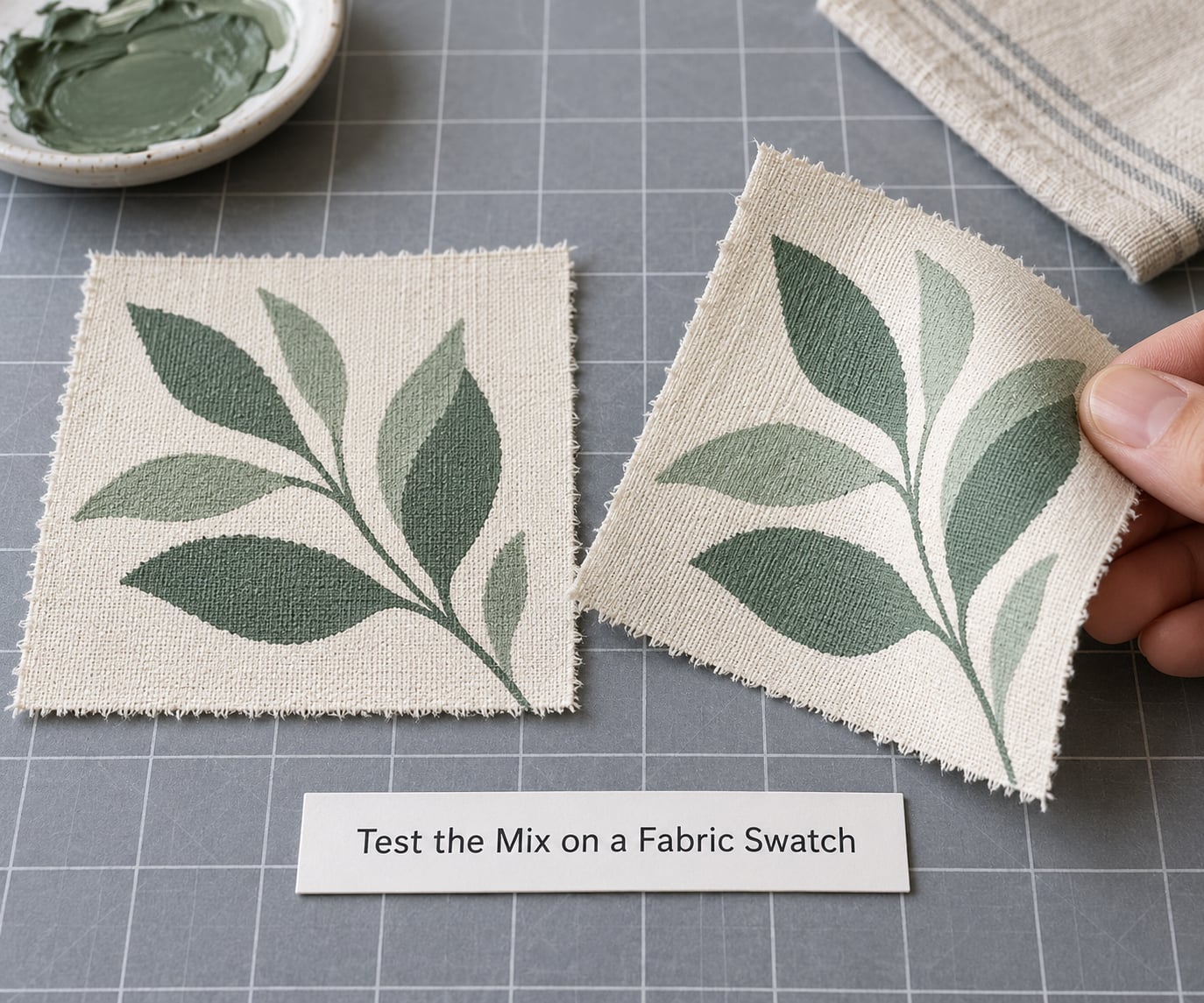
Paint two identical swatches from the same mixture. Let one dry untouched, then heat-set the other exactly as you plan to heat-set the finished piece.
Once the swatch has dried and been heat-set, bend it gently in a curve, the way a sleeve or a cushion would move. Rub the painted area with a dry fingertip and look for any lift at the edges.
Also check the colour. Some mediums lighten paint slightly, and a glycerin mix can shift a shade warmer. If the swatch reads duller than you wanted, tint the acrylic a little stronger next time instead of adding more medium.
Apply the Paint in Thin Layers
Thickness is what turns flexibility into a lie. One heavy coat dries as a solid slab; three thin coats dry as three flexible films that move with each other.
Use a soft flat brush for broad areas, a foam roller for even coverage on totes and cushions, and a stencil brush for edges. Pull the brush lightly across the weave rather than pushing colour into it, and let each coat dry to the touch before the next.
Two or three thin coats will look smoother than one thick one, and they will not crack when the fabric bends.
Dry and Flex the Paint at the Right Time
Acrylic feels dry long before it is cured. Testing a swatch while it is still slightly soft gives you a false read in both directions — it may feel rubbery, or it may tear, when a few more hours would have settled it.
Let each coat dry fully between layers, then heat-set the finished piece once the whole surface has dried. For an iron, turn the item inside out, lay a clean pressing cloth over the paint, and press for 15 to 30 seconds without sliding the iron. For a dryer, tumble low for 15 minutes with the item inside out.
Do the flex test after heat-setting, not before. That is the state your finished garment will actually be in when someone sits down in it.
Seal the Fabric Without Making It Stiff
A sealer adds abrasion resistance, but many conventional primers and varnishes dry into a rigid layer. Put a flexible fabric sealer over a flexible mixture, never a rigid primer or heavy gloss varnish, or you have rebuilt the problem you just fixed.
Check compatibility before you buy. Water-based flexible sealers go with water-based acrylic mixtures without fuss. Avoid anything described as a hard, high-gloss or automotive coating on a garment.
Apply the sealer in two thin passes, allowing the first to dry fully. A thick coat of sealant does not protect more, it just stiffens the hand.
Common Mistakes
- Using an incompatible additive — some household products make the paint softer but do nothing for adhesion.
- Adding too much softener or water — the mixture thins, coverage drops, and colour shifts lighter.
- One heavy coat — the most reliable way to end up with cracking.
- Testing while the paint is still soft — you will misjudge flexibility and adhesion.
- Sealing a flexible mixture with a rigid product — the sealer cracks first and takes the paint with it.
- Skipping the swatch — a ten-minute test saves a ruined garment.
Common Mistakes and Fixes
Almost every cracking problem traces back to one of five things: no medium, too much water, too thick a coat, unwashed fabric, or the wrong sealer.
Paint cracks along a fold. The film dried too rigid. Mix in more textile medium, drop the paint-to-medium ratio to 2:1, and rebuild the coat in thin layers.
Paint peels off in flakes. The fabric almost certainly still had sizing on it. Manufacturers of textile medium list pre-washing as a non-negotiable step, and paint applied over sizing has nothing to grip. Wash the piece, dry it, iron it, then repaint.
Paint washes out. Either it was never heat-set, or the mixture was too thin to hold pigment. Heat-set fully after the paint is completely dry, and use a heavier base coat before tinting.
Painted area feels stiff and crunchy. Too much medium-to-water ratio, or a rigid sealer on top. Drop back toward 2:1 paint to medium and switch to a flexible sealer.
Mod Podge instead of a sealer. A repeat question on r/crafts, and the answer is fairly clear: a water-based glue sealer adds a film but does not make the acrylic underneath flexible. It will not rescue a piece that already cracks. Fix the mixture first, then seal if you want extra protection.
Colour looks thin or washed out. You mixed before you tinted. Mix your colour from full-strength acrylic first, then add the medium, and stop adjusting with more paint afterwards.
Two habits cover most of it. Measure by volume every time, so your second batch matches your first, and change one variable at a time on the swatch — otherwise you will not know what fixed it.
Frequently Asked Questions
Can you make acrylic paint flexible just by adding water?
Water thins acrylic paint but does not soften it. Acrylic cures as a polymer film, and thinning that film with water leaves it just as rigid once dry, plus weaker, so it cracks more easily than paint you never thinned. If you want flexibility, add a textile medium or a glycerin and water solution instead. Water is useful for keeping a mixture workable in the jar, not for changing how the dried paint behaves.
What is the best additive for making acrylic paint flexible on fabric?
A textile or fabric medium is the best additive. Mix about 2 parts paint to 1 part medium, tint your acrylic first, and apply thin coats. Medium is formulated to bind into the paint film so it flexes with the cloth and can be heat-set for washability. Glycerin and water is the strongest homemade alternative, and fabric softener only softens the hand temporarily without adding real binding power.
Does glycerin make acrylic paint flexible after it dries?
Yes, though it is a gentler result than a textile medium. Glycerin acts as a humectant that keeps the dried film from becoming fully rigid, so paint mixed with a glycerin and water solution bends more easily than straight acrylic. Recipes range from 1 part glycerin to 5 parts water to a stronger 1 glycerin, 1 water, 2 paint. Expect moderate flexibility rather than garment-grade durability.
Will regular acrylic varnish or primer keep painted fabric from cracking?
Usually not. Primers, gesso and conventional varnishes dry into rigid layers, so on fabric they crack at the first bend and often take the paint underneath with them. A gesso-style primer is useful on a stiff panel such as a canvas tote, but not on anything that moves. On clothing and cushions, use a flexible fabric sealer applied in thin coats over a paint-and-medium mixture.
How long should painted fabric dry before it is bent or handled?
Let each coat dry to the touch before adding the next, then heat-set the finished piece once the surface is fully dry. Iron inside out over a pressing cloth for 15 to 30 seconds without sliding, or tumble low for about 15 minutes inside out. Test flexibility after heat-setting, not before, because paint that still feels soft will give you a misleading result.
If you take one thing from this, mix a small batch of paint with a textile medium at 2 parts paint to 1 part medium, and test it on a swatch of the exact fabric first. That ten-minute test settles the questions no ratio chart can answer for your particular garment.