If you are making art rather than running a garment factory, the answer usually comes down to the surface you are printing on. Water based ink is the right call for paper prints, cotton totes, light garments and any piece where you want the fabric to still feel like fabric. Plastisol is the stronger choice for bold opaque color on dark garments, high-coverage graphics and prints that need to survive hard use. This guide breaks down where each one wins so you can pick before you buy a single screen.
Table of Contents
- Water Based vs Plastisol Screen Printing Ink for Art at a Glance
- Color, Opacity, and Finish
- Water Based vs Plastisol Screen Printing Ink for Color Choices
- Absorption, Fabric Feel, and Substrate Compatibility
- Washability, Abrasion, and Long-Term Durability
- Curing, Heat, and the Printing Process
- Cleanup, Odor, and Studio Safety
- Cost, Availability, and Scaling
- Which Should You Choose?
- Frequently Asked Questions
- Is water-based or plastisol screen printing ink better for beginners?
- Can water-based ink be used on cotton and linen fabric?
- Does plastisol ink always feel plasticky?
- How should screen printing inks be cured?
- Which ink is more eco-friendly?
- How can artists test water-based and plastisol inks before choosing one?
- Conclusion
Water Based vs Plastisol Screen Printing Ink for Art at a Glance
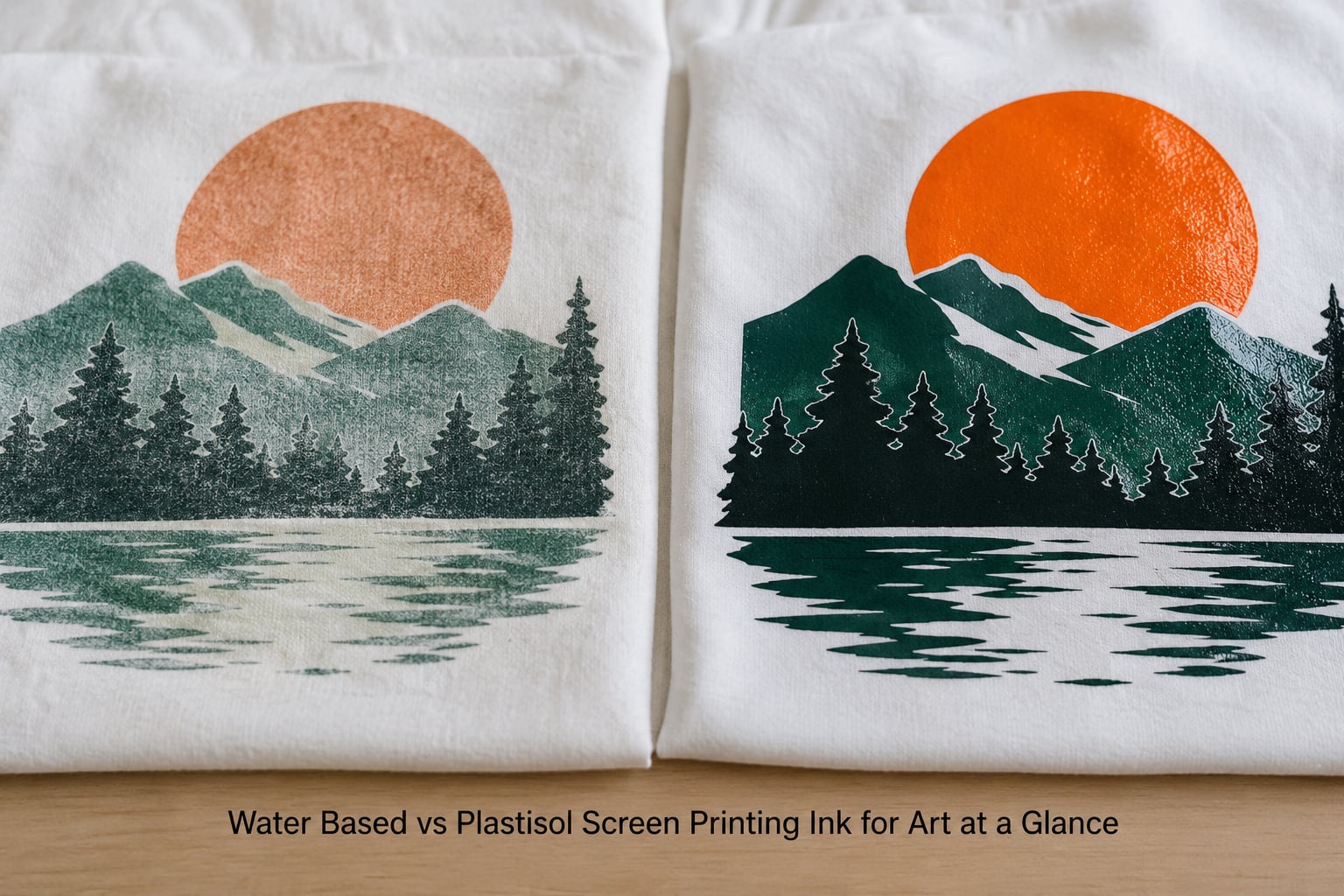
Plastisol is a 100% solid paste of PVC resin suspended in plasticiser. Water based ink is pigment carried in water with an acrylic or latex binder. That single difference in carrier decides hand feel, opacity, curing temperature and how you clean your screens at the end of the night.
| Attribute | Water Based Ink | Plastisol Ink |
|---|---|---|
| What it is | Pigment in water with an acrylic or latex binder | PVC resin and pigment paste in a plasticiser carrier |
| Hand feel | Soft, often nearly no print feel | Noticeable film on top, from matte to high gloss |
| Opacity on dark garments | Weak without a white base or underbase | Excellent, built for coverage |
| How it dries | Water evaporates, then binder is heat set | No evaporation, the paste gels and fuses under heat |
| Typical cure | Forced high-velocity air, warm air, or conveyor | Heat around 160C, infrared flash or conveyor dryer |
| Cleanup | Tap water, screen wash and a brush | Solvent or press wash, then a separate reclaim step |
| Odor and ventilation | Low odor, open windows are usually enough | Noticeable solvent odor, use extraction |
| Screen stability | Less forgiving, dries in the mesh if you pause | Long open time, stable on screen all day |
| Stretch and drape | Stretches with the fabric, breathable | Can crack or peel on heavy stretch and high heat |
| Paper and fine art | The standard choice for screen-printed art prints | Not suited to paper, too thick and rubbery |
| Best for | Paper prints, cotton totes, light garments, soft hand | Dark garments, bold graphics, durable statement prints |
One more thing worth knowing before you compare the rest: art ink brands are often lumped into the wrong family. Speedball, Jacquard and Caligo screen inks sold for paper and fabric printing are water based acrylic inks, not plastisol. When you see the word plastisol in an art context, it almost always refers to a textile ink designed for garments.
Color, Opacity, and Finish
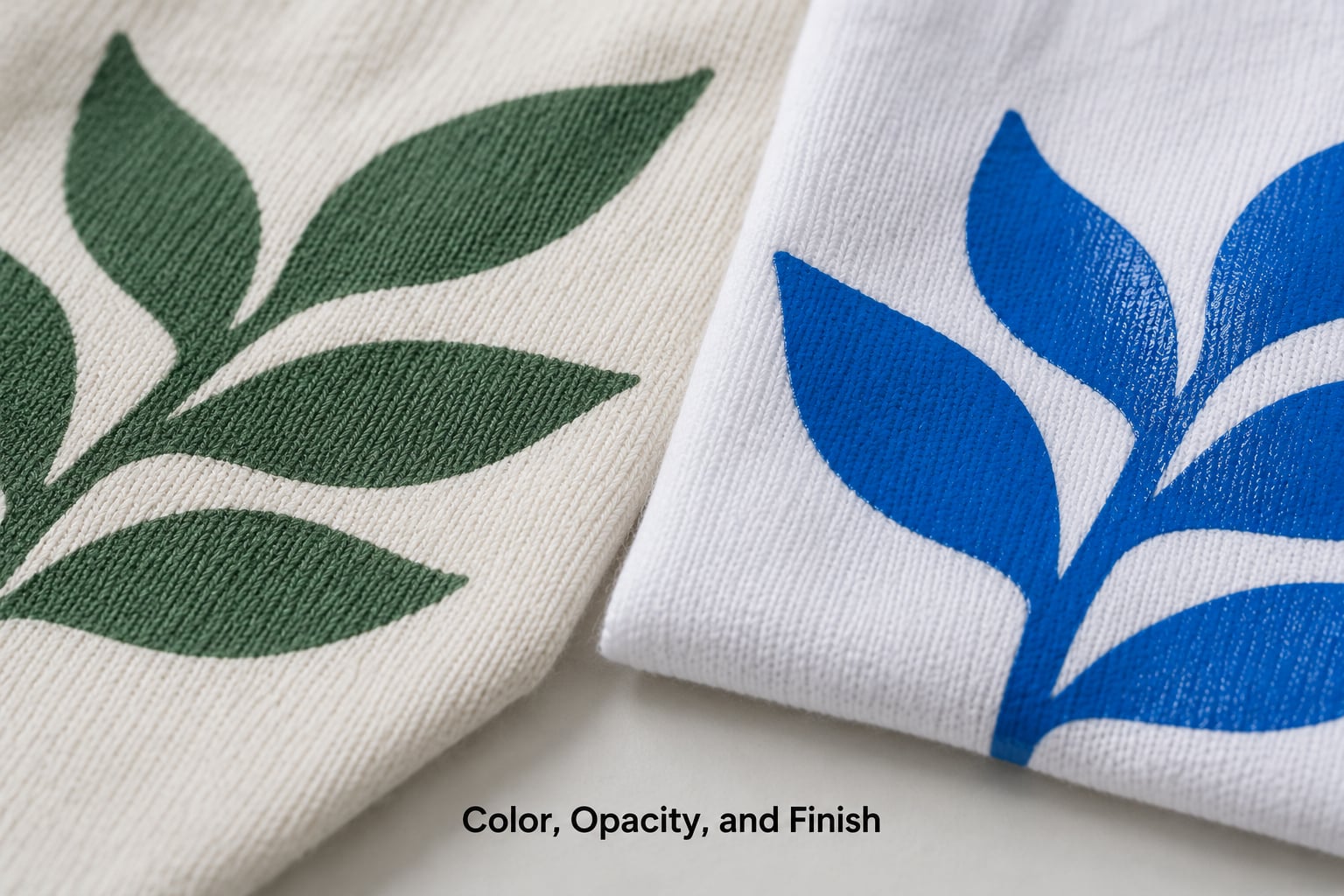
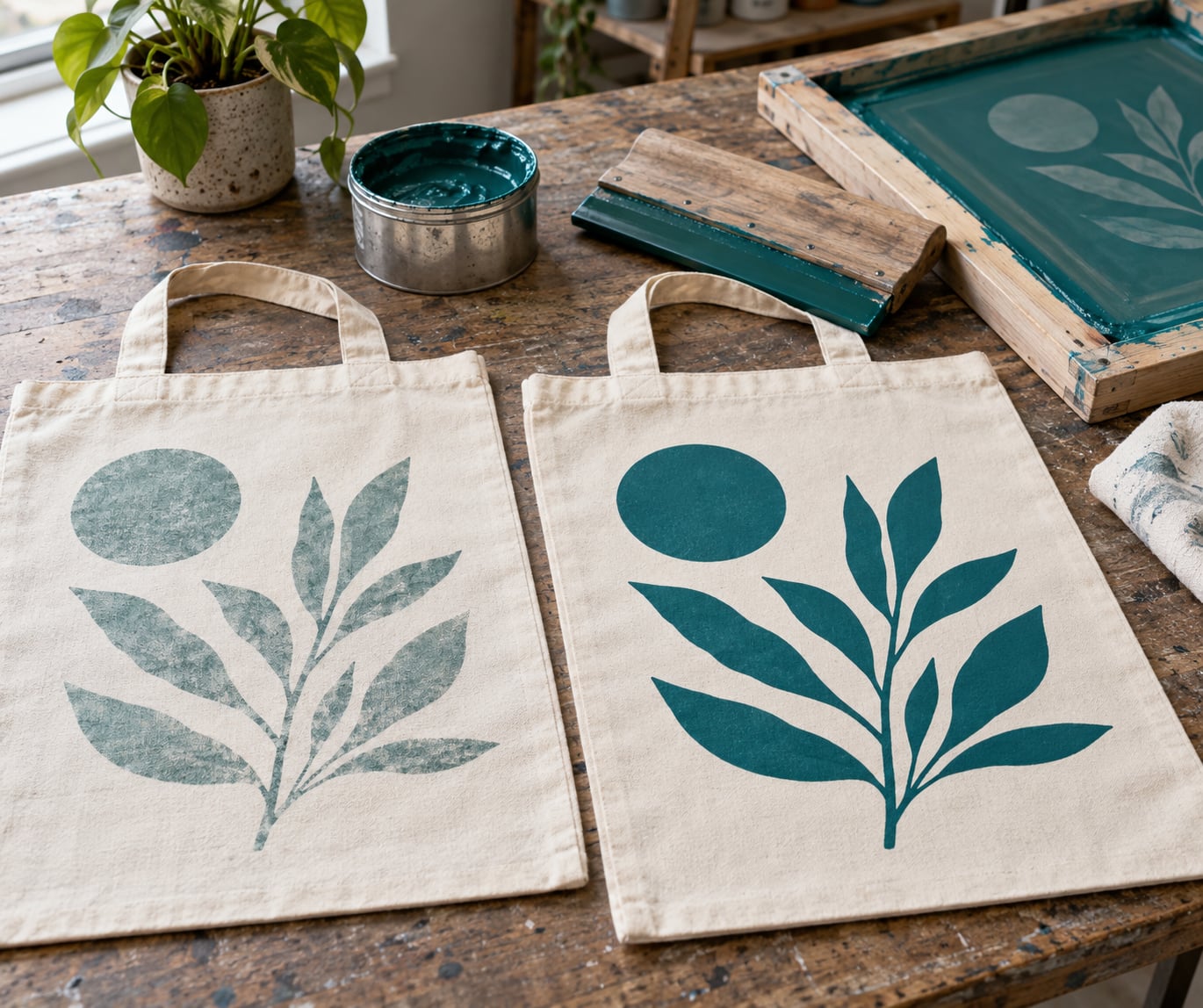
Color is where the two inks separate most clearly. Water based ink carries color into the top fibers of the fabric, so the print takes on a slightly muted, woven quality. Plastisol lays color down as a solid film sitting on the surface, which is why it looks more saturated and more graphic.
Neither is universally better. A soft, breathable print that reads as part of a natural fabric is exactly what many artists want. So is a flat, dense hit of color that reads from across a room. Match the ink to the effect you are after rather than to a rule.
Finish is a separate dial from opacity. Matte, satin and gloss plastisol are all available, and matte water based inks exist too. Discharge ink is a third path again, bleaching the garment and replacing the dye with color for a vintage or soft-hand look on dark cotton.
Water Based vs Plastisol Screen Printing Ink for Color Choices
Start with the garment color, because that decides everything downstream. On white or natural fabric, both inks give you a wide range. On a black or navy shirt, opacity requirements push most printers toward plastisol or toward a water based white underbase laid down first.
Metallics and fluorescents are where the ranges diverge. Fluorescent inks depend on an opaque base to hold the bright pigment, so they lean toward plastisol. Water based metallics and pearlescent inks exist for paper and fabric work, and they print beautifully where a soft hand matters more than coverage.
Fine line work, halftones and gradients favor water based ink on paper because the binder sits in the paper rather than on it, so fine detail does not sit on a raised film. Plastisol handles large single-color areas and hard-edged shapes more predictably. For layered colors and multi-color registration, both work, and neither gains much.
If you need to match a specific color, work from an ICC profile and a spectrophotometer for either ink, then print a test on the actual substrate. Pantone-style spot matches on fabric shift more than people expect, and the shift is mostly a substrate and ink film question.
Absorption, Fabric Feel, and Substrate Compatibility
Water based ink soaks into cotton and linen. That is the whole point, and it is why the print breathes, drapes and feels soft. It is also why the color sits slightly under the fabric surface and why coverage on a dark ground is a struggle without help.
Plastisol does not absorb. It forms a film on top of the fiber and stays flexible because the plasticiser keeps it gummy, but it is a separate layer that can crack, peel or harden with age and high heat.
Polyester and poly-cotton blends are the awkward case for water based ink. Synthetic fibers do not absorb, and many garments are dyed with disperse dyes that can migrate into a print under heat. Experienced printers on r/SCREENPRINTING treat this as the main reason to choose plastisol or a water based ink with built-in dye migration resistance.
Paper is the opposite case, and it is the one most guides skip. Water based acrylic screen ink is standard for serigraphy on paper, poster stock and cotton rag. Ink soaks into the sheet, giving flat color with no hand at all. Plastisol on paper would be a mistake: it is too thick, it sits on top like rubber, and it will not bond.
The practical rule is to pretest. Print the same ink on the light and dark side of the fabric, on the seam allowance, and on a scrap of the same blend. Ink that behaves beautifully on 100% cotton can bead on a 50/50 blend, and nobody’s guarantee covers your specific garment.
Washability, Abrasion, and Long-Term Durability
Surface durability and colorfastness are two different things, and they fail differently. Surface durability is about the film resisting scuffs and flex. Colorfastness is about whether the color stays put when the garment is washed.
Properly cured plastisol is exceptionally durable against abrasion because it is a thick fused film. Its weakness is the opposite: a rigid film on a stretchy knit can develop micro-cracks with wear, and high heat in a tumble dryer or a hot iron can stress those areas further. That cracking is the most common complaint I hear about plastisol on cotton.
Water based ink has less material to abrade in the first place. Once the binder is heat set, a well-processed water based print is flexible and holds color well, particularly on cotton. Where it can fall short is coverage, so a thin, under-opaque print on dark fabric has less color to lose in the first place.
Wash care matters more than brand. Cold water, inside out, and no dryer on high heat preserves either ink better than hot cycles and a tumble dry. If you are selling prints, wash and stretch test a few before you promise anything to a customer.
I would not promise a number of years for either ink. Lightfastness, wash frequency, fabric, cure quality and storage all change the outcome, and no ink manufacturer offers a lifespan guarantee.
Curing, Heat, and the Printing Process
Curing is where the two inks are least alike. Plastisol does not dry, it gels. There is no solvent or water to evaporate, so heat does the work: the paste sits on the screen indefinitely and flashes off when it hits hot air. Most plastisol is cured around 160C, with infrared flash dryers giving fast spot cure and conveyor dryers giving an even, controlled result.
Water based ink loses water first, then needs the binder set with heat. Air drying alone leaves a print that feels good but washes out fast. Forced high-velocity air is the standard cure because moving air strips moisture far faster than still air at the same temperature, and a home setup usually means a fan or a heat gun on a rotating platform. Ink suppliers publish specific times and temperatures for their own formulas.
For plastisol, cure temperature that is too low gives you a print that looks finished and peels after a wash. For water based, inadequate cure gives you a print that feels fine and fades first. Both failures look identical on day one. Follow the ink manufacturer’s cure instructions and test on a scrap garment, because these numbers are not interchangeable across brands.
Cleanup, Odor, and Studio Safety
Water based ink washes out with water, a screen printing wash and a brush. On a small home screen this is the difference between a ten-minute cleanup and an evening spent with a solvent reclaim. That single difference is often what sells beginners on it.
Plastisol needs a solvent or press wash while fresh, and screens used for plastisol usually need a separate reclaim step to strip cured ink. The odor in the studio is real, so ventilation matters. Solvents also carry VOC load and need storage away from ignition sources.
Safety guidance should come from the ink itself. Every ink has a safety data sheet following GHS format, and that sheet is the authority on gloves, ventilation, spill response and disposal. Read the SDS for the specific product before you handle it, and follow the manufacturer instructions for storage and disposal.
A related question comes up constantly, so here is the direct answer: do not mix plastisol and water based ink in the same bucket or on the same screen. The chemistries do not blend, and the result is generally lumpy, short shelf life and unpredictable cure. Experienced printers on r/SCREENPRINTING treat cross-contamination as a ruined job. Use separate tools and wash everything between inks.
Cost, Availability, and Scaling
Compare cost per finished piece, not per jar. Ink that needs a second white underbase layer, a slower screen change and rework for clogged mesh costs more by the time a shirt leaves the dryer. That math shifts with run length, and small artist runs are where setup dominates.
Water based ink is widely available from art suppliers and printing supply houses, and water based textile inks are common in commercial channels. Plastisol is equally available and priced similarly per unit, but a plastisol workflow adds screen cost, solvent cost and dryer requirement to the setup.
Mesh and emulsion choices shift spend too. Water based ink behaves better on lower mesh counts that deposit more ink, and on a cotton ground you want a water resist or photopolymer emulsion. Plastisol prints well on high mesh counts for fine detail, and the classic cap that several threads on t-shirtforums recommend, roughly 155 to 200 mesh, is about laying down enough white to underbase a dark garment.
For a ten-piece run of art shirts, labor is the real line item in both cases. For a few hundred pieces, cure time and screen stability start to matter, and plastisol’s longer open time becomes an advantage. For thousands of pieces, throughput and setup efficiency decide the cost.
Which Should You Choose?
Choose water based ink when the work is on paper, on light or natural fabric, or when the finished piece needs to feel like cloth rather than a coated surface. It is the right call for fine line detail, art prints, cotton totes, breathable garments and any studio that would rather clean screens with water.
Choose plastisol when you need bold opaque color, a dark garment without a white underbase, high coverage over textured surfaces, or a print built to take hard wear. It is more forgiving on the press, which matters if you are printing large color areas or working with a squeegee held by a person who is not you.
A short checklist before you commit:
- Decide the substrate first: paper, light cotton, dark cotton, or synthetic blend. That rules out half the options.
- Choose the finish you want to touch: invisible soft hand, or a raised graphic film.
- Set the opacity requirement, then decide whether you need an underbase.
- Match your mesh and emulsion to that ink, not to the last job you printed.
- Check your cure equipment against the ink manufacturer instructions before you open a jar.
- Print one test on the real garment, cure it, then wash and stretch it.
If you are still torn, print the same design in both inks on the same garment and let the print decide. That test takes an afternoon and settles arguments that specs never will.
Frequently Asked Questions
Is water-based or plastisol screen printing ink better for beginners?
Plastisol is usually easier to learn on, because it stays workable on the screen for hours and does not clog the mesh if you take a break. Water-based ink rewards a cleaner workflow and cleans up with tap water, which is a big advantage in a small home studio. Beginners printing paper or light fabric will do fine with water-based. Beginners printing dark garments will hit opacity problems fast.
Can water-based ink be used on cotton and linen fabric?
Yes. Water-based ink is at its best on cotton and linen, which absorb the binder into the fiber and give a soft, breathable print with almost no hand feel. Coverage on a dark ground is harder, so a white underbase or a brighter shirt is usually the easier first project. Always pretest on the specific fabric and garment dye before a full run.
Does plastisol ink always feel plasticky?
No. Hand feel depends on the ink, the mesh count, how many layers you lay down, and the finish. A matte plastisol printed through a fine mesh on a soft knit can feel far better than a high-gloss build on heavy mesh. Thin single-hit prints feel noticeably lighter than multi-hit builds. If the raised feel is a problem for you, print a test and handle it before committing.
How should screen printing inks be cured?
Plastisol is cured with heat, commonly around 160C, using a flash dryer or a conveyor dryer, until the film is fully gelled and fused. Water-based ink must dry, then be heat set, and forced high-velocity air is the standard method. Cure too cool and plastisol peels; cure too cool on water-based and the print fades. Follow the ink manufacturer’s stated times and temperatures.
Which ink is more eco-friendly?
Water-based ink avoids PVC and usually cleans up with water instead of solvent, so it is the lower-impact option in the studio. It is not impact free, since drying and curing still take energy, and dyes and pigments vary by formula. PVC-free and phthalate-free plastisol versions also exist. Check the ink’s safety data sheet and any OEKO-TEX or similar certification rather than relying on the word eco.
How can artists test water-based and plastisol inks before choosing one?
Print the same simple two-color design on the actual garment or paper you plan to use, one of each ink, and let them cure fully. Then handle them, bend them, wash one, and stretch one. Compare color, hand feel, coverage and how the print survives. Testing on a scrap fabric tells you much less than testing on the material you will actually sell.
Conclusion
The choice is simpler than the spec sheets make it sound. Start with the substrate: paper and light natural fabric point to water based acrylic ink, dark garments and synthetic blends point toward plastisol. Then decide whether you want a soft hand you can barely feel or a bold opaque graphic with a film on top.
Print one test of each on the material you actually plan to sell, cure it the way the manufacturer specifies, then wash and stretch it. That afternoon of testing will answer in a way no comparison chart can, and you will know which ink your studio can print consistently. Whatever you pick, buy the ink you can finish properly rather than the one that sounds more impressive.