If you want one straight answer: medium-weight quilting cotton is the best fabric for art quilts in most cases, because it stays stable under the needle, takes dense stitching without puckering, and comes in the widest range of colors and values. Swap it for silk dupioni, linen, or wool when the surface itself is doing the artistic work, not just the composition.
That second sentence is where most of the confusion lives. Art quilts get judged on surface, movement, and value structure, and the fabric you choose decides whether the piece drapes like textile art or hangs like a plywood panel. A bed quilt asks fabric to survive laundering. A wall piece asks it to hold a shape, catch light, and stay soft.
I have watched this go wrong in both directions: a landscape-format quilt that turned into a rigid board after five layers of fusible interfacing, and a silk piece that was gorgeous until the first full seam broke through and pulled. Both failures were fabric decisions, not technique failures. Once you know what each material is actually doing, the choice gets much faster.
Table of Contents
- What Fabric Is Best for Art Quilts at a Glance
- Cotton
- Best for Everyday Art Quilts
- Linen
- Wool
- Silk
- Rayon and Tencel
- Denim and Canvas
- Cotton Blends
- How to Choose Fabric for Your Art Quilt
- How to Choose the Best Fabric for Art Quilts That Will Not Go Stiff
- How to Test Fabric Before You Commit
- Frequently Asked Questions
- What kind of fabric is best for quilts?
- Should I prewash fabric before quilting an art quilt?
- Is big-box fabric good enough for an art quilt?
- Do art quilts need to be washed?
- Can I use linen for quilting?
- What backing and batting work best for a large art quilt?
- Conclusion
What Fabric Is Best for Art Quilts at a Glance
Cotton wins by default because it is forgiving and available in every color you can imagine. Everything below it earns its place by adding something cotton cannot: slub texture, sheen, weight, loft, or a surface that changes in the light.
| Fabric | Hand and texture | Drape | How it takes stitching | Best art-quilt use | Care |
|---|---|---|---|---|---|
| Quilting cotton (medium weight) | Crisp, matte, fine tooth | Medium | Excellent; minimal puckering, clean appliqué edges | Everyday pieces, pieced scenic work, gallery work | Machine wash cold |
| Linen and linen blends | Slubby, strong, matte | Stiff to medium | Good, but press hard; frays at raw edges | Texture-forward abstracts, rugged scenic work | Machine wash, expect shrinkage |
| Wool, felted and woven | Fuzzy, sculptural, matte | Heavy, body-filled | Needs sharp needles; can shed | Tactile panels, dimensional work | Dry clean or spot clean |
| Silk, dupioni, raw silk | Crisp with slub and sheen | Fluid (dupioni), fluid (raw silk) | Fine detail only; pin or glue to stabilize | Show pieces, luminous abstracts, layered collage | Hand wash or dry clean |
| Rayon and Tencel | Smooth, fluid, slight sheen | Fluid | Good, but slips and wrinkles | Flowing abstracts, soft collage layers | Machine wash cold, hang dry |
| Denim and canvas | Rigid, coarse, structured | Stiff | Stable but may pucker with dense stitching | Architectural panels, embellished work | Machine wash, rare |
| Cotton-poly and cotton-linen blends | Depends on ratio | Medium to fluid | Very stable; less puckering than pure cotton | Long durability, mixed-material quilts | Machine wash, less wrinkling |
One note on that table: drape is not a quality score. Whether you want drape or stiffness is a design decision, and a quilt that hangs in folds reads completely differently from one that holds a plane away from the wall.
Cotton
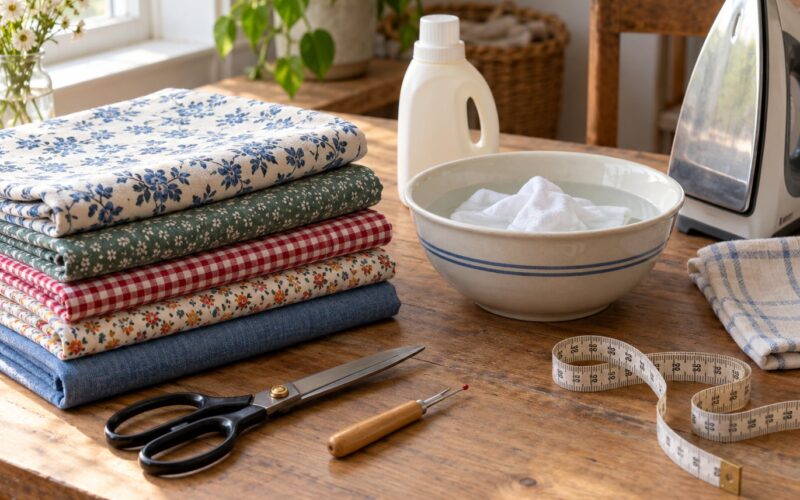
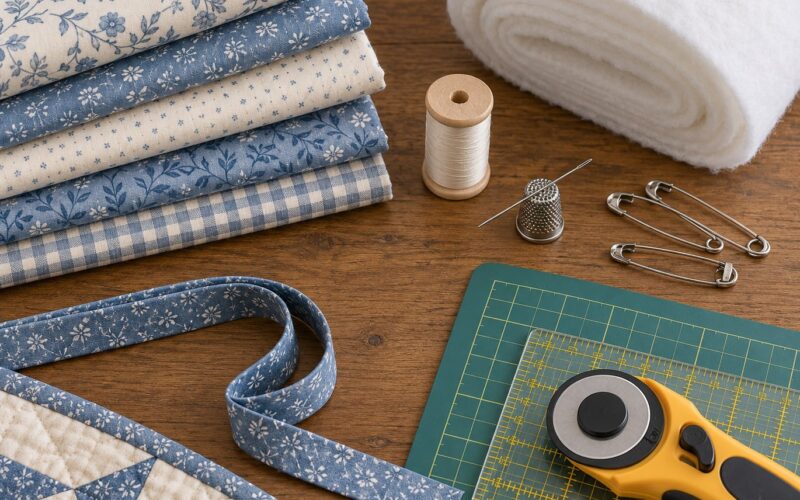
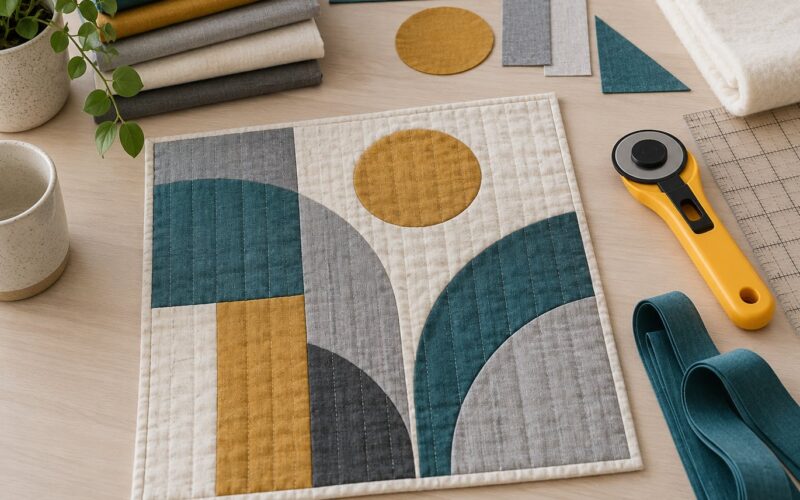
Medium-weight quilting cotton is the fabric I default to, and it is the right answer far more often than the specialty aisles suggest. It has enough body to sit flat on a cutting mat, enough stability to take a long seam without stretching, and enough tooth to stop appliqué edges from disappearing under a presser foot.
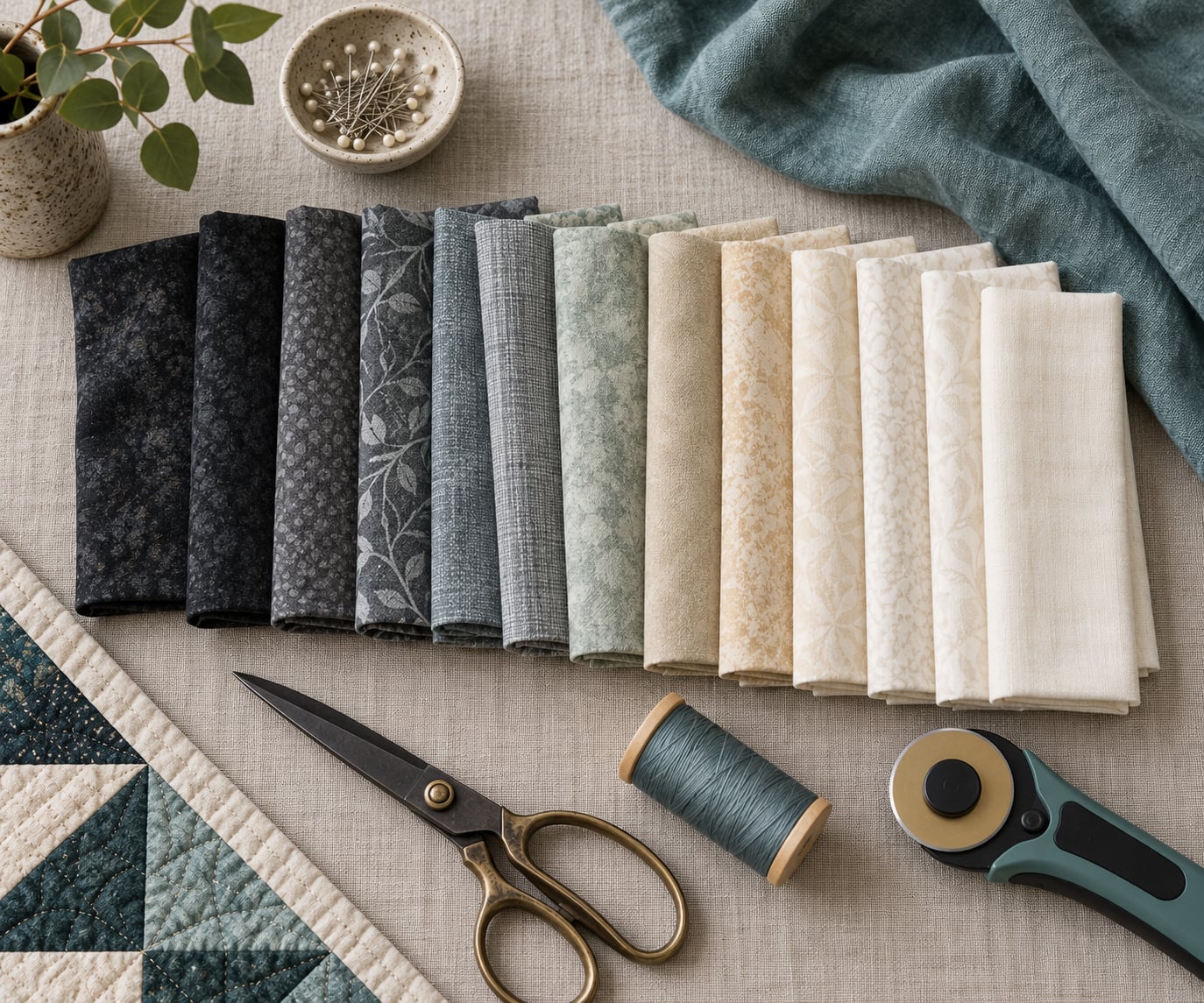
The practical advantage is availability. When you need eleven value steps from deep charcoal to warm cream to build a sky, cotton is the one material where you can walk into a shop and pull bolts until the gradient works. Silk and hand-dyed cloth do not offer that range, and trying to force a gradient from three bolts becomes a design compromise you fight all the way to the binding.
Cotton also handles both construction styles. Machine appliqué, hand appliqué with a small appliqué foot, free-motion quilting, and running stitch all work on it without a fight. If your piece has many pieced sections or layered raw-edge work, cotton is the least likely to distort.
Best for Everyday Art Quilts
For beginners, frequent makers, and anything that needs easy sizing and reliable stitching, cotton is the practical best fabric for art quilts. It presses well, sews well, cuts predictably, and forgives the small mistakes that come with a first attempt at a complex composition.
Lightweight cotton voile is worth knowing too. It takes a sharp stitch beautifully and gives a crisp, almost papery surface, which reads well for flat collage pieces and high-detail work. Its weakness is that it shows every flaw and will not hide a lumpy seam underneath.
Linen
Linen brings a texture cotton cannot fake. The slub, the slight irregularity in the yarn, and the way it takes dye deeper in some spots create a surface with depth even in a single flat color. That makes it a strong choice for abstract pieces where you want the material to carry part of the image.
The tradeoffs are stiffness and shrinkage. A fiber-content test is worth running before you commit: cut a 4-inch square from the bolt, mark it, wash it the way you plan to wash the finished piece, and measure. Linen commonly moves several percent, and that shift will distort pieced work if you did not allow for it.
Press linen with steam and a hot dry cloth, and cut with sharp blades. It frays more than cotton, which matters if you are leaving raw edges as part of the design, and it can feel board-like in large pieces unless your backing is chosen carefully.
Wool
Wool is the tactile option. Felted wool, boiled wool, and woven wool coatings give a piece a sculptural presence that no plant fiber reproduces, and they hold shape without interfacing. Experienced art quilters name wool often when a work needs to feel like an object rather than a hanging.
It also takes dense stitching differently. A thicker wool compresses under the needle and holds a line, so you can build relief with quilting alone instead of adding foam or batting loft. Use sharp needles, because a dull one will punch rather than penetrate, and expect some shedding if the wool is not fully felted.
Care is the limiting factor. Most wool art quilts are dry-cleaned or spot-cleaned, so if the piece needs to be washable, choose a wool blend with a cotton content rather than pure wool.
Silk
Silk is where art quilts separate from bed quilts most sharply. Dupioni has a crisp, papery hand with visible slub and a low-key sheen that shifts as the viewer moves. Raw silk feels fluid and falls into soft folds, and both catch light in a way cotton never does. Forum discussions consistently name silk dupioni as the go-to material for wall hangings and show pieces, while warning against it for anything that gets slept on or washed often.
The limits are practical. Silk is unforgiving of heavy stitching, so dense free-motion quilting can pucker or break threads. Stabilize it with a lightweight fusible or a spray stabilizer before long seams, and pin rather than stretch.
If you want the look without the risk, silk-blend cloth or a good rayon solves most of it. That is also the route I would take for a first silk experience, because a botched silk panel is frustrating in a way a botched cotton panel is not.
Rayon and Tencel
Rayon and Tencel are the practical silk substitutes. Both drape fluidly, take color beautifully, and are much easier to sew than real silk. Tencel in particular has a soft, cool hand and a subtle sheen that photographs well and stays stable dimensionally.
Both wrinkle more than cotton, which is the main thing to plan around: press them and consider a light starch or sizing if crispness matters to the composition. They fray less than linen but can still fray at raw edges, so turn or cover those edges. For layered and appliqué work they behave nicely, since they lie flat and do not fight the curve.
Denim and Canvas
Denim and canvas give a piece architecture. Their weight and stiffness let an art quilt hold a shape away from the wall, which is a real advantage for abstract work that would otherwise collapse into a flat sheet. Denim’s diagonal twill also catches light differently depending on the direction you cut it, so the texture can become part of the composition.
Use new denim if the piece is going on display near a window, since the indigo fades. Both are stable under the needle, but both can pucker under very dense stitching, so drop your stitch length slightly and use a walking foot if needed. For heavily embellished work, they are the most forgiving base you can ask for.
Cotton Blends
Blends are what most of my working stash is made of. Cotton-polyester gives you cotton’s familiar hand with more strength and far less wrinkling, and the lower shrinkage makes it a sensible choice for large pieces. Cotton-linen gives you cotton’s stability with linen’s texture, which is a fair compromise when you want slub without the full linen commitment.
The tradeoffs are real but small. Polyester content pills over years of handling and can trap a static charge that makes appliqué pieces shift. Cotton-linen behaves like linen at the presser foot, so it inherits linen’s fraying. Check the fiber content label before buying, and if you are mixing materials in one quilt, test them together.
How to Choose Fabric for Your Art Quilt
Start with the job, not the fabric. A quilt that will be handled, washed, and used has different requirements from one that hangs in a gallery for ten years. Art quilts are mostly the second kind, which is why laundering arguments that dominate most quilting buying guides matter less here. Drape, color stability, and how the surface reads from three feet away matter more.
Then decide the scale, because scale changes the answer. Small pieces under about 16 inches can carry almost anything, including stiff and specialty cloth. Large wall pieces cannot, and they are where fabric problems become obvious.
- Define the job. Wall display, gallery piece, or a quilt that gets used and washed.
- Decide the scale. Under 16 inches, prioritize surface interest. Over 24 inches, prioritize drape and layer control.
- Choose hand and drape. Flowing abstract work wants fluid cloth; architectural work wants structure.
- Plan the value range first. Lay out your darks, mids, and lights before choosing texture, so the composition stays intact.
- Check that you can source more of it. Hand-dyed and specialty cloth is often small-batch, and a second bolt may not exist.
How to Choose the Best Fabric for Art Quilts That Will Not Go Stiff
A rigid art quilt is almost always a layer problem, not a fabric problem. The stiffness comes from density and construction: heavy fusible interfacing on every layer, dense quilting at a short stitch length, and a heavy backing. Big pieces make it worse because the weight of the quilt itself starts pulling it straight.
- Use one layer of fusible interfacing, medium weight, only where you need stability, rather than fusing every shape.
- Choose a thinner batting for large work, and stay under about a quarter inch of loft per layer.
- Quilt at a moderate density. Very dense quilting in a heavy thread is the single biggest stiffness factor.
- Back with a lighter cotton or a soft blend rather than upholstery weight, so the two sides balance.
- Wash the finished piece with a small amount of fabric softener or a cup of white vinegar if you want it to relax and soften after a stiff start.
- Keep the piece sized so it can hang from a single cleat; too long and the weight does the rest.
How to Test Fabric Before You Commit
Prewash advice swings from always to never, which is usually a sign that the right answer depends on the fabric. Ten minutes of testing resolves it better than any amount of discussion.
- Cut a swatch from the same bolt you plan to use, at least 4 by 4 inches.
- Mark it with a pen at the edges and measure the exact width.
- Wash and dry it the way the finished piece will be cared for.
- Measure again. Anything over about 3 percent shrinkage gets cut oversized or prewashed.
- Run a rub test with a damp white cloth on the back to check colorfastness.
- Sew two lines of dense stitching on a scrap, then press, and see whether it puckers.
- Hang the sample over your hand and compare drape to what you have in mind.
Frequently Asked Questions
What kind of fabric is best for quilts?
For most quilts, medium-weight quilting cotton is the best all-around choice. It is stable, affordable, easy to find in a wide range of colors, and takes machine or hand stitching cleanly. Bed quilts that need frequent laundering benefit most from cotton or a cotton-polyester blend. Art quilts and wall hangings can stretch the choice toward silk dupioni, linen, wool, or hand-dyed cloth when surface texture is the point.
Should I prewash fabric before quilting an art quilt?
It depends on the fabric, so test a swatch instead of following a blanket rule. Cut a 4-inch square, mark it, wash and dry it the way you plan to care for the finished piece, then measure. Anything that shrinks more than about 3 percent should be prewashed or cut oversized. Hand-dyed cloth benefits from a gentler hand wash and air drying, and prewashing can shift its color distribution.
Is big-box fabric good enough for an art quilt?
Often yes, especially for backgrounds, backing, and areas covered by other elements. Quality matters most in the fabrics that carry the visual focus and the parts you handle or stitch densely. Quilters report that lower thread-count cottons ravel more readily at cut edges, which matters most for raw-edge appliqué. Check the fabric by hand: a good cloth feels substantial, frays slowly, and does not feel papery or over-starched.
Do art quilts need to be washed?
Most never are. Art quilts are displayed, not used, so shrinkage arguments matter far less than drape, color stability, and how the piece looks on a wall. Spot-clean or gently hand-wash if you need to, and test any cleaning method on a scrap first. If the piece is made with wool, silk, or a fusible collage construction, dry cleaning or spot cleaning is usually the safer choice.
Can I use linen for quilting?
Yes, and experienced art quilters use it deliberately for its slub texture and durability. Linen is less forgiving than cotton: it frays more at cut edges, presses differently, and commonly shrinks several percent. Cut with sharp blades, press with steam and a hot dry cloth, and keep large pieces from getting board-like by choosing a light backing. Linen blends are a softer middle ground if you want the texture without the stiffness.
What backing and batting work best for a large art quilt?
For a large piece, keep both light. A medium-weight fusible interfacing used only where you need stability, a thin-to-medium batting, and a soft cotton or blend backing will keep the quilt drapey. Very dense quilting in heavy thread is usually the biggest cause of stiffness, not the batting itself. If the piece is already built and feels rigid, a wash with fabric softener or a cup of white vinegar will help it relax.
Conclusion
Pick cotton for the piece that has to work, silk dupioni or linen for the piece that has to hold attention, wool and denim for the piece that has to feel like an object, and rayon or Tencel when you want flow without the risk.
Start with the surface and the construction demands, not the aisle. Cut one swatch from the bolt you actually intend to use, wash it, stitch it, and hold it. Ten minutes of that tells you more than a page of specifications.