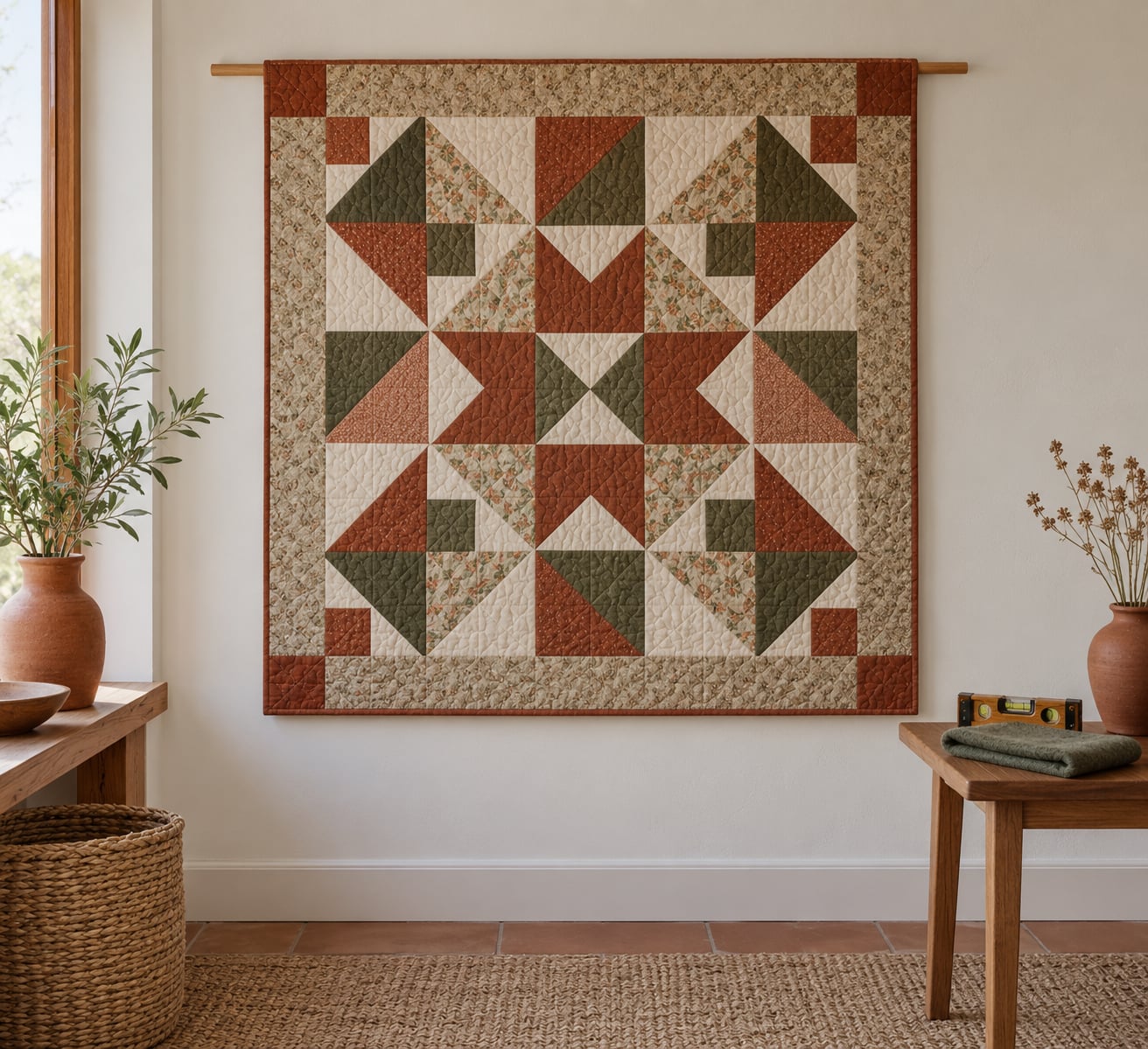
To hang a quilt on a wall without damaging it, support the quilt from a rod, sleeve or clip that carries the weight, and keep every piece of hardware on the wall side of the fabric. If you want zero holes, an adhesive hook holds a curtain rod with quilt clips and takes the quilt up off the wall. If you want a hang that lasts years, sew a hanging sleeve and slide a dowel through it. Both keep the quilt flat and leave the wall repairable.
Most damage happens at one of two places: a nail or pin driven into drywall, or clips tightened hard enough to bow the quilt forward. Both are easy to avoid once you pick the method before you buy the hardware, which is why the method comes first below and the hardware second.
This guide covers how to hang a quilt on a wall without damaging it, from measuring the wall to choosing anchors for drywall, plaster, brick or wallpaper. It also covers the common case nobody addresses: a quilt with no sleeve already sewn on the back.
Table of Contents
- What You Need to Hang a Quilt on a Wall Without Damaging It
- Step-by-Step
- How to Choose the Right Hanging Method Without Damaging the Wall
- Prepare the Wall and Measure the Quilt
- Attach the Hanging Hardware
- Place and Secure the Quilt
- Check the Display and Maintain the Quilt
- Common Mistakes
- Frequently Asked Questions
- Can I hang a quilt with picture hooks?
- What is the best way to hang a quilt on a wall?
- How do I keep a quilt from wrinkling while it hangs?
- How much space should I leave between a quilt and the wall?
- Can I hang a valuable quilt in direct sunlight?
- What should I do before hanging a quilt in a rental home?
- Conclusion
What You Need to Hang a Quilt on a Wall Without Damaging It
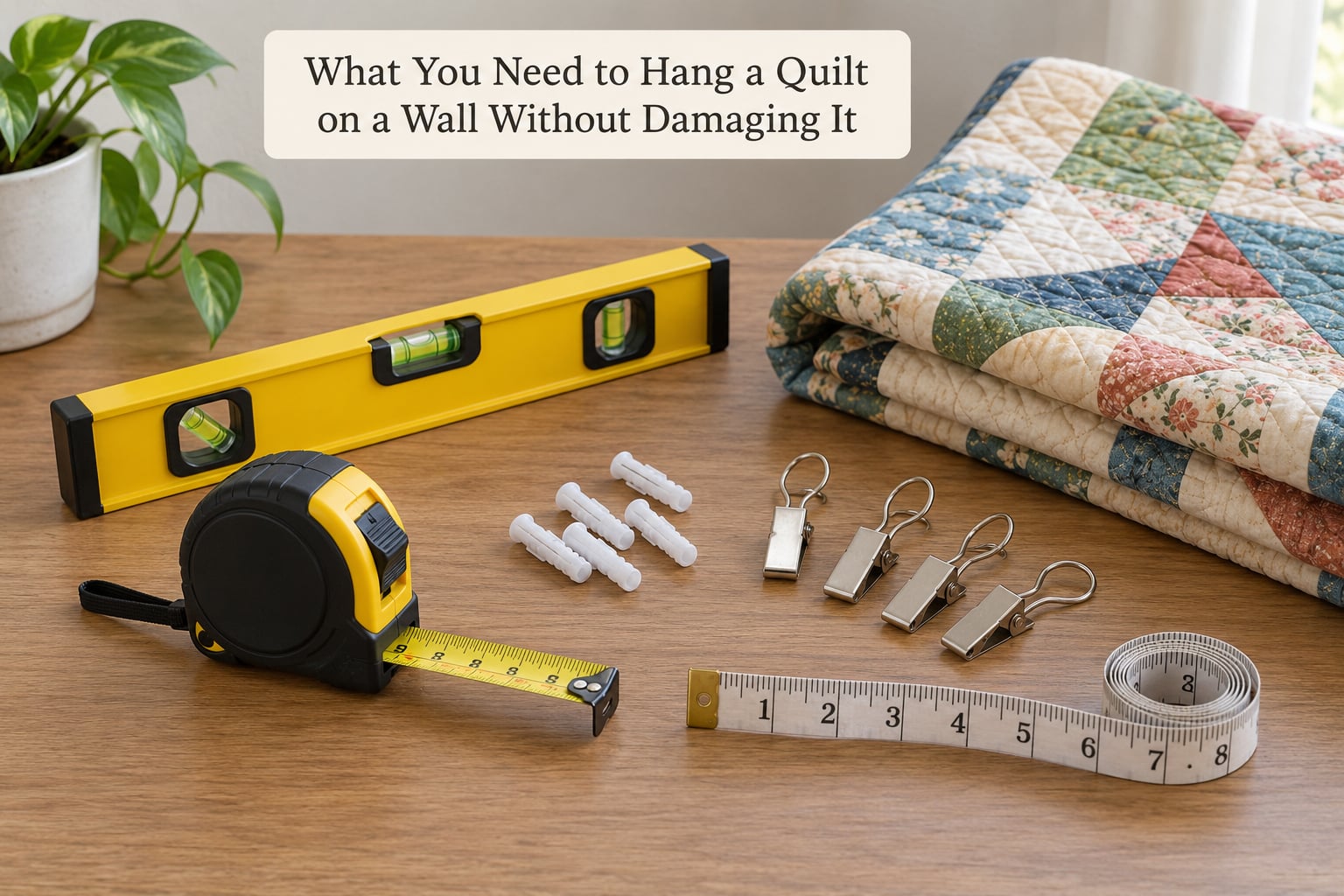
Most of what you need is short, and you already own half of it.
- A support that is wider than the quilt. A dowel, a flat batten, or a curtain rod at least 3 to 4 inches wider than the finished quilt so the edges hang free instead of rolling inward.
- Anchors matched to your wall. Plastic plugs or heavy-duty anchors for drywall, masonry screws for brick or concrete, and a stud finder or a knock test to know what is behind the surface.
- Measuring tools. A tape measure for the wall and the quilt, and a small level so the rod does not end up a degree off.
- Protective materials. A furniture pad or a strip of felt between the rod brackets and the wall, plus painter’s tape to mark your drill line on a painted surface before you touch it.
- Clean hands. Quilt batting grabs onto skin oil and dust fast, and washing a spot out of a wall quilt is miserable. Handle by the top edge or with clean cotton gloves.
- Optional: clips or a sleeve. Quilt clips for a no-sew hang, or a strip of fabric, thread and a needle if you plan to sew a hanging sleeve.
Before anything else, lay the quilt flat on the bed and check the corners. Quilts that have been folded for years in storage often want to be stretched flat again, and hanging a quilt that still holds a crease produces exactly the uneven look people complain about.
Step-by-Step
How to Choose the Right Hanging Method Without Damaging the Wall
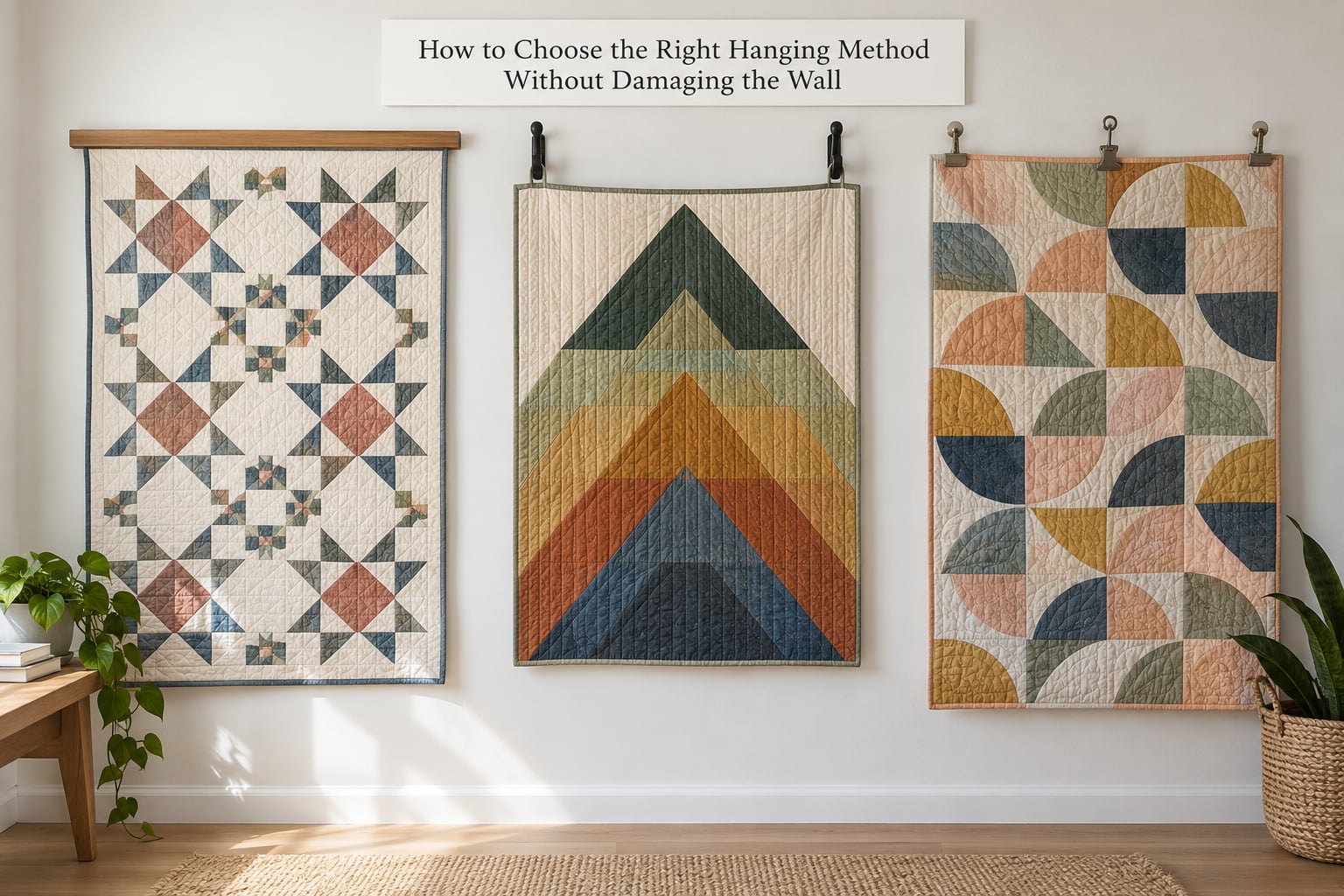
The least damaging methods are adhesive hooks carrying a rod, clips gripping the top edge, and a sleeve on a dowel. Push pins work but leave holes. Whatever method you pick, the wall takes the weight, not the quilt fabric.
- Adhesive hooks plus curtain rod. No wall damage at all if the paint is sound, low effort, fully reversible. Best for rentals, heavy quilts and anyone who does not want to sew.
- Quilt clamps or clips on a rod. Damages only the rod fixings, low effort, reversible. Best for quilts that already have no sleeve on the back.
- Sewn hanging sleeve on a dowel. Two small fixings, more effort, reversible. Best for heirloom quilts and flat permanent display.
- Rod pocket. Two small fixings, medium effort, reversible. Best for mini quilts and heavier fabrics.
- Sewn tabs on a rod. Two small fixings, medium effort, reversible. Best for quilts too large for a dowel.
- Picture-hanging wire on D-rings. Two small fixings, medium effort, reversible. Best for the heaviest quilts that need to hang from one point.
- Push pins or thumbtacks. Tiny holes, low effort, reversible with a dab of filler. Best for light mini quilts in a bedroom.
- Direct tape or safety pins. Possible adhesive residue, low effort, only mostly reversible. Best for temporary display.
Wall type changes the answer as much as quilt size. On drywall with no stud in reach, adhesive hooks are the honest option for anything you plan to move. On brick, concrete or a masonry wall, skip adhesive entirely and use masonry screws or a rod mounted into two solid points. Old plaster cracks around anything that concentrates force in one spot, so spread the load along a batten. On wallpaper, fasteners tear the paper and adhesive can lift the top edge of a strip, so test a hidden corner first.
Quilt weight matters next. A king-size quilt is heavy, and no adhesive hook is meant to hold that for years. Sewing tabs on the back and carrying the quilt on a curtain rod held by two adhesive hooks is a common approach, and it works because the rod spreads the load across two points, not because the hooks are unusually strong.
Push pins are honest work for a small hanging. For anything above about 30 inches wide, gravity wins and the quilt will bow or slide over time.
Prepare the Wall and Measure the Quilt
Measure the quilt across its widest point, including any points or scallops, then measure the rod or dowel you plan to use. The support should extend 3 to 4 inches past the quilt on each side so the quilt’s own weight pulls it straight rather than rolling the edge inward.
Measure the wall space too, and check the height where furniture will sit. Most quilts hang best with the bottom edge 6 to 8 inches above a sofa back or a bed frame, which leaves the piece readable rather than crowded.
Find out what is inside the wall. With a stud finder, mark the stud centres; with a knock test, tap along the wall and listen for the solid dull sound. Mark the height with painter’s tape first, then draw a level line across it.
Keep the quilt away from direct sun and away from heating vents. Light fades dyes slowly and evenly, and the top edge catches the most of it.
Attach the Hanging Hardware
Hold the rod up to the level line and mark each bracket or screw position. Check for wiring and plumbing before you drill: run a detector or avoid any area near switches, outlets and bathroom fixtures.
For drywall, use the widest toggle or anchor that fits the hole rather than a small screw into the paper facing alone. For brick or concrete, use masonry bits and screws, and let the drill cool between holes. Into a stud, a long screw is enough, but put a felt strip under the bracket head so the metal does not press a mark into the paint over years.
For adhesive hooks, the surface has to be clean, dry and smooth. Wipe the area with isopropyl alcohol, wait a full minute, press each hook for 30 seconds, then wait the full cure time listed on the pack before the rod goes on. Skipping the wait is the number one reason adhesive hooks let go.
Leave the rod 2 to 3 inches out from the wall for a sleeve hang so the dowel has room to sit inside the tube without pressing the quilt flat against the surface. Clips need a little more clearance so the jaws can grip the quilt’s top edge.
Place and Secure the Quilt
Lay a clean sheet or blanket on the floor below, then lift the quilt with two people for anything larger than 50 inches. Never grab a single corner and pull. Support the whole top edge with both hands and let the bottom hang.
Slide the dowel through the sleeve from one end, or open the quilt clamps one at a time along the rod and clamp only the top edge of the quilt with its binding. Space clips every 8 to 10 inches. If you tighten them past the point where the quilt hangs straight, the top edge cups forward and the whole piece looks like a pouf.
Sew the sleeve so it stands slightly open in the back and the quilt can hang flat. A flat-sewn sleeve pushes the quilt out in front of itself. Leave the rod a touch loose and let gravity finish the job.
Step back two or three paces and squint. The quilt should hang dead straight with an even shadow line along the bottom.
Check the Display and Maintain the Quilt
Give the hardware a firm tug the first day, then check again after a week. A hook that has crept will lean the whole piece.
Let the quilt settle flat for a few days. Some fabric relaxes on its own and some needs a gentle steam from the back, held well away from the surface.
A few habits keep a display safe over the years. Check the top edge every few months for fibre breakage, particularly where clips bite. Keep it out of direct sunlight, or use UV-filtering film on nearby windows. If the quilt is an antique or a sentimental one, take it down every three or four months and lay it flat to rest rather than leaving it up year-round. That rotation is the cheapest conservation advice there is.
To take a quilt down, support the top edge with both hands, open the clips from one end to the other, and lift the rod off its brackets in one piece. Never lower a large quilt one-handed while it is still clipped to something.
Common Mistakes
Using a single picture nail for a heavy quilt. One nail concentrates the whole load into one drywall point, and the quilt slowly rolls around it. Use two fixings at least 16 inches apart, or a rod on hooks.
Hanging a quilt flat against the wall. A sleeve against the surface pushes the quilt forward at the top and the piece bows. Stand the rod 2 to 3 inches proud of the wall.
Tightening clips until the top edge cups. Clamps only need to grip, not to cinch. Set them so the quilt hangs straight and stop.
Pinching a quilt face with safety pins or tape. Anything that touches the front leaves marks in the batting and dulls the fabric. Keep all hardware behind the quilt.
Hanging on a textured wall directly. Popcorn, brick and heavy texture keep rubbing against the back of the quilt every time the room moves. Use a flat batten or spacers to hold the piece off the surface.
Leaving it in a sunlit spot. Fading is the one kind of damage no repair fixes. Hang it out of direct light or add UV film.
Ignoring the quilt’s weight when picking adhesive hooks. Check the load rating on the pack against the actual weight of the quilt plus the rod, and use two hooks spaced apart. When in doubt, step up to screws in studs.
Hanging over furniture without checking the sightline. Stand back from the room and look before you commit. A rod that reads level in a close-up can still sit high against a tall headboard.
Frequently Asked Questions
Can I hang a quilt with picture hooks?
Picture hangers work for light mini quilts on a stud-backed wall, but a single hook concentrates the weight in one point and a large quilt will slowly roll around it. Use two hooks or a rod spaced 16 inches or more apart, and mount into studs or proper anchors rather than drywall alone.
What is the best way to hang a quilt on a wall?
For most quilts, a hanging sleeve on a dowel or curtain rod is the most durable answer because the rod carries the weight and the quilt hangs from its top edge. If you do not want to sew anything, mount a curtain rod on adhesive hooks and clip the quilt’s top edge to it. Both methods keep hardware behind the quilt.
How do I keep a quilt from wrinkling while it hangs?
Steam it from the back first, hold the iron well away from the surface, and let the quilt hang for several days so the fabric can relax. Check again after a week, because batting that has been folded in storage keeps a memory for a while.
How much space should I leave between a quilt and the wall?
Leave 2 to 3 inches between the wall and the rod so a sleeve has room to sit without pressing the quilt flat against the surface. Clip hangs need slightly more clearance so the jaws can grip the top edge. That gap is what stops the quilt from bowing forward.
Can I hang a valuable quilt in direct sunlight?
Not without protection. Direct sun fades dyes and weakens fibres over time, and the top edge takes the most light. Hang it on an indirect wall, keep it out of a south-facing window, or apply UV-filtering film to the glass if the spot is the only one available.
What should I do before hanging a quilt in a rental home?
Assume no holes and no adhesive are allowed, and tell your landlord before you use any removable mounting. A curtain rod held by adhesive hooks or a tension rod that presses between two walls leaves the surface untouched, and both come down in minutes when you move out.
Conclusion
Start by choosing the support, not the hardware. Measure the quilt, pick a rod three or four inches wider, decide whether you are sewing a sleeve or clipping, then match your anchors to the wall type. Mount level, leave two or three inches of clearance, and clip or sleeve the top edge without tightening. Check the display after a week, keep it out of direct sun, and take an heirloom down every few months to rest flat. That is the whole method for how to hang a quilt on a wall without damaging it: the wall carries the load, and the fabric stays untouched.