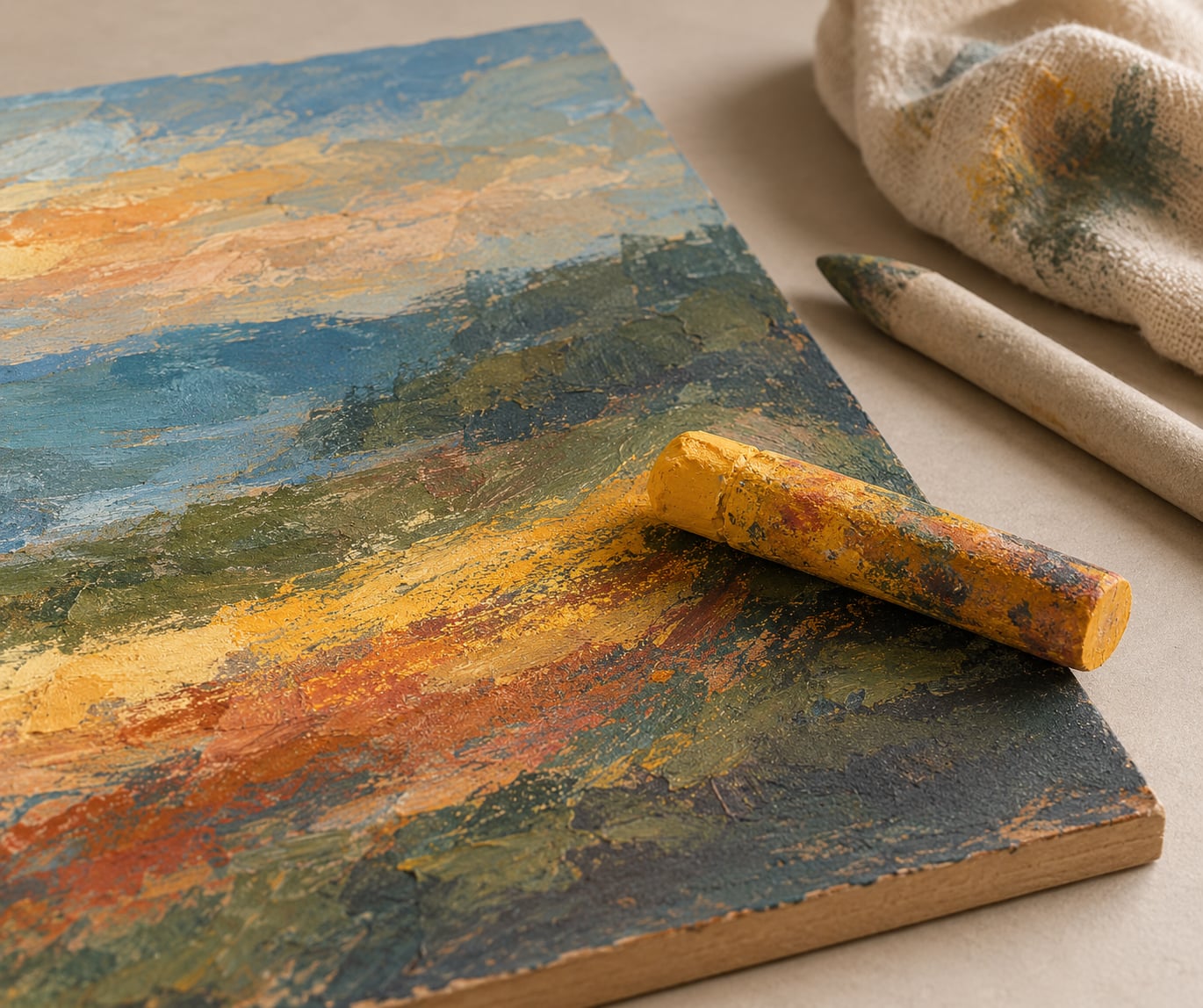
Yes, you can use oil pastels over acrylic paint, as long as the acrylic is completely dry before you touch it with a pastel. Acrylic is a water-based paint that cures to a firm, slightly porous film, while oil pastels are made of pigment suspended in oil and wax. That makes the pastel the softer, more flexible layer on top, which is exactly the order painting wants.
The catch is timing. Draw on acrylic that is merely dry to the touch and the pastel picks up pigment, drags the acrylic underneath, and peels. Wait for a real cure and the combination is dependable, which is why this technique shows up in so many mixed-media studios.
Table of Contents
- Can You Use Oil Pastels Over Acrylic Paint?
- Why Oil Pastels Work Differently on Acrylic
- Which Acrylic Paint Finish Works Best?
- How to Prepare the Acrylic Surface
- Let the acrylic cure, not just dry
- Clean the surface
- Build tooth if the surface is smooth
- How to Apply Oil Pastels Over Acrylic Paint
- Can you use oil pastels over acrylic paint without pressing hard?
- How to Blend Oil Pastels Into Acrylic Without Making a Mess
- Should You Seal Oil Pastels on Acrylic Paint?
- Common Problems and Fixes
- Ways to Use Oil Pastels With Acrylic Paint
- Frequently Asked Questions
- Can I use pastels on acrylic paint?
- How long should acrylic paint dry before adding oil pastel?
- What paint can you put on top of oil pastels?
- Does fixative spray work on oil pastels?
- Can you varnish over oil pastels?
- Will oil pastel stick to regular canvas?
- Conclusion
Can You Use Oil Pastels Over Acrylic Paint?
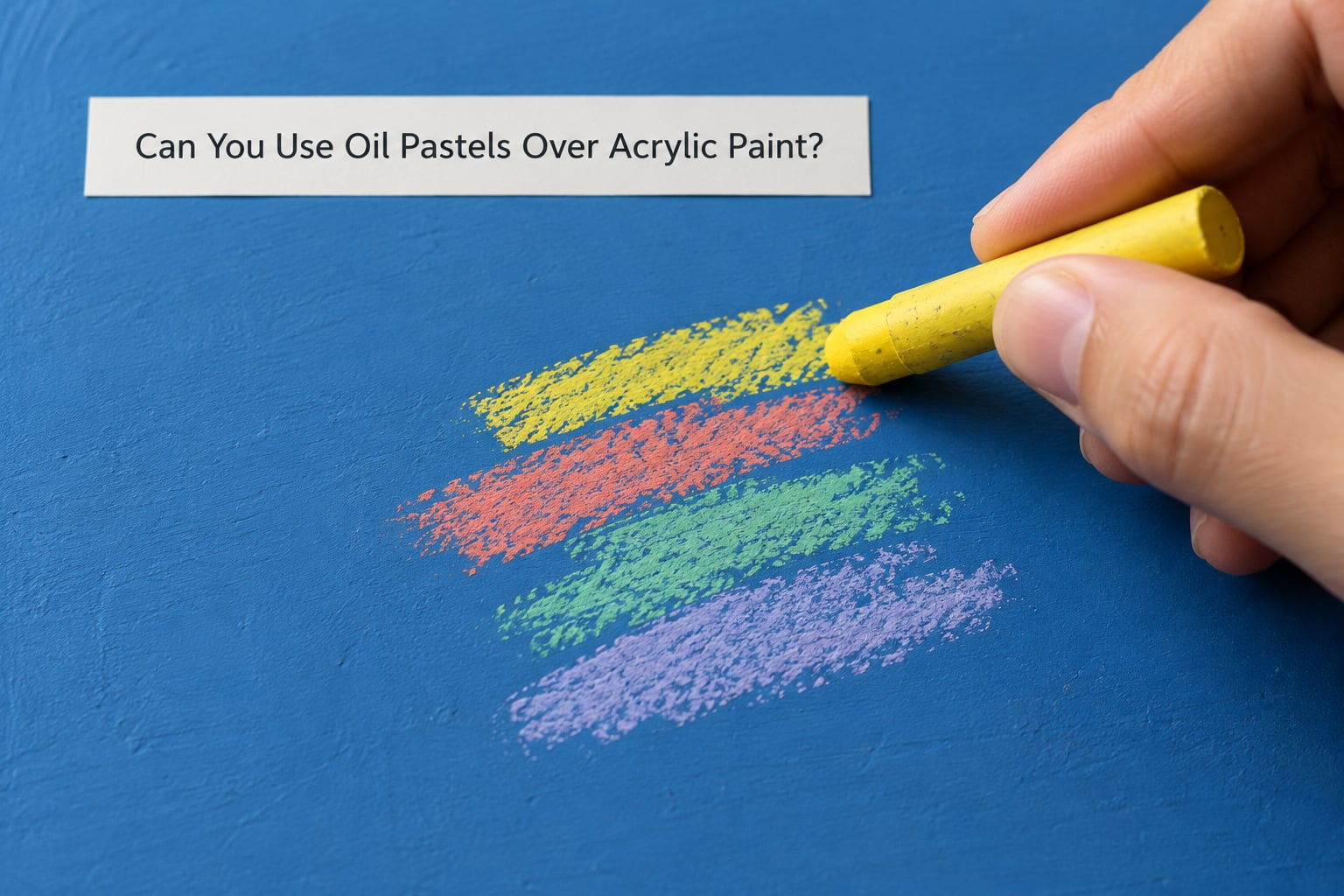
Key takeaways before you start:
- Dry first, draw second. A thin acrylic film needs at least three days; a thick layer can take two to three weeks or more.
- Matte and satin acrylic grip best. Gloss or gel medium surfaces leave the pastel sliding around with nothing to hold onto.
- Add tooth if the surface is smooth. A coat of clear gesso or matte medium gives the pastel something to grab.
- Never reverse the order. Acrylic paint, water-based medium, or water-based varnish will not bond to oil pastel, because the pastel never hardens.
- Frame finished work under glass. Glass or Plexiglass keeps dust off the wax surface without any coating at all.
Golden Artist Colors, whose technical page on oil over acrylic draws on decades of adhesion testing, treats the layering as sound practice with a short list of conditions around it. The forum consensus on r/Oilpastel and painters-online is more blunt: it works, but the surface underneath decides whether it looks deliberate or looks like a mistake.
Why Oil Pastels Work Differently on Acrylic
Two different chemistries are meeting on one surface. Acrylic paint is a polymer emulsion in water; as the water leaves, the particles fuse into a continuous plastic film that is hard, stable, and slightly permeable. Oil pastel is pigment bound in a non-drying oil and wax. It never cures. It stays soft enough to smear with a fingertip years later.
This is the fat over lean rule in reverse of the usual failure. Lean, rigid layers go down first, and fat, pliable layers go on top, so the softer material never has to hold up the stiffer one. When acrylic sits on top of oil pastel, the rigid water-based film tries to bond to a waxy surface that will not accept it, and you get peeling or beading.
Because the pastel sits on top rather than mixing into the acrylic, two things follow. The pastel covers cleanly, so you can lay an opaque light colour over a dark underpainting in a single pass. It also picks up whatever texture is underneath, which is why a toothy surface gives you grippy, broken colour and a slick surface gives you flat, floating colour.
Which Acrylic Paint Finish Works Best?
| Acrylic finish | How the pastel behaves | Verdict |
|---|---|---|
| Matte | Absorbs pressure into the film, pastel grips and picks up surface texture | Best surface to draw on |
| Satin | Firm enough to work, still has enough micro-tooth to hold pigment | Very workable |
| Gloss or gel medium | Pastel slides, leaves glossy streaks, edges lift easily | Avoid or scuff first |
Gloss is the finish that generates most of the complaints. A slick surface has no mechanical tooth for the wax to hold, and artists on r/Oilpastel regularly report that pastels simply will not sit on smooth or glossy canvas. If the painting is already glossy, you have two options: scuff it lightly with fine sandpaper or 0000 steel wool where you plan to draw, or paint a matte medium over the whole surface and let that cure.
Glossy gel medium also carries a separate risk. Thick gloss films are the most rigid thing on the surface and can craze or crack as the support flexes, which is why Golden recommends staying away from them as a drawing ground.
How to Prepare the Acrylic Surface
Preparation is where most mixed-media pieces are won or lost. Work through these in order and take your time on the first one.
Let the acrylic cure, not just dry
Dry to the touch and fully cured are different states. The surface feels fine long before the film underneath has hardened enough to resist abrasion.
| Acrylic layer | Minimum wait before drawing |
|---|---|
| Thin wash or single thin coat | About 72 hours in normal room conditions |
| Standard brushwork, a few layers | One to two weeks |
| Heavy impasto, roughly a quarter inch thick | Two to three weeks or more |
Humidity and cold both stretch this out. A studio at 60 percent humidity in winter will need longer than a warm dry room in July, and thick impasto cures from the outside in, so the last of the moisture sits behind a skin that already feels solid.
Clean the surface
Wipe the dry acrylic with a barely damp cloth, then go over it with a clean dry one. Dust, skin oil, and any leftover surfactant from the wash will stop the pastel from gripping just as effectively as a wet film would.
Build tooth if the surface is smooth
Brush a thin coat of clear gesso or acrylic matte medium over the area you intend to draw on, then let it cure fully. Reddit commenters on r/Oilpastel recommend exactly this when pastels refuse to sit on canvas. The matte coat gives the pastel a micro-textured surface to bite into, and it costs one extra drying cycle.
On paper, the tooth is already there. On stretched canvas or a sealed wood panel, you usually need to add it.
How to Apply Oil Pastels Over Acrylic Paint
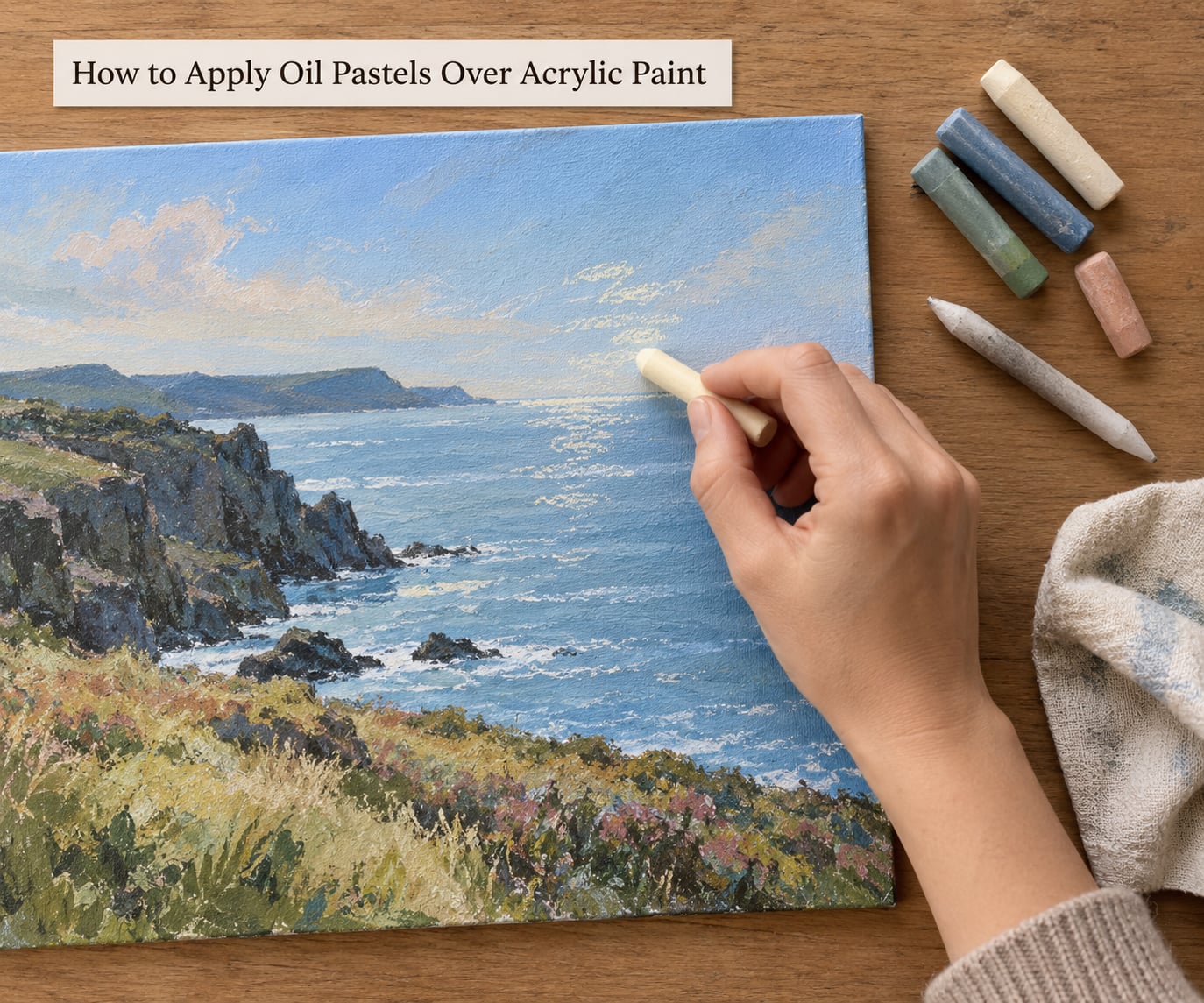
Pastel marks behave differently depending on pressure, so start small and work up.
Can you use oil pastels over acrylic paint without pressing hard?
Yes, and light pressure gives you a cleaner line. Heavy pressure pushes wax sideways instead of depositing it, and the sideways wax is what picks up the acrylic underneath.
- Make test marks in a corner. Three or four short strokes at light, medium, and heavy pressure tell you how the surface takes the pastel before you commit to the composition.
- Start light and layer over. Harder pastels make crisp line and detail; softer ones lay down opaque coverage. Working from lighter tones toward darker ones keeps colours bright, since dark pastel pressed on top of a light one smudges the light one.
- Use light, even pressure. Dragging hard pushes wax around instead of depositing it. Short, confident strokes with the side of the stick lay down more colour than pressing the tip down.
- Block in broad areas first. Pastels do not blend like wet paint. Experienced painters on painters-online lay pure stick colour beside another colour rather than trying to mix it, then soften the join with a blending stump or a fingertip.
- Sharpen edges when you want them. A craft knife trims a stick into a chisel point for fine linework and for scratching back into the acrylic underneath to expose it.
- Scratch back deliberately. Because the pastel sits on top, you can drag a knife or a stick through the wax to reveal the acrylic layer beneath. That gives you calligraphic lines and highlights the acrylic never had.
- Check adhesion as you go. Rub a fingertip lightly on an edge you have finished. If wax transfers to your finger, the layer is too thin or the surface is too slick for that colour.
A rigid panel holds up better than a stretched canvas here. A flexible support moves, and movement cracks a cured acrylic film, which then takes the pastel layer with it. Golden specifically advises against rolling or flexing supports in oil over acrylic work.
How to Blend Oil Pastels Into Acrylic Without Making a Mess
Blending is where beginners get frustrated, because oil pastels were never designed to mix the way paint does. Pastel colour comes from stacking, not stirring.
Use a white pastel to lift and lighten a spot. Dragging a pale stick over an area picks up the colour beneath and redistributes it, softening a hard edge without smearing everything into mud. A blending stump, a soft cloth, or a cotton swab gives finer control than your hand, and a finger works fine for large flat areas if you are willing to wash your hands often.
For a wet, paint-like blend, a small amount of artist solvent such as mineral spirits on a cloth will dissolve the wax locally and let two colours move together. Two cautions. Keep solvent off the acrylic surface, because it can swell or lift a cured film, and test on a scrap first. And work on a protected surface, since wax transfers to everything you touch, including the table and your hands.
Should You Seal Oil Pastels on Acrylic Paint?
Sealing is optional, and it is the one place where people most often make an expensive mistake. A water-based varnish will bead and peel on a wax surface no matter how many coats you apply. Whatever goes on top of oil pastel has to be a non-water-based product or nothing at all.
| What you add on top of oil pastel | Safe? | Notes |
|---|---|---|
| Glass or Plexiglass in a frame | Yes | Best option. Blocks dust and light, leaves the surface untouched |
| Mat board spacers | Yes | Stop the pastel surface touching the glass, or it will stick and take colour with it when removed |
| Oil pastel fixative | Yes | Sprays into the wax rather than over it. Use a light coat and test for colour shift first |
| Oil or alkyd varnish | With care | Not water-based, so it can work, but a wax surface has to be warmed or flamed to accept it |
| Acrylic or water-based varnish | No | Will not bond to wax. Expect beading and peeling |
| Acrylic paint or water-based medium | No | Same failure. The rigid water-based layer sits on a soft surface that never hardens |
If you prefer a sprayed surface to glass, a fixative made for oil pastel is the right tool. Sennelier is the commonly named example. Workable fixative leaves the wax soft enough to keep drawing on, final fixative sets it more firmly. Apply thin coats outdoors or with good ventilation, and check the colour under the fixative because it can deepen or dull pastels.
Common Problems and Fixes
The acrylic is peeling off the pastel. This is the complaint that tops the r/Oilpastel results, and it almost always means one of two things: the acrylic was not cured, or the reverse order was used and acrylic went on top. Dry acrylic longer, then sand or scuff the surface lightly and redraw.
The pastel will not stick at all. It slides and lifts when you touch it. You are probably on a glossy or very smooth surface. Add a clear gesso or matte medium coat, or scuff the area.
Pastel picks up too much paint underneath. Too much pressure, or a chalky matte surface. Switch to a harder pastel, lighten your pressure, and lay the first colour down in thin layers.
It looks dusty or chalky. Loose pigment is sitting on top instead of bonding. Burnish it with a blending stump or a soft cloth, and set it with a light fixative coat rather than trying to scrub it off.
Colours look muddy where they meet. You tried to mix them. Lay one stick colour beside the other and soften the seam with white pastel, a stump, or a swab instead.
Dust keeps appearing. Oil pastel never dries, so airborne dust sticks permanently. This is the strongest argument for framing under glass rather than sealing, because no coating stops dust as well as a physical barrier does.
Wax transfers onto paper or other surfaces. Pastel pigment can stain. Keep works separate while they are in progress, and put interleaving tissue between stacked pieces.
Ways to Use Oil Pastels With Acrylic Paint
Once the technique stops being the question, it opens up a lot of choices.
- Opaque accents and highlights. The most common use: a dark acrylic ground, then white or bright pastel lines on top. Because the pastel is opaque, it needs no blending to read.
- Linework over a painted background. Acrylic establishes colour and shape, pastel draws the structure. Sharpening sticks work well for architectural or street-scene subjects in broad blocky tones.
- Texture building. Acrylic spackle or joint compound gives a raised ground to draw across, adding relief you cannot get from paint alone.
- Scratch-back drawing. Knife lines through the wax reveal the acrylic underneath, so you can draw with removal instead of addition.
- Collage and paper work. On heavier paper around 140 lb, artists combine pastel, acrylic, and ink in layers. Keep the acrylic cured between each pastel stage.
- Sketchbook and journal work. The same order holds on smaller sheets, with less pressure and a harder pastel.
One archival note if you are working on paper. Oil pastel is not a lightfast, permanent medium in the way a cured acrylic film is, and pastel colours can oxidise and shift over time. Museum framing under UV-filtering glass with archival mat board is the usual accommodation, and it protects the surface from dust at the same time.
Frequently Asked Questions
Can I use pastels on acrylic paint?
Yes, once the acrylic is fully dry. Because oil pastel is softer and more pliable than the cured acrylic film underneath, it sits on top and grips the surface rather than cracking off it. Wait at least about 72 hours for a thin coat and considerably longer for thick layers, and remember that oil pastels over acrylic works while acrylic over oil pastels does not.
How long should acrylic paint dry before adding oil pastel?
Give a thin acrylic film at least three days, a standard layered painting one to two weeks, and a heavy impasto layer two to three weeks or more. Cold and humid rooms slow curing. If you are unsure, press a fingernail firmly into an inconspicuous spot; a dent that stays means the film is still soft underneath.
What paint can you put on top of oil pastels?
Very little. Oil and alkyd paints can work if the wax surface is prepared to accept them, but acrylic paint and any water-based medium will bead and peel, because water-based film cannot bond to a non-drying wax surface. Your realistic options are a fixative made for oil pastel or glass in a frame.
Does fixative spray work on oil pastels?
Yes, if you use a fixative intended for oil pastel. It penetrates and sets the wax rather than forming a film on top of it. Workable fixative keeps the surface soft so you can continue drawing, while final fixative sets it harder. Apply thin coats with good ventilation and test first, since fixative can shift the colour.
Can you varnish over oil pastels?
Not with a water-based varnish, which will not adhere to wax and will peel away in sheets. An oil or alkyd varnish can work, but the pastel surface has to be warmed to open the wax before the varnish is applied. Framing under glass is simpler and protects the surface from dust without any chemical risk at all.
Will oil pastel stick to regular canvas?
Often not well, because smooth primed canvas has little tooth for the wax to grip. That is why artists add a coat of clear gesso or acrylic matte medium over the painting and let it cure, which gives the pastel a textured surface to bite into. Canvas that is already textured holds pastel much better than a slick sealed panel.
Conclusion
You can use oil pastels over acrylic paint, and the order matters more than any product choice. Wait for a real cure, work on a matte or toothy surface, begin with light pressure and test marks, and never put water-based paint or varnish on top of the pastel. Start by testing the stick in one corner of a dry painting and see what the surface gives you.