Learning how to write a cover letter for an art exhibition is simpler than most artists expect. The letter is one page. It names the person receiving it, says exactly what you are asking for, connects your work to that venue’s program, and gives a curator enough evidence to advocate for you to a director or a jury.
An exhibition cover letter is a one-page letter that accompanies your artwork when you submit to a gallery, museum, curatorial space, or open call. It introduces you and your practice, states exactly what you are asking for (a solo show, a group show slot, or representation), and explains why your work fits that specific venue’s program.
Most templates online are written for job applications, which is why so many artists send something that reads like a cover letter for a design role. That is the gap this guide closes. Whether you have shown work for twenty years or you are submitting your first open call, the structure below holds.
Table of Contents
- What You Need Before You Draft
- Step-by-Step: Writing an Art Exhibition Cover Letter in Six Steps
- Step 1: Address the Curator or Gallery Right
- Step 2: Open With a Clear Reason for Writing
- Step 3: Show Why the Work Belongs
- Step 4: Summarize the Artist’s Relevance
- Step 5: Confirm the Practical Details
- Step 6: Close Professionally and Proofread Before Sending
- A Strong Art Exhibition Cover Letter Example
- How the Cover Letter Differs From Your Statement, Bio, and CV
- Common Mistakes in Writing an Art Exhibition Cover Letter
- Frequently Asked Questions
- How long should an exhibition cover letter be?
- What should I include in an exhibition submission cover letter?
- Should I attach images or just send a portfolio link?
- Is a cover letter still required when the call goes through a submission platform?
- Do I need exhibition history to write a strong cover letter?
- How do I follow up after submitting without being annoying?
- Conclusion
What You Need Before You Draft
Most weak letters fail in the preparation stage, not the writing stage. Gather these six items first and the drafting takes about an hour.
- The exhibition announcement or submission guidelines. Read them twice. Word counts, file formats, image limits and required attachments are not suggestions.
- The curator’s or gallery’s contact details. A named person, not “Dear Sir or Madam”. Check the staff page and recent exhibition announcements for the correct title.
- A concise description of the proposed work. Medium, size, count, and the series it belongs to, in two or three lines.
- Installation or presentation details. Wall dimensions, lighting needs, plinths, vitrine requirements, anything unusual about how the work hangs.
- Relevant credentials. Only the ones that matter here: recent exhibitions, collections, awards, teaching roles, publications, residencies.
- The submission format. A required subject line, a character limit on the email body, a platform form with separate fields, or a mailed package.
Keep every one of these on a single page as working notes. When you write without them, you either invent details or pad with biography.
Step-by-Step: Writing an Art Exhibition Cover Letter in Six Steps
Step 1: Address the Curator or Gallery Right
Use the recipient’s actual name and title: “Dear Ms. Okonkwo” or “Dear Mr. Rivera”. Salutations that match the institution’s published preference go further, though a standard “Dear” is always safe.
State the purpose of the letter in the first sentence. If you are responding to an open call, name the call exactly as it was announced. If you are writing unsolicited, name the exhibition or program and say why you are writing.
An art advisor quoted in a comment thread on gallery-approach advice made the point that most artists over-write themselves and under-write the venue. A curator who sees their own program named in your second sentence is already reading differently.
Step 2: Open With a Clear Reason for Writing
Introduce yourself in one or two sentences, then connect your practice to the opportunity. Do not open with a full biography, and do not ask to be considered without explaining why this particular opportunity.
Five opening patterns that work in the art world:
- The specific reference. “I saw the exhibition Soft Edges at your space in the spring and the handling of surface in those pieces stayed with me.”
- The call. “I am writing in response to your New Directions open call, which closed on the 14th of this month.”
- The continuity. “My last three bodies of work have all explored worn cloth and industrial dye; the proposed series continues that line.”
- The direct statement. “I am submitting twelve new textile works for the upcoming winter group show and would welcome your consideration.”
- The shared interest. “Your program’s interest in material recovery matches the questions driving my current studio work.”
What to avoid: “I am writing to express my deep passion for the arts,” or “Your prestigious gallery has long been a dream of mine.” Both tell a curator nothing they can use.
Step 3: Show Why the Work Belongs
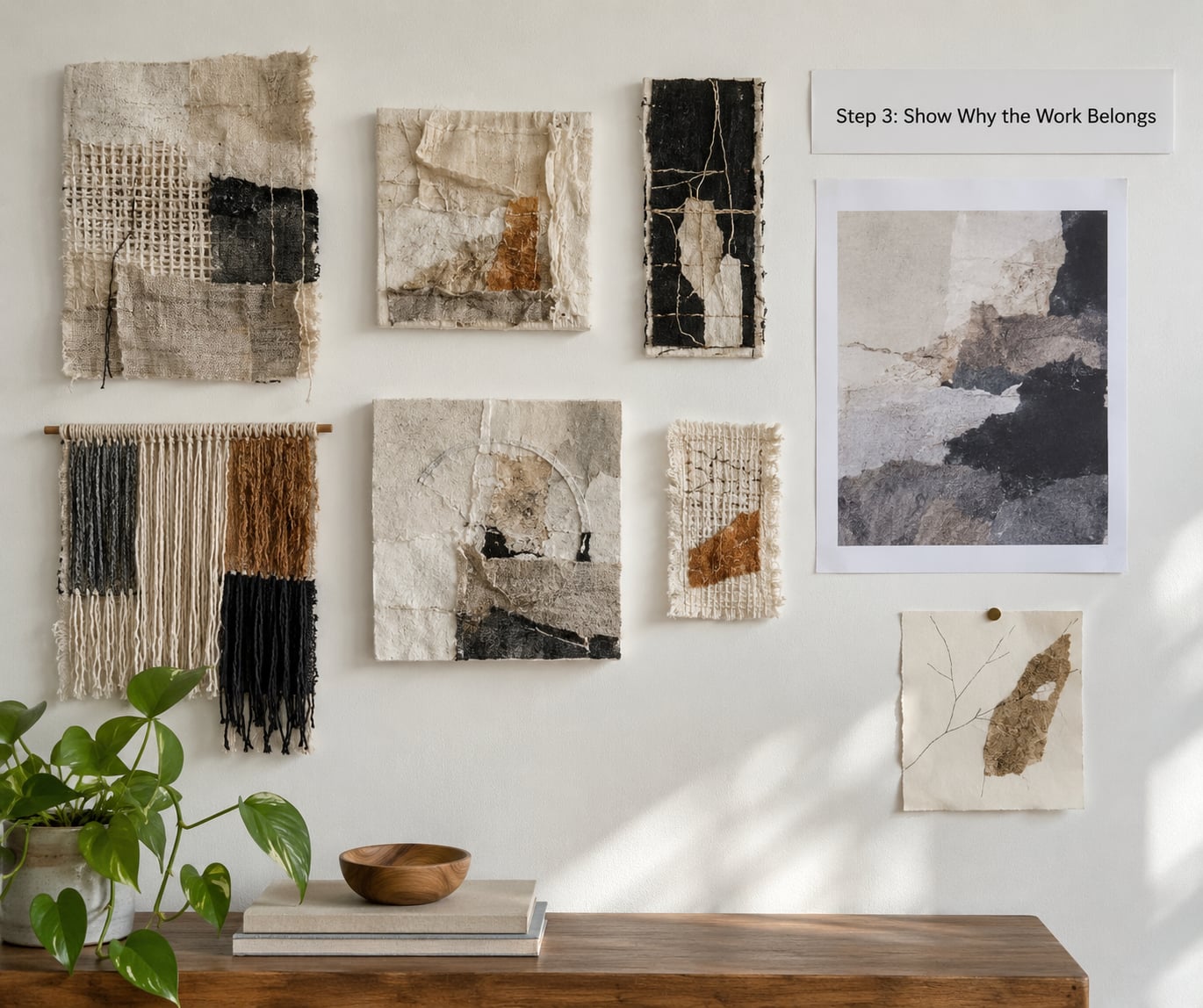
This is the paragraph that earns the second look. Describe the exhibition’s concept or curatorial frame, the central question behind your work, and the specific body of work you are proposing.
Give a curator enough to understand the connection without reproducing your artist statement or catalogue essay. Two or three sentences usually do it. Name a work or two so the letter is anchored to something real rather than to an abstract intention.
When the fit is genuine, describe it plainly. Say which of their artists or recent shows you responded to and what the shared thread is. Presumptuous claims collapse on contact: telling a gallery its program “perfectly aligns” with work they have not seen reads as flattery.
Step 4: Summarize the Artist’s Relevance
Add only the credentials that strengthen this submission, and tie each one back to the opportunity. Prior exhibitions, permanent collections, awards, residencies, teaching positions, and published writing all count when they are relevant.
Emerging artists often assume they have nothing to list. That is not true. Degree shows, juried group exhibitions, residencies, teaching roles, self-initiated projects, and consistent studio output are real evidence. Emerging artists in one forum discussion reported being advised to attend openings, talk with staff, and submit only once the gallery already knew their name. That is slow, and it works.
Two habits to keep:
- Connect facts to the ask. “I have installed work in two former industrial spaces of comparable scale” says more for a site-specific proposal than any award list.
- Be exact. Title, venue, year. An inflated claim or a misremembered year is the fastest way to lose a curator’s trust.
If you submit through a platform, the artist CV and statement fields usually handle the record. Your letter still needs the summary, because a reviewer should not have to open three files to learn what you do.
Step 5: Confirm the Practical Details
A curator should be able to evaluate your proposal from your letter plus one link. State the facts that decide it: work dimensions, materials, installation requirements, availability, deadlines, insurance, and where the full proposal lives.
Use the same labeling convention everywhere. Title, medium, dimensions, year, in that order, matching your portfolio and CV. Labeled work is one of the trust signals curators consistently name.
Do not repeat details already handled in an attached proposal. A curator who receives a five-page proposal with a two-page restatement of it will stop reading. Point to the file instead.
Step 6: Close Professionally and Proofread Before Sending
Thank the curator, restate your request in one sentence, invite a conversation, and give a clear next step. Sign with your full name, email, phone number, and website.
Then proofread against the submission guidelines. Check the recipient’s name and title, the exhibition title and dates, artwork dimensions, links, and file names. Many artists report losing submissions to a broken portfolio link, which is the one error no amount of good writing recovers from.
Once sent, wait two weeks before any follow-up. If there is no reply after six weeks, send one short note. After that, quarterly updates about your practice keep you on the radar without demanding an answer. Artists who follow this cadence report it works better than silence, and better than calling out a non-response directly.
A Strong Art Exhibition Cover Letter Example
Here is a complete example for a textile and mixed-media artist applying to a curated group exhibition. Swap the bracketed fields, keep the structure, and delete anything you cannot support.
[Your Name]
[Studio Address] · [City, State] · [Email] · [Phone] · [Website][Date]
Dear [Curator’s Full Name],
I am writing to submit my work for [Exhibition Title], the juried group show running [Dates] at [Venue Name]. My practice centers on worn industrial textiles and the traces of labor left in them, which is the thread I see running through your spring program.
I was drawn to [Curator’s Name]’s exhibition [Recent Show Title], where the treatment of surface in the smaller pieces was especially effective. My current series, [Series Name], takes discarded factory banners and works their dyed and worn surfaces back into twelve new wall-mounted pieces. Each work measures between [dimensions], and the group is intended as a single continuous run rather than as individually hung objects.
I completed this body of work between [Year] and [Year], exhibited it in [Venue] in [Year], and received [Award or recognition]. I also teach at [Institution], and my work was included in [Publication] in [Year].
The proposed work requires a clear white wall of roughly [wall length] with track lighting and no plinths; I can ship insured within the US or arrange crating for international venues. Installation notes and a full PDF proposal are on my website at [link], and my CV and artist statement are attached.
Thank you for your time reviewing this submission. I would be glad to answer questions or provide additional images if that would help your jury, and I am available for an installation visit in the week of [date range].
Sincerely,
[Your Name]
Why this one works, line by line:
- The salutation and first sentence do the work. The recipient is named, the opportunity is named, and the ask is unambiguous within two sentences.
- The fit is specific rather than flattering. It points to one recent exhibition and describes what the artist noticed, which a curator can verify.
- The work is described, not interpreted. Medium, scale, and installation logic matter more to a preparator and a jury than an emotional account of meaning.
- Credentials are brief and connected. Each fact supports the proposal instead of reciting a resume.
- Practical needs are isolated in one paragraph. Wall length, lighting, shipping, insurance, and availability sit together so a juror can evaluate quickly.
- The closing asks for one specific next step. Offer availability and additional images rather than a vague “please let me know”.
The same structure works for a group show, a solo proposal, or a residency. For a group show, shift weight from the solo body of work toward how your piece holds a room alongside others. For a solo proposal, expand the installation and lighting paragraph because the venue is committing far more space to you.
How the Cover Letter Differs From Your Statement, Bio, and CV
Most confusion in this area comes from treating four documents that do different jobs as interchangeable. Knowing the difference makes drafting much faster, because you stop rewriting the same material in four formats.
The cover letter is first-person, one page, and aimed at one decision: this submission, right now. The artist statement is third-person or neutral voice, three to five paragraphs, and describes your practice and thinking over time. The artist bio is a short paragraph of fact, written in third person for a program, catalogue, or press release. The artist CV is a document, not prose: exhibitions, collections, awards, education, and publications in list form.
In practice, the letter borrows a line or two from each of the other three, but none of them wholesale. A jury reading twenty submissions needs the argument in your letter first, then the detail in the statement, then the record in the CV.
Common Mistakes in Writing an Art Exhibition Cover Letter
Eight mistakes come up again and again, and each has a direct revision.
- Writing ME-ME-ME. The letter is entirely about you. Revision: rewrite the second paragraph so half of it names something specific about the venue’s program, a recent show, or a curatorial interest.
- Using a generic recipient. “Dear Curators” tells a reader you did not look. Revision: find the staff page, use a name, and match the institution’s preferred form of address.
- Pasting your artist bio. A third-person bio is not a cover letter. Revision: rewrite it in first person, cut the birth year and education list, and keep only what bears on this submission.
- Asking for critique. Requesting feedback reads as an imposition on unpaid professional time. Revision: state what you are asking for, and if you want feedback, offer to send work through a formal review program instead.
- Attaching too much. Sending eighteen images, or a portfolio file larger than the guidelines allow, buries the letter. Revision: link to a curated online portfolio and attach only the files the call requests.
- Claiming a fit you have not checked. Revision: open the venue’s site, look at the current roster and the last two exhibitions, and write from what is actually there.
- Running past one page. Curators read in short bursts between other tasks. Revision: cut to 250 to 350 words, which is the range most art-world advisors recommend, then move anything extra into the proposal.
- Exaggerating achievements. Revision: use exact titles, venues, and years, and leave out anything you cannot document. Honesty is the baseline that makes a strong claim credible.
A few habits that raise your odds. Follow the published submission guidelines exactly, including file format and word count. Keep your portfolio, CV, and letter using one labeling convention. Check for scam “artist opportunity” emails before engaging: legitimate calls do not charge application fees, and generic praise about how original your work is is a warning sign rather than a compliment.
Finally, treat the letter as a sample of your practice rather than a formality. The same judgment about clarity, edit, and finish that you bring to an installation is what the writing is being judged on.
Frequently Asked Questions
How long should an exhibition cover letter be?
Keep it to one page, or roughly 250 to 350 words. Curators read between other tasks, so density beats detail. Use a short fit paragraph, two or three sentences of credentials, and one paragraph of practical details. Put your artist statement and full CV in separate files instead of stretching the letter.
What should I include in an exhibition submission cover letter?
Five things: the recipient’s name, the specific opportunity you are responding to, a plain description of the proposed work, two or three relevant credentials, and one clear request. Add a line on installation needs and where the full proposal lives. Everything else belongs in the artist statement, CV, or portfolio.
Should I attach images or just send a portfolio link?
Send a link to a curated online portfolio as your default, and attach only the files the guidelines request. Label every image with title, medium, dimensions, and year so the same order runs through your portfolio, CV, and letter. Linking avoids oversized attachments and lets a curator view work at their own pace.
Is a cover letter still required when the call goes through a submission platform?
Yes, when the form asks for one, and it is still worth writing even when it does not. Platform forms separate your letter into labelled fields, so each answer should carry one idea rather than a running paragraph. The email that accompanies the form is still read, and it is the easiest place to show you researched the venue.
Do I need exhibition history to write a strong cover letter?
No. Emerging artists can point to degree shows, juried group exhibitions, residencies, teaching work, self-initiated projects, and consistent studio output. Describe the installation experience you have rather than the venues you have shown in. Studios, art organizations, and exhibition committees often commission submission letters from artists who have not yet shown commercially.
How do I follow up after submitting without being annoying?
Wait two weeks, then send nothing further unless the call gave a timeline. At six weeks, send one short note restating your submission and offering more information. After that, send quarterly practice updates rather than chasing an answer. Artists who update regularly report better results than those who press for a response.
Conclusion
Start by pinning down the exhibition’s specific theme and curatorial focus, because that research is what every other sentence depends on. Then write the shortest version that connects your proposed work to that opportunity: who you are, what you are asking for, why it fits, and what you need to make it happen.
Re-reading how to write a cover letter for an art exhibition comes down to restraint. One page, a named recipient, an honest account of the work, and a single clear request. Check every submission requirement before you send, then wait and follow up on a schedule rather than on anxiety.