
A revision request does not have to cost you the client or the piece. The way to handle commission revisions is simple: decide how many rounds are included before you take the deposit, freeze the design in writing at each stage, and quote anything beyond that as paid work that gets settled before you pick up the brush again.
Most artists I know lose money on revisions for the same reason. Nobody set a number, nobody wrote anything down, and by round four the commission is technically finished but nobody feels finished with it.
This guide walks through the whole process: what to have ready, the six steps for handling a request, how to price extra rounds, and the exact wording to use when you have to say something difficult. Everything here is a template you can adapt. Round counts are a studio choice, not an industry rule, so pick what you can actually deliver well and write it down before the money changes hands.
Table of Contents
- What You Need Before a Revision Request Arrives
- Step-by-Step: How to Handle Commission Revisions
- 1. Review the request before reacting
- 2. Check the original commission agreement
- 3. Separate feedback from direction
- 4. Explain the impact on time, cost, and design
- 5. Offer choices and get written approval
- 6. Track the revision and confirm the final scope
- Common Mistakes
- Frequently Asked Questions
- How many revisions should I include in a commission?
- Can I charge more when a client requests extensive revisions?
- What if the client keeps changing their mind?
- Should I revise a finished commission after the final approval?
- How do I politely tell a client that a requested change is not possible?
- Conclusion
What You Need Before a Revision Request Arrives
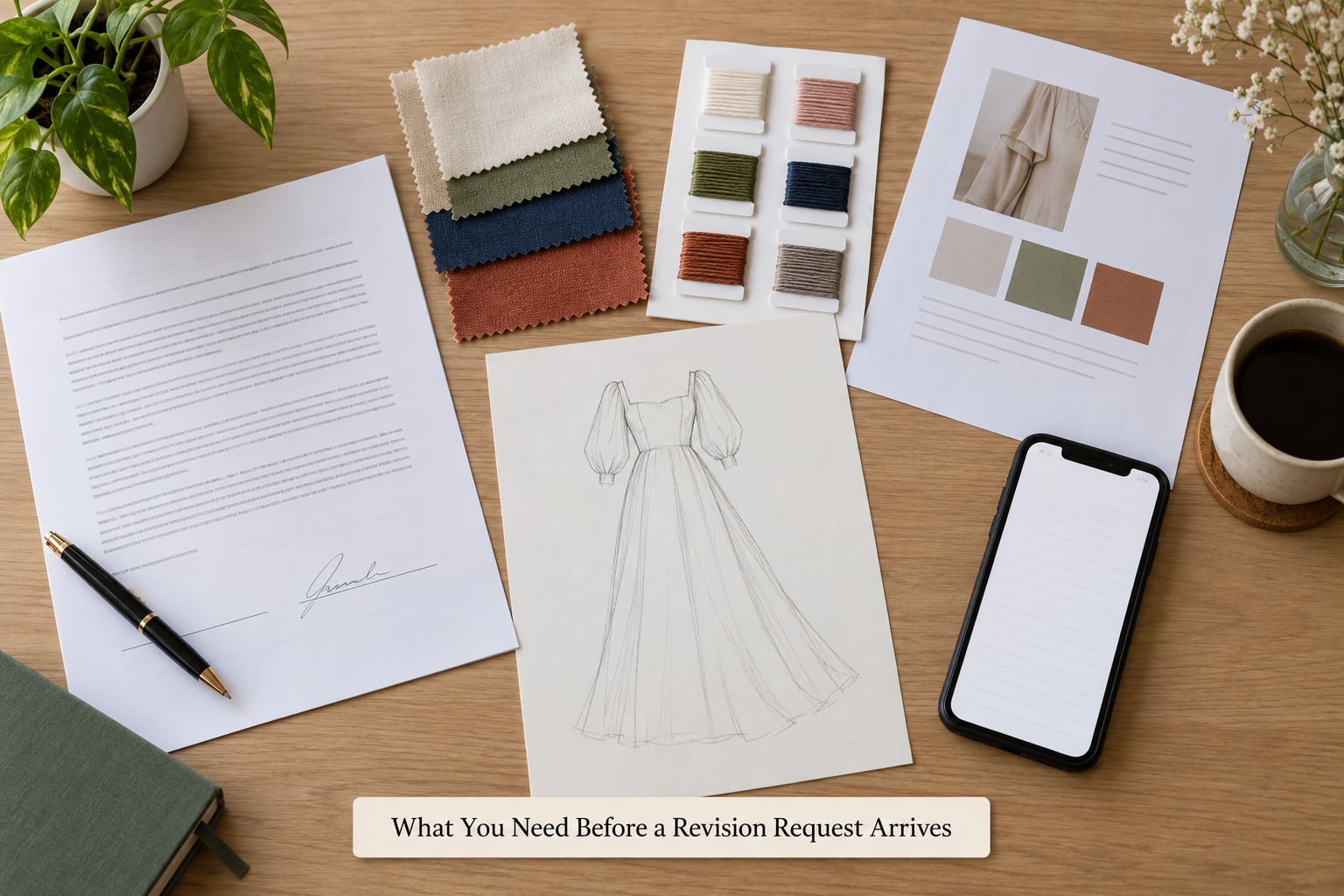
Handling commission revisions smoothly is mostly preparation done on a calm day. Six things should exist before the first message arrives, and each one removes a decision you would otherwise have to make mid-project.
- The commission agreement or terms of service — the document that says what is included, how many rounds, and what happens after.
- Project records — the brief, the sketches sent, the dates they were sent, and the approval that came back.
- Visual references — saved images of every stage, filed by name and date.
- A stated price for extra work — a number, not a vibe. Even a rough one protects you.
- One agreed communication channel — usually email, because it leaves a trail you can point back to.
- A revision log — a running note of what changed, when it was approved, and what it cost.
If the agreement is silent on revisions, that silence is doing a lot of work at the worst moment. An agreement does not have to be long to be useful. One page covering scope, stages, rounds, payment, and cancellation handles most of it.
One note before you go further: templates like the ones below are starting points, not legal advice. If a project is large enough that you stand to lose meaningful money, have your terms reviewed by someone qualified in your jurisdiction.
Step-by-Step: How to Handle Commission Revisions
The workflow below runs from the moment a change request lands to the moment the final scope is confirmed. It takes about twenty minutes of desk work for a small commission and an hour for a large one.
1. Review the request before reacting
Do not reply straight away, and definitely do not reply emotionally. Read the message twice, then restate the request back to yourself in one plain sentence: change the background from the garden to a rooftop.
Most requests that feel enormous in the inbox are small in production. Repainting a background you disliked anyway is half an evening. Reworking the whole composition is three days and a new set of materials.
Before you price anything, find out what the client actually wants. Ask one question: is this a colour change or a different idea about the scene? Clients often send three requests in a single paragraph and expect all of them. Splitting the message into separate items, each with its own answer, is the single most useful thing you can do in that reply.
The test for whether something is new scope is simple. If the change would have altered your original estimate or your delivery date, it is new scope. If it would not have, it is a refinement inside the existing work.
2. Check the original commission agreement
Open the document the client actually signed, not the version you keep on your drive. Look for four things: the number of included rounds, what each round covers, the written approval requirement, and what happens when a request arrives after approval.
Then check your own records. Which stage were you at? When did you send the last proof? Did the client reply in writing, and what did they say? A message saying “looks great, go ahead” is approval, even if it was typed in a hurry at midnight.
When the agreement is silent, you still have options, and the least disruptive one is to write the rule now, in writing, and apply it going forward. Announcing a new policy after the client has already paid tends to read as a penalty, so frame it as clarity rather than as a change of terms.
You can also lean on your refund ladder, which should be in the agreement and keyed to named completion stages. Here is the pattern most studios use.
| Stage reached | Typical deposit position | What you can still change | Refund position if cancelled |
|---|---|---|---|
| Brief agreed, nothing drawn | Deposit received | Everything | Deposit returned |
| Concept sketch sent | Deposit received | Direction, composition, palette | Partial, less studio time |
| Colour pass approved | Deposit plus progress payment | Detail and refinements only | Partial, materials already committed |
| Final layout locked | Most of the balance paid | Small corrections only | Small or no refund |
| Delivered | Paid in full | Anything is new work | Nothing |
Percentages vary widely between studios and there is no standard ladder, so publish your own and never retroactively apply one that was not agreed. The value of the ladder is that it turns a painful conversation about sunk time into a table the client can read.
3. Separate feedback from direction
Emotionally charged messages become manageable the moment you sort them. Most comments fall into four buckets, and each one gets a different response.
- Preference — “I wonder if it might be nicer without the birds.” No action is required; preference is not a request.
- Correction — “The date on the plinth is 1994, not 1949.” Fix it, no charge, no discussion.
- Feasibility — “Can we make the sky much darker?” Check whether the medium allows it before agreeing.
- Scope change — “Let’s swap the whole figure for a standing one.” This is new work, and it gets priced.
Then sort each item as a minor revision or a major one. This distinction is the backbone of every policy that works, and it belongs in writing so the client never has to guess.
| Minor revision | Major revision |
|---|---|
| Adjusting a colour within an agreed palette | Changing the composition or the pose |
| Fixing a date, a name, a small factual detail | Introducing a new element or removing a focal point |
| Tidying a line the client already flagged as soft | Changing the medium, scale, or orientation |
| Minor texture or surface refinement | Starting a design the client has not seen yet |
| Usually inside the included rounds | Quoted as a change order, paid before work resumes |
A revision round means one consolidated set of changes at one stage, delivered together. Five requests sent one at a time over three days is not one round, and you are entitled to say so. That single definition prevents the most common argument in this entire business.
4. Explain the impact on time, cost, and design
The reason to charge is not gatekeeping. It is that the change costs you materials, hours, and a queue position, and the client should know that before they decide.
Three pricing methods work well, and the right one depends on how predictable the change is.
| Method | How you calculate it | Best when |
|---|---|---|
| Flat fee per round | A set figure published in your terms, typically 15 to 25 percent of the commission price | Most commissions, because the client knows the number up front |
| Hourly | Your studio rate multiplied by an honest estimate of hours | Open-ended requests where you genuinely cannot predict the work |
| Percentage of commission | A share of the total commission, higher for a redesign than for a refinement | Redesigns that approach starting over |
A worked example, since almost nobody publishes one. A commission priced at 1,200 with a flat extra-revision fee of 20 percent means each additional round costs 240, and a full redesign is quoted at 35 percent, or 420. Those percentages are a studio’s own choice and should be scaled to how long your real stages take; a month-long tapestry takes a different multiple than a five-day illustration.
Now the deadline conversation. Revisions push delivery, and a pushed delivery eats the buffer you built into your timeline. State the new date in the same message as the price, so the client is choosing with both facts in front of them. Where a rush surcharge applies, say that too, and be clear that it applies because the schedule has compressed, not because you misjudged it the first time.
Be specific about what gets harder, not just longer. Repainting a section means matching dried media, which is why a late change is harder than an early one. That is not an excuse; it is a real technical fact, and it explains your price better than any policy language.
5. Offer choices and get written approval
Never send a single number with no alternative. People decline a price far more easily than a dead end, and offering options lets them choose the outcome they want rather than the outcome you imposed.
Three options cover almost everything: use the remaining included round now, add a paid round at the stated rate, or keep the approved design as it stands. A fourth, for larger changes, is to treat it as a redesign with a fresh estimate and a new timeline.
Then ask for approval in writing, naming the option, the price, and the new delivery date in the same sentence. Silence is not approval, however comfortable it feels when they stop replying.
Quoting an extra revision:
Thanks for this, and I can see what you are after. Our agreement includes two rounds of revisions, and one is used up at the sketch stage. This one changes the composition, so I have priced it as an additional round at 240. That adds three working days, so delivery moves to the 24th. I can start as soon as you confirm, and I have attached the revised layout with the change marked. If you would rather keep the composition as approved, I can carry on with the current design and still hit the original date.
Declining a revision, with an alternative:
I have looked at this properly, and I do not want to commit to it. At this size the weave would sit too tightly to keep the curve you are describing, and it would weaken the piece. What I can do instead is soften the edge with a second thread pass, which gives a similar effect without the risk. If that does not work for you, I would rather return your deposit minus the time spent so far than deliver something I know is not what you pictured.
Nudging a client who has gone quiet, because stalled projects are as damaging as scope creep. In the r/artbusiness and r/Artadvice threads about ghosting, the recurring lesson is that silence is a decision the client made, and your queue should not be held hostage to it.
Following up on the layout I sent on the 14th. I have held the slot through Friday, after which I release it to the next project. A quick yes or no is all I need, and if the timing no longer suits, tell me and we will work something out without any pressure.
6. Track the revision and confirm the final scope
Write the revision down at the moment it is agreed, not at the end of the project when your memory has gone soft. A short log with a handful of fields is enough.
- Date the request arrived and which stage it belongs to.
- The change, in one sentence, in the client’s own terms.
- Whether it was classified minor or major, and why.
- Whether it used an included round or was charged.
- The price, the payment status, and the new delivery date.
- The approval, quoted from their reply.
At the final stage, name the freeze explicitly. Tell the client that the design is locked for production, that remaining changes are corrections against the approved reference, and that anything beyond that is new work. A written confirmation at this point is what makes the delivered piece the piece they approved.
Requests that arrive after delivery are the hardest, because the artist has often moved on to the next project and the piece is finished. The r/artcommissions consensus is consistent here: major edits belong in the sketch phase, not after completion. That is not rudeness, it is how the schedule works. Handle the post-delivery request as new work with a fresh quote, be warm about it, and offer to keep the conversation to something small and kind rather than an argument about fairness.
Common Mistakes
Every expensive revision problem I have seen traces back to one of a handful of avoidable errors. Each has a straightforward fix.
Agreeing to unlimited revisions. “Unlimited” sounds generous and behaves like an invitation to negotiate forever. The absence of a cap in the agreement is named again and again as the root cause of endless rounds. Fix it by naming a number and publishing it before the deposit.
Making changes informally. A quick favour this once feels harmless, and the second time it becomes the expectation. The fix is a rule with no exceptions: nothing happens until it is in writing, and unpaid work waits.
Arguing about subjective feedback. You are not going to win a debate about whether the birds improve the composition. Sort each comment into the four buckets instead, then respond to the item, not the tone.
Delaying a difficult conversation. Silence lets a small request become a large one. Artists report absorbing unpaid hours out of fear of confrontation, and the fee they never invoiced is the part that still hurts at tax time. Fix it with a fixed reply window, then use the scripts above.
Not documenting approvals. The piece they described in one email is not the piece on the wall. Every stage gate gets a written sign-off, and you keep the message.
Treating each message as a new round. Five one-line requests are one round, not five. Say so when the requests arrive, and consolidate them into a single list for approval.
Continuing work before payment lands. Artists who require additional payment in full before proceeding report far fewer problems than those who start and invoice later. The sequencing rule is simple and non-negotiable: extra revision fees are settled before studio time is spent on them.
Two smaller habits are worth building in. Ask for feedback in one consolidated round rather than an open stream, and set a response window at each stage, so a client knows what silence means. If a client insists on unlimited free revisions, refuses a quote increase for added scope, reverses their own feedback repeatedly, or will not give written approval, those are red flags worth declining before you start rather than managing halfway through.
Frequently Asked Questions
How many revisions should I include in a commission?
Most working artists land on two rounds for an average commission, and three for larger or simpler briefs. The number is your own studio choice rather than an industry standard, so pick what you can genuinely deliver without rushing. Define a round as one consolidated set of changes at one stage. Write the number into your agreement before the deposit, and price anything beyond it as additional paid work.
Can I charge more when a client requests extensive revisions?
Yes, and you should set the rate in advance rather than improvising it mid-project. A flat fee per round, commonly 15 to 25 percent of the commission price, is easiest for a client to understand. A redesign is usually quoted higher because it approaches new work. Announce the charge with the affected timeline and collect it in full before the revision begins.
What if the client keeps changing their mind?
Pause production and send one message that names the pattern without blaming them. Ask which version is final, list each open option, and state that further changes after the design freeze will be quoted as new work. If they reverse earlier feedback, each reversal is a fresh request against the round count. If the reversals continue, charge hourly from that point and keep a written log of every change.
Should I revise a finished commission after the final approval?
Only as new work. Once a piece is delivered and paid for, major edits mean starting again, so quote them fresh with a new timeline and new deposit. Small corrections you already flagged in writing are fair to absorb. Artists working in commissions broadly agree that major edits belong in the sketch phase, and holding that line is what keeps the relationship intact.
How do I politely tell a client that a requested change is not possible?
Explain the material or technical reason in one sentence, offer the nearest thing you can do instead, and leave the choice with them. Mention that you would rather return part of the deposit than deliver something you know is not what they pictured. Artists often find that framing does more for the relationship than quietly attempting a change that could ruin the piece.
Conclusion
If a revision request is sitting in your inbox right now, do four things before you reply. Pause the work at the current stage, open the agreement and check what the last approval actually covered, decide whether the change is a refinement or new scope, then send one written reply with the price, the new date, and two or three options.
That is how to handle commission revisions without losing the client. Most people are not resisting the change itself. They are resisting a surprise, and a clear, early answer removes the surprise from both sides of the table.