A short artist bio is one paragraph, usually 50 to 100 words, that tells a gallery, curator, journalist or collector who you are, what you make, and what you have already done. Learning how to write a short artist bio takes about half an hour once your facts are in front of you, and the hard part is rarely the writing itself. It is deciding what to cut.
Most people I work with start at a blank page and stall there. They have plenty of material — classes, shows, a website, years of work — they just do not know which pieces belong in the paragraph that has to fit in a gallery submission box. The fix is a fact inventory first and prose second. Here is the process, in the order that stops the stalling.
Table of Contents
- What You Need Before You Draft
- Step-by-Step: How to Write a Short Artist Bio in Six Steps
- Step 1: Choose the Bio’s Purpose and Length
- Step 2: Gather the Facts Readers Need
- Step 3: Write a Clear First Sentence
- Step 4: Add Context and Evidence
- Step 5: Tailor the Bio to Each Use
- Step 6: Refine and Proofread
- Common Mistakes to Avoid When You Write a Short Artist Bio
- Frequently Asked Questions
- How long should a short artist bio be?
- What is the difference between a short artist bio and an artist statement?
- What should every short artist bio include?
- How do I write an artist bio with little professional experience?
- Can I use AI to help write my artist bio?
- Conclusion
What You Need Before You Draft
Six things, and only six. Anything longer than this list is a CV in disguise.
- One-sentence identity statement. Your name as you use it professionally, your primary medium, and what you make things about.
- Training or background. A degree, a certificate, a residency, or an honest line about being self-taught. Self-taught is not a gap you need to apologise for.
- Media and subject matter. The materials and the recurring themes, in plain words.
- Selected showing history. Two or three exhibitions, collections or clients that actually mean something, not every entry you have ever had.
- Awards, press or commissions. Only if you have them. Do not borrow anyone else’s.
- Current work. What you are making now, which keeps the bio from sounding archived.
Add one more thing that people forget: the format you have been asked for. A 150-character Instagram bio and a 100-word gallery submission share almost no material. Know the limit before you write the sentence.
Step-by-Step: How to Write a Short Artist Bio in Six Steps
Step 1: Choose the Bio’s Purpose and Length
Match the bio to the place it will appear, then write to that exact length. A 50-word bio and a 150-word bio are not the same text trimmed down — they are different emphases.
Four reference points cover most visual art writing:
- 30 words — an event listing or a marketplace seller profile.
- 50 words — a social profile, an open call that asks for brevity, a short intro in an application form.
- 75 to 100 words — a gallery submission, an art fair application, a studio visit page.
- 150 to 200 words — your website About page, an exhibition catalogue entry, a press release.
Social profiles have hard character caps rather than word targets. Instagram bio lines run to roughly 150 characters, and X and TikTok profile bios sit near 160. A website About page has no cap, which is exactly why it needs one.
| Where the bio goes | Length to aim for | What leads |
|---|---|---|
| Instagram profile | About 150 characters | Medium, then what you sell |
| X or TikTok profile | About 160 characters | Medium, location, link |
| Gallery or fair submission | 100 to 150 words | Practice, then selected history |
| Open call response | Whatever the call states | Practice fit for that project |
| Website About page | 150 to 200 words | Practice, process, current work |
| Catalogue or wall label | 50 to 75 words | The work itself, not the career |
| Online shop listing | 40 to 70 words | What is made, size, materials |
Step 2: Gather the Facts Readers Need
A bio describes the artist. It does not reproduce a résumé. That single distinction saves most beginners from writing something that reads like a CV with the bullet points stripped out.
Write everything down first, in a plain fact sheet, with no editing. Name, location, medium, materials, themes, where you studied, every show, every award, who collects your work, and what you are working on this year. Most people find their real opening sentence hiding in the messier half of that list.
Then ask what a reader needs in the first ten seconds. Usually: who you are, what you make, and whether your work has any track record. Everything beyond that is optional.
Step 3: Write a Clear First Sentence
A good opening sentence is your full name, your medium, your subject, and one specific focus, in that order and in one breath. It should read like information, not like a promise.
Weak: “With a unique vision and a deep passion for the ocean, Josiel creates work that inspires and heals.”
Stronger: “Josiel Roebuck is a mixed-media artist in Savannah who builds layered textile and painted surfaces from salvaged fabric.”
The second version names the medium, the place, and the process. It also leaves the reader something to hold onto for the next sentence. You can do the same work for any practice — a painter naming paint and subject, a ceramicist naming clay and firing, a photographer naming lens and terrain.
Step 4: Add Context and Evidence
Support that opening with two or three details that are true and checkable. Choose the details your specific reader needs most. A gallery cares about exhibitions and collections. A teaching employer cares about studio practice and workshop history. A grant panel cares about public benefit, process and output.
A fill-in template keeps this from becoming guesswork:
[Full name] is a [medium] artist based in [city, region]. Her work [what it is and what it is about], often using [one material or technique]. She holds a degree in [field] from [institution] / is a self-taught artist. Her work has been shown in [named exhibition or venue] and is held in [collection, if applicable]. She is currently [what you are making now].
Fill in only the fields you can stand behind. Blank brackets are worse than a short bio, so delete what does not apply rather than forcing a sentence around it.
Step 5: Tailor the Bio to Each Use
Keep one master version with every fact in it, then cut different excerpts from it. The facts never change; the emphasis does, and that is where most drafts go wrong.
- Portfolio website. Longest version. Add process and current direction, and a line about what you are looking for from readers.
- Gallery or fair submission. Lead with practice, then selected showings. Curators read dozens of these and skip anything padded with adjectives.
- Exhibition catalogue. Shortest formal version. Talk about the work on the wall, not your career history.
- Teaching application. Lead with studio practice, workshops taught, and materials you can teach safely and clearly.
- Grant application. Write to the stated limit and lead with the public outcome of the work, not your biography.
- Press mention. Fact-check everything. Journalists copy and paste, and they do not verify. A wrong venue name follows you around for years.
Step 6: Refine and Proofread
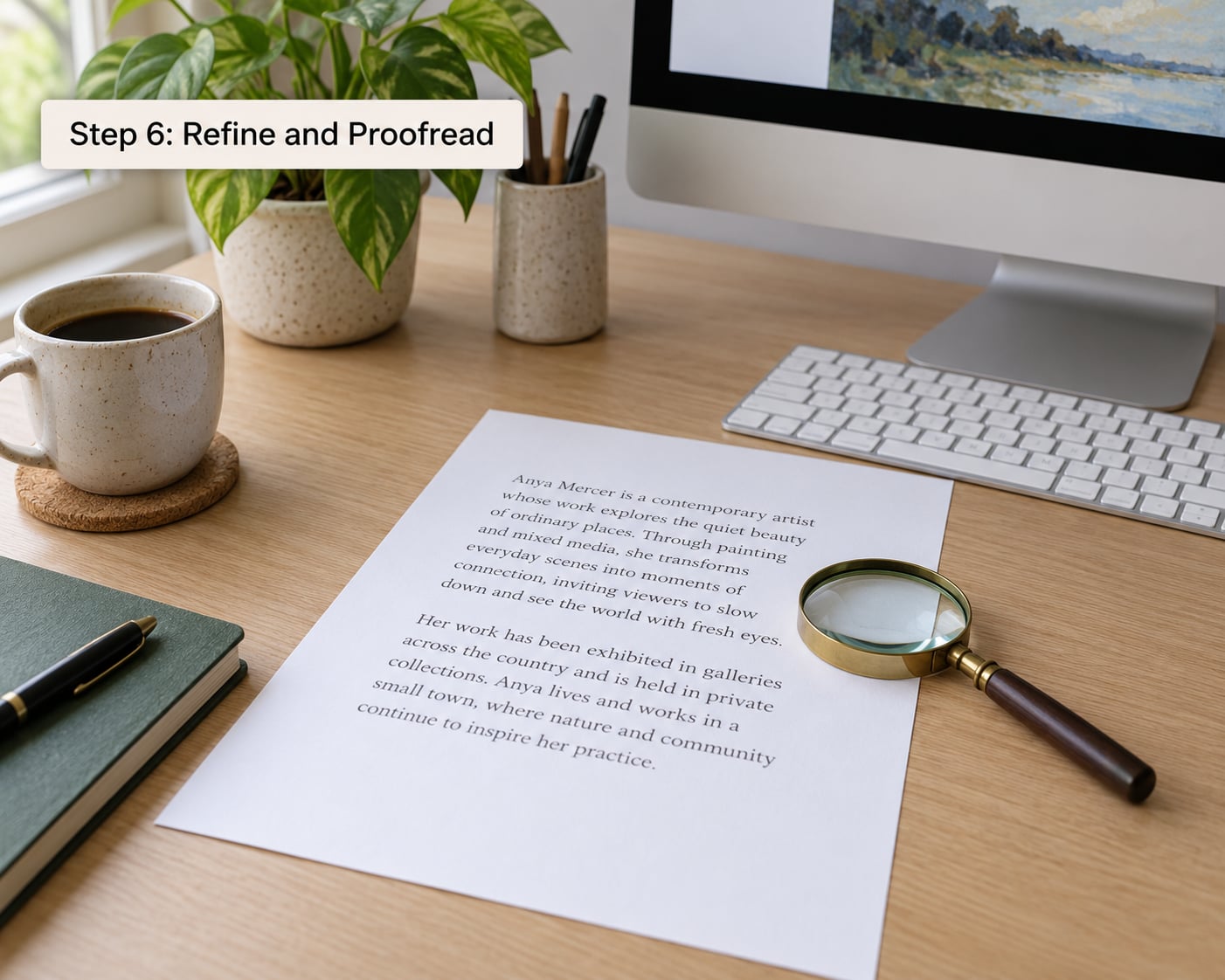
Run this checklist once the draft exists, and once more tomorrow, when you have stopped loving it.
- Is it inside the requested word or character limit? Count it.
- Does the first sentence name medium and subject without adjectives doing the work?
- Is every venue name, date, award and collection spelled exactly as it should be?
- Are medium labels consistent throughout? Do not say mixed media in one sentence and collage in the next if you mean the same practice.
- Is the voice active and readable out loud?
- Has the filler gone? “Unique,” “passionate,” “inspired by,” “in today’s world” and “journey” usually cost you space and add nothing.
- Would you be comfortable if this were read aloud to a stranger?
Give it to one person who makes things for a living and ask them to read it silently for ten seconds, then tell you what they think you make. If their answer differs from your intention, rewrite the first sentence. That ten-second test catches more than any grammar checker.
Common Mistakes to Avoid When You Write a Short Artist Bio
Each of these comes up in the same order, and each has a plain fix.
- Opening with a generic statement. “With a unique vision and a passion for…” tells a curator nothing. Fix: name medium, place and subject in sentence one.
- Confusing the bio with an artist statement. The bio describes you. The statement explains the ideas behind one body of work. Fix: if a sentence starts “This series explores…”, it belongs in the statement.
- Listing every credential. Nobody remembers thirty shows. Fix: keep the three that fit your audience.
- Making claims you cannot support. “Critically acclaimed” and “rising star” are hype words with no evidence attached. Fix: replace them with a named venue, award or collection.
- Using one bio everywhere. A 150-character profile cannot hold a career. Fix: cut a different excerpt per platform.
- Overloading it with art-world jargon. If a curator has to decode your medium, they move on. Fix: describe what you do in words a non-specialist understands.
- Skipping the fact-check. Misspelled names and outdated exhibition years are the fastest way to lose a curator’s trust. Fix: read every proper noun aloud before sending.
Frequently Asked Questions
How long should a short artist bio be?
Most short artist bios run 50 to 100 words. Use 30 to 50 words for social profiles and event listings, 100 to 150 words for gallery submissions and art fair applications, and 150 to 200 words for a website About page or catalogue entry. Social platforms cap by characters instead: roughly 150 on Instagram and 160 on X and TikTok. Write to the shortest limit you have been given.
What is the difference between a short artist bio and an artist statement?
A bio describes who you are: your name, medium, location, training, selected exhibitions and current work. An artist statement explains the ideas, influences and reasoning behind a specific body of work, usually written in the first person. Galleries and curators ask for both because they serve different purposes, and mixing them is one of the most common bio mistakes.
What should every short artist bio include?
Six things: your name as a professional, your primary medium, the subjects or themes you address, where you are based, two or three checkable credentials such as exhibitions, collections, clients or awards, and what you are working on now. Write it in that order and cut everything else. A bio that cannot be verified line by line is not finished.
How do I write an artist bio with little professional experience?
Describe your practice instead of padding a thin showing history. Name your medium, your subject matter, where you are based, where you studied or that you are self-taught, and what you are currently making. Workshops, group shows, online sales and studio visits all count as real experience. Being honest about being early-career reads far better than borrowing someone else’s credibility.
Can I use AI to help write my artist bio?
Use it as an editor, not an author. Draft the facts yourself, then ask a tool to tighten the phrasing, cut filler or check length. Never accept invented credentials, venues, awards or exhibition history, because curators verify details and a single wrong name undermines the whole paragraph. Every fact in your bio should be one you could prove.
Conclusion
Open a document and write every fact you own — training, shows, collections, materials, current project — with no editing and no judgement about whether it is impressive enough. Then write one sentence that names you, your medium and your subject. Fill that sentence out with the two or three details your reader most needs, cut it to the length you were asked for, and read every proper noun out loud before you send it. That is how to write a short artist bio that holds up when somebody reads it twice.