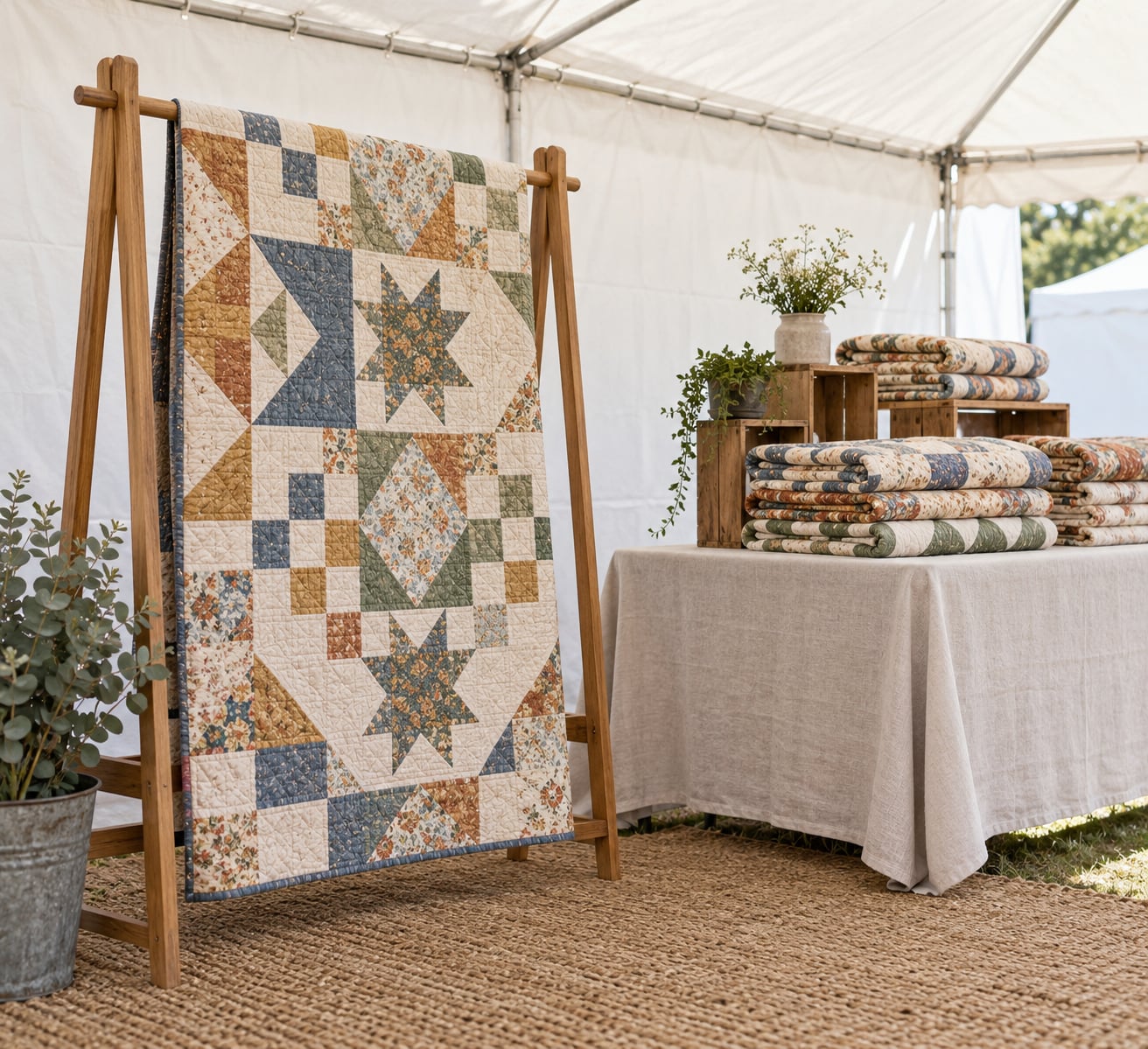
To display quilts at a craft show, hang them vertically so the full design reads at eye level, using the booth back wall, a pipe-and-drape frame, a leaning quilt ladder or a multi-bar floor rack. Support the top edge with a fabric sleeve and dowel or board so the weight spreads and nothing touches the ground.
Setup takes about 30 minutes once you have done it a few times, and the hard part is not the hanging. It is deciding what the venue allows, what your booth can carry, and how a quilt behaves when people walk past it for ten hours.
A few years of watching vendors at guild shows and markets taught me that most quilt displays fail in the same two ways: the fabric sags because the top edge is unsupported, or the layout buries the quilting behind a table banner nobody can see past. Fix those and the rest is details.
Table of Contents
- What You Need
- Step-by-Step: How to Display Quilts at a Craft Show
- Confirm the Venue’s Display Requirements Before You Pack
- Choose a Display Method That Protects the Quilt
- Prepare and Support the Quilt
- Create an Attractive Booth Layout
- Secure the Display and Add Clear Labels
- Check and Maintain the Display Throughout the Show
- Common Mistakes
- Frequently Asked Questions
- What is the safest way to display quilts at a craft show?
- Do craft shows allow quilts to be hung on walls, or should I use a rack?
- How do I prevent quilts from wrinkling or stretching during a show?
- What type of hanging hardware is safe for quilts?
- Should I display a quilt on a table or hang it vertically?
- How can I make a quilt booth look attractive without crowding the quilt?
- Conclusion
What You Need
Start with support hardware, because that is the part that determines whether a quilt survives the weekend.
- Fabric hanging sleeves and dowels or balsa boards. A muslin strip sewn to the quilt back that holds the rod and spreads the load is the single best thing you can own for display. It works in a booth, a gallery and a home wall.
- A back rail, dowel rod or tension rod for wall and pipe-and-drape hanging, plus brackets or hooks to mount it.
- A quilt ladder or a multi-bar floor rack for booths with no wall, or walls you are not allowed to pierce.
- Clothespins or wooden clip hangers for cards, labels and temporary hangs. Quilters on r/quilting recommend clothespins for description cards because they hold weight without marking anything.
- Zip ties and bungee cords for attaching wire grid panels to a frame when the venue allows it. Vendors filming their setups online routinely use overlapping bungee cords plus hooks on the back of a rack to hold wire panels in place.
- Table risers, wire cubes or a small step stool to give small quilted goods some height instead of laying everything flat.
On the preparation side, bring clean white muslin or a roll of batting as back padding, and a clear plastic drop cloth for the base of any rack. A quilt guild raffle quilt was once displayed draped over a laundry drying rack with a clear plastic drop cloth, which is a good trick for protecting the lower edge from a scuffed tent floor.
For documentation, every quilt needs a card with the maker’s name, title, finished size, techniques used and fiber content. If the quilt contains wool, an FTC fiber-content label has to stay visible to buyers. Vendors who take that seriously get fewer awkward questions at pickup time.
For transport, use large clear zipper blanket bags, one per quilt. Keep clips, bungees and a small tool kit in one caddy so setup is not a scavenger hunt. Vendors who roll quilts, tie them with ribbon and turn one corner down to show the reverse can pack a whole booth of quilts in a single vehicle.
If you sell small items too, table runners, potholders and mug rugs do not need hanging hardware at all. They need risers and a table that is not covered in so much signage that the goods disappear.
Step-by-Step: How to Display Quilts at a Craft Show
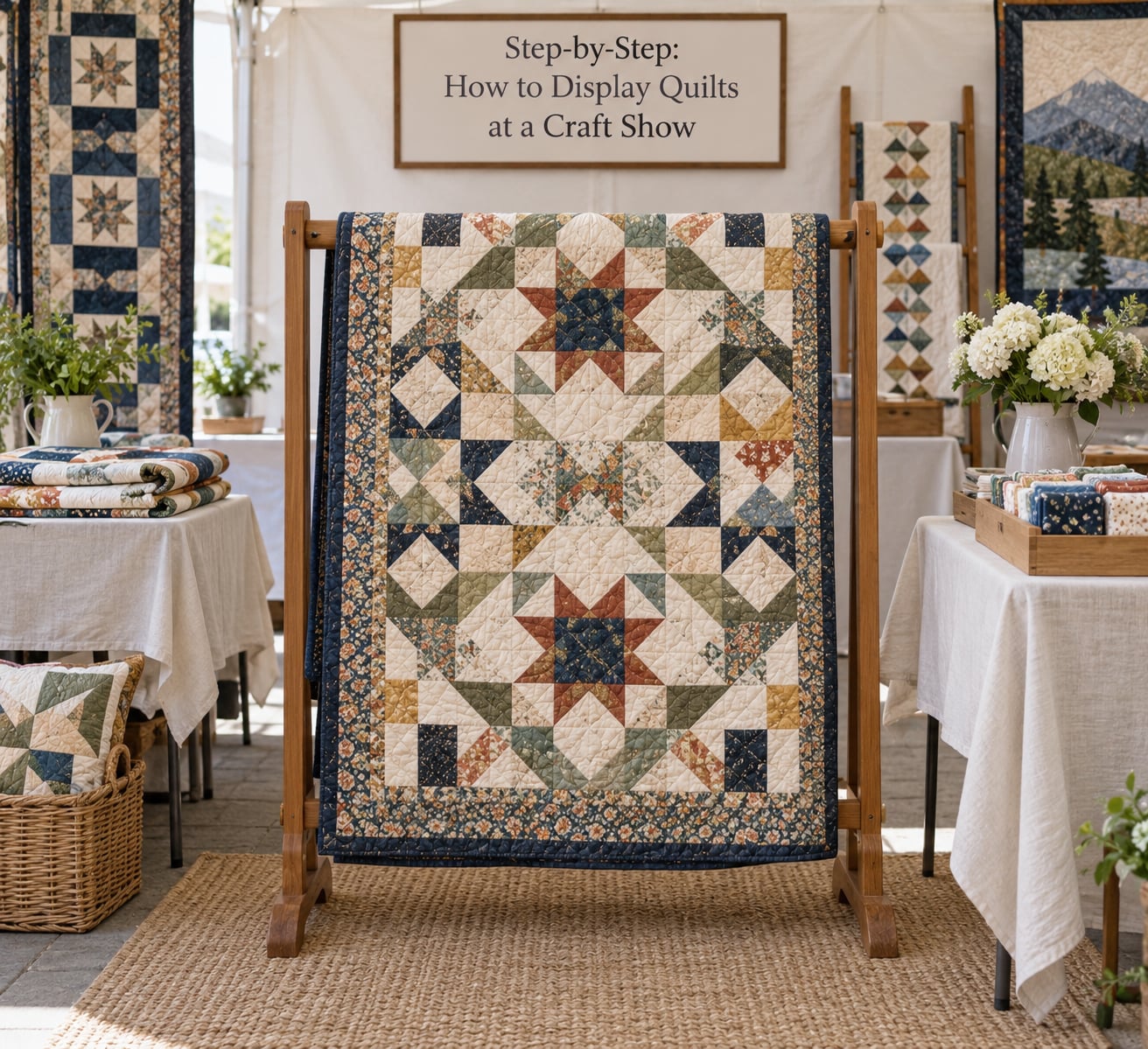
Confirm the Venue’s Display Requirements Before You Pack
Ask the organizer for the exhibitor rules in writing, and read them before you load the car. Most venues specify booth dimensions, whether walls can be drilled or taped, the height of hanging, and whether you are allowed to bring your own frame.
Some indoor halls ban anything attached to the walls outright. Fire code is the reason: adhesives and hanging hardware above a certain height can block sprinklers and egress. If you show up with a plan that assumes a wall, you may end up folding quilts over a table instead.
Also confirm setup and teardown windows, whether overnight storage is available, whether the booth has power for lighting, and whether the show is judged or purely commercial. Outdoor shows add wind load, sun exposure and rain to the same list, so ask what happens if the weather turns.
Choose a Display Method That Protects the Quilt
Match the method to the quilt and the booth, not to the prettiest photo. Each approach suits a different weight, size and space.
- Back wall hanging suits large quilts at indoor halls where drilling or Command strips are permitted. A rail at about shoulder-to-eye height shows the whole design.
- Pipe-and-drape frame suits tent shows with no wall. A PVC frame carries a backdrop you can hang quilts from with clips or sleeves.
- Quilt ladder suits medium quilts and small booths. A leaning wooden ladder reads as rustic, costs little and takes seconds to set up.
- Multi-bar floor rack suits a sales booth where people should be able to flip through pieces without handling them off the display. Bars hold a quilt flat with no stretching at all.
- Padded tables and risers suit folded quilts, table runners and potholders. Lay pieces flat, do not stack them, and keep the table cloth tucked so nothing drags.
- Poster-board style photos suit a judged show or a raffle where you do not want handling at all. Members of the Missouri Quilt Co forum display photos on science-project poster boards so visitors can study the stitching without touching the quilt.
Whichever you pick, the bottom edge of every quilt should clear the floor by enough that mopped floors and passing carts cannot reach it.
Prepare and Support the Quilt
Bring quilts to the show clean. If a quilt has been in storage, air it out and check for any marks, loose threads or odors before it goes on display.
Support the top edge properly. If the quilt has a sleeve, thread a dowel, a balsa board or a slim curtain rod through it and hang it from two points so the weight is shared. Metal clips left on fabric too long can leave rust or stain marks, so remove everything before you pack up.
Distribute the load evenly along the top edge. A quilt draped over a bare rod with no sleeve will slump at the corners, curl at the top, and hang unevenly by the end of the day. Rod width should be close to the quilt width so the fabric barely has to hang past the ends.
Put batting or muslin behind any surface you hang against, so a rough tent wall or a wire grid cannot catch a loop of thread.
Create an Attractive Booth Layout
Keep the entrance clear. A standard table across the front of a booth stops people stepping in, and most of the browsing that turns into a sale happens once somebody is inside. Push tables to the sides or the back and use a narrow two-by-four-foot table along one edge for sales items instead.
Hang the biggest quilt where someone standing outside can see the whole pattern. The centre of the visual field is roughly eye level, so a quilt hung from shoulder height upward reads better than one hung low, even though low hanging looks dramatic in a photo.
Leave space around each piece. Quilts hung edge to edge read as one long strip, and the stitching nobody can see is the stitching you worked weeks on.
Layer heights where you can: one quilt flat on a rack, one at eye level behind it, small items on risers at the front. That gives a booth depth without adding much hardware.
If you are showing large quilts for judging rather than selling, give each one its own airspace, neutral background and even lighting. Judges penalise a cluttered presentation before they look closely at the quilting.
Secure the Display and Add Clear Labels
Treat every rack as something a child will lean on. Cross-brace tall floor racks, weight the feet, and keep the base out of the walking path. Outdoors, add a second bungee or a sandbag to anything taller than about chest height, because gusts catch flat fabric like a sail.
Put something between the visitor and the quilt. A low table edge, a rope line or a small sign reading please do not touch does more than you would think, because most damage comes from a hand reaching out to feel the stitching.
Hang a card beside each quilt with the title, size, technique and fiber content, readable from about four feet away. Place cards at the lower corner rather than centered, so they do not cover the work.
For a sales booth, add pricing on the same card so nobody has to ask and nobody wanders off while you are helping someone else.
Check and Maintain the Display Throughout the Show
Walk your own booth every hour or so. Look for a lifted corner, a slipped clip, a tilting rack and a quilt that has crept lower as the day goes on.
Check the ground line especially. If the edge of a quilt is resting on the floor, lift it and reset the support rather than tidying it up at the end of the day.
Watch the light. Colour under dim tent lighting or warm bulbs reads wrong, and once people see the wrong colour they do not buy. If your show runs into the afternoon or evening, add a daylight-balanced LED strip or clip lamp aimed flat across the display, and test it before you leave home.
If a quilt gets touched, creased or splashed, deal with it at once. A pressing cloth and a spray of water handle most accidental marks; a heavy damp spot left until closing often becomes a permanent one.
Common Mistakes
Hanging from a bare rod with no sleeve. The top edge curls and the quilt hangs unevenly, and the corners take the whole weight. Fix: use a sleeve with a dowel or board, supported at two points.
Leaving metal clips attached between shows. They leave marks on the fabric over time. Fix: a clip is a temporary hanger, not a storage method.
Covering quilts in plastic for the whole show. It protects the quilt and quietly kills sales, because buyers cannot get close enough to judge the quilting. The raffle-display thread on quiltingboard made the same point from the other direction: covering a quilt reduced ticket sales because people needed to see it up close, front and back. Fix: use a clear drop cloth on the floor and stand the quilt up properly.
Letting a quilt touch the ground. It picks up dirt, gets stepped on and wicks moisture. Fix: raise every piece so the bottom edge is well clear.
Putting a table across the booth entrance. It blocks the space people need to step into. Fix: push tables to the sides and back, and keep the front open.
Overcrowding the display. Quilts hung edge to edge merge into one mass. Fix: space pieces so each has a border of background around it.
Trusting whatever hardware is in the booth. Zip ties, bungees and wire panels save time but must be checked, because loose fittings sag under the weight of a quilt across a day. Fix: tension them at setup, then recheck hourly.
Frequently Asked Questions
What is the safest way to display quilts at a craft show?
Hang the quilt vertically from a fabric sleeve and a dowel or board, with the weight shared across the top edge and the bottom clear of the floor. A multi-bar floor rack is even safer because nothing grips the quilt at all. Avoid metal clips left on for hours, and check the piece every hour for sagging or a lifted corner.
Do craft shows allow quilts to be hung on walls, or should I use a rack?
It depends entirely on the venue. Many indoor halls allow drilling or approved adhesives, while fire code rules restrict what can be attached above a certain height, and some halls permit nothing on the walls at all. Ask for the exhibitor rules in writing before you pack. If the answer is no, a pipe-and-drape frame, quilt ladder or floor rack gives you the same vertical display.
How do I prevent quilts from wrinkling or stretching during a show?
Spread the weight across a wide top edge with a sleeve and dowel, and use a rod close to the quilt’s full width so the fabric barely hangs past the ends. Bars on a floor rack hold a quilt flat with no tension at all. Bring quilts rolled rather than folded, keep the bottom edge off the floor, and smooth a crease with a pressing cloth rather than pulling the fabric.
What type of hanging hardware is safe for quilts?
Wooden clip hangers, clothespins and balsa boards with dowels are the safest options for most situations. Clips made of coated wire or plastic are fine for short hangs and for cards, but leave any metal clip off the fabric before packing. Avoid thin metal hangers and anything with a sharp edge, since both mark quilts and batting over time.
Should I display a quilt on a table or hang it vertically?
Hang large quilts vertically, because that is the only way a shopper sees the whole pattern at once. Use tables for folded quilts, table runners, potholders and mug rugs, where the work is small enough to handle. A good booth does both: one or two quilts on racks at eye level, with small goods on risers at the front.
How can I make a quilt booth look attractive without crowding the quilt?
Space pieces so each one has a visible border of background, and hang the largest quilt at or above eye level where it can be read from outside the booth. Keep tables to the sides and back so the entrance stays open, use one clear sign per quilt rather than a banner across the front, and vary heights with risers instead of adding more pieces.
Conclusion
To display quilts at a craft show well, confirm the venue rules first, then choose a support system that carries the top edge and keeps the bottom clear of the floor. Walk the display every hour, and treat any sagging, tilt or mark as something to fix immediately rather than at closing time.
If you only add one thing this season, make a sleeve and a dowel for each quilt. That single habit removes most of the damage people report at shows, and it makes the difference between a display people look at and one they buy.