Grading studio art assignments fairly comes down to three habits: publish the criteria before the project starts, score every piece against the same fixed scale, and write feedback that points at evidence in the work rather than at taste. This guide gives you a repeatable grading session, a four-criterion art assignment rubric you can copy into your gradebook today, and the fixes for the mistakes that make studio grades feel arbitrary.
It is written for K-12 and college studio teachers, and it works whether you have 22 students or the 500-plus load that teachers describe on r/ArtEd. Budget about an hour to set the system up, then roughly 60 to 90 seconds per finished piece once the stack is photographed and sorted.
Table of Contents
- What You Need
- Step-by-Step
- Define What Success Looks Like
- Review Evidence Before Judging the Result
- Score Each Criterion Separately
- Write Feedback the Student Can Use
- Check for Bias and Grade Consistently
- Common Mistakes
- Frequently Asked Questions
- How do I grade subjective art fairly when students have different levels of experience?
- Should I grade studio art assignments using the final artwork, process, or both?
- How can I give art critique without students taking feedback personally?
- How many rubric criteria should I use for a studio art assignment?
- Should participation affect an art assignment grade, and how can I assess it fairly?
- What should I do when a technically unfinished piece shows strong experimentation and planning?
- Start With the Rubric, Not the Stack
What You Need
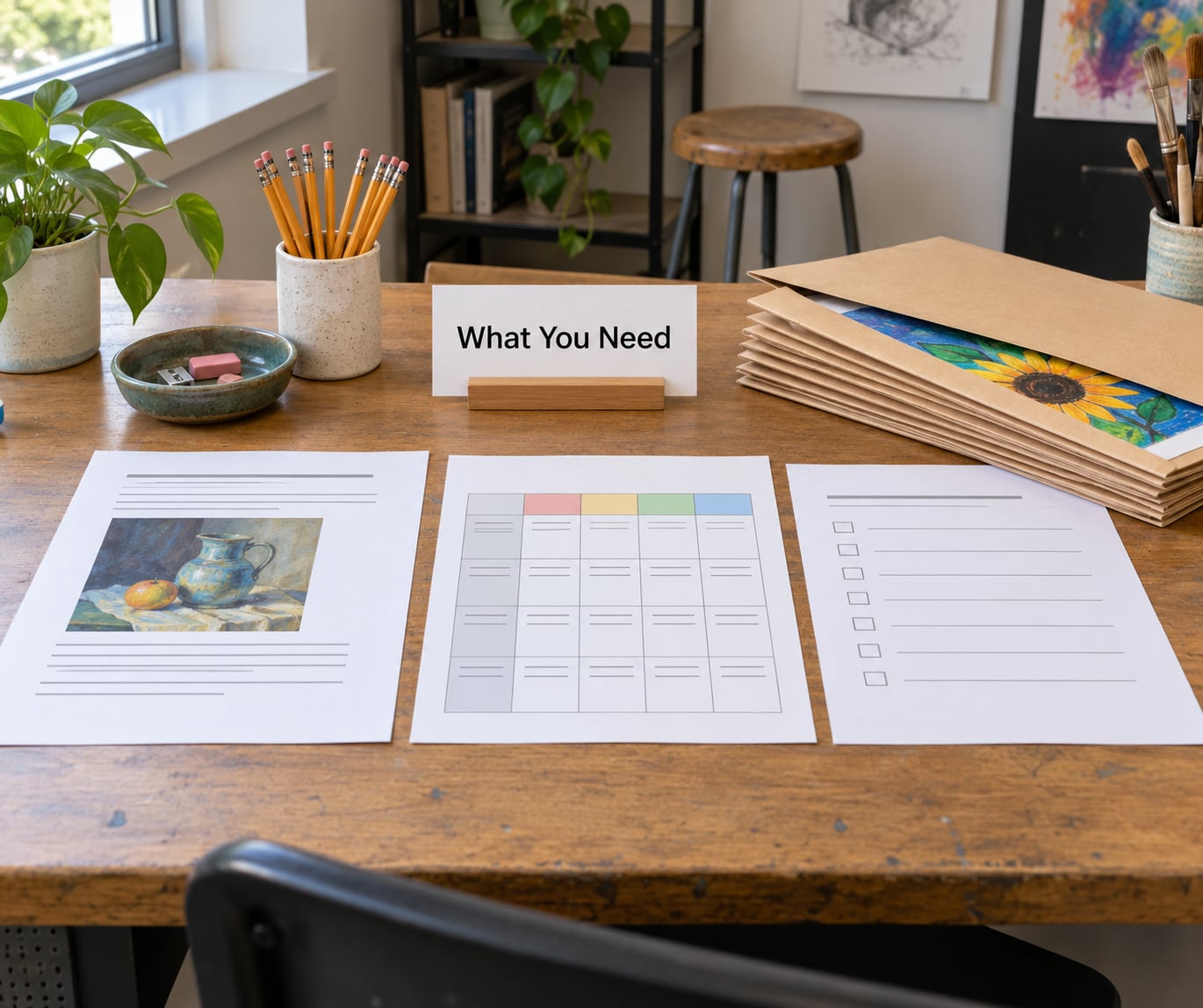
None of this costs money, and most of it takes one sitting to build. The point of each item is to remove a decision from the moment you actually sit down to grade.
- An assignment brief with three to five explicit requirements. If the brief says “explore texture,” write down what evidence of texture you will look for.
- A skill-based rubric with four criteria and four performance levels. Keep one master rubric for the course and change only the project-goals criterion per assignment.
- Two anchor pieces, one that meets the standard and one that approaches it. These do more for consistency than any amount of intention.
- An observation checklist for studio habits: materials returned, cleanup, work in progress at the end of class, response to critique.
- A feedback log, either a comment box in your gradebook or a shared doc, so evidence-based comments take under a minute.
- A fixed grading block in your calendar. Grading 30 pieces in stolen minutes between periods produces inconsistent scores; one 90-minute session does not.
Step-by-Step
Define What Success Looks Like
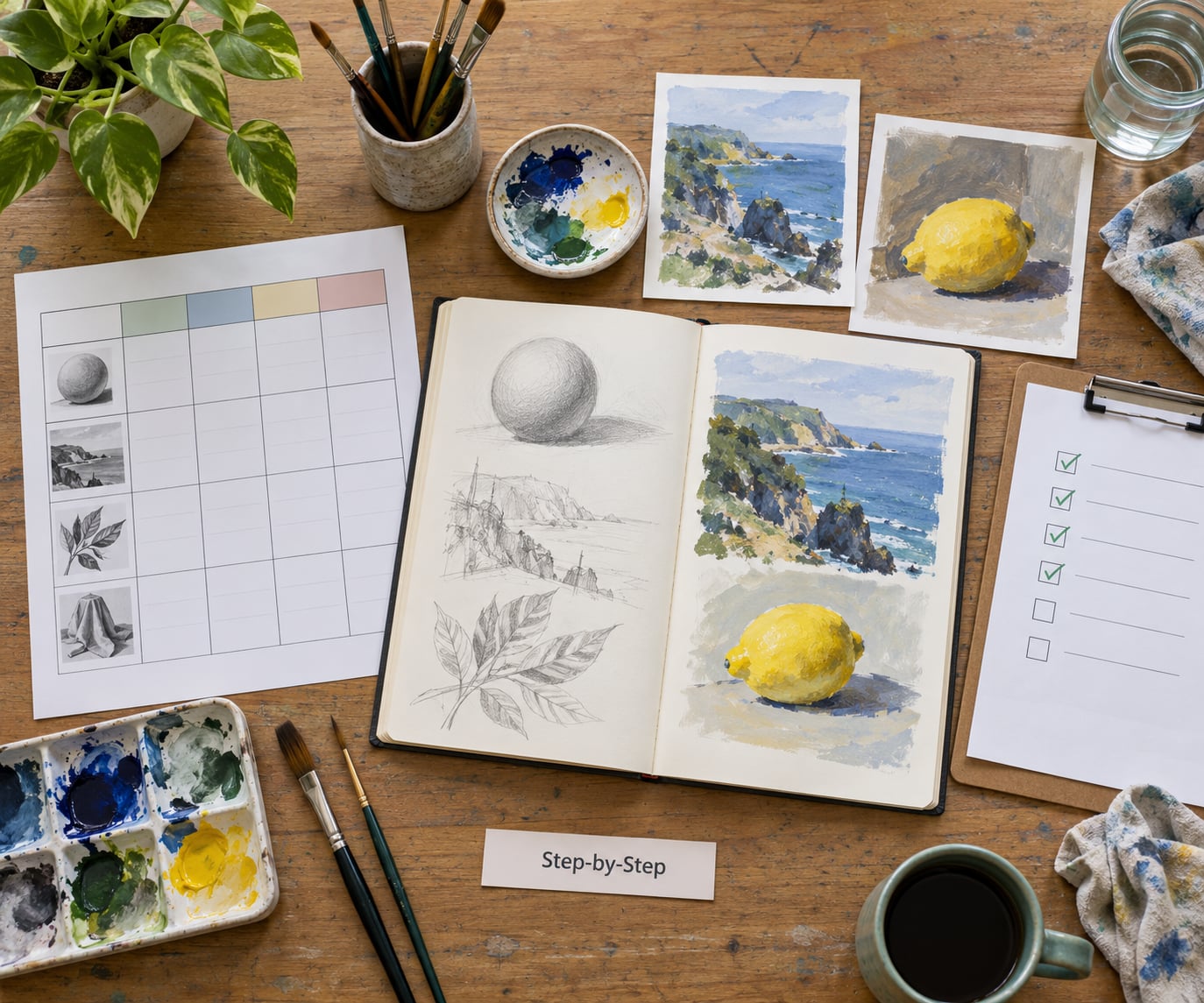
The direct answer to how to grade studio art assignments fairly starts here, because nothing downstream works without written criteria. Translate each project into four observable categories: project goals, craftsmanship and technique, originality and risk-taking, and process and studio habits.
Observable is the important word. “Creativity” is not observable. “Tried at least two approaches that both failed and then documented what changed” is. Write one plain sentence per criterion that a student could read and understand without you standing there explaining it.
Publish the rubric on day one. A teacher on r/AskTeachers asked what a student must actually do to earn a perfect grade in studio, and the honest answer is that most classrooms never say it out loud. Handing over the criteria before the project is the single strongest defense you have when a grade is questioned later.
Review Evidence Before Judging the Result
Judge the piece, not the student. Open the final artwork alongside the process evidence: thumbnail sketches, material tests, photographs of the work in progress, revision notes, critique sticky notes and the artist statement.
Decide the product and process split once and keep it stable. A workable default is 60 percent finished work and 40 percent process for major projects, with warm ups and daily sketches scored on studio habits alone. Tell students the split when you hand out the brief, not after you have scored.
Self-assessment slips are worth keeping, but use them lightly. Teachers who left weekly process journals in place reported shallow reflections that turned into task management, so a single honest self-rating at the end of a project beats a required journal page every week.
Score Each Criterion Separately
Score the four criteria independently, then combine them. What breaks fairness is letting one strong area carry the whole grade, or letting one weak area sink it.
Use four levels with written descriptors, and weight the categories. A defensible set for a studio course: project goals 35 percent, craftsmanship and technique 30 percent, originality and risk-taking 20 percent, process and studio habits 15 percent. The weights belong in the syllabus and on the rubric.
| Criterion | 4 Exceeds | 3 Meets | 2 Approaching | 1 Beginning |
|---|---|---|---|---|
| Project goals | All requirements met and one meaningfully pushed past the brief | All stated requirements met | One requirement unmet or loosely interpreted | Several requirements unmet |
| Craftsmanship and technique | Materials handled deliberately; control is confident and consistent | Materials handled correctly; control is steady | Control breaks down; some wasted or rushed work | Materials mishandled; work is visibly unfinished or unsafe |
| Originality and risk-taking | A personal choice is made and defended with evidence | A clear personal choice is visible in the work | Choices are mostly safe or borrowed | No identifiable personal choice |
| Process and studio habits | Documents change; responds to critique and revises | Shows working stages and responds to critique | Incomplete documentation; limited response to critique | No evidence of process between classes |
One anchor per level is enough to anchor the whole stack. Place a level 3 piece next to your stack, score against it, and resist the urge to rank the pile by first impression before you have any scores down.
Write Feedback the Student Can Use
Feedback is the part teachers dread, and it is the part students remember. A four-part formula gets you through 30 pieces without writing an essay: evidence, strength, next step, and the goal it connects to.
- Evidence: point at something visible. “The edges on the lower third of the print” beats “nice work on composition.”
- Strength: name one thing that is genuinely working, tied to a criterion.
- Next step: one specific, do-able action for the next piece.
- Goal: link it to the learning objective so the comment reads as guidance, not preference.
Compare the two versions. “This has a lot of energy but it feels unfinished” tells a student almost nothing. “Your scraped texture in the top section works; the bottom third is thin, so test your second pull of the ink next time and print two versions before committing” is specific, kind and actionable.
Check for Bias and Grade Consistently
Two passes, always. Pass one scores all four criteria with no comments written. Pass two adds feedback and lets you change a score only if you can point at the criterion, not at a feeling.
Sort before you score. Flip through every piece first and group them by first impression into likely levels, then score each group against the anchors. This keeps your attention evenly spread across the stack instead of drifting after the first hour.
The fairness problem nobody names out loud is access. Craftsmanship scores reflect access to materials, studio time and prior training, not just effort. So keep effort out of the craftsmanship criterion, score studio habits against what you actually observed in class, and hold the same conditions constant: the same class period length, the same access to tools.
Finally, re-score any piece that lands unusually high or low. If you cannot name the evidence that moved it a whole level, it probably belongs where it started.
Common Mistakes
Grading from first impression. The fix is the two-pass rule: score the whole stack before writing a single comment. The first piece sets an anchor that quietly colors everything after it.
Rewarding polish over learning. A photorealistic render can sit at level 1 on process and level 4 on technique. Weight the categories so technical finish cannot carry an entire grade on its own.
Writing vague feedback. “Show more effort” is ungradeable and unfalsifiable. Replace it with a behavior you can name: two material tests logged, one revision after critique, materials cleaned before dismissal.
Penalising an unusual approach. This is the outside-the-box problem teachers argue about most. Decide your policy once, in writing, and put it in the syllabus. My version: originality and risk-taking earns points for a defended choice, and project goals still apply, so unconventional work is neither rewarded nor punished for being unconventional.
Never teaching the rubric. A rubric students have never seen cannot be a fair instrument. Go over the levels with a piece of anonymous student work, argue about which level it hits, and let them adjust the score. It takes ten minutes and it does more for the rest of the year than any grading tweak.
On philosophy: some teachers moved toward minimalist grading after reading Alfie Kohn’s The Case Against Grading and grade almost nothing, which protects intrinsic motivation but leaves nothing defensible when a parent calls. Others run strict analytic rubrics and end up marking conformity. The hybrid works better than either in a studio: grade few, high-stakes projects strictly against published criteria, and treat warm ups and daily sketches as participation and studio habits.
Frequently Asked Questions
How do I grade subjective art fairly when students have different levels of experience?
Fairness comes from comparing every piece to the same anchors rather than to the top of the pile. Score process and studio habits against what you observed in class, and score craft against the conditions you actually gave that student. Most unfairness in studio is access, not judgment: unequal materials, unequal studio time, unequal prior training. Name the conditions in your rubric and students can argue about the criteria instead of your taste.
Should I grade studio art assignments using the final artwork, process, or both?
Both, and decide the split before the project starts. A workable default is 60 percent finished work and 40 percent process for major pieces, with warm ups and daily sketches scored on studio habits alone. Process evidence means thumbnail sketches, material tests, revision notes and responses to critique, not busy-looking sketchbooks. Tell students the weighting when you hand out the brief so the score is never a surprise.
How can I give art critique without students taking feedback personally?
Structure the talk so critique is about the work, not the maker. Use four moves: describe what you see, analyse how it is made, interpret what it communicates, then judge whether it meets the criteria. Have students critique anonymous or work-in-progress pieces first, and post two written observations before any discussion. Requiring a specific observation before speaking removes most of the personal sting.
How many rubric criteria should I use for a studio art assignment?
Four is the sweet spot for a major project: project goals, craftsmanship and technique, originality and risk-taking, and process and studio habits. Four keeps a single-page rubric, which means students actually read it and you can score it in about a minute. More than six criteria rarely change the final grade because everything gets rated 3. For warm ups, drop to a single studio habits checklist.
Should participation affect an art assignment grade, and how can I assess it fairly?
Yes, but score it as observed studio habits rather than as a vibe. Define three or four checkable things: materials cleaned and returned, work in progress at dismissal, response to peer critique, materials handled safely. Record them on a weekly checklist, unprompted, so the score comes from records rather than memory in week nine. Keep participation out of the final artwork grade so it cannot mask weak craft or weak process.
What should I do when a technically unfinished piece shows strong experimentation and planning?
Score each criterion separately and let the numbers do the work. Strong testing and documented revision earn level 4 on process, and the piece scores accordingly. If the final artwork is thin or the stated requirements are unmet, that lands on project goals and craftsmanship. This is exactly why scoring criteria independently matters: the grade reports exactly what the student did well and what they did not finish, with nothing hidden.
Start With the Rubric, Not the Stack
Do one thing this week: take your most recent finished project, pull the two best pieces and two mid pieces from that stack, and write level descriptors against them. Publish the rubric to students before the next assignment starts, then run your next grading session in two passes inside one fixed block of time.
Once criteria, anchors and a fixed session are in place, grading studio art assignments stops being a matter of taste and starts being a matter of evidence. That is the whole difference between a grade a student argues with and a grade a student can act on.