How to flatten a warped canvas depends on which part actually failed. Slack fabric is fixed by evening out pressure from behind and tightening the corners with canvas keys. Bent stretcher bars are fixed by bracing the joint and pressing the high corner down. A roll bend or crease needs controlled moisture and slow drying. Pick the wrong method for your warp and you can set a crease you cannot remove.
The fastest version, for a canvas that is only slightly slack with sound wooden bars:
- Lay the painting face down on a clean, flat, rigid surface with a soft sheet between the canvas and the table.
- Press evenly across the back with both hands, working from the centre outwards, until the surface lies flat.
- Turn it face up and check the weave under raking light. Any remaining waves mean more pressure is needed.
- Press a canvas key into each corner joint a little at a time, working opposite corners and never pulling harder than the bar can take.
- Check tension by tapping the surface with a fingertip; it should sound and feel firm, with no give in the middle.
If the bars themselves are bowed, or the canvas has a memory bend from being rolled, skip to the diagnosis section first. Ten minutes of reading will save you an afternoon of chasing a warp you never treated correctly.
Table of Contents
- What You Need
- Step-by-Step: How to Flatten a Warped Canvas Safely
- Inspect and Identify the Type of Warp
- Prepare a Flat, Stable Work Surface
- Relax the Canvas Slowly and Evenly
- How to Flatten a Warped Canvas Under Even Pressure
- Dry It Gradually in a Protected Space
- Check, Re-tension, and Store the Result
- Common Mistakes
- Frequently Asked Questions
- Can you flatten a warped canvas with an iron?
- How long does a warped canvas take to flatten?
- Will fixing a warped canvas damage the painting?
- How do I flatten a rolled canvas print that arrived in a tube?
- What if the stretcher bars themselves are warped or twisted?
- When should I hand a warped painting to a professional framer or conservator?
- Conclusion
What You Need
The list is short because most people already own it. Borrowed tools work fine here, which is useful if you are only doing this once.
Workspace and support
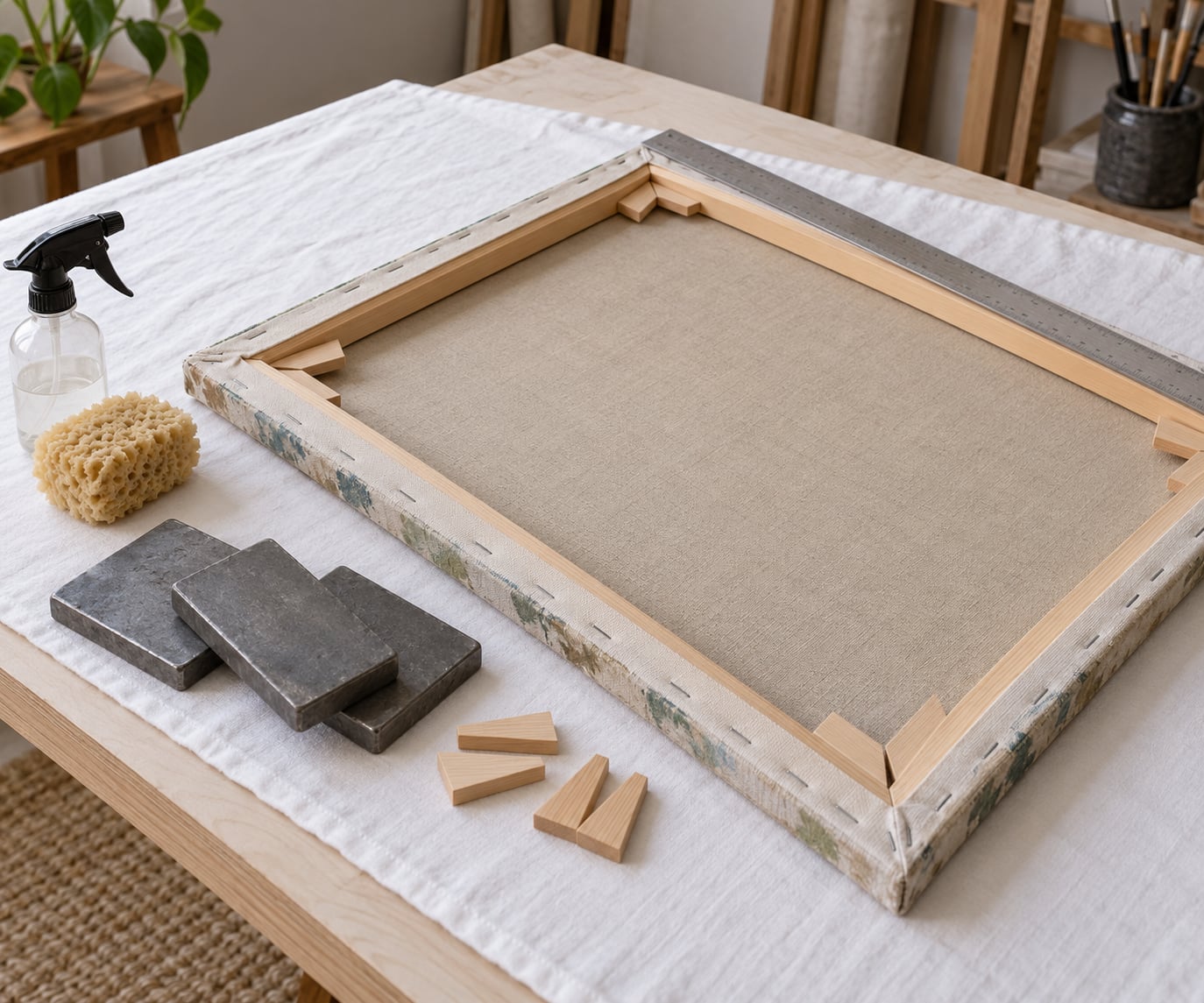
- A flat rigid work surface at least a few inches larger than the canvas on all sides. A table, a sheet of plywood on the floor, or a clean glass panel.
- Two clean flat boards if you plan to sandwich the work, plus a clean cotton or muslin sheet to sit between canvas and board.
- A straightedge long enough to span the frame, for checking whether the bars are square.
Moisture
- Clean water in a hand sprayer set to a fine mist and a clean sponge. Some painters prefer a damp cloth applied to the back instead.
- A soft brush for lifting a slack edge so moisture can reach underneath rather than sitting on top of the weave.
Pressure and weighting
- Canvas keys, the small wooden wedges that tighten a corner joint. Stretching pliers or pliers with a wide, flat jaw help get them seated.
- Weights that sit flat: books, unopened paint-filled jars, a second board with something heavy on it. Bags of rice or sand work as adjustable weight.
- Small squares of plywood or hardboard to shim a bowed corner joint from behind, plus a few screws and a screwdriver, if you are correcting the frame itself.
Drying
- A dry, ventilated room away from direct sun, radiators, dust and animals.
- A hair dryer on the cool setting only, if you want to speed up the first stage.
Protection
- Clean sheeting or a sheet of polythene for the painted face, plus gloves if you are handling an old or fragile surface.
- Brown paper or acid-free tissue if you plan to store the work rolled afterwards.
One note on approach. If the wooden bars are sound and the fabric has simply gone slack, work on the painting where it hangs and correct it in place. A temporary flattening board is for a loose, unstretched piece, a rolled canvas, or a buckling panel. For a framed painting, a full removal from the bars adds risk you do not need.
Step-by-Step: How to Flatten a Warped Canvas Safely
Inspect and Identify the Type of Warp
Diagnosis takes two minutes and determines everything after it. Press the surface with your fingertips, look at it in raking light, then lay a straightedge across the frame in both directions.
| What you see | Type of warp | Method | Typical time | Risk to the artwork |
|---|---|---|---|---|
| Centre dips, surface feels floppy, corners still tight | Slack fabric | Flat pressure from behind, then canvas keys | 30 minutes | Low if you work gradual |
| One corner sits proud, straightedge rocks or lifts | Bowed or twisted bar | Shim the joint, press the high corner down | 1 to 3 days under load | Medium on an old frame |
| Frame out of square, corners mismatched | Out-of-square frame | Shim and re-square, then re-tension | 1 to 3 days | Medium |
| Line across the surface, bend that reads as a dip from one side | Roll bend or crease | Dampen the reverse, dry flat under even weight | 3 to 7 days | Higher on brittle paint |
| Waves across an unstiffened panel, cardboard core bowing | Buckled panel | Steady moisture plus slow drying, no heat | 4 to 10 days | High if the core is split |
Two more checks before you touch anything. Look at the painted surface in raking light for lifting, flaking or a web of fine cracks, and press gently in the area of the worst distortion with a clean fingertip. If paint moves, stop: a flexible surface and moisture together is how you lift a layer.
Also check the paint for looseness on the reverse. Oil and acrylic that were applied to a slack canvas often hold a little of the waviness in the film itself, which no amount of moisture will remove.
Prepare a Flat, Stable Work Surface
Clear a table or a patch of floor with room to work on every side. Lay down a clean cotton sheet, then your flat rigid support on top, so the painting never touches bare wood or a dusty floor.
If you are flattening a loose or rolled piece, put a clean sheet directly under it and keep a second sheet or a board handy for covering once the moisture goes on. A damp canvas sitting on bare wood will transfer dirt into the weave as it dries.
Move pets out of the room. Move the plant off the windowsill too. Hair, dust and a sudden dry heat source are the three things that turn a slow flatten into a blotchy, uneven one.
Relax the Canvas Slowly and Evenly
This step only applies to fabric that has taken a set: a roll bend, a crease, or a buckle in a stiff panel. A merely slack canvas needs no moisture at all, and adding it risks unnecessary damage.
Mist the back of the canvas lightly from 12 inches away until the fibres darken slightly and feel cool, not wet. Work around the whole surface rather than concentrating on the dent. Then let it sit and absorb for 15 to 30 minutes while you get the weights ready.
Use the sponge instead if the weave is open or the warp is deep, and dab rather than soak. If moisture beading on the surface is a problem, lift the slack edge with the soft brush so air can reach underneath.
What to avoid: soaking, pooled water, and any heat above cool. Heat drives the water to the surface fast, which is how a crease turns into a buckle and how acrylic softens enough to pick up a fingerprint that never comes out.
How to Flatten a Warped Canvas Under Even Pressure
For a slack canvas on a sound frame, this is mechanical work. Turn the painting face down onto the clean sheet and press across the back with both hands, moving from the centre out to the edges in slow passes until the surface no longer ripples under the light. Do not push hard in one spot; the aim is to redistribute slack, not to drive the centre down.
For a rolled, creased or buckled piece, lay it face down on the sheet and cover it with a clean sheet, then a flat board. Weight the board evenly. Several medium weights spaced across the whole area beat one heavy weight in the middle, which just re-creases the work.
For a bowed bar, place the canvas face up, support the whole frame on your flat surface, and press down on the corner that stands proud. The opposite corner lifts as the wood straightens under load, which is exactly what you want. If the joint stays stubbornly open, shim it: slide a small square of plywood into the corner gap, screw it from the back, then re-press. Repeat on the same load as the other corners so the frame stays square.
Never place weight directly on a painted surface. Fibres or a stiff foam guard are fine on a fully dry acrylic or oil surface; on a freshly painted or tacky surface, put a clean sheet down first and keep the load light.
Dry It Gradually in a Protected Space
Speed is the enemy here. Fast drying locks whatever shape the canvas happened to be in, which is how a fix turns into a new warp. Give a dampened piece 3 to 7 days, a creased piece longer, and a stiff cardboard panel up to 10 days before you judge the result.
Leave the stack where air moves around it, out of direct sunlight and away from radiators, ovens and exterior doors. Turn the whole assembly over after 24 hours and check the reverse for damp patches. If one area is still dark and cool while the rest has dried, redistribute the weight and let it go longer.
A hair dryer on cool, held 12 inches away and moved constantly, is acceptable for the first ten minutes of drying. Never use heat or warm air. If you catch yourself checking the piece more than twice a day, set a date instead, because that impatience is usually what starts the next problem.
Check, Re-tension, and Store the Result
When the reverse is dry to the touch and the same colour throughout, take the weights off and leave the canvas undisturbed for another day. Then check under raking light. A faint, temporary memory of the old distortion is normal for another few days; a sharp crease is not.
Once it reads flat, re-tension if it is back on its frame. Turn it face up and work from the centre outward, adjusting one corner at a time in turn rather than cranking one corner hard. Insert the canvas keys gradually, tapping each one home with pliers, until the surface gives a firm fingertip response and a clear sound. Continue tensioning from the centre rather than the corners, alternating sides, which is how professional stretchers avoid the diagonal ripples that a corner-first job leaves behind.
Store the finished piece flat or upright at the stretcher bar line, never leaning at an angle. Stable humidity is the real goal, somewhere around 40 to 60 percent for most homes, which is why a bathroom, a basement or a loft is the worst place for a canvas to live.
Two checks keep the warp from returning. Run your fingertip across the surface every six to twelve months, since a new dip in the centre shows up long before it looks obvious. And look at the back for corner joints that have opened and need a shim.
Common Mistakes
These are the four or five things that turn a fixable warp into a ruined one.
- Soaking the canvas. Water on a painted surface can lift acrylic, bloom into oil, soften watercolour gum and swell the weave beyond its original length. The fix is mist-level moisture on the reverse only, then patience.
- Using heat or an iron. Heat sets a crease rather than removing it, and on any painted or printed surface it can glaze, melt or transfer ink. Flattening a warped canvas with an iron is the single most common piece of bad advice on forums. If you must press, use a heavy board and weight, never a hot tool.
- Hammering staples or pins deeper. Driving a fixing deeper while the bar is bowed hides the symptom by slackening the fabric around it. Fix the joint, then re-tension with keys.
- Pulling harder than the joint allows. Over-stretching thins the weave, distorts the image and strips fibres from the corner. Work the keys in small increments, checking after each pass.
- Weighing a wet or tacky painted surface. It picks up impressions and blocks. Put a clean sheet down, keep the load light and leave enough room for air.
- Dry it fast to get it over with. A hairdryer on warm locks in the shape it had when you started. Flatten a warped canvas slowly and it stays flat; rush it and you repeat the job next week.
- Starting on paint that is already lifting. Any moisture or pressure will take a loose layer off. If paint is loose, use the workaround below instead.
The workaround for large or valuable warped works: frame them so nothing touches the bowed surface. A conservator-style response to a warped pastel or a big oil is to leave a raised mat gap and a deep frame, so the framing presents an even plane while the warped painting sits behind it, unattached and undistressed. It does not fix the warp, but it removes the pressure to fix it and protects the work from the rest.
Medium matters before you dampen anything. Oil tolerates gentle misting on the reverse once the paint is properly cured but blooms if water reaches the surface. Fully cured acrylic is fairly forgiving on the reverse, soft and paintable, so gentle moisture is usually safe. Watercolour and ink lift and tear very easily when wet. Encaustic is fused with heat, so a warm press can re-soften the wax. Printed and glued canvas will take an impression and can delaminate from heavy weight. Needlepoint, cross-stitch and canvas used as a drop cloth block best with dampening and weight, since there is no paint film to ruin.
Frequently Asked Questions
Can you flatten a warped canvas with an iron?
No. Heat on a painted or printed surface can glaze it, melt wax in encaustic or transfer ink, and on a raw stretched canvas it flattens the fibres into a permanent pressed shine. Heat also sets a crease rather than lifting it. To flatten a warped canvas, use moisture on the reverse plus flat weight and slow drying, and check the result over several days.
How long does a warped canvas take to flatten?
A slack canvas can be pressed flat and re-keyed in about half an hour. A roll bend or crease wants 3 to 7 days of weighted drying, and a stiff or cardboard panel can need 4 to 10 days. Judge it by touch and colour on the reverse, not by the calendar. Let it lie undisturbed for another day after it looks dry, since the weave often settles late.
Will fixing a warped canvas damage the painting?
Done gradually, rarely. The common causes of damage are soaking the surface, applying heat, hammering fixings deeper and pulling the fabric tighter than the joint allows. Keep moisture on the reverse, keep pressure even and light, and never start on paint that is already lifting or flaking, since moisture and pressure will take a loose layer with them.
How do I flatten a rolled canvas print that arrived in a tube?
Unroll it, then let it lie flat under light weight for two to three days before you add any moisture, so the bend relaxes on its own. If a crease remains, mist the reverse lightly, cover with a clean sheet and a flat board, and weight evenly. Leave it 3 to 7 days. Never iron a canvas print, and keep weights off the printed face.
What if the stretcher bars themselves are warped or twisted?
Correct the wood before you touch the fabric, because a bowed bar will keep re-warping the canvas no matter how you tension it. Lay the frame flat, press down on the corner that sits proud, and shim any joint that will not close with a small square of plywood or hardboard screwed into the back. Check with a straightedge, then re-tension evenly from the centre.
When should I hand a warped painting to a professional framer or conservator?
Take it to a conservator when the paint is lifting, flaking or crazed, when the canvas has torn along a fold, when the bars are split or the joints will not close, or when the work is valuable to you and you would rather not risk it. A framer can handle routine re-stretching and shimming. For a large or precious warped work, ask about framing it behind a raised mat so nothing touches the bowed surface.
Conclusion
Start by working out what actually moved: loose fabric, bent bars, or a roll bend held in the weave. Correct the bars first if the wood is bowed, because a canvas tensioned onto a twisted frame will go slack again within weeks.
From there the sequence is simple. Relax the fabric gradually, misting the reverse only and keeping well away from heat and water. Press it flat with even weight spread across the whole surface, never heavy in the middle. Let it dry slowly in a ventilated room for as many days as the table above says, and only re-tension once it is genuinely dry and reads flat under raking light.
Most warps are one of those three problems wearing the same name. Ten minutes of diagnosis will tell you which method to flatten a warped canvas is yours, and which advice to ignore.