A group art critique works when it runs like a meeting with an agenda, not like a conversation that happens to involve several people. The core of how to run a group art critique is simple: pick the kind of critique the group needs, agree on ground rules out loud, give each artist 60 to 90 seconds of context, then run feedback in three short rounds while someone keeps time. Budget 90 minutes for two presenting artists and three hours as a hard ceiling.
That last part is the one groups skip. Somebody has to be the facilitator, and if that somebody is also the person presenting, the session drifts into a rambling conversation where two people talk and everyone else watches. My advice is to keep a sheet of paper with minutes next to it and treat the clock as a tool, not a suggestion.
The steps below cover a critique in a studio, a classroom, or a video call. The only part that changes with the setting is how work gets shown; everything else, the framing, the rounds, the moderator’s job, holds up whether you have six people or sixteen.
Table of Contents
- What You Need to Run a Group Art Critique
- Start with a written purpose the group can read
- Work, and enough wall space to look at it properly
- Prompts, feedback slips, and a facilitator
- The numbers that keep a session on track
- Step-by-Step
- 1. Decide What Kind of Critique the Group Needs
- 2. Set Clear Expectations and Ground Rules
- 3. Invite Artists to Present with Context
- 4. Separate Observation from Interpretation
- 5. Structure Feedback in Three Useful Rounds
- 6. Guide Questions Instead of Prescribing Solutions
- 7. Capture and Prioritize the Feedback
- 8. Close with an Artist Reflection and Next Action
- Common Mistakes
- 1. Vague praise dressed up as feedback
- 2. Unsolicited redesigns
- 3. Comments about the artist instead of the work
- 4. One person running the room
- 5. Solution overload
- 6. Judging the material or the market
- 7. No context from the artist
- 8. Technique talk with no relevance
- Frequently Asked Questions
- How many people should be in an art critique group?
- Can you run a group art critique online?
- How do you run an art critique with students?
- Should a critique group show finished work or work in progress?
- How do you balance specific praise with constructive criticism?
- Conclusion
What You Need to Run a Group Art Critique
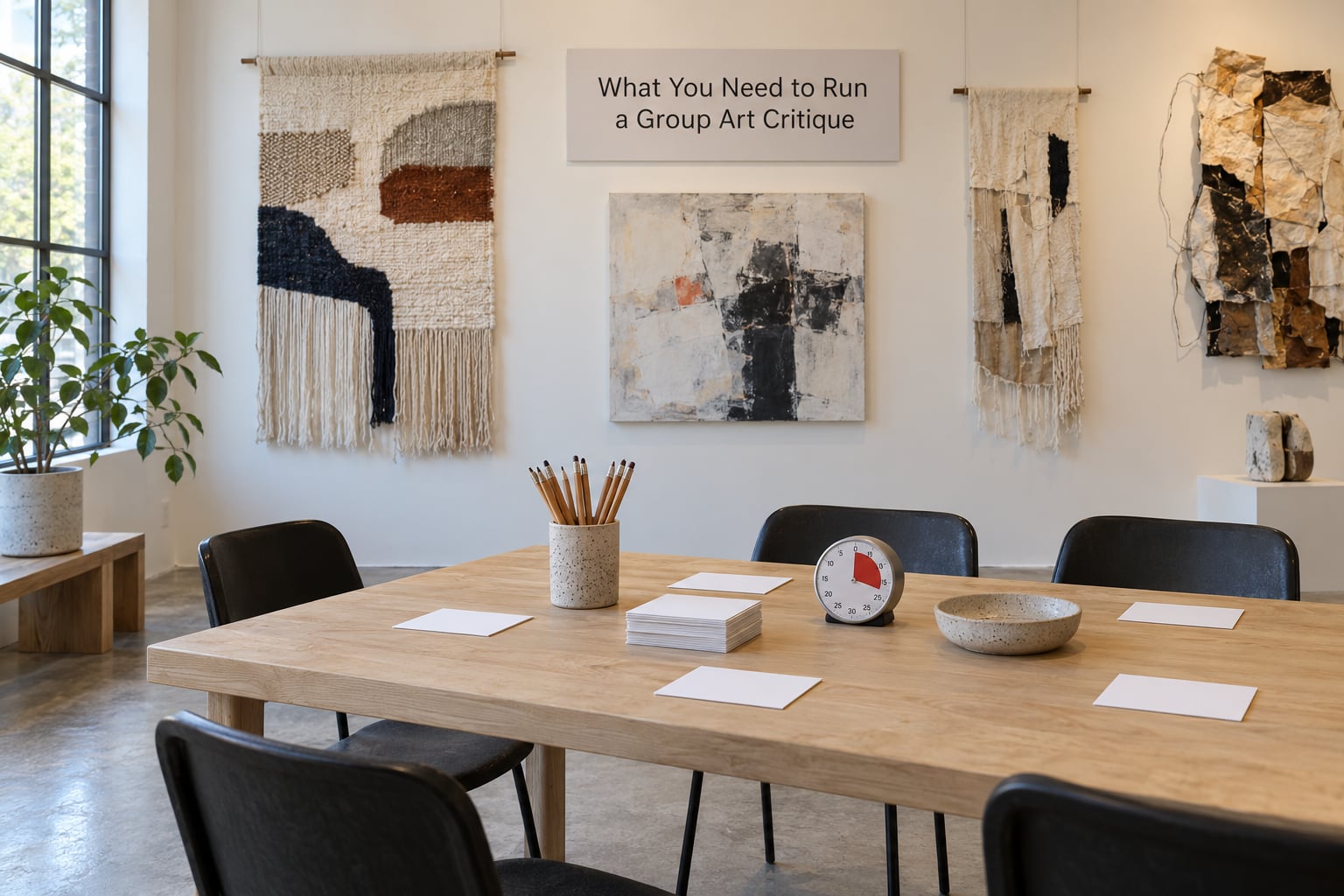
You need four things to run a group art critique well: a stated purpose, a piece per artist, a structure with a time limit, and a person enforcing that limit. Everything else is helpful, and everything else can be improvised with index cards and a kitchen timer.
Start with a written purpose the group can read
One or two sentences describing what the group is for, posted where everyone can see it. Members of r/ContemporaryArt make the same point when they advise new groups to make each artist’s goals explicit before the first session, because the difference between making art for pleasure and making it for a portfolio produces completely different feedback.
Write it as a question the group keeps returning to. Something like, which piece from this body of work holds up best when the light is low and the viewer is moving. A recurring question gives members something to measure progress against six months later, when the first session’s enthusiasm has worn off.
Work, and enough wall space to look at it properly
Each presenting artist brings one piece. Finished work is fine, work in progress is fine, and honestly the most useful sessions mix both, because a group that only sees polished pieces loses the ability to talk about decisions.
Hanging matters more than most people expect. Put the work at eye level, give it a metre or more of clear wall, and light it evenly. Studios that rotate homes, whether it is a community arts space, a library room, or someone’s garage, need tape, T-pins, and a level. For digital work, a large screen or projector beats laptop-sized thumbnails every time.
Prompts, feedback slips, and a facilitator
- One facilitator. Someone other than the presenting artists, whose job is time, order, and protection from derailment. A different member can do it each month.
- Feedback slips. Index cards, one per attendee per piece. Writing forces a comment to be specific, and it gives the artist something to keep after the room empties.
- Three written prompts. What did you notice first, what do you think it is doing, what question do you have for the artist. Printed on the agenda sheet, they rescue the silence that kills most first sessions.
- A timer. A phone on the table works. Give the facilitator permission to use it without apology.
- Optional reference images. Two or three works you want the group to look at alongside, ideally by artists outside the group, so the conversation has somewhere to go besides personal taste.
The numbers that keep a session on track
Four to eight members gives every person time to speak and still fits in a single evening. Under ten is where the discussion stays connected to the work; past ten, feedback gets thin and members start talking to their neighbours instead. Plan 45 to 60 minutes per presenting artist, two or three pieces per session, and a hard stop at three hours. Groups that meet longer than that get tired rather than insightful.
Step-by-Step
Eight stages take a critique from setup to reflection. Here is the run of show for a 90-minute session with two artists, which you can stretch by adding a third presenting slot or a third hour of group discussion.
- 0 to 10 min. Arrive, install work, read the purpose and ground rules, facilitator names tonight’s timekeeper.
- 10 to 12 min. Facilitator restates the structure and the time limit, group agrees to it out loud.
- 12 to 22 min. Artist one presents piece and question, group writes silently.
- 22 to 50 min. Three rounds: observation, interpretation, questions, artist responds at the end.
- 50 to 60 min. Artist two presents piece and question, group writes silently.
- 60 to 88 min. Same three rounds for artist two, artist responds.
- 88 to 90 min. Artist names one thing they are taking forward, group closes.
1. Decide What Kind of Critique the Group Needs
Choose one of four formats and write it on the agenda: a completed work, a work in progress, a group exhibition, or a skill-based review. Then define the single decision or question the group should focus on.
This is where most sessions go wrong, because eight people bring eight agendas and the feedback ends up scattered. A review of a finished piece works best with a question about effectiveness. Work in progress works best with a question about the next decision. Skill-based review needs a named skill, not a general verdict on the work.
You know the format is right when every comment in the room could reasonably be answered with “yes, that is what I was after,” or “no, I was trying something else.”
2. Set Clear Expectations and Ground Rules
Ground rules are the difference between a critique and an argument. Write five or six, print them, and read them at the start of every session until they are habit. The ones that matter most: critique the work, never the artist; one speaker at a time; every member speaks once before anyone speaks twice; comments describe before they judge; and anyone may pass.
The pass rule is the one people leave out and the one that matters most for beginners and for anyone showing an experiment they are unsure about. It gives permission without embarrassment, and it costs nothing to include.
Add two more that prevent the two classic derailments. Say that a comment must name a specific formal element, such as composition, colour, texture, material, scale, technique, or sequence, before offering a solution. And say that advice stays with the artist: the group can describe what it sees and ask questions, but the decision belongs to the maker.
Threads on r/ArtistLounge keep circling one point, that critiques are not praise sessions, and that people get more from them when they arrive ready to hear hard feedback. Writing that into the ground rules protects everyone, including the artists who came hoping for reassurance.
You know the rules are working when the first comment in a session names something in the work instead of praising the artist.
3. Invite Artists to Present with Context
Give each artist 60 to 90 seconds and four prompts: name the piece, describe the audience or effect you intended, identify one deliberate choice you made, and ask one focused question. That last prompt is the highest-value item on the list and the one most often skipped.
Without a question, the group guesses at what the artist cares about, and half the feedback misses. The difference between “that piece is too quiet, I wonder if it needs one larger note” and a specific question about whether the quiet is intentional is the difference between useful and wasted airtime.
Record the question where the facilitator can see it. The group answers that question first and only then opens up.
You know the presentation worked when the feedback that comes back is about what the artist actually asked about.
4. Separate Observation from Interpretation
Ask the group to describe what is visibly present before anyone suggests meaning or a solution. Where does your eye go first, what colour repeats, where does the surface change, what happens at the edge of the frame. Only after two or three observations does interpretation begin, and even then it should be phrased as a possibility, “it reads to me as,” rather than a fact.
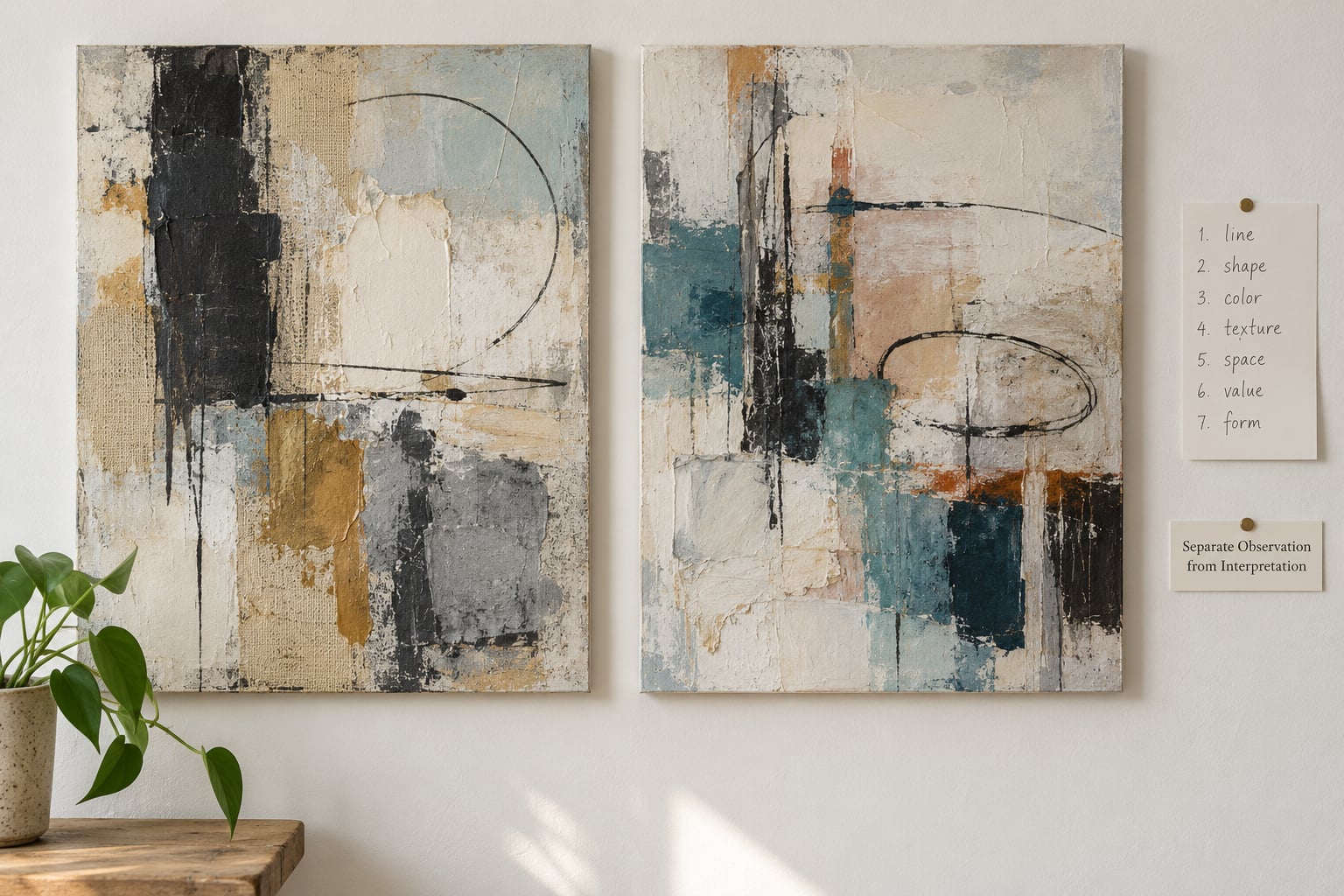
Observation is also how the group gets around personal taste. “I dislike green” is a preference and it ends the conversation. “There are three greens in the lower third and they hold the composition together” is a description, and the artist can do something about it.
You know the separation is working when you can point to two or three comments in a row that name things rather than verdicts.
5. Structure Feedback in Three Useful Rounds
Run the feedback in three short rounds: observation, then interpretation, then questions for the artist. Give each round a few minutes, and stop repetition as it starts, because the third person to say the work feels unfinished is not adding anything.
Each member speaks once per round. That rule handles the dominant voice without a scene, because a facilitator saying “please, we have not heard from everyone yet” is a neutral request, while a facilitator saying “you are talking too much” is a personal one.
Close the artist’s segment with a short response in their own words, two minutes, what they are taking forward. Then move on. The artist decides what advice to use, and the facilitator’s job is to make that visible rather than to make it happen.
You know the rounds are working when the artist can summarize the feedback in a sentence, and the summary is not the first thing that was said.
6. Guide Questions Instead of Prescribing Solutions
Facilitators fix silence by asking questions, not by making suggestions. The prompts that work are the ones about attention: where does your eye go first, what did you expect to happen that did not, which element is doing the most work, where did the viewer pause, what would you test in a five-inch study.
Questions about intention are the most productive of all, because they hand the decision back to the artist instead of making them a consumer of someone else’s taste. “The piece made a larger version of a problem you already solved” is a real observation, and it invites a response about scale rather than dictating a change.
You know it is working when most of the airtime is questions, and the artist is answering them rather than defending decisions.
7. Capture and Prioritize the Feedback
At the end of each piece, the artist collects the written slips and sorts them into three piles: the most useful insight, one question worth testing, and one practical next step. That last pile is what makes a critique worth the evening, because it converts a conversation into a movement.
Some advice will conflict with the intent of the work, and the artist is allowed to discard it without dismissing the person who offered it. Different viewers read the same surface differently, and that variation is data, not an instruction. Keep the slip, mark it as not for this piece.
You know it is working when the artist leaves with one or two specific next actions rather than a general feeling.
8. Close with an Artist Reflection and Next Action
Ask the presenting artist what changed in their understanding, and what they plan to do next. Two minutes each, no cross-talk. Then run a quick group check: did this feel specific, respectful, and useful tonight, and did anything need fixing for next time.
Collect anything nobody wants to raise in front of the group privately, by message afterwards. Artists who are upset often say nothing in the room and quit the group a month later without explaining, so a direct message means more than it looks like it does.
You know the session worked when members tell you what they are working on before the next meeting, unprompted.
Common Mistakes
These eight failure modes account for most of what goes wrong. Each one has a fix you can apply the next time, without a lecture and without embarrassing anyone.
1. Vague praise dressed up as feedback
What it sounds like: beautiful work, I love the colour, you should really keep going.
Fix: Require one specific formal element in every comment. The colour is doing something, now say what. “Noticing a change in value across the left half is specific enough to act on.”
Tip: Put the three prompts on the agenda sheet. A group holding a card does not have to invent a comment at the same moment it has to say it out loud.
2. Unsolicited redesigns
What it sounds like: I would take that element out and make it twice the size, and use a warmer ground.
Fix: Move it to the question round. If the observation stands, it survives being phrased as a question, and the artist gets to decide. Members also need permission to make work nobody asked about; a shared studio wall or a later conversation handles that better than a critique does.
3. Comments about the artist instead of the work
What it sounds like: this is not really your style, or you always do this.
Fix: Put it in the ground rules and enforce it in the moment. Redirect once, plainly, without naming anyone: let’s keep it on the piece.
4. One person running the room
What it sounds like: the same voice through all three rounds, with everyone else nodding.
Fix: One speaker at a time, and every member once per round before anyone goes twice. Rotate the facilitator so the enforcement is not personal.
5. Solution overload
What it sounds like: five different suggestions, none of them connected to each other.
Fix: Cap interpretation to three minutes and questions to three minutes. If there is more to say, it belongs in a conversation after the session with one or two people, not in the round.
6. Judging the material or the market
What it sounds like: this would sell, that is not going to hang in a gallery, nobody will pay for that.
Fix: Name the venue of the comment. If the group is a portfolio or sales group, market talk belongs on the agenda by agreement. Otherwise it is one person’s guess about a market, delivered with more confidence than it deserves.
7. No context from the artist
What it sounds like: a room full of opinions about a work whose goal nobody heard.
Fix: Make the four presentation prompts non-negotiable, including the focused question. If the artist cannot articulate a question, that is itself useful information, and it is worth five minutes of the session.
8. Technique talk with no relevance
What it sounds like: a short course in materials that has nothing to do with the work on the wall.
Fix: Tie technique to intent. “Warmer whites would support the quiet reading you described” works. Unsolicited war stories about a medium get logged for later, not for the round.
Frequently Asked Questions
How many people should be in an art critique group?
Four to eight members is the sweet spot. Below four, one absence guts the session and the feedback repeats itself. Above ten, each artist gets under 45 minutes and members drift into side conversations. If you can only gather twelve or more people, split into two breakout groups of six, each with its own facilitator, and compare notes in the last ten minutes.
Can you run a group art critique online?
Yes, with three changes. Send high-resolution images the day before so nobody waits on a screen share, require a photo of the work with something standard beside it so scale is readable, and keep the moderator stricter than in person. Online critique is weaker on texture and scale, stronger on attendance. Members on r/ArtCrit and r/Artadvice keep asking for structured online groups, so demand is real.
How do you run an art critique with students?
Shorten everything and raise the structure. Fifteen minutes per piece, one round of observations and one round of questions, and no interpretation round for beginners. Seat students in a circle rather than rows so everyone can see the work and each other. Write the four parts of critique, description, analysis, interpretation, judgment, on the board and have the group stay in the first two parts until they have earned the rest.
Should a critique group show finished work or work in progress?
Work in progress, as long as the artist names the decision they are facing. An unfinished piece with a clear question produces better feedback than a finished piece with none, because the group has something specific to answer. Mix both across sessions so members learn to read each other at different stages, and never let unfinished work become an excuse for vague encouragement.
How do you balance specific praise with constructive criticism?
Do not use a praise sandwich. Artists read it as dishonest, and r/ArtistLounge threads reject it outright. Instead, let a comment carry recognition and criticism in the same sentence: the repeated greens hold the composition together, and the lower right gets lost. That names a strength, names a problem, and stays attached to something the artist can act on.
Conclusion
Start smaller than feels right: four people, two pieces, 90 minutes. Before anything else, write one sentence describing what your critique group is for, and one ground rule that says comments must name a specific part of the work before offering any solution. Everything after that, the rounds, the slips, the rotating facilitator, is detail. The principle underneath all of it is that the group’s job is to make the work more legible to the artist, and the artist’s decision stays with the artist.