A critique that goes badly is one that lands as an insult instead of information: it arrives from someone with no standing to judge your work, it is delivered in front of a group, it attacks you rather than the piece, or it is simply mistaken. Handling one well takes about twenty minutes of deliberate work and no defending. The process is always the same, and I have walked through it enough times with my own students and critique groups that I can lay it out step by step. This guide covers receiving critique. The other half of the craft, giving it, is a separate conversation.
The advice below reflects current studio practice for 2026, and most of it comes out of artist forums where the same handful of problems keep surfacing: the urge to reply within minutes, the loss of momentum for days afterward, and the difficulty of telling craft feedback apart from a stranger’s taste.
Table of Contents
- What You Need
- How to Handle a Critique That Goes Badly, Step by Step
- Step 1: Step away before reacting
- Step 2: Separate facts, interpretations, and personal remarks
- Step 3: Ask clarifying questions
- Step 4: Choose what to change and what to keep
- Step 5: Respond without defending or over-apologizing
- Step 6: Turn a Critique That Went Badly Into One Small Next Step
- Common Mistakes
- Tips for staying constructive after difficult feedback
- Frequently Asked Questions
- What should I do if I cry during an art critique?
- How do I respond when a critique feels rude or personal?
- How can I disagree with an art teacher without sounding defensive?
- What if several people give me conflicting critique advice?
- Should I revise my artwork immediately after every critique?
- How do I give someone else feedback without making them feel attacked?
- Conclusion
What You Need
You need very little, which is part of why people get it wrong. They arrive with nothing but adrenaline and end up defending themselves to a screen at one in the morning.
- Ten uninterrupted minutes away from your phone and the comment thread. Ten is enough.
- A pen and paper, not a screen. Writing by hand slows the loop between reading and reacting.
- Your original statement of intent, the sentence you wrote before you started. If you did not write one, write it now: this piece is about X, and it is finished when Y.
- One trusted peer, ideally one of the two or three people whose eye you actually trust. Artists who handle critique well tend to have a small circle rather than a wide one.
- Unhurried studio time the next day. The emotional hangover is real and it arrives late, usually once you have stopped thinking about the critique and reached for materials.
How to Handle a Critique That Goes Badly, Step by Step
Six steps, in this order, take a critique that went badly and turn it into either a decision or a file you close. The order matters most at the start. Reacting early ruins every step after it, which is why the urge to defend yourself within minutes is the most common regret reported in artist forums.
Step 1: Step away before reacting
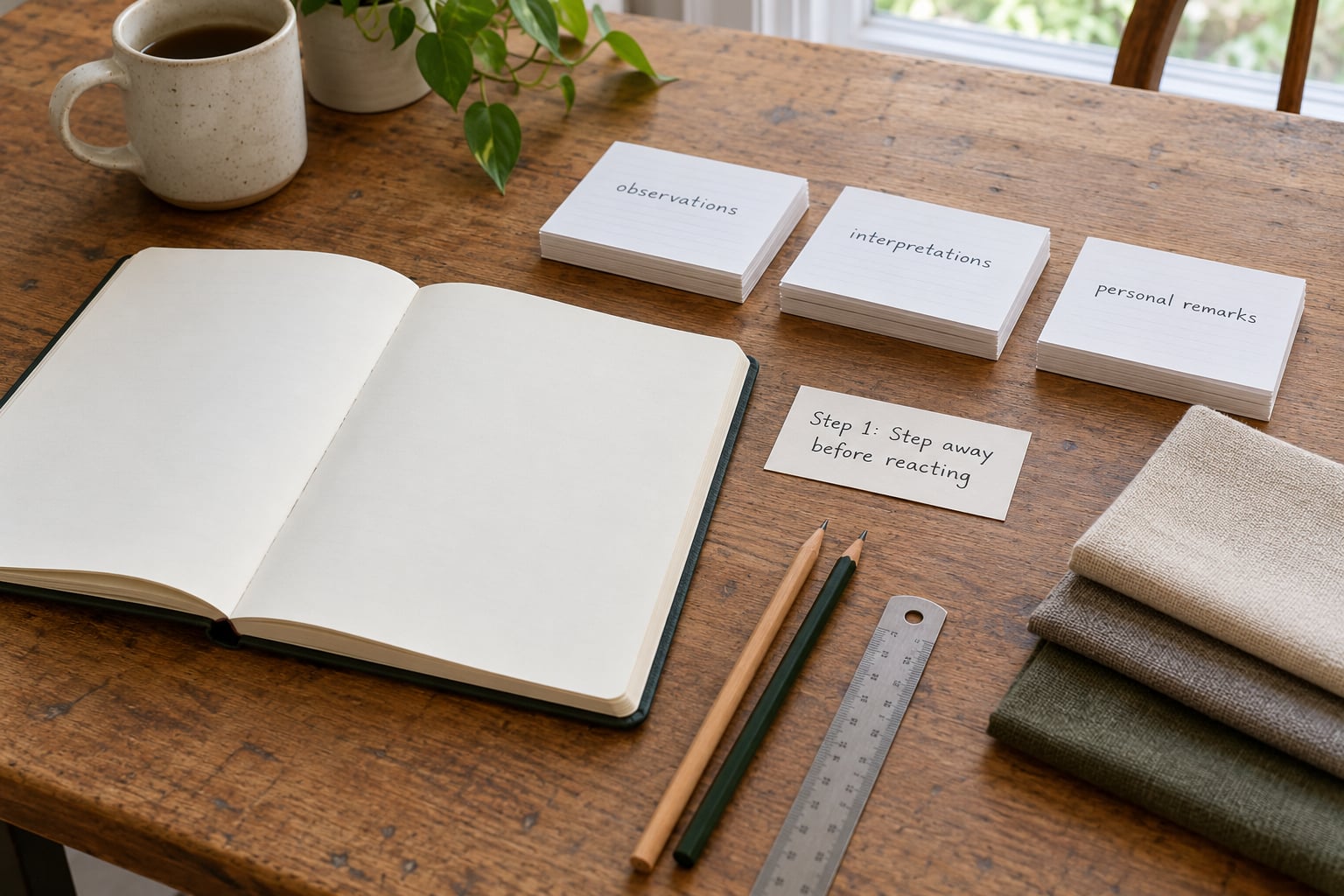
Do not reply for at least an hour, and not while you are still in the room. Set a timer rather than trusting your sense of how you feel, because adrenaline reports itself as settled long before it has settled.
While you wait, do something physical and dull. Walk the block, wash the brushes you used last week, sharpen pencils. The goal is not calm exactly. It is to move your body out of the fight-or-flight state so the sentence you are about to write comes from your head rather than your ribs.
Then write down the critique in the critic’s own words, as close to verbatim as you can manage. Do not summarize it and do not argue with it yet. This is the single tactic that forum regulars name most often as the thing that actually helped, because a comment written on paper stops moving while a comment on a screen keeps running.
Step 2: Separate facts, interpretations, and personal remarks
Sort every sentence of the critique into one of three columns: observations about the work, interpretations about what it means, and remarks about you. Only the first column is usable as written.
An observation names something visible in the piece. The bottom corner of the quilt is where my eye snagged, or the second coat of wax reads cooler than the first. An interpretation adds meaning, and sometimes it is accurate even when the phrasing is clumsy: the reviewer may feel unsettled and describe it as the color being too busy.
A personal remark is about the maker rather than the making. Your hand isn’t controlled enough for this, you seem to be imitating someone, or you clearly don’t know what you’re doing. On wood cutouts, reviewers often attack the tool choice instead of the shape; on painting, they attack the style; in mixed media, they attack the concept as pretentious. None of those are observations.
Read your three columns back in order. Most people find the observations column is thinner than they feared and the personal column is heavier than they expected. That ratio is the useful fact.
Step 3: Ask clarifying questions
Vague criticism becomes useful the moment you ask where it points. These questions are non-defensive because they treat the critic as a source of information rather than an opponent.
- Where does your eye land first, and where does it stop?
- Which edge or area felt unresolved to you?
- What technique did you notice there?
- What would you expect to see instead?
- Is that a craft note or a preference? Either answer is fine, I just want to know which one to treat it as.
That last question does most of the work. Naming the difference between a technical note and a taste preference is a fair question to ask, and it moves the conversation off the moral ground where it usually ends up.
Step 4: Choose what to change and what to keep
Now test each observation against your intent and your constraints. Feedback that conflicts with what the piece was trying to do is not bad feedback, it is feedback for a different piece. Write that down too, because it is easy to forget by the next session.
Three tests are worth running. Does the comment describe something you can change without breaking the idea? Would the same observation come from more than one person? Does it survive a week of you living with the piece before you touch it?
Most of the time one observation survives. Change that one thing, not the five suggestions you collected. A quilt that has three colors and nine edits is no longer the quilt you made.
Step 5: Respond without defending or over-apologizing
A short, warm reply closes the exchange better than a long one. Here are the lines I use, and you can copy them as they are.
To thank someone whose note helped: Thank you for the honest read, especially the part about where the eye stops. That is exactly what I was unsure about, and I am going to work on it.
To decline a suggestion that does not fit: I appreciate the thought. That change would push the piece away from what I set out to do, so I am going to leave it. It is useful to know how you read it, though.
To ask for more precision: You are right that something is off in the left third. Can you point to a specific place, or describe what you expected there? I would rather fix the right thing than the wrong one.
To set a boundary after a personal remark: I am happy to talk about the work. I am not going to discuss my skill level in this thread. If you want to comment on the piece itself, I will read it.
When you are in the room and it is going badly: Say your piece once, calmly, and then stop talking. Artists who defend themselves in a group session lose the room almost immediately. If a comment is directed at you rather than the work, a simple Does that address the piece or do you want to talk about me? usually redirects it in front of everyone without making you the difficult one.
Step 6: Turn a Critique That Went Badly Into One Small Next Step

A critique informs a decision. It does not make one. Finish by writing a single sentence: the one change I am making before I show this piece again, or the one experiment I am running instead.
Then schedule the follow-up before you close the notebook. Two weeks is usually enough to see the piece with slightly fresher eyes, and a date keeps you from drifting back into the loop of relitigating the comment.
Keep your original concept sheet in the folder. When the revised version frustrates you in a month, being able to see what you were after and what you actually did is worth more than any note anyone gave you.
Common Mistakes
These five responses turn a difficult critique into a fight or a lost week. Each has a corrective action that works.
- Arguing in public, immediately. You will not win, and the thread becomes your reply instead of your work. Correction: one hour minimum, notes on paper first, one short reply later or no reply at all.
- Accepting every suggestion. The result is a piece edited by committee, and you stop recognizing it. Correction: one change, chosen against your stated intent.
- Treating one opinion as law. A single viewer is a data point, not a verdict. Correction: ask whether two other people in the room noticed the same thing.
- Abandoning the work the same day. The sting is loudest in the first 24 hours and the decision made then is the worst one you will make about this piece. Correction: no decisions until the work has been off your desk for a week.
- Treating harsh delivery as accurate feedback. Rude is not the same as right. Correction: sort by specificity, not by tone. A vague comment delivered unkindly is still vague.
Tips for staying constructive after difficult feedback
Most of the damage happens because critique arrives uninvited. You can prevent next time by shaping the request. Ask for two strengths and one thing to fix. Ask for technical notes only, no taste comments. Ask for one type of observation at a time, so a color critique is not delivered on a day you were already tired.
Written feedback before spoken feedback tends to land better for both sides, and small groups of two or three beat a room of fifteen every time. Artists report the same thing in different words: the critique that gets singled out in front of a group is the one that feels like an attack.
Afterwards, record which notes you acted on and why. A running log of decisions is the fastest way to notice that the same comment shows up for the third piece in a row, and that is a pattern in the work worth fixing.
Frequently Asked Questions
What should I do if I cry during an art critique?
Let it happen and step out of the room if you need to. Crying is not a failure of composure; it is your nervous system telling you the comment landed somewhere important. Most artists who cry during a critique describe the same reason: it was in front of other people, which is what makes it feel like exposure rather than feedback. Step away, breathe, and come back to the notes afterward when you can read them accurately.
How do I respond when a critique feels rude or personal?
Name the behavior without matching it. A line like I am happy to talk about the work, but I am not going to discuss my ability in this thread keeps you out of the argument. Then disengage rather than performing a debate. Online, most artists who regret a reply regret it within the hour, and the comment thread never becomes the place where your work is discussed on its own terms.
How can I disagree with an art teacher without sounding defensive?
Disagree out loud about the work instead of about yourself. Ask what the decision was meant to solve, and say what you were solving. Teachers respond well to a student who can describe an intention and name a trade-off, because that is a studio conversation rather than a complaint. If it stays personal after that, ask for the feedback in writing later and take it to a peer who is not your instructor.
What if several people give me conflicting critique advice?
Conflict is normal in a room with five people, because they are describing five different audiences. Do not average the advice. Write down each note, then pick the one that recurs or that matches your intent, and ignore the rest for now. If the contradiction is about taste, keep your original decision. If it is about craft, test the version that two people flagged and see which one you still recognize as yours.
Should I revise my artwork immediately after every critique?
No. Wait at least a week before making changes, and treat a single comment as a question rather than an instruction. Artists who revise on the spot tend to undo choices that were deliberate, and the piece ends up aimed at an imagined audience nobody has actually met. If a note is genuinely specific and genuinely right, it will still be right in seven days. That is the test to use.
How do I give someone else feedback without making them feel attacked?
Describe before you evaluate. Say what you see first, then what you noticed about it, then ask a question instead of delivering a verdict. Two strengths and one thing to fix keeps the ratio honest, and asking technical-only is often kinder than offering taste. Forum regulars put it simply: people should learn how to critique before doing it, and most bad critiques are badly given rather than badly received.
Conclusion
Start with one move: put the critique down for an hour, write it out in the critic’s own words, and find the single most specific and relevant observation in it. Change that one thing, or deliberately choose not to, and then keep making. A critique that goes badly costs you a day if you let it. It costs you a season if you let it make the decisions for you.