Wait until the artwork is fully dry, then protect its surface and edges, separate every canvas from the next with an acid-free barrier, and store it upright in a dark room that holds steady between 65 and 70 degrees F and 40 to 55 percent relative humidity. The whole job takes about ten minutes per piece once you have the supplies.
Damage from bad storage is quiet. It shows up a year later as a fine web of cracks, a bloom of mold, or a set of corner imprints, and none of it reverses. The good news is that the prevention is cheap, boring, and mostly about spacing things out.
How to store canvases without damaging them follows the same routine for any medium, whether the work is stretched, unstretched, painted, or built up with collage. The rules come out of standard museum practice that has not really changed in 2026, which should tell you how settled the science is.
Table of Contents
- What You Need
- How to Store Canvases Without Damaging Them Step by Step
- 1. Check that the surface is completely dry
- 2. Clean the surface and protect the edges
- 3. Separate canvases so surfaces cannot touch
- 4. Choose the right storage orientation
- 5. Control light, humidity, temperature, and pests
- 6. Recheck stored canvases periodically
- Common Mistakes
- Frequently Asked Questions
- Can I store canvases vertically?
- How should I store unstretched canvas?
- What humidity level is safe for stored canvases?
- Should I wrap a canvas in plastic?
- How do I store a canvas with thick paint or collage?
- How often should I check stored canvases?
- Conclusion
What You Need
Gather your materials before you start moving anything. A surprising number of damaged canvases come down to a rushed wrap with whatever was in the drawer.
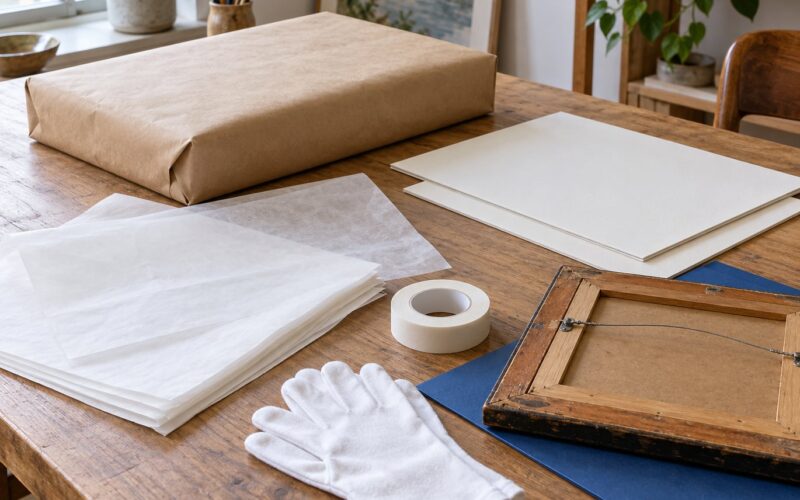
- Acid-free tissue or glassine for the face-to-face barrier between pieces. Buy it from an art supply house, not a grocery aisle, because lignin in cheap paper acidifies over time.
- Rigid separators such as foam board, archival mat board, or lignin-free corrugated board. These hold a gap and keep a heavy stretcher bar from pressing into the next canvas.
- Clean nitrile gloves or freshly washed hands. Skin oil is hard to remove from an unvarnished surface and it will yellow.
- A soft brush or a clean sable for dust, plus a soft cloth. No water, no solvent, no scrubbing.
- A stable location with no direct sun, no exterior wall, and no shared wall with a garage or bathroom.
- A hygrometer if the collection matters to you. A cheap dial unit tells you more than a thermostat does, and a small data logger records what happened while you were asleep.
- Packing tape or museum putty for hardware, never tape on a painted surface.
How to Store Canvases Without Damaging Them Step by Step
1. Check that the surface is completely dry
Acrylic paint skins over in minutes but cures for weeks. Oil is slower still, and a thick impasto passage or a varnished surface can take the better part of a year before it is truly handled-safe.
The test is touch and time, not the calendar alone. Touch an edge of the painted area with a clean knuckle; if it feels tacky or cool in a way that suggests damp, it is not ready. For anything oil or mixed, treat a full year as the floor, not the goal.
Wrapping a damp canvas traps moisture between the surface and the barrier. That moisture softens the paint film, and when it finally escapes it takes the top layer with it. You end up with sticking, adhesion loss, and a grey haze that no amount of cleaning removes.
2. Clean the surface and protect the edges
Brush loose dust off with a soft brush held at a low angle so it skims rather than presses. Work from the center outward and keep your other hand off the surface.
Then look for trouble. Check for flaking paint, lifting collage edges, and raised texture that will catch on anything it touches. Those spots are the ones that get covered first, with a sheet of glassine laid loosely on top and tucked at the corners so it cannot slide.
For stretcher bars and corners, wrap in glassine or kraft paper. Many artists use green painter’s tape to hold edges to a board for a short move, and that is fine for a day in a car, but tape residue on raw wood or paint will outlive the tape itself. If hardware is loose, secure it with a dab of museum putty inside the frame rather than tape over the paint.
3. Separate canvases so surfaces cannot touch
Every contact leaves a mark. Two canvases stored face to face can transfer a bit of paint, leave a scuff arc, or pick up an impression from a textured passage on the other piece. The damage scales with pressure, which is why the stretcher bars are the worst offenders.
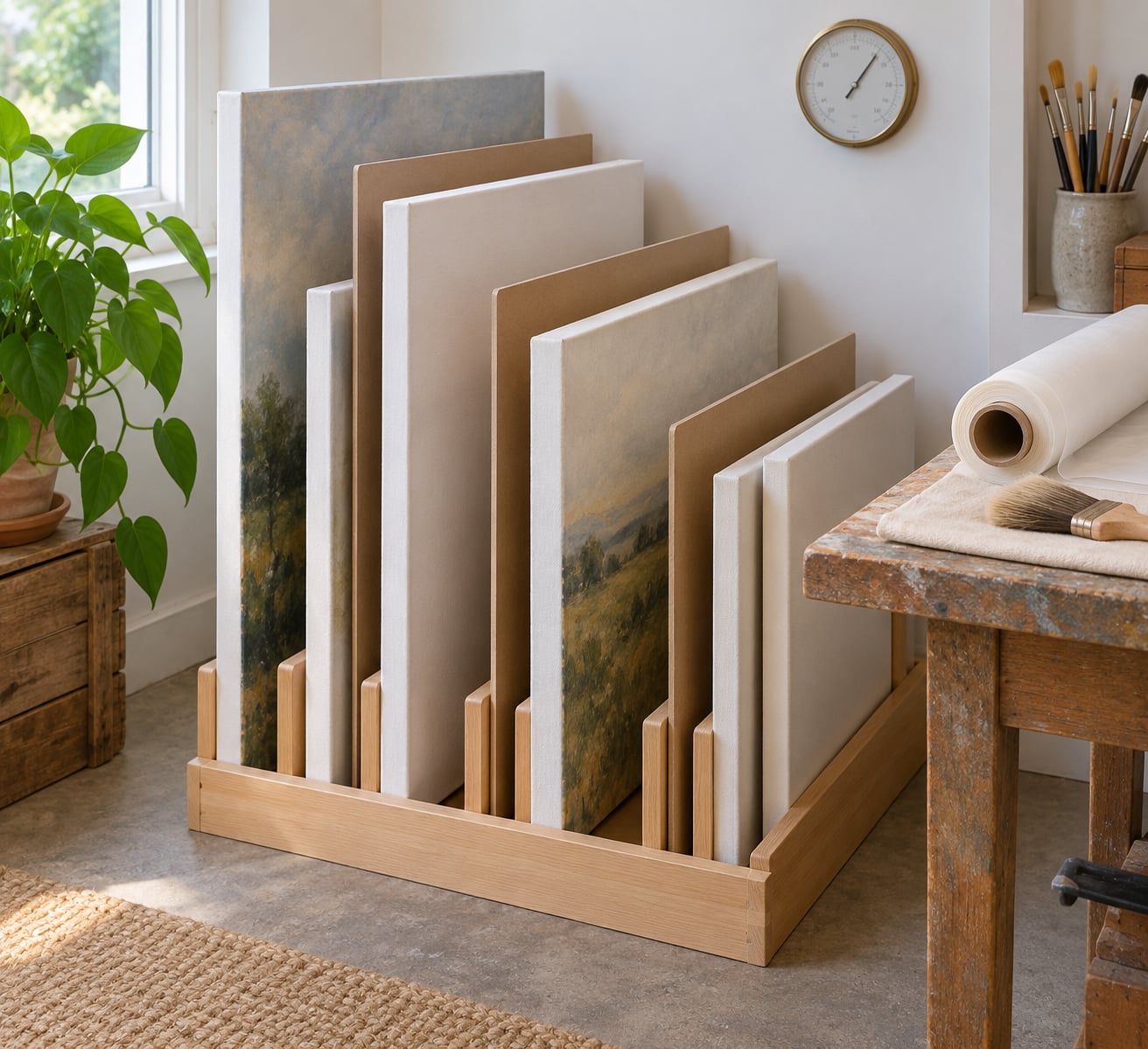
The fix is a sandwich: rigid board, then canvas, then rigid board, repeated through the stack. Leave a 1 to 2 inch air gap between painted surfaces so nothing is under load and nothing is rubbing.
Two extra inches of space between pieces also lets you check one without unstacking the whole pile. In a small room that is the difference between a system you keep and a system you stop maintaining.
4. Choose the right storage orientation
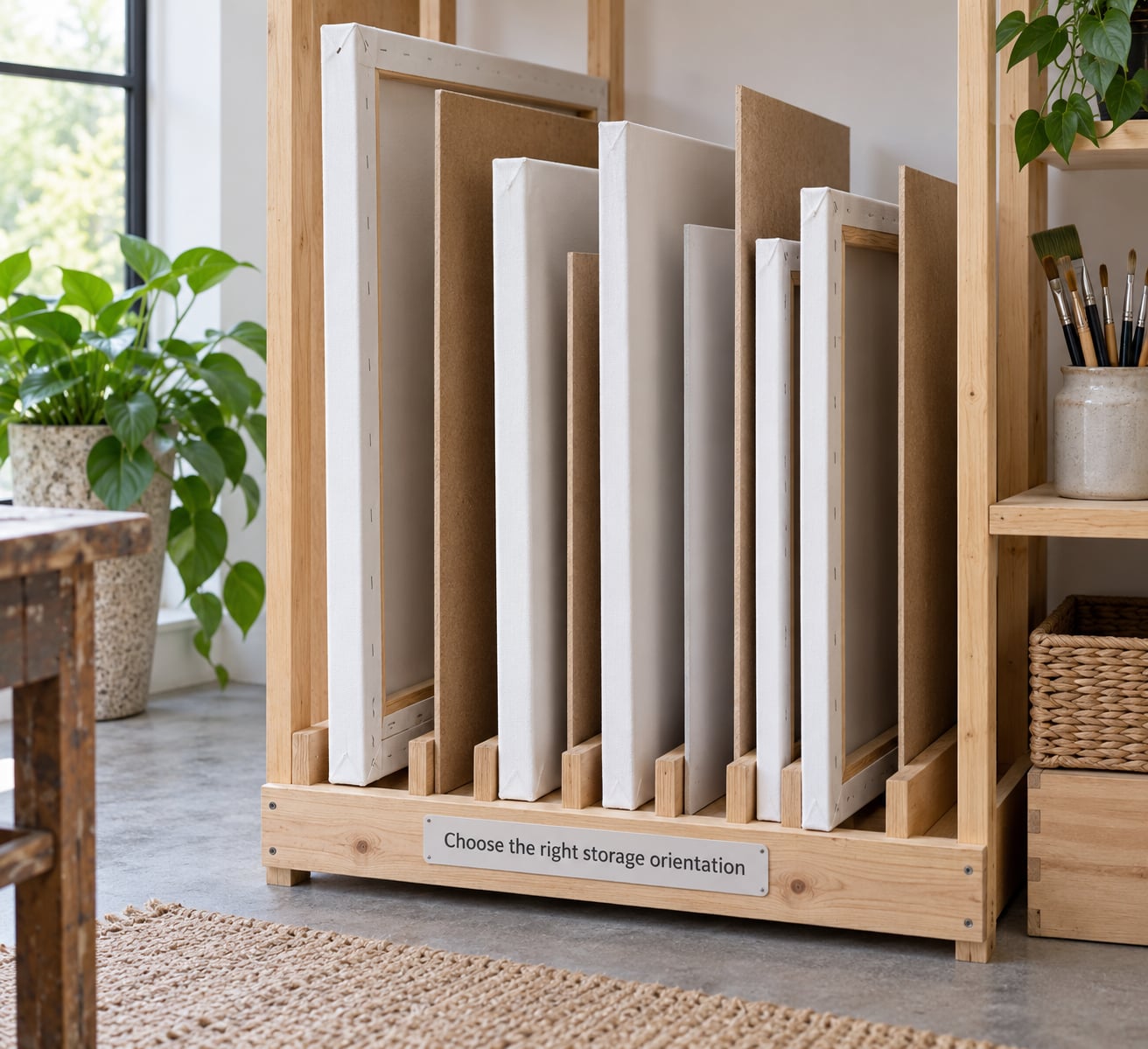
Upright is the default, the way records sit in a crate. Build a vertical rack from 1 by 4 lumber with a shallow lip on each shelf so a canvas cannot slide forward, and slot the pieces in with board between each one. Face out, face in, or back to back all work as long as a barrier sits between every two surfaces.
Flat storage suits works on paper, unstretched canvas, and anything too fragile to stand on its own edge. Stack flat only on rigid boards, never bare, and keep the load on the unstained margins rather than across an image.
Short-term rack storage, meaning a wire drying rack or a slotted wall in a working corner, is fine for a few weeks of work in progress. It is not a place to let finished work sit for a season, because dust settles into wet impasto and a leaning canvas develops dents at the point of contact with the wall.
Rolling is the last resort. An unstretched, unpainted roll can stay rolled for months; a painted work, especially with thickness, will crack along the fold. If you must roll, roll paint side out around a wide tube, interleave with glassine, and unroll it within a season.
5. Control light, humidity, temperature, and pests
Canvas, stretcher bars, and most paint layers are hygroscopic, meaning they absorb moisture from the air and give it back. Every swing in relative humidity makes them expand and contract, and that movement is what eventually loosens paint from its support and opens cracks.
Here is the range most conservation guidance names for common work:
- Oil on stretched canvas: 65 to 70 F, 40 to 55 percent relative humidity, stored vertically behind glassine or foam board.
- Acrylic on canvas: 65 to 70 F, 40 to 55 percent relative humidity, stored vertically behind glassine or foam board.
- Unstretched canvas: 65 to 70 F, 40 to 60 percent relative humidity, stored flat or rolled in acid-free tissue.
- Watercolors and works on paper: 65 to 70 F, 40 to 50 percent relative humidity, stored flat in an archival box with acid-free tissue.
- Photographs and prints: 65 to 70 F, 35 to 50 percent relative humidity, stored flat or vertical with interleaving tissue.
- Textile and fiber art: 65 to 70 F, 40 to 55 percent relative humidity, stored flat or rolled in acid-free tissue.
Stability matters more than a perfect number. A room that sits at 55 percent all winter beats one that swings from 30 to 70 with the weather. Put the hygrometer near the canvases, not near the window, and check the reading in the morning and again after a cold snap.
Keep everything off the floor, at least a few inches, and away from exterior walls where condensation forms. Basements, attics, garages, and unconditioned closets on shared walls run through the whole cycle of hot and cold, and artwork stored there develops mold within months in damp conditions.
For light, closed doors beat UV film. If a corner has to stay open to the room, block daylight with a blackout curtain and check for direct sun on any wall. For pests, seal stored boxes, avoid leaving cardboard in the room, and look for the first signs of silverfish or webbing, which show up early.
6. Recheck stored canvases periodically
Twice a year, set a recurring reminder and walk the storage space. Look at the front canvas of each stack first, since the most exposure happens at the face of the group.
Check for condensation on the barrier boards, any bowing in the stretcher bars, spots that were not there last time, damaged separators, insects, and hardware that has worked loose. Rotate which piece sits at the front so no single canvas stays exposed the whole year.
While you are there, photograph each piece. A dated photo set turns into condition records you will be glad to have after a leak, a move, or an insurance question.
Common Mistakes
Almost every ruined stored canvas comes from one of a short list of habits. Each has a straightforward fix.
- Wrapping work that is still wet. Fix it: finish the drying first, then wrap loosely in a breathable material.
- Stacking canvases with nothing between them. Fix it: add a rigid board and an acid-free layer between every pair, and keep the air gap open.
- Storing everything vertically. Fix it: works on paper, unstretched canvas, and fragile pieces belong flat or in a box, not standing on edge.
- Using ordinary cardboard and household tape. Fix it: swap in lignin-free board and use tape only on hardware, never on a painted surface.
- Using plastic wrap as a barrier. Fix it: plastic traps moisture and can stick to paint. Use glassine, silicone release paper, or acid-free tissue instead.
- Using the attic, basement, or garage. Fix it: use a conditioned interior room, or a climate-controlled unit with a steady reading on the hygrometer.
- Leaving canvases leaning against a wall. Fix it: build a shallow-lipped rack so each piece stands on its stretcher bars with nothing touching the image.
- Ignoring humidity swings. Fix it: log readings twice a year and act when the number drifts more than about 10 percent.
Two more worth naming. Rolling painted work and calling it storage is how a canvas ends up with a permanent crack line down the middle. And hanging finished canvases on a wall where they catch a window’s afternoon light looks fine for a few months, then fades the whole composition unevenly.
Frequently Asked Questions
Can I store canvases vertically?
Yes, and vertical is the best orientation for most stretched work. Stand each canvas on its stretcher bars in a shallow-lipped rack, with a rigid board and an acid-free layer between every piece. Leave a 1 to 2 inch air gap so nothing presses against a painted surface. Face out, face in, or back to back all work as long as a separator sits between any two surfaces.
How should I store unstretched canvas?
Keep unstretched canvas flat, rolled, or loosely folded, never stretched or hung. Interleave folds and rolls with acid-free tissue so the fabric does not crease against itself, and store it in a breathable box or a covered shelf away from direct light. Primed, unprimed, and rolled primed canvas all benefit from being off the floor and out of damp basements or unconditioned closets.
What humidity level is safe for stored canvases?
A relative humidity between 40 and 55 percent is the range most conservation guidance names, paired with 65 to 70 degrees F. The bigger issue is stability rather than the exact number. Large swings make canvas and paint expand and contract, which opens cracks and can grow mold. A cheap dial hygrometer near the storage spot is enough to confirm conditions.
Should I wrap a canvas in plastic?
No. Plastic wrap and plastic bags trap moisture against the paint surface, and they can stick to a surface that is not fully cured. A wrapped canvas in a warm room can end up with adhesion loss or a grey haze that will not clean off. Use glassine, silicone release paper, or acid-free tissue as a breathable barrier, and cover the piece loosely.
How do I store a canvas with thick paint or collage?
Give impasto and collage surfaces the most room. Stand the piece upright in a rack so nothing rests on the texture, place a sheet of glassine loosely over the raised areas, and keep at least a 2 inch air gap to the next canvas. Check the separators often, since raised elements catch on board edges and snag. Never lay a thick surface face down under a flat stack.
How often should I check stored canvases?
Twice a year is a good rhythm, and a quick glance every month or two catches problems earlier. Look for condensation, bowing in the stretcher bars, new mold spots, damaged separators, insects, and loose hardware. Rotate which canvas sits at the front of each stack so no single piece stays exposed, and update your dated condition photos while you are there.
Conclusion
The first thing to do is simple: wait until the work is completely dry, and do not rush that for a busy stack of finishing work. Then clean the surface, shield the edges, put an acid-free barrier between every canvas, and stand them upright in a dark room holding 65 to 70 degrees F and 40 to 55 percent humidity.
Check the space twice a year. That is the whole system, and it costs far less than re-housing one warped canvas.